
Pro Audio Key Account Management Cheat Sheet: Best Practices
Key account management is critical in the pro audio industry. These accounts are not just customers; they are strategic partners that drive significant revenue. While 80% of your revenue may come from just 20% of your accounts, in pro audio distribution, this ratio can be even more extreme, with top-tier retailers, major rental houses, and leading studios generating the majority of your sales volume.
Industry consolidation has transformed the landscape, with fewer but larger players dominating distribution channels. This makes strategic account management essential for survival—losing a key account can mean losing 10-20% of your revenue overnight. The competitive advantage comes from treating these relationships as strategic partnerships rather than transactional exchanges.
Practical steps to implement immediately:
- Identify your true key accounts using the 80/20 rule—track revenue contribution and strategic importance.
- Map each account's decision-makers and influencers beyond just purchasing departments.
- Develop customized value propositions addressing each account's unique business challenges.
- Create quarterly business reviews with clear metrics and mutual growth objectives.
- Establish regular strategic planning sessions to align on long-term goals.
By shifting from reactive sales to proactive partnership management, you'll secure predictable revenue streams, gain valuable market intelligence, and build barriers against competitors trying to poach your most valuable relationships.
Building Your Key Account Management Framework: From Solo Reps to Team-Based Approach
Effective key account management requires a collaborative approach. Transitioning from solo reps to team-based key account management necessitates a structured framework to ensure all stakeholders are aligned. Start by mapping stakeholders on both sides: identify decision-makers, influencers, and end-users at dealer organizations, while aligning your internal team with sales, technical support, and marketing roles. This ensures comprehensive coverage and prevents single points of failure.
Develop clear roles and responsibilities within your account team. Assign a primary account manager for strategic oversight, supported by technical specialists for product expertise and customer success reps for ongoing support. Establish communication protocols, such as weekly syncs and shared documentation, to maintain alignment and transparency.
Practical steps:
- Conduct stakeholder analysis to map key contacts and their influence levels.
- Define team roles with RACI matrices (Responsible, Accountable, Consulted, Informed).
- Implement a centralized CRM or project management tool for tracking interactions and tasks.
- Schedule regular cross-functional meetings to review account health and opportunities.
- Create escalation paths for resolving issues quickly.
Tips: Foster collaboration through joint business planning with dealers, and use data from competitor tracking tools to identify market gaps and tailor strategies. This multi-touch approach enhances relationships and drives long-term growth in the pro audio industry.
Strategic Planning and Execution: Aligning Product Launches with Account Goals
Strategic planning is crucial for aligning your efforts with account objectives. Strategic product launches require meticulous coordination with key accounts' marketing calendars to maximize impact. Begin by mapping your product roadmap against major industry events like NAMM and AES, then align with each account's promotional cycles.
Create a 90-day pre-launch checklist:
- Share confidential product specs with key accounts 60 days before announcement.
- Coordinate exclusive previews for their sales teams.
- Develop joint marketing assets.
- Schedule synchronized social media campaigns.
Leverage trade shows as strategic platforms by planning joint initiatives: co-host demo sessions at NAMM booths, create exclusive show specials for key accounts, and schedule private meetings with their VIP clients. Pro tip: Reserve 20% of your trade show budget for account-specific activations.
For customized rollout plans, conduct quarterly account reviews to identify specific needs. Create tiered launch packages:
- Platinum accounts get early access, dedicated support teams, and co-branded marketing.
- Gold accounts receive priority inventory allocation and training sessions.
Always include account-specific positioning in your launch messaging—highlight how your product solves their unique market challenges. Track success with joint KPIs measuring sell-through rates, customer feedback, and revenue growth.
Competitive Intelligence Integration: Learning from Industry Leaders
Staying ahead of competitors is key to maintaining account loyalty. Integrating competitive intelligence into your key account management strategy transforms you from a reactive vendor to a proactive strategic partner. By understanding competitor movements, you can anticipate market shifts and tailor your strategies accordingly. Here’s how to leverage competitor insights effectively:
Analyze Competitor Product Launches & Awards:
- Create a tracking spreadsheet for competitor product releases, award wins (like CES Innovation Awards or Pro AV Best in Market), and industry recognition.
- For each launch, analyze: target market, pricing strategy, unique features, and customer reception.
- Use this data to identify gaps in your own offerings and develop counter-strategies for key accounts.
- Example from RivalSense: Shure introduced the IntelliMix Bar Pro and MXA320 Table Array Microphone and won six major awards at ISE 2026 in Barcelona.
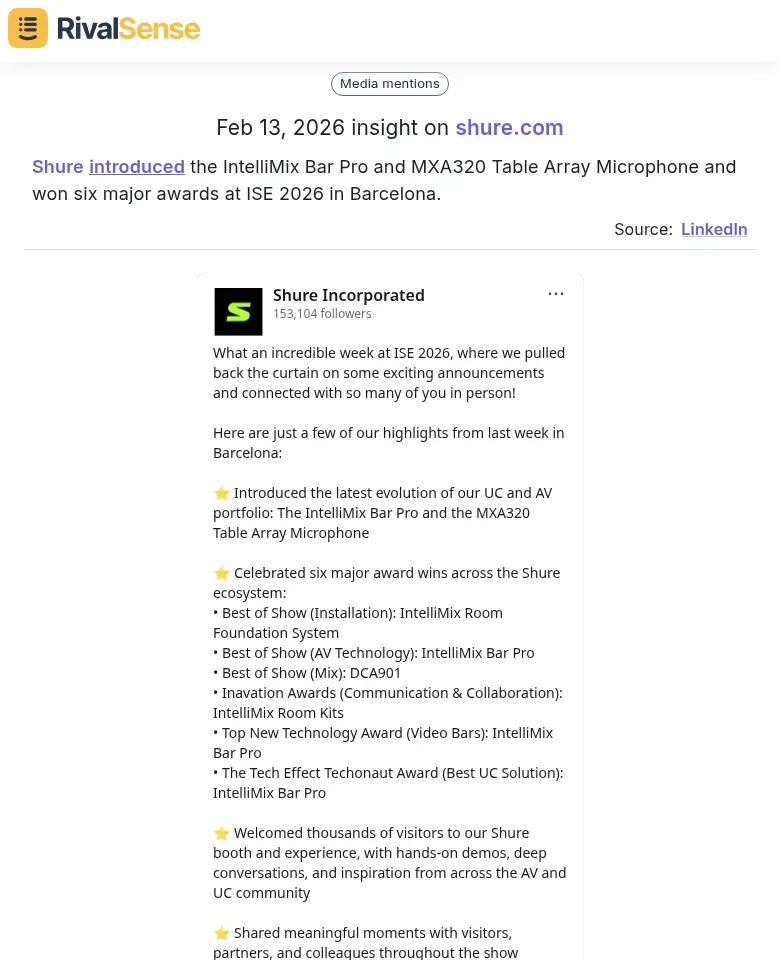
- Why it's valuable: Tracking award wins helps you understand which products are gaining market recognition and can inform your product development and marketing strategies.
Monitor Industry Events & Announcements:
- Set up Google Alerts for major pro audio events (NAMM, AES, InfoComm) and competitor announcements.
- Track competitor booth sizes, product demos, and partnership announcements at trade shows.
- Anticipate market trends by analyzing which technologies competitors are investing in.
- Example from RivalSense: Shure will announce its latest products and innovations at the ISE 2026 event in Barcelona from February 3-6.
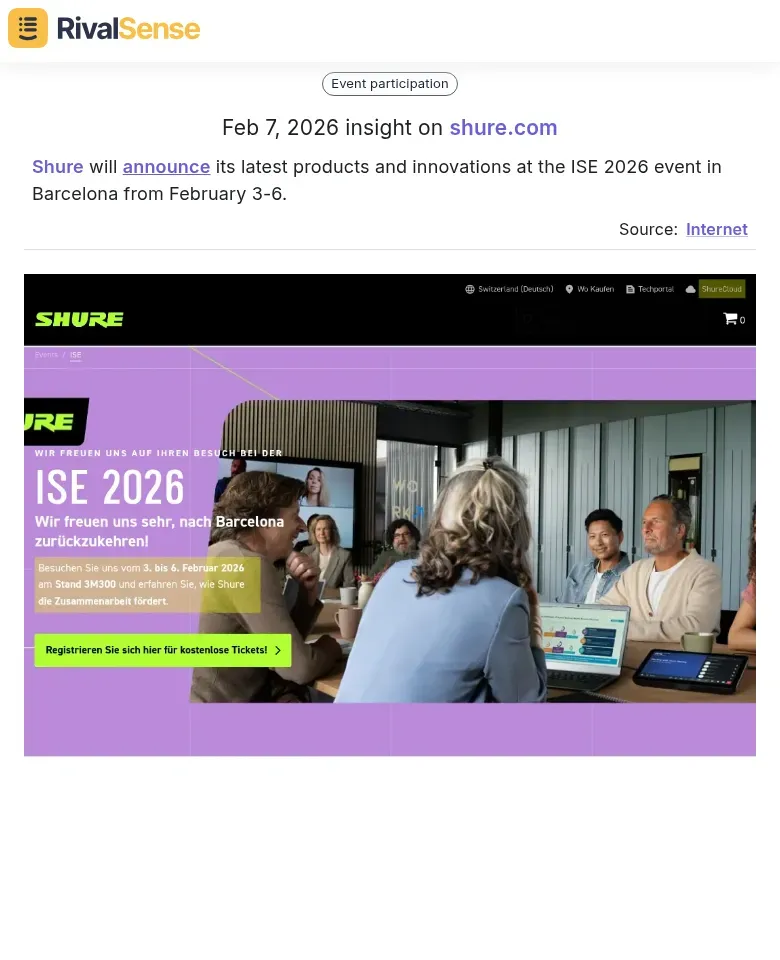
- Why it's valuable: Monitoring event participation allows you to anticipate competitor moves and plan your own event strategies to counter or capitalize on their announcements.
Practical Checklist for Implementation:
✅ Weekly competitor news review (15 minutes)
✅ Monthly competitive analysis report for key accounts
✅ Quarterly competitive landscape assessment
✅ Set up RivalSense alerts for competitor product launches
✅ Create a "competitive response playbook" for common scenarios
Turn Competitor Innovations into Opportunities:
When competitors win awards or launch new products, ask: "What customer needs are they addressing that we’re missing?" Use this insight to develop enhanced account offerings that address those same needs more effectively. For example, if a competitor wins an award for AI-powered audio processing, consider how you can integrate similar (or better) technology into your key account solutions.
- Example from RivalSense: Shure launched the IntelliMix Bar Pro with intelligent video framing and superior sound capture for AI transcription at ISE booth 3M300.
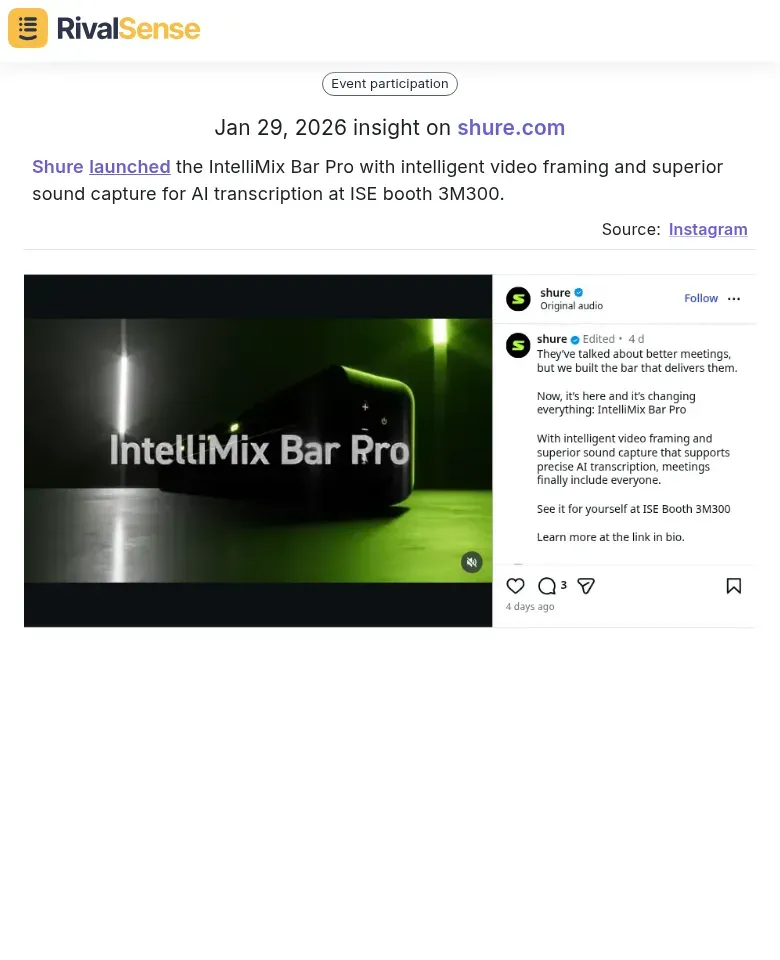
- Why it's valuable: Detailed product launch insights reveal specific features and technologies competitors are promoting, helping you identify innovation gaps and opportunities for differentiation in your offerings.
Pro Tip: Share competitive insights with your key accounts during quarterly reviews. This positions you as an industry expert who understands the broader market landscape, not just your own products. When you can say, "Here’s what your other options are, and here’s why our solution better addresses your specific needs," you build trust and demonstrate strategic value.
Communication and Collaboration Best Practices: The Engine of Account Success
Strong communication fosters trust and collaboration. Effective communication and collaboration form the engine of key account success in pro audio, enabling seamless coordination and problem-solving. Establish structured communication cadences with quarterly business reviews (QBRs) and monthly check-ins, each with clear agendas and documented action items.
Use collaborative planning processes by involving key accounts in product development—invite them to beta testing and co-create marketing campaigns. Create feedback loops by systematically collecting insights on competitor moves, market trends, and customer pain points, then analyze this data to identify competitive advantages.
Practical steps:
- Schedule QBRs with pre-defined templates to ensure consistency.
- Set up joint planning sessions for product roadmaps and marketing initiatives.
- Use tools like shared dashboards for real-time collaboration and transparency.
- Implement a feedback repository to track and act on insights from accounts.
Tips: Keep meetings focused, assign ownership for action items, and reward account participation. This transforms account relationships into strategic partnerships that drive mutual growth.
Measurement and Continuous Improvement: Tracking What Matters
Continuous improvement relies on accurate measurement. Effective measurement is the backbone of pro audio key account management, providing insights into performance and areas for enhancement. Start by defining balanced KPIs that track both financial metrics (revenue growth, margin, product mix) and strategic indicators (market share growth, new product adoption, joint marketing initiatives).
For pro audio, track studio equipment adoption rates, software license renewals, and cross-selling success across your product ecosystem. Implement quarterly Net Promoter Score (NPS) surveys and monthly engagement tracking. Monitor communication frequency, response times, and joint planning sessions. Use CRM dashboards to visualize account health scores combining financial performance, satisfaction metrics, and strategic alignment.
Conduct quarterly business reviews (QBRs) with a structured agenda:
- Performance analysis against targets.
- Goal progress and partnership health indicators.
- Identification of growth opportunities.
- Adjustments to account plans based on data insights.
Pro tip: Include technical support metrics for pro audio accounts—track resolution times for equipment issues and training completion rates to ensure comprehensive service.
Establish a continuous improvement cycle: measure → analyze → adjust → implement. Use account performance data to refine your approach, allocate resources effectively, and strengthen strategic partnerships in the competitive pro audio landscape.
Take Your Key Account Management to the Next Level
To effectively implement these strategies and stay ahead of competitors, consider using tools like RivalSense. RivalSense tracks competitor product launches, pricing updates, event participations, partnerships, regulatory aspects, management changes, and media mentions across company websites, social media, and various registries, delivering all in a weekly email report. This comprehensive competitor intelligence can help you anticipate market moves, tailor your account strategies, and maintain a competitive edge.
Try RivalSense for free at https://rivalsense.co/ and get your first competitor report today to enhance your key account management approach.
📚 Read more
👉 Avoid These Media Mentions & Content Marketing Competitive Intelligence Mistakes
👉 How to Analyze Competitor Events: A Telenor MWC 2026 Case Study
👉 How to Analyze Competitor Websites in 2026: A Practical Guide with Actionable Steps
👉 Industrial Machinery Maintenance: Benchmarking Key Account Advocacy Tracking
👉 From Threat to Opportunity: How Competitor Intelligence on Shure's MXA320 Enabled a Strategic Pivot