
Predictive Cybersecurity Analysis: Key Account Tracking for Competitive Edge
Traditional cybersecurity approaches often fail because they're reactive—responding to threats after they emerge. Without predictive competitive analysis, you're fighting yesterday's battles while competitors are positioning for tomorrow's opportunities. The convergence of predictive cybersecurity and competitive intelligence transforms this dynamic, enabling proactive market positioning through key account tracking.
Why Traditional Approaches Fail:
- Reactive security focuses on past threats, missing competitor-driven market shifts
- Without competitor intelligence, you can't anticipate which security solutions will gain traction
- Isolated threat analysis ignores how competitors leverage emerging vulnerabilities for market advantage
Key Account Tracking Transformation:
- Monitor competitor wins daily - Track which accounts adopt new security solutions
- Analyze partnership patterns - Identify emerging alliances before they reshape the market
- Map technology integrations - Understand how competitors build comprehensive security stacks
Strategic Advantage Checklist:
✅ Set alerts for competitor security partnerships with major cloud providers
✅ Track executive movements between cybersecurity firms for strategic insight
✅ Monitor regulatory compliance updates to anticipate competitor adaptations
✅ Analyze competitor case studies by industry vertical to identify expansion patterns
✅ Correlate threat intelligence with competitor solution announcements
By anticipating competitor moves through systematic key account tracking, you transform cybersecurity from a cost center into a competitive differentiator, positioning your solutions ahead of market demand rather than reacting to it.
Learning from Financial Performance Signals: Beyond the Numbers
Financial performance signals reveal more than just numbers—they're windows into competitor strategy and market dynamics. When analyzing earnings reports, look beyond revenue growth to interpret market confidence. Strong margins with conservative guidance often signal defensive positioning, while aggressive growth targets with increased R&D spending indicate emerging market opportunities.
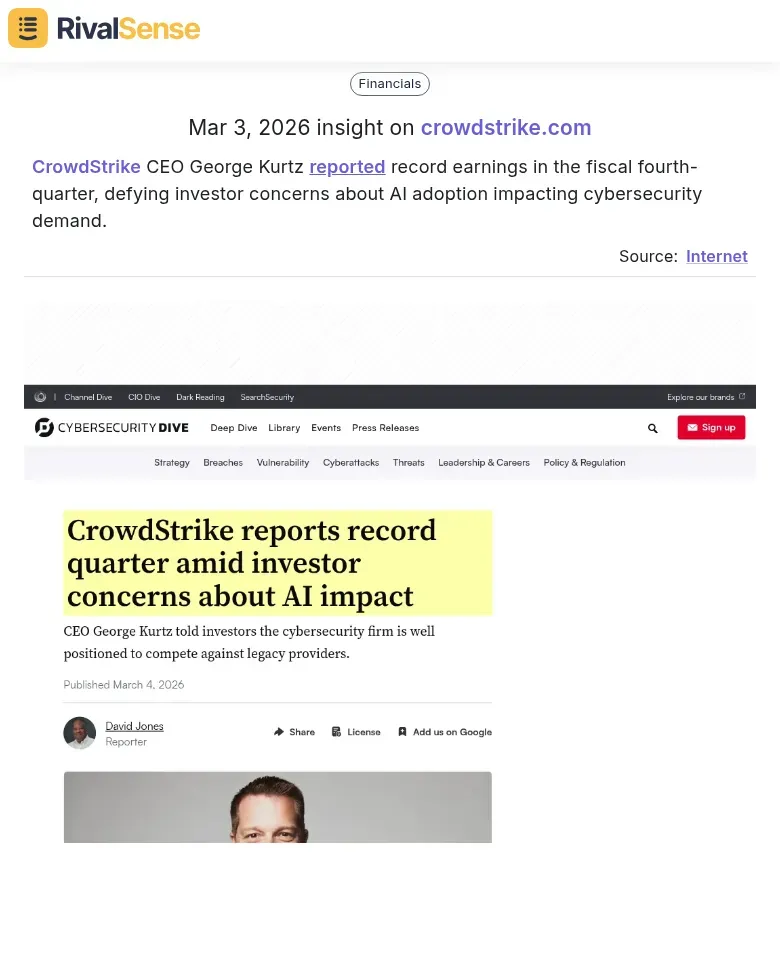
For instance, RivalSense tracked that CrowdStrike CEO George Kurtz reported record earnings in the fiscal fourth-quarter, defying investor concerns about AI adoption impacting cybersecurity demand. This type of insight is valuable because it shows how financial performance can signal market resilience and strategic confidence, helping you anticipate competitor investments and market trends.
Practical Checklist for Financial Signal Analysis:
- Track R&D spending trends—increases predict future product launches
- Monitor capital expenditure patterns to identify investment priorities
- Analyze cash flow statements for strategic resource allocation
- Compare guidance vs. actual performance for confidence indicators
- Watch for margin compression in specific segments signaling competitive pressure
Key Distinctions:
- Offensive Signals: High R&D growth, expanding sales teams, new market entry costs
- Defensive Signals: Cost-cutting initiatives, margin protection, dividend increases
- Opportunity Signals: Unusual capital raises, strategic partnership announcements, geographic expansion
Use financial metrics to predict competitor moves: rising SG&A expenses often precede market expansion, while declining R&D suggests consolidation. Track these patterns quarterly to anticipate where competitors will allocate resources next quarter.
Strategic Partnership Intelligence: Decoding Alliance Patterns
Strategic partnership intelligence reveals your competitors' hidden priorities through alliance patterns. Analyze partnership announcements to decode technology integration priorities—when a cybersecurity firm partners with a cloud provider, they're likely expanding cloud-native security capabilities. Track joint go-to-market initiatives as competitive positioning indicators: co-marketing campaigns signal market segment targeting, while integrated product launches reveal ecosystem expansion strategies.
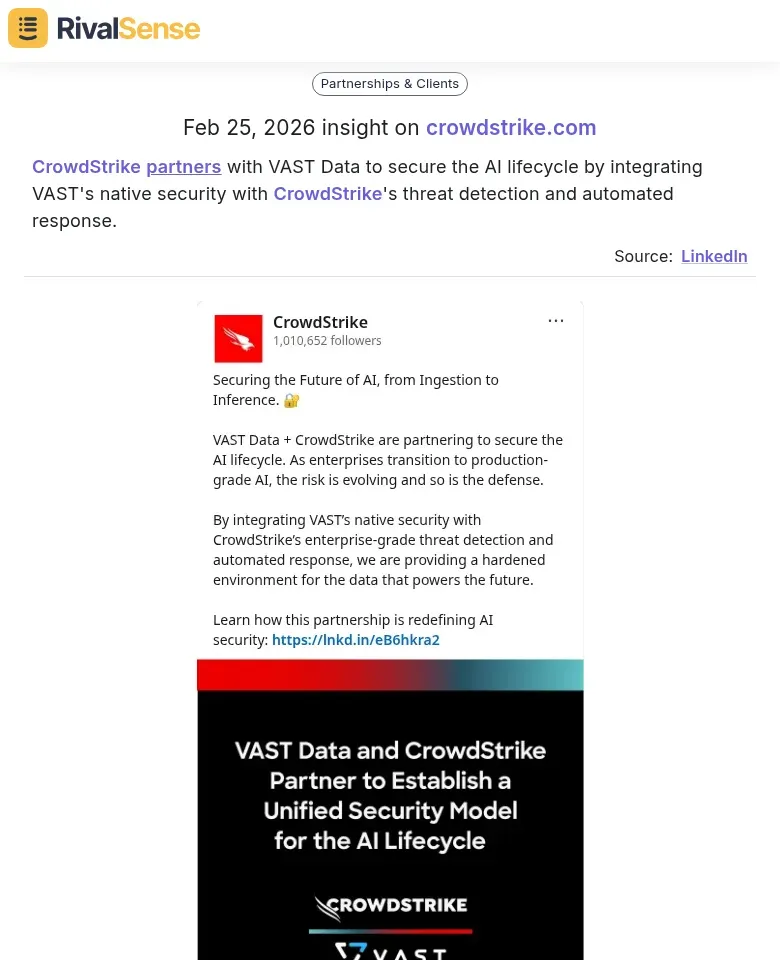
For example, RivalSense captured that CrowdStrike partners with VAST Data to secure the AI lifecycle by integrating VAST's native security with CrowdStrike's threat detection and automated response. This insight is crucial as it highlights how partnerships can reveal strategic moves into emerging technologies like AI security, allowing you to identify collaboration opportunities and potential market gaps.
Practical steps:
- Create a partnership tracking dashboard monitoring press releases, social media, and industry news
- Categorize alliances by type: technology integration, market expansion, co-marketing, or R&D collaboration
- Map partnership networks to identify ecosystem development patterns
- Score alliance strength based on commitment level (press release vs. joint venture)
- Monitor partnership longevity—short-term tactical alliances may signal testing, while long-term strategic partnerships indicate core direction
Use partnership patterns to anticipate market shifts and identify collaboration opportunities. When competitors consistently partner with specific technology providers, consider alternative partnerships to create differentiation. Analyze failed partnerships for insights into market challenges. This intelligence enables proactive positioning rather than reactive responses.
Event Participation Analysis: Extracting Strategic Insights from Industry Gatherings
Event participation analysis transforms conference intelligence into actionable competitive insights. Track which competitors speak at which events and what topics they cover—this reveals their thought leadership priorities and market focus areas. For example, if a rival consistently presents on cloud security at fintech conferences, they're likely targeting that vertical.
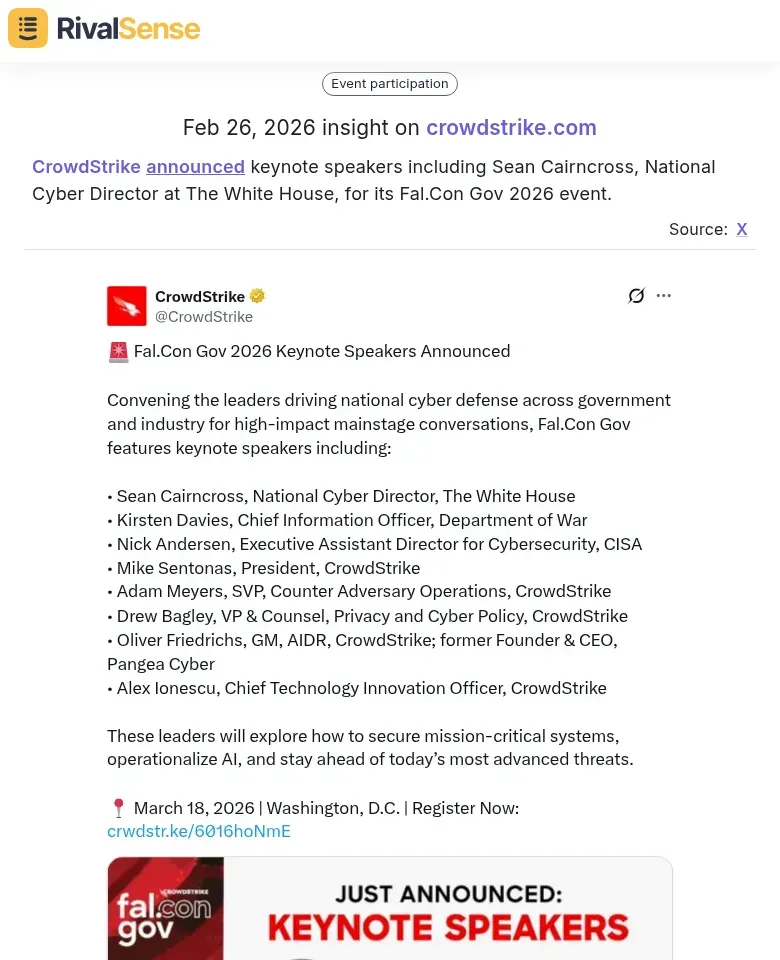
A recent RivalSense insight showed that CrowdStrike announced keynote speakers including Sean Cairncross, National Cyber Director at The White House, for its Fal.Con Gov 2026 event. Monitoring such event details is valuable because it indicates a competitor's focus on government and regulatory engagements, helping you predict their market expansion into public sector verticals.
Practical steps:
- Create a competitor event tracking matrix (event name, date, competitor, speaker role, presentation topic)
- Analyze presentation topics over time to identify emerging threat verticals
- Monitor changes in event participation patterns—sudden focus on healthcare conferences could signal new market entry
- Watch for product teasers in presentations that may precede official launches
Conference intelligence often provides early warning signals. A competitor shifting from technical deep-dives to business value messaging may indicate upcoming product repositioning. Track Q&A sessions for unscripted insights into their strategic direction. Combine this with booth size, sponsorship levels, and attendee engagement to gauge resource allocation priorities.
Key insight: Competitors often test new messaging at smaller events before major launches. Monitor regional conferences for early signals of strategic shifts that will later appear at flagship industry gatherings.
Technology Integration Monitoring: Predicting Market Adoption Patterns
Tracking how competitors deploy their cybersecurity solutions reveals strategic expansion into new industries and use cases. When a rival announces integrations with platforms like AWS Security Hub or Microsoft Sentinel, analyze the target verticals—are they moving from financial services to healthcare? This signals market diversification and helps you anticipate where they'll compete next.
Monitor integration announcements to understand scalability approaches. For example, if a competitor emphasizes API-first architecture in their Slack or Salesforce integrations, they're likely prioritizing enterprise scalability. Document these technical decisions to benchmark your own architecture and identify gaps in your solution.
Practical steps:
- Create a tracking spreadsheet with columns for competitor, integration partner, industry focus, and technical approach
- Set up Google Alerts for "[competitor name] integration" and "[competitor name] partnership"
- Analyze quarterly: Are integrations moving toward cloud-native platforms (predicting market consolidation) or niche tools (indicating fragmentation)?
- Use this data to forecast which market segments will become saturated and where underserved gaps exist—like IoT security integrations that few players address.
Tip: Look beyond press releases to GitHub repositories and developer documentation, where early-stage integration experiments often appear before official announcements.
Implementation Framework: Building Your Predictive Cybersecurity Intelligence Program
Building an effective predictive cybersecurity intelligence program requires a systematic implementation framework. Start by selecting key account tracking tools with cybersecurity-specific capabilities: prioritize platforms offering real-time threat intelligence integration, compliance monitoring, and API access for seamless connection to your security stack. Practical checklist: verify source coverage (80+ sources ideal), data freshness, and integration with SIEM systems and threat intelligence platforms like Recorded Future or Cyble.
Establish measurable ROI metrics for competitive intelligence in security decision-making: track win/loss rates against monitored competitors, time-to-detection improvements for competitive threats, and product roadmap acceleration based on competitor feature analysis. Create a dashboard with KPIs including competitive threat detection rate, intelligence-to-action conversion time, and market share impact from intelligence-driven decisions. Pro tip: calculate ROI using prevented breach costs and reduced mean time to respond (MTTR).
Develop actionable workflows that transform competitor insights into strategic security advantages: implement weekly intelligence review meetings with security and product teams, create alert thresholds for urgent competitor moves (major security acquisitions, critical vulnerability disclosures), and establish response protocols. Use a three-tier system: immediate alerts for critical developments, weekly summaries for strategic planning, and quarterly deep-dives for market positioning analysis. Integrate intelligence directly into product development cycles and business development pipelines to ensure competitive insights inform both technical and commercial strategies.
Take Action with RivalSense
To effectively implement these strategies and gain a competitive edge, consider using RivalSense. It tracks competitor product launches, pricing updates, event participations, partnerships, regulatory aspects, management changes, and media mentions across company websites, social media, and various registries, delivering all in a weekly email report. Try RivalSense for free at https://rivalsense.co/ and get your first competitor report today to start anticipating market shifts and positioning your business ahead of the curve.
📚 Read more
👉 Step-by-Step Guide: Track Competitor Partnerships, Clients, and Executive Moves
👉 How to Analyze Competitor Innovations: A Case Study on IXI's Autofocus Eyewear
👉 The Ultimate Guide to Key Account Management Forums: Practical Strategies for 2026
👉 Analyzing Competitor Loyalty Programs to Boost Warehouse Productivity
👉 How LinkedIn's AI Hiring Insight Helped Competitors Accelerate Recruitment Innovation