
Predictive Analytics for Key Account Monitoring: A Web Scraping Guide for B2B Leaders
The competitive intelligence landscape has undergone a fundamental transformation in recent years, shifting from reactive monitoring to predictive analytics. Where once businesses tracked competitors' past actions, today's leaders anticipate future moves before they impact market position. This evolution is particularly crucial in key account monitoring, where understanding competitor strategies for high-value clients can mean the difference between retaining market share and losing critical revenue.
Web scraping technology has been the catalyst for this shift, enabling real-time tracking of key account activities across digital channels. By monitoring competitor websites, pricing pages, client case studies, and executive announcements, businesses can detect early signals of account targeting strategies. For instance, tracking when competitors update their client portfolio pages or announce new enterprise features can reveal which accounts they're prioritizing.
🚀 Practical steps for implementing predictive key account monitoring:
- Identify your 20% most valuable accounts that generate 80% of revenue.
- Monitor competitor mentions of these accounts across their digital properties, including social media and blogs.
- Track pricing changes and feature announcements targeted at your account segments.
- Analyze competitor hiring patterns for account management or sales roles in specific regions.
- Set up alerts for when competitors reference your key accounts in marketing materials or case studies.
This proactive approach allows you to anticipate competitor moves, prepare counter-strategies, and strengthen relationships with your most valuable clients before competitive threats materialize.
Predictive Analytics Fundamentals for Account Monitoring
Predictive analytics transforms raw web scraping data into actionable foresight by analyzing historical patterns to forecast competitor moves. Start by building a comprehensive dataset tracking at least 6-12 months of competitor activity across product updates, pricing changes, and feature releases. Look for recurring patterns—do competitors typically launch new features before major industry events? Do pricing adjustments follow specific seasonal trends?
🔍 Key indicators to watch:
- Sudden increase in product update frequency (may signal upcoming major release).
- Gradual feature deprecation (could indicate platform pivot).
- Pricing page A/B testing (often precedes permanent changes).
- Plan tier restructuring (suggests target market realignment).
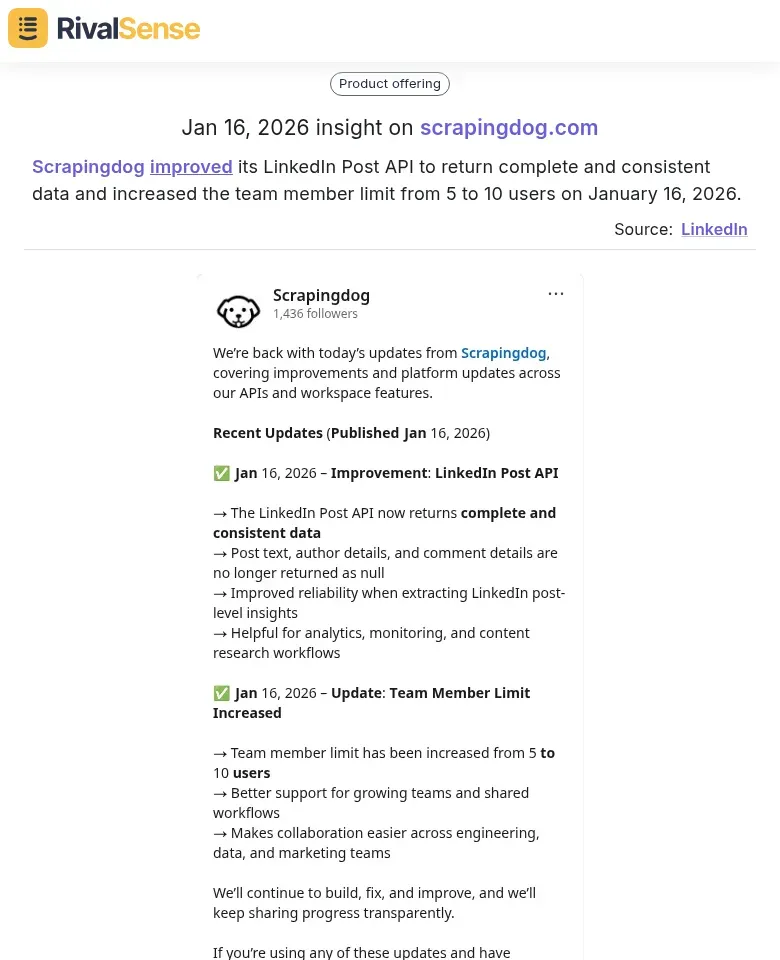
For example, RivalSense recently tracked that Scrapingdog improved its LinkedIn Post API to return complete and consistent data and increased the team member limit from 5 to 10 users on January 16, 2026. This type of product update insight is valuable for business strategy as it reveals competitor innovation and potential targeting of team-based customers, helping you adjust your own product roadmap and sales pitches.
📋 Practical steps for implementation:
- Establish baseline metrics for each key account (e.g., update frequency, pricing change cadence).
- Create alert thresholds for deviations from historical patterns.
- Monitor product documentation changes and feature announcements as early warning signals.
- Track pricing page modifications and plan restructuring for strategic shift indicators.
Pro tip: Combine multiple weak signals—when competitors simultaneously adjust pricing AND restructure plans, they're likely executing coordinated strategic shifts rather than isolated tactical moves.
Web Scraping Techniques for Proactive Account Intelligence
To implement proactive account intelligence through web scraping, start with automated monitoring of competitor website changes and API updates. Set up regular scrapers (daily or weekly) that track critical pages like pricing, features, documentation, and blog sections. Use change detection algorithms to flag significant modifications—when a competitor adds new API endpoints or revises documentation, it often signals upcoming product launches or strategic shifts.
For pricing intelligence, monitor not just price changes but also tier structures, feature allocations, and discount patterns. When a competitor restructures pricing, analyze the market implications: Are they targeting enterprise clients with premium tiers? Are they undercutting entry-level pricing to capture market share? Track these changes over time to identify pricing strategy patterns.
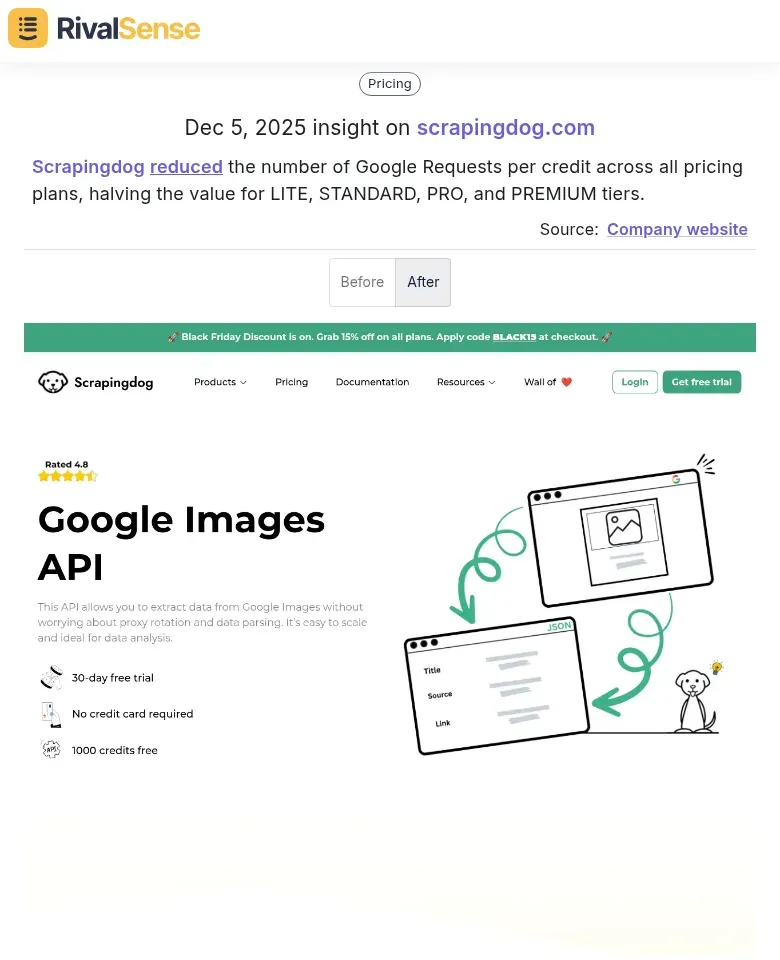
💰 Example from RivalSense: Scrapingdog reduced the number of Google Requests per credit across all pricing plans, halving the value for LITE, STANDARD, PRO, and PREMIUM tiers. This pricing insight is crucial for business strategy as it indicates a competitive move to offer more value, potentially to attract cost-sensitive customers or respond to market pressure, allowing you to reassess your own pricing models.
✅ Checklist for effective web scraping:
- Identify key data sources (competitor websites, social media, registries).
- Automate scraping schedules to ensure real-time updates.
- Implement change detection algorithms to highlight anomalies.
- Analyze patterns over time to forecast trends.
- Correlate findings with market events for context.
Practical tip: Focus on structured data (JSON, XML) when available, as it's more reliable than parsing HTML for critical metrics like pricing or API specifications.
Case Studies: Learning from Competitor Pattern Recognition
Let's examine real-world patterns that reveal strategic shifts. When a competitor adds enterprise-grade security features to their web scraping platform, they're likely targeting regulated industries like finance or healthcare—signaling market expansion beyond their current customer base. Recognizing these patterns early gives you a competitive edge in account retention and acquisition.
📈 Growth metrics and revenue announcements provide predictive insights. Scrape quarterly reports, funding announcements, and leadership changes. When a competitor announces revenue growth or new funding, anticipate their next moves—expanded marketing, accelerated hiring, or product development.
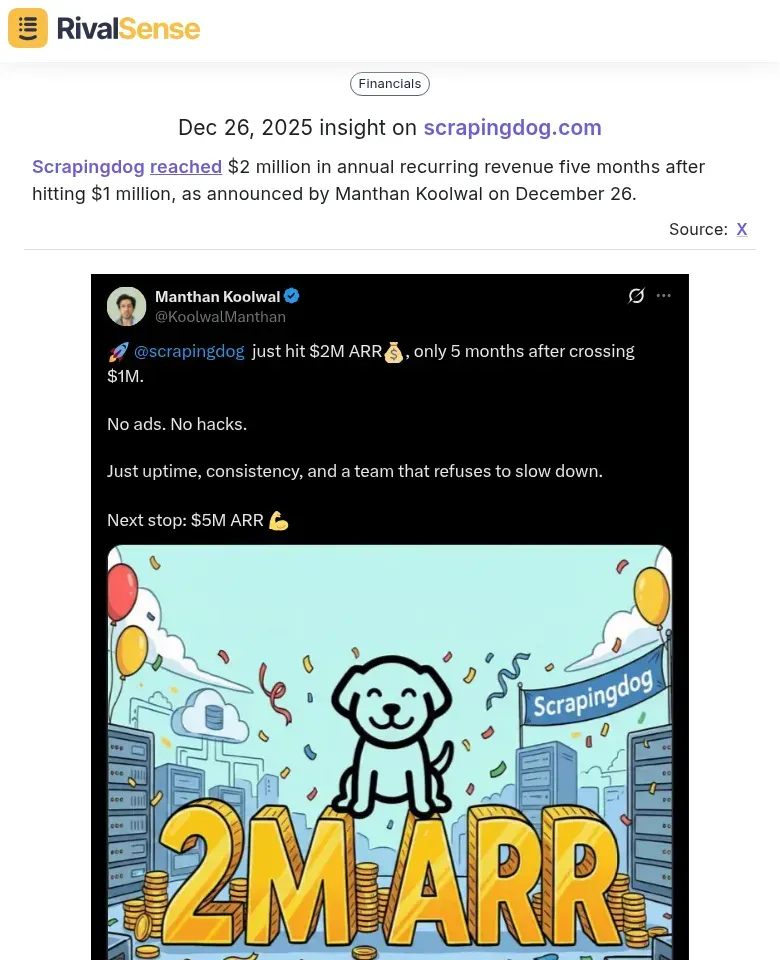
For instance, RivalSense captured that Scrapingdog reached $2 million in annual recurring revenue five months after hitting $1 million, as announced by Manthan Koolwal on December 26. This revenue milestone insight is valuable for business strategy as it highlights rapid scaling, suggesting aggressive market capture or potential expansion plans, enabling you to prepare defensive strategies for key accounts.
🔧 Practical Steps for Pattern Recognition:
- Feature Tracking Checklist: Monitor API rate limit increases, new data source integrations, and compliance certifications (SOC 2, GDPR). These indicate scaling ambitions.
- Revenue Pattern Analysis: Track quarterly growth spikes. A 40%+ revenue jump often precedes geographic expansion or new vertical targeting.
- Pricing Model Decoding: When competitors shift from per-request to tiered enterprise pricing, they're moving upmarket. Note the timing—price changes typically follow major feature releases by 30-60 days.
Key Insight: Rapid feature iteration (monthly releases) combined with pricing increases suggests aggressive market capture. Conversely, stable pricing with incremental improvements indicates consolidation in existing markets.
Building Your Predictive Monitoring Framework
To build an effective predictive monitoring framework for key account tracking, start by establishing baseline metrics. Identify 5-7 core performance indicators for each competitor, such as pricing changes, feature launches, content publication frequency, hiring patterns, and customer review trends. Use web scraping to gather historical data over 3-6 months to create reliable benchmarks. For example, if a competitor typically releases 2-3 blog posts weekly, deviations from this pattern signal strategic shifts.
Next, create intelligent alert systems. Set up automated triggers for significant changes like price drops exceeding 10%, new product announcements, leadership team changes, or funding rounds. Use machine learning algorithms to detect anomalies in scraped data—sudden increases in job postings might indicate expansion plans. Configure alerts to prioritize by impact level: immediate notifications for pricing changes, daily digests for content updates.
🔄 Response protocols based on predicted actions:
- If a competitor lowers prices: Analyze their customer feedback for quality issues before matching.
- For predicted feature launches: Prepare counter-messaging highlighting your unique advantages.
- Establish quarterly review cycles to refine predictions based on accuracy rates.
Pro tip: Involve cross-functional teams (sales, marketing, product) in protocol development to ensure alignment across departments.
Strategic Implementation and Continuous Optimization
Integrating predictive insights requires a systematic approach to drive business outcomes. Start by establishing a feedback loop where predictive alerts trigger specific business actions—for example, when a competitor's pricing algorithm shows patterns suggesting an upcoming price drop, automatically adjust your sales team's discount thresholds. Create a decision matrix that maps predictive signals to predetermined responses across departments.
Measure ROI through market impact analysis by tracking three key metrics:
| Metric | Description | Why It Matters |
|---|---|---|
| Time-to-response advantage | How much faster you react than competitors. | Ensures proactive account defense. |
| Market share preservation | Percentage of accounts retained due to proactive monitoring. | Directly ties to revenue protection. |
| Revenue impact | Gains from preemptive moves or new acquisitions. | Quantifies the value of predictive insights. |
📊 Continuously refine monitoring parameters with quarterly competitive landscape reviews. Checklist:
- ✅ Review false positive/negative rates to improve accuracy.
- ✅ Update keyword triggers based on competitor messaging shifts.
- ✅ Adjust alert thresholds based on seasonal patterns.
- ✅ Validate predictive models against actual outcomes.
- ✅ Incorporate new data sources (e.g., social sentiment, review trends).
Practical tip: Implement a 'competitive intelligence dashboard' that visualizes predictive trends alongside traditional metrics, enabling real-time strategic adjustments. Remember, the most effective predictive monitoring evolves as your competitors do—treat it as a living system, not a set-and-forget tool.
Take Action with RivalSense
Implementing predictive analytics for key account monitoring can be complex, but tools like RivalSense simplify the process by automating competitor tracking. RivalSense monitors competitor product launches, pricing updates, event participations, partnerships, regulatory changes, management shifts, and media mentions across websites, social media, and registries, delivering consolidated weekly email reports.
🚀 Ready to stay ahead of the competition? Try RivalSense for free at https://rivalsense.co/ to assist with the challenges described in this post. Get your first competitor report today and start anticipating moves before they impact your key accounts!
📚 Read more
👉 Data-Driven Insights: How Competitor Partnerships & Client Wins Reveal Hiring Strategies
👉 How to Leverage Competitor Executive Changes for Strategic Insights
👉 The Ultimate Guide to Key Account Health Dashboards in 2026: Practical Strategies for B2B Success
👉 A Practical Guide to Building a Key Account Management Framework for Software Development
👉 How Revolut's Virtual Card Designs Sparked Competitor Loyalty Program Innovation