
Predictive Analysis: Forecast Competitor Event Participation for B2B Success
In today's hyper-competitive B2B landscape, forecasting competitor event participation isn't just nice-to-have intelligence—it's a critical strategic capability that separates market leaders from followers. Traditional competitive monitoring tells you where rivals have been; predictive analysis reveals where they're going next. This transforms reactive tracking into proactive strategic planning, allowing you to anticipate industry presence moves before they happen.
Consider this: when you can predict which conferences competitors will target, you can secure premium speaking slots first, position your messaging to counter theirs, and allocate booth resources more effectively. The business impact is substantial—better ROI on event marketing spend, stronger industry positioning, and the ability to intercept competitor messaging before it reaches your shared audience.
Practical steps to get started:
- Analyze 2-3 years of competitor event history patterns
- Monitor competitor leadership social media for event hints
- Track industry association memberships and speaking applications
- Use predictive tools to identify emerging event opportunities
- Create a quarterly competitor event forecast dashboard
By mastering predictive event intelligence, you shift from playing catch-up to setting the competitive agenda. 🚀
Data Sources and Signals for Predictive Event Analysis
To forecast competitor event participation, you need to tap into multiple data streams. Start by monitoring direct signals like sponsorship announcements, booth registrations, and speaker submissions. These often appear 6-12 months before events, so early detection is key. Create a simple tracking spreadsheet with columns for event name, competitor, signal type, date detected, and confidence level to stay organized.
Analyze historical patterns by reviewing 2-3 years of past participation data. Note which competitors consistently attend specific events, their sponsorship tiers, and geographic focus. Look for patterns like "Competitor X always sponsors the main conference in Q3," which can inform your predictions.
For example, RivalSense tracked that Teacher Tapp will have a stand at BETT 2026 with merchandise and team members available for discussions.
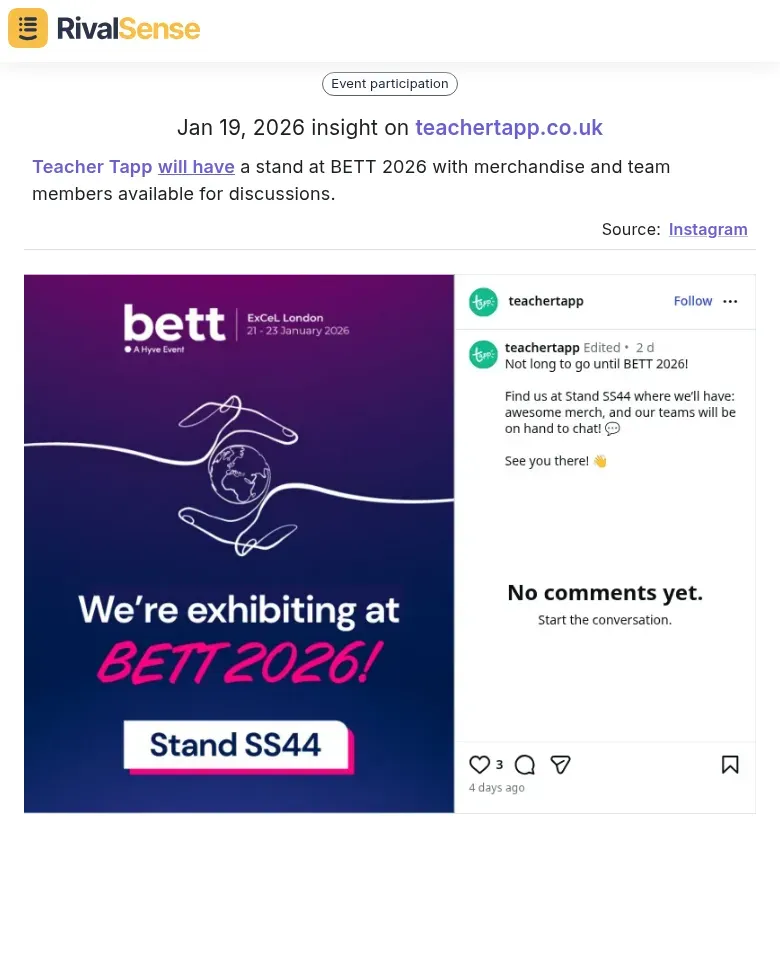
Why this insight is valuable: Knowing about a competitor's planned stand at a major event allows you to anticipate their direct engagement strategy, enabling you to plan your own presence or counter-messaging effectively.
Monitor indirect signals that often precede event participation: hiring patterns, product launches, and partnership announcements. Set up Google Alerts for competitor names combined with keywords like "event," "sponsor," and "speaking" to catch early hints.
Practical checklist:
- [ ] Create competitor event history database
- [ ] Set calendar reminders for major industry event registration windows
- [ ] Monitor competitor job postings for event-related roles
- [ ] Track product launch timelines relative to event calendars
- [ ] Review competitor social media for event-related content patterns
Combine these signals to predict with 70-80% accuracy which events your competitors will prioritize. 📊
Analyzing Competitor Event Objectives and Strategic Intent
Understanding why competitors attend specific events reveals their strategic priorities and helps you decode their market moves. Start by decoding sponsorship levels: basic booths signal market presence, while premium sponsorships indicate aggressive market capture or product launches.
For instance, a competitor opting for top-tier sponsorship at a niche industry event suggests targeted customer acquisition in that segment. RivalSense identified OnPress Book Printing as a titanium sponsor at the SCBWI conference, promoting its services for children's books and self-publishing.
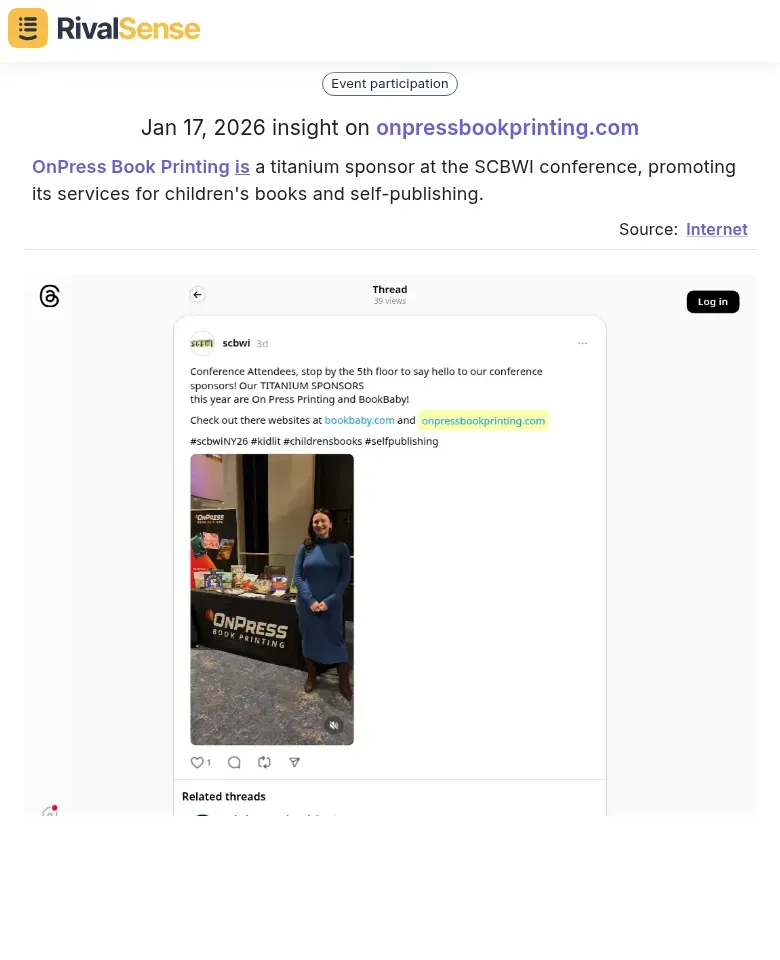
Why this insight is valuable: This high-level sponsorship insight shows where a competitor is investing heavily, highlighting their strategic focus on a specific audience, which can guide your own event strategy and resource allocation.
Analyze audience targeting by mapping events to competitor customer segments. If a B2B SaaS company consistently attends enterprise-focused conferences, they're likely targeting large organizations.
Create a checklist:
- List competitor-attended events
- Categorize by audience type (enterprise, SMB, vertical-specific)
- Cross-reference with their marketing messaging
Identify strategic partnerships by observing co-marketing activities at events. Competitors sharing booths or hosting joint sessions reveal alliance-building strategies. Monitor event agendas for competitor speaking slots with partners—this indicates deeper integration beyond mere sponsorship. Track these patterns quarterly to forecast future event participation and anticipate market moves. 🔍
Predictive Models for Forecasting Competitor Event Strategies
Predictive models transform raw competitor data into actionable intelligence for anticipating event participation strategies. By combining historical event attendance patterns with real-time market signals, you can forecast when competitors will announce participation and allocate resources accordingly.
These models help you stay ahead by identifying trends and anomalies in competitor behavior. Start by building a framework based on key components.
Key Framework Components:
- Historical Analysis: Track 3+ years of competitor event participation across categories (trade shows, conferences, webinars)
- Market Intelligence: Monitor industry trends, funding rounds, and product launches that signal strategic shifts
- Timing Predictions: Use seasonal patterns and announcement cadences to anticipate competitor moves 60-90 days in advance
Practical Implementation Steps:
- Create a weighted scoring system for event types based on competitor priorities
- Map regional investment patterns to identify emerging market focus areas
- Set up alerts for competitor leadership changes that may signal event strategy shifts
Resource Allocation Forecasting:
Predict competitor investment levels by analyzing booth sizes, sponsorship tiers, and speaker participation. High-investment events typically correlate with major product launches or market expansion initiatives. Track year-over-year budget changes to identify strategic priorities.
Pro Tip: Combine predictive models with real-time monitoring of competitor job postings and partnership announcements for enhanced accuracy. This dual approach helps validate forecasts and adjust strategies dynamically. 📈
Actionable Intelligence: Turning Predictions into Competitive Advantage
Transform predictive insights into tangible competitive advantage with these actionable steps. By acting on forecasts, you can outmaneuver competitors and capture market opportunities more effectively.
Start by developing counter-strategies based on predicted competitor moves. For example, RivalSense captured that PayJoy held its first sales clinic in Machala, El Oro province, with strategic partners, local authorities, and OPPO representatives presenting the new Oppo Reno14 F model.
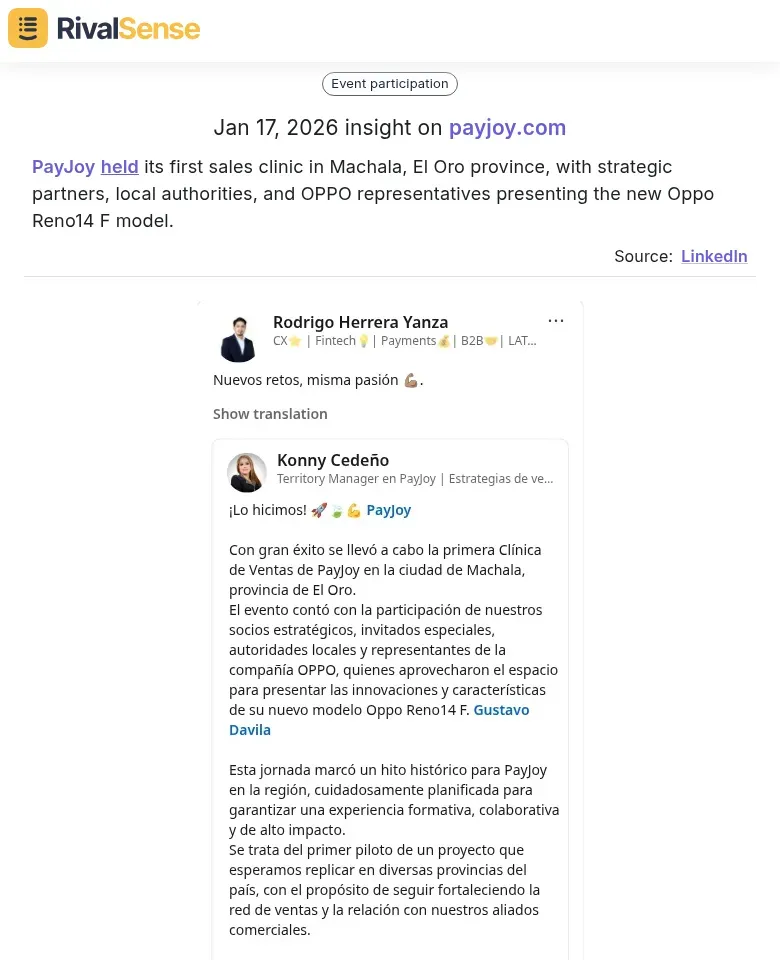
Why this insight is valuable: This reveals a competitor's partnership-driven local market expansion, allowing you to identify emerging trends and adjust your own event or market entry strategies to compete or collaborate.
Counter-Strategy Development Checklist:
- [ ] Preemptively schedule your events 2-4 weeks before predicted competitor participation
- [ ] Develop targeted messaging that directly addresses competitor weaknesses identified in their event patterns
- [ ] Create "counter-positioning" content that highlights your unique value where competitors are absent
- [ ] Establish rapid response teams to adjust tactics based on real-time competitor event intelligence
Opportunity Identification Framework:
- Map competitor event coverage by industry vertical, geographic region, and audience segment
- Identify gaps where 2+ major competitors are consistently absent
- Prioritize underserved markets with high growth potential
- Develop specialized content and offers tailored to these neglected segments
Resource Optimization Formula:
Allocate budget using the 70/20/10 rule:
- 70% to events where competitors are heavily invested (direct competition)
- 20% to emerging events competitors are testing (early positioning)
- 10% to uncontested spaces (blue ocean opportunities)
Practical Tips:
- Use predictive analytics to identify competitor event patterns 6-12 months in advance
- Create "what-if" scenarios for different competitor participation levels
- Establish quarterly review cycles to adjust allocations based on prediction accuracy
- Measure ROI by comparing actual competitor participation against your predictions
By converting predictions into preemptive actions, you transform intelligence from reactive monitoring to proactive market shaping. 💡
Implementation Framework and Best Practices
To implement predictive analysis for competitor event participation, establish a systematic framework with these best practices. A structured approach ensures consistency and improves the accuracy of your forecasts over time.
Begin by building a systematic tracking and analysis process. This involves creating templates, setting up review cycles, and leveraging technology for automation.
Building a Systematic Approach:
- Create a standardized competitor tracking template with fields for event history, participation patterns, and strategic objectives
- Develop quarterly review cycles to update competitor profiles and predict upcoming event participation
- Implement a scoring system based on historical data (past 2-3 years) to weight likelihood of participation
Technology and Tools:
- Leverage competitive intelligence platforms like RivalSense for automated monitoring of competitor announcements, social media activity, and industry event calendars
- Set up real-time alerts for competitor mentions at industry events and conference speaker announcements
- Use AI-powered sentiment analysis to detect subtle shifts in competitor messaging that may signal upcoming event participation
Continuous Improvement:
- Track prediction accuracy rates monthly and adjust models based on performance metrics
- Conduct post-event analysis comparing predictions with actual participation to identify blind spots
- Incorporate market feedback from sales teams and industry contacts to refine predictive algorithms
- Maintain a "lessons learned" database to improve future forecasting accuracy
Practical Checklist:
- [ ] Map all major industry events for the next 12 months
- [ ] Assign probability scores (high/medium/low) to each competitor-event combination
- [ ] Create automated monitoring dashboards for key competitors
- [ ] Schedule monthly calibration sessions to review and adjust predictions
- [ ] Document successful predictions and analyze failures for pattern recognition
Take Action with RivalSense
Predicting competitor event participation is complex, but with the right tools, you can streamline the process and gain a competitive edge. RivalSense tracks competitor product launches, pricing updates, event participations, partnerships, regulatory aspects, management changes, and media mentions across company websites, social media, and various registries, delivering all insights in a weekly email report.
Ready to transform your competitor intelligence? Try RivalSense for free at https://rivalsense.co/ and get your first competitor report today! 🚀
📚 Read more
👉 Leveraging Executive Moves for Competitive Edge: A Real-World Example
👉 The Ultimate Key Account Management Playbook for 2026: A Strategic Guide for Business Leaders
👉 Advanced Tactics: Monitor Key Account Growth for Commercial Insurance Brokers
👉 How Salesforce's Hoa Sen Partnership Enabled Competitors to Target CRM Gaps
👉 Best Practices: Extract Competitor Insights from Website Changes for Key Account Success