
Predictive Analysis: Forecast Competitor Churn via Media & Content Insights
In today's hyper-competitive landscape, reactive competitor monitoring is no longer sufficient. Predictive analysis transforms competitive intelligence from a rear-view mirror exercise into a forward-looking strategic tool. By analyzing media coverage, content patterns, and public signals, you can forecast competitor churn before it manifests in market share shifts.
Media and content insights reveal subtle but telling patterns: declining thought leadership output, reduced press mentions, or shifting messaging priorities often precede organizational turmoil. These public signals provide early warnings of internal challenges, leadership changes, or strategic pivots that could create market openings.
Practical steps to implement predictive competitor analysis:
- 🔍 Track competitor content velocity and quality trends monthly
- 📉 Monitor media sentiment shifts and coverage frequency
- 👔 Analyze executive visibility and thought leadership patterns
- 🎯 Watch for messaging inconsistencies or defensive positioning
- 📊 Benchmark against industry norms and historical patterns
This approach moves you from simply knowing what competitors are doing today to anticipating where they'll struggle tomorrow. By identifying vulnerabilities before they become public crises, you gain strategic advantage in timing market entries, talent acquisition, and customer outreach.
Decoding Industry Reports: Strategic Pressure Points and Market Shifts 🔍
Industry reports reveal more than market trends—they expose competitor vulnerabilities through modernization pressures and timeline constraints. Look for sections detailing technology adoption deadlines, regulatory compliance dates, or industry-wide transformation initiatives. These create strategic pressure points where competitors must invest or risk falling behind.
Identify expertise gaps by analyzing which skills or technologies are highlighted as critical but show low adoption rates among competitors. Resource limitations become apparent when reports mention high implementation costs or specialized talent shortages that certain players lack.
For example, RivalSense recently tracked that Gelato released its State of Intelligent Print Production 2026 report, showing that 78% of print CEOs say they must modernize within 12 months and 65% cite expertise as the biggest AI barrier.
Why this insight matters: Industry report insights like this highlight strategic pressure points and modernization deadlines, helping you anticipate where competitors might struggle to keep up or invest resources, revealing potential churn opportunities.
Practical steps:
- 📅 Extract modernization deadlines from industry whitepapers and regulatory documents
- 🗺️ Map competitor capabilities against required transformation milestones
- 📉 Calculate resource gaps by comparing industry benchmarks with competitor public disclosures
- 🔄 Monitor report updates quarterly to track evolving pressure points
Use market-wide data to benchmark competitors against transformation requirements. When you see a competitor consistently missing industry-adopted technologies or lagging in required certifications, these signal potential churn vulnerabilities as their clients seek more modern solutions.
Media Appearances and Public Statements: Reading Between the Lines 🎤
Executive media appearances and public statements offer invaluable strategic intelligence when analyzed systematically. Monitor key executives' interviews, podcasts, and speaking engagements for subtle shifts in language that reveal strategic pivots. For example, when a competitor's CEO repeatedly emphasizes "operational efficiency" over "growth," it may signal upcoming cost-cutting measures that could impact customer service quality.
Analyze public statements for partnership signals by tracking mentions of other companies, joint announcements, or technology integrations. When a competitor announces a new integration partner, it often indicates resource allocation toward that ecosystem, potentially leaving other areas under-supported.
Consider how RivalSense captured LA Knight's interview on ESPN SportsCenter, discussing a potential WrestleMania 42 match against Drew McIntyre.
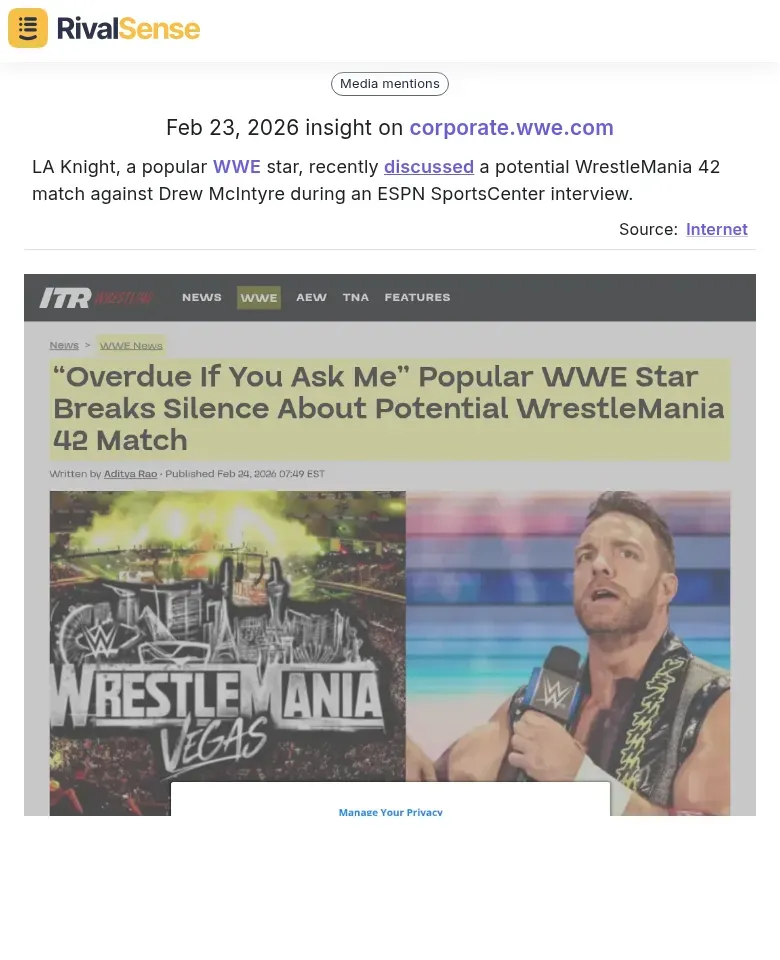
Why this insight matters: While from entertainment, this demonstrates how media appearances can signal future moves and shifts in focus; in business, similar insights reveal strategic pivots, partnerships, or leadership priorities that foreshadow churn risks.
Practical steps:
- 📋 Create a tracking list of competitor executives and their regular media outlets
- 😊 Use sentiment analysis tools to detect subtle tone shifts over time
- 👥 Cross-reference public statements with hiring patterns and job postings
- ⚠️ Monitor for contradictions between different executives' statements
- 📈 Track frequency and timing of announcements for resource allocation patterns
Identify potential conflicts by comparing marketing messaging with executive statements. When marketing promises "24/7 support" while executives discuss "automating customer interactions," this strategic misalignment often leads to service gaps and eventual customer churn. Document these inconsistencies to predict which customer segments might become dissatisfied first.
AI and Technology Adoption Signals: Competitive Differentiation Gaps 🤖
Tracking how competitors discuss AI implementation reveals critical competitive intelligence. Monitor their content for specific technology mentions, implementation timelines, and capability claims. Look for gaps between market demand (what customers want) and competitor delivery (what they actually provide).
A recent RivalSense insight showed Drata's CEO Adam Markowitz saying AI is driving more demand for Drata's compliance, security assurance, and vendor risk services.
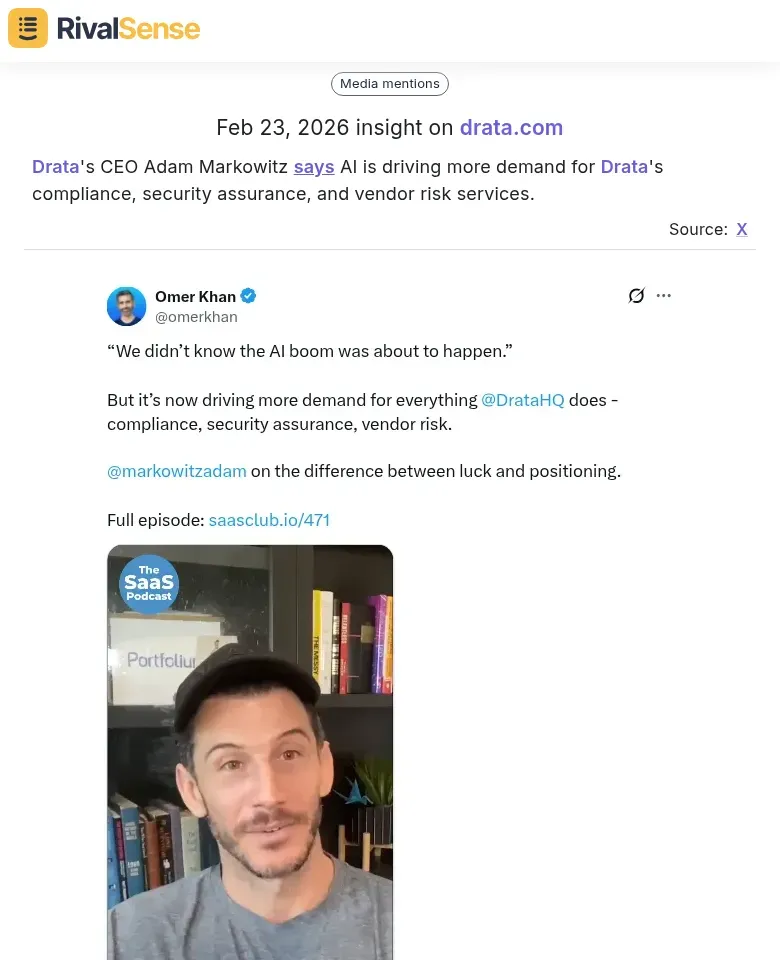
Why this insight matters: CEO statements on AI adoption signal how competitors are positioning themselves technologically, revealing investment areas, capability gaps, or market trends that can inform your own strategy and highlight churn vulnerabilities.
Practical steps:
- 📊 Create a technology adoption matrix tracking competitors' AI mentions across blogs, whitepapers, and announcements
- 🔍 Identify implementation gaps - where competitors promise but don't deliver
- 👨💼 Monitor hiring patterns for AI/tech roles indicating capability expansion
- 📝 Analyze customer reviews mentioning technology shortcomings
When competitors over-promise on AI capabilities but under-deliver, this creates vulnerability. Conversely, competitors quietly building robust AI infrastructure while downplaying capabilities present future threats. The key insight: technology adoption creates differentiation not through announcements, but through actual customer impact.
Checklist for analysis:
- [ ] Track frequency and specificity of AI mentions
- [ ] Compare claimed capabilities with customer-reported experiences
- [ ] Monitor technology-related hiring and partnerships
- [ ] Identify gaps between market needs and competitor offerings
Technology adoption signals become competitive advantages when they translate to measurable customer benefits that competitors cannot easily replicate.
Building Your Predictive Churn Analysis Framework 🏗️
Building a predictive churn analysis framework requires a systematic approach to transform media signals into actionable intelligence. Start by establishing a comprehensive data collection system that monitors competitor content across multiple channels: blog frequency and quality, social media engagement trends, webinar attendance, whitepaper downloads, and press release cadence.
Develop a scoring model with weighted metrics: assign points for content gaps (0-10), engagement decline (0-15), leadership visibility reduction (0-10), and messaging inconsistencies (0-5). Calculate a vulnerability score (0-40) where higher scores indicate greater churn risk. For example, a competitor scoring 30+ with declining blog posts and disappearing executives signals high vulnerability.
Establish trigger points for strategic action:
- 🟡 At 25: Increase monitoring frequency
- 🟠 At 30: Analyze customer testimonials for dissatisfaction patterns
- 🔴 At 35: Prepare targeted outreach campaigns to vulnerable segments
Monthly review checklist:
- [ ] Update scoring weights based on new data
- [ ] Verify data sources for accuracy
- [ ] Document false positives to refine the model
- [ ] Refine your model based on actual churn events
Practical tip: Cross-reference content signals with hiring patterns and funding news for validation. Early warning indicators include sudden content strategy shifts, reduced thought leadership, and inconsistent messaging across channels.
Turning Predictions into Competitive Advantage 🚀
Once you've identified which competitors are likely to churn customers, transform those predictions into tangible competitive advantage. Start by developing targeted acquisition strategies: analyze the specific customer segments your struggling competitors serve, then craft personalized outreach campaigns that address their likely pain points.
Align your marketing and sales efforts with anticipated market gaps. When competitor churn predictions reveal upcoming opportunities in specific industries or regions, reallocate resources proactively. Create a quarterly 'opportunity map' that visualizes where competitor weaknesses align with your strengths, then coordinate cross-functional teams to capitalize on these openings.
Most importantly, develop proactive retention strategies by learning from competitor vulnerabilities. If analysis shows competitors losing customers due to poor onboarding or support gaps, conduct a vulnerability audit of your own customer journey. Implement early warning systems that monitor similar signals in your business, and create retention playbooks for at-risk segments before issues escalate.
Put Your Insights into Action with RivalSense 🔥
Implementing a predictive churn analysis framework can be time-consuming without the right tools. RivalSense automates competitor tracking across company websites, social media, and various registries, delivering key insights like product launches, pricing updates, event participations, partnerships, and media mentions in a weekly email report.
By leveraging RivalSense, you can focus on strategic decision-making rather than data collection. Try RivalSense for free today at https://rivalsense.co/ and get your first competitor report to start forecasting churn and gaining a competitive edge!
📚 Read more
👉 Decoding Competitor Moves: How Hiring Insights Reveal Strategic Shifts
👉 Mastering Competitor Trade Show Strategy for 2026 Business Growth
👉 A Step-by-Step Guide to Comparing Key Account Management Tools for Industrial Machinery Maintenance
👉 How n8n's Pricing Shift Let Competitors Capture Enterprise Clients
👉 Predictive Facebook Competitor Insights: Key Account Management Case Study