
Predictive Analysis: Decoding Competitor Advertising Strategies for Insurance Brokers in 2026
The insurance brokerage market in 2026 is more competitive than ever. With AI-driven search engines and multi-platform optimization, staying ahead requires proactive strategies beyond traditional monitoring. In 2026, insurance broker advertising has evolved into a complex digital ecosystem where AI-powered search engines, multi-platform optimization, and predictive analytics dominate. Traditional competitor analysis methods—manual monitoring of ads and occasional market research—are no longer sufficient. With 73% of insurance buyers researching online before contacting brokers and AI engines like ChatGPT providing direct answers without website clicks, reactive monitoring leaves you vulnerable to competitors who leverage predictive analysis.
✅ Practical Checklist for 2026 Competitive Intelligence:
- Monitor AI Answer Engines: Track when competitors appear in ChatGPT, Google Gemini, and Perplexity responses to insurance queries
- Analyze Multi-Platform Presence: Assess competitor visibility across Google Business Profile, LinkedIn, YouTube, and emerging platforms
- Track Predictive Patterns: Use tools to identify when competitors increase ad spend before market shifts or policy renewals
- Measure Content Authority: Evaluate competitor content depth and data-backed insights that AI engines prioritize
Predictive analysis transforms reactive monitoring into proactive strategy by identifying patterns in competitor behavior before they launch campaigns. Instead of reacting to competitor moves, you can anticipate market shifts, optimize for emerging platforms, and position your brokerage where AI-driven buyers are searching. This shift from historical analysis to forward-looking intelligence is the key differentiator for insurance brokers in 2026's competitive landscape.
Foundations: What Predictive Analysis Means for Competitor Intelligence
Predictive analytics is revolutionizing how businesses understand their competitors. For insurance brokers, this means moving from historical data to forecasting future moves for strategic advantage. Predictive analytics transforms competitor intelligence from historical reporting to forward-looking strategy. For insurance brokers, this means using machine learning models to forecast competitor advertising moves before they happen. Instead of just tracking what rivals spent last quarter, you can anticipate their next campaign themes, budget allocations, and target demographics.
Key data sources for insurance broker advertising intelligence include:
- Meta Ad Library and Google Ads Transparency Center for active campaign analysis
- Competitor website changes (home pages, landing pages, pricing pages)
- Job postings revealing marketing team expansions
- Social media engagement patterns and content themes
- Industry publications and regulatory filings
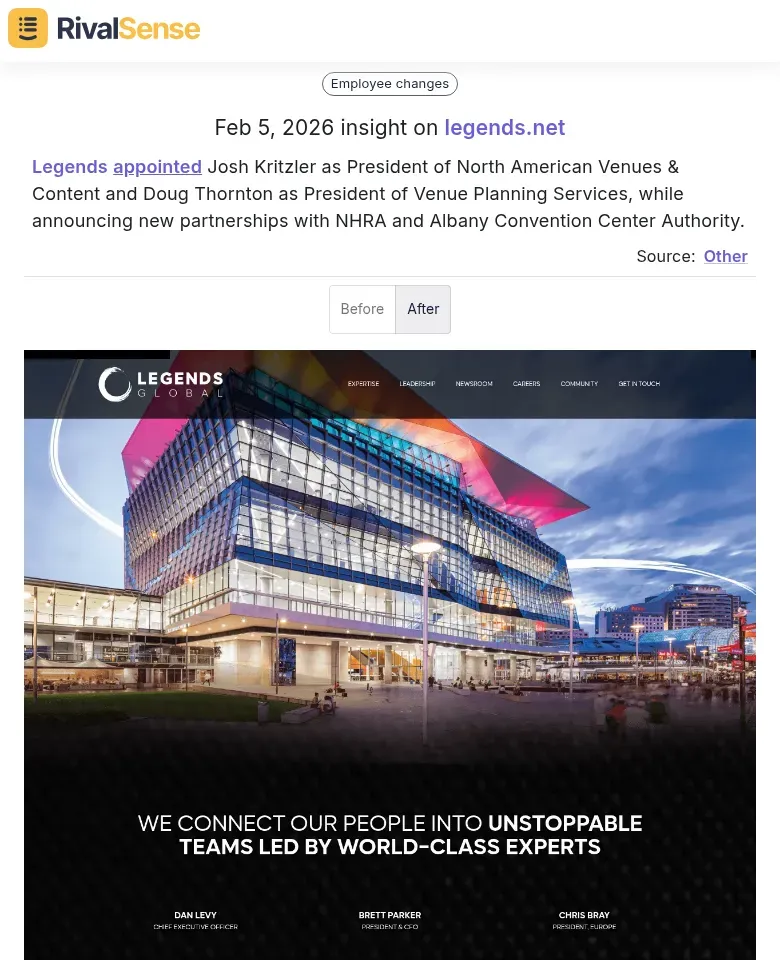
For instance, tracking management changes can reveal strategic shifts and new market directions. Recently, RivalSense detected that Legends appointed Josh Kritzler as President of North American Venues & Content and Doug Thornton as President of Venue Planning Services, while announcing new partnerships with NHRA and Albany Convention Center Authority. This type of insight helps anticipate expansions into new service areas or geographic markets, allowing you to adjust your own strategy proactively.
Practical steps to implement predictive competitor analysis:
- Collect 6-12 months of historical competitor advertising data
- Identify patterns in seasonal campaigns, budget cycles, and messaging shifts
- Monitor real-time signals like job postings for marketing roles or website redesigns
- Use AI tools to analyze sentiment and predict next campaign themes
- Create "what-if" scenarios for different competitor moves
💡 Tip: Focus on signals that precede major advertising shifts—website redesigns often launch 2-3 weeks before new campaigns, while hiring spikes in marketing roles indicate budget increases.
The shift from historical to predictive analysis means moving from "What did they do?" to "What will they do next?" This enables proactive strategy adjustments rather than reactive responses.
Decoding Competitor Advertising Channels: Where Insurance Brokers Are Investing
Understanding where competitors invest their advertising dollars is crucial for strategic planning. By analyzing their channel choices, you can identify opportunities and threats in your own marketing mix. Insurance brokers can gain strategic advantage by systematically analyzing competitor advertising investments across key channels. Start by examining PPC strategies: identify which competitors are bidding on high-intent keywords like "business insurance quotes" or "commercial liability coverage," and analyze their ad copy patterns, landing page approaches, and seasonal bidding trends. Use tools like SEMrush or Ahrefs to uncover their keyword targeting and budget allocation patterns.
For social media advertising, track competitors on LinkedIn (ideal for B2B commercial insurance), Facebook (effective for personal lines), and emerging platforms like TikTok for reaching younger demographics. Monitor their ad formats, targeting parameters, and engagement metrics to identify effective approaches.
Content marketing and SEO analysis reveals long-term visibility strategies. Map competitors' content pillars (e.g., risk management guides, industry compliance updates) and backlink profiles. Identify their top-performing organic keywords and content formats driving traffic. Monitoring product launches can signal innovation trends and competitive threats. For example, Vellum introduced a new Insurance Claims Automation Agent that assesses claims and verifies policy details, replacing the previous agent that summarized lengthy PDF reports. This insight shows how competitors are leveraging AI for efficiency, prompting you to evaluate your own tech stack and service offerings.
✅ Practical Checklist:
- Audit 3-5 key competitors' PPC campaigns monthly
- Track social ad spend patterns quarterly
- Analyze content gaps in your niche vs. competitors
- Monitor emerging platform adoption trends
- Benchmark SEO performance against industry leaders
💡 Tip: Focus on competitors targeting similar commercial sectors (construction, healthcare, tech) for most relevant insights. Combine channel data to identify overall advertising strategy patterns and investment priorities.
Predictive Models: Anticipating Competitor Moves Before They Happen
Predictive models allow you to anticipate competitor actions based on patterns and signals. This forward-looking approach gives you a strategic edge in timing and resource allocation for your insurance brokerage. Predictive models transform reactive monitoring into proactive strategy by anticipating competitor moves before they launch. For insurance brokers, this means moving beyond tracking what competitors are doing today to forecasting what they'll do tomorrow.
📈 Pattern Recognition for Campaign Cycles:
Use time-series analysis to identify seasonal patterns in competitor advertising. For example, if a major competitor consistently increases PPC spend 30 days before Q4, you can preemptively adjust your own budget. Practical tip: Track 3+ years of competitor ad spend data to establish reliable patterns.
💰 Budget Allocation Forecasting:
Predict when competitors will shift budgets between channels (Google Ads → LinkedIn, TV → digital). Monitor signals like job postings for digital marketing roles or agency partnerships. Checklist: 1) Track competitor hiring trends, 2) Monitor agency announcements, 3) Analyze channel performance correlations.
📢 Messaging & Positioning Predictions:
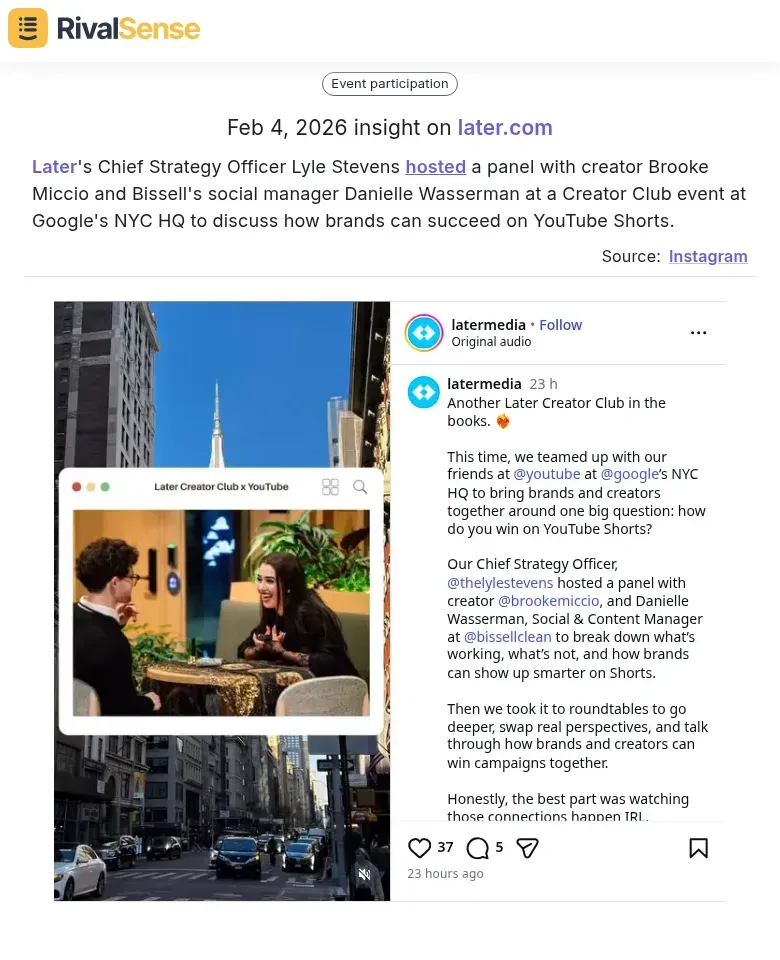
Forecast messaging changes by analyzing market signals: regulatory updates, economic indicators, and customer sentiment shifts. When competitors start emphasizing "cyber liability" after data breach news, predictive models can anticipate this shift weeks in advance. Event involvement often precedes marketing campaigns and can reveal focus areas. Later's Chief Strategy Officer Lyle Stevens hosted a panel with creator Brooke Miccio and Bissell's social manager Danielle Wasserman at a Creator Club event at Google's NYC HQ to discuss how brands can succeed on YouTube Shorts. Such insights help predict where competitors will focus their messaging, allowing you to prepare counter-strategies.
💡 Hint: Combine social listening with regulatory tracking for early warning signals on messaging shifts.
✅ Actionable Steps:
- Implement time-series forecasting for competitor ad spend patterns
- Create channel shift probability models based on market conditions
- Develop messaging prediction algorithms using NLP on competitor content
- Set up automated alerts for predicted competitor moves
By anticipating rather than reacting, you gain 4-6 week advantages in campaign planning and resource allocation.
Actionable Intelligence: Turning Predictive Insights into Competitive Advantage
Transforming predictive insights into tangible results requires a systematic approach. For insurance brokers, this means embedding intelligence into daily decision-making processes. Transform predictive insights into tangible competitive advantage with these actionable steps:
-
Counter-Strategy Development: When you predict a competitor's upcoming ad campaign, create preemptive content addressing their weaknesses. For example, if a rival insurance broker plans to promote "lowest rates," launch educational content about coverage quality and hidden fees before their campaign begins.
-
Budget Optimization Framework: Allocate 70% of your ad budget to proven channels, 20% to test new opportunities identified through competitor analysis, and 10% for rapid response to unexpected competitor moves. Use competitor intelligence to identify underutilized channels where you can dominate.
-
Strategic Timing Checklist:
- Launch new offerings 2-3 weeks before competitors' predicted campaigns
- Schedule content debunking competitor claims to coincide with their ad launches
- Plan retention campaigns during competitors' acquisition pushes
- Test new messaging during competitors' budget reallocation periods
-
Quick Response Protocol: Establish a 48-hour response system for unexpected competitor moves. When a rival launches a surprise campaign, immediately deploy pre-prepared counter-messaging and adjust your ad placements to appear alongside theirs with superior offers.
💡 Practical Tip: Create a "competitor playbook" documenting each rival's historical patterns and your corresponding counter-strategies. This enables rapid, data-driven responses that consistently outmaneuver competitors in the insurance brokerage market.
Implementation Roadmap: Building Your Predictive Competitor Intelligence System
Building a predictive competitor intelligence system requires a structured and scalable approach. Start with clear objectives and gradually integrate tools and processes for continuous improvement. Here's your implementation roadmap:
🔧 Essential Tools & Technologies:
Start with competitor tracking platforms like RivalSense that monitor insurance broker advertising across digital channels. Complement with web scraping tools for pricing data, social listening platforms for brand sentiment, and analytics dashboards for visualization. Key technologies include AI-powered pattern recognition for ad strategy analysis and predictive modeling tools.
📊 Data Collection & Analysis Workflow:
- Establish automated data collection from competitor websites, social media, PPC campaigns, and industry publications
- Create standardized data cleaning and normalization processes
- Implement weekly analysis cycles to identify emerging trends
- Set up alert systems for significant competitor moves (new product launches, pricing changes)
- Maintain a centralized intelligence repository accessible to decision-makers
🔄 Strategic Integration Process:
- Schedule monthly competitive intelligence reviews with leadership
- Map competitor strategies against your own market positioning
- Use predictive insights to anticipate market shifts 3-6 months ahead
- Incorporate competitor analysis into quarterly planning sessions
- Create "what-if" scenarios based on competitor behavior patterns
✅ Practical Checklist:
✓ Identify 5-7 key competitors to monitor
✓ Define 10-15 key metrics (ad spend, messaging themes, target keywords)
✓ Assign team ownership for data quality
✓ Establish reporting cadence (weekly tactical, monthly strategic)
✓ Integrate insights into marketing and product roadmaps
💡 Tip: Start with 2-3 predictive indicators (like seasonal ad pattern changes) rather than trying to predict everything at once. Focus on actionable insights that directly impact your insurance brokerage's growth strategy.
Conclusion: Leveraging Tools for Continuous Advantage
To stay ahead in 2026's competitive insurance brokerage landscape, predictive analysis is no longer optional—it's essential. By decoding competitor advertising strategies, you can anticipate moves, optimize resources, and seize opportunities before others do. Implementing a robust intelligence system requires the right tools and consistent execution.
Consider using a tool like RivalSense to streamline this process. It tracks competitor product launches, pricing updates, event participations, partnerships, regulatory aspects, management changes, and media mentions across company websites, social media, and various registries, delivering all insights in a weekly email report. This comprehensive monitoring helps you build predictive models and act on real-time data.
Ready to transform your competitor intelligence? Try RivalSense for free at https://rivalsense.co/ and get your first competitor report today to start decoding your rivals' advertising strategies.
📚 Read more
👉 How TrustDecision's Soneri Bank Win Prompted Rivals to Accelerate Pakistan Market Entry
👉 Mastering Facebook Competitor Insights: A Cheat Sheet for Key Account Management
👉 Biotech Key Account Tracking Automation Checklist for Precision Medicine
👉 Decoding Competitor Hiring and Layoffs: A Strategic Guide for Business Leaders
👉 Competitor Insight: Decoding Rivan Industries' Latest Filings