
Optimizing Key Account Management for Tech Companies: A Strategic Playbook
In today's competitive tech landscape, key account management (KAM) has evolved from a sales function to a strategic imperative. The most successful tech companies recognize that 20% of their accounts typically generate 80% of their revenue—making focused investment in these relationships essential for sustainable growth and market leadership. These high-value partnerships drive predictable recurring revenue, create valuable reference cases, and establish barriers to entry that competitors struggle to overcome.
Competitive intelligence reveals a clear industry shift: leading tech firms are moving beyond transactional relationships to build true strategic partnerships with their key accounts. By analyzing competitor behavior, we see top performers dedicating specialized teams, developing co-innovation programs, and creating executive sponsorship models that transform customers into long-term allies.
Practical steps to optimize your KAM strategy:
- Identify your 20%: Use data analytics to pinpoint accounts with highest lifetime value and strategic importance
- Map competitor relationships: Track which accounts your competitors are investing in most heavily
- Develop tiered engagement models: Create different service levels based on account value and strategic fit
- Establish clear metrics: Measure account health, expansion opportunities, and partnership depth
- Build cross-functional teams: Ensure marketing, product, and support all contribute to account success
Start by auditing your current account portfolio this quarter—categorize accounts by revenue contribution, strategic alignment, and growth potential to focus resources where they'll deliver maximum competitive advantage.
Strategic Account Identification and Segmentation Framework
Identifying key accounts requires looking beyond revenue metrics. A robust framework considers multiple dimensions to ensure strategic alignment and growth potential. Develop a multi-dimensional scoring framework that evaluates: (1) Strategic alignment with your product roadmap, (2) Market influence and referenceability, (3) Growth potential based on their industry position, and (4) Partnership readiness for co-innovation. For example, a mid-sized fintech with strong industry connections may offer more strategic value than a larger, less innovative enterprise.
Learn from competitor referral programs by analyzing which accounts they prioritize for expansion. Monitor their case studies, partnership announcements, and customer advocacy programs to identify accounts with high relationship capital. These accounts often represent untapped expansion opportunities where you can leverage existing trust networks.
Segment accounts into three actionable tiers:
- Strategic Partners: High influence, innovation-ready accounts for joint development
- Growth Accelerators: High expansion potential with strong product-market fit
- Foundation Accounts: Stable revenue sources with moderate growth potential
Practical checklist:
- Score each account on strategic value (0-10), growth potential (0-10), and partnership readiness (0-10)
- Map competitor reference accounts to identify relationship networks
- Create tier-specific engagement plans with clear success metrics
- Quarterly review segmentation based on account performance and market shifts
Building Partnership Ecosystems and Referral Networks
Building a thriving partnership ecosystem requires moving beyond transactional relationships to create mutual value. It involves designing programs that incentivize collaboration and foster long-term alliances. Start by designing structured referral programs with clear incentives—consider tiered rewards based on deal size or volume, like offering 15-20% commission for qualified leads that convert. Implement verification systems to track referrals accurately, using unique codes or dedicated landing pages.
For example, tracking competitor initiatives can provide valuable insights for refining your own strategies. Consider how Roam introduced "Refer to Roam" on November 12, offering a Gold Verification Check for referrals and recurring revenue for influencers using their platform.
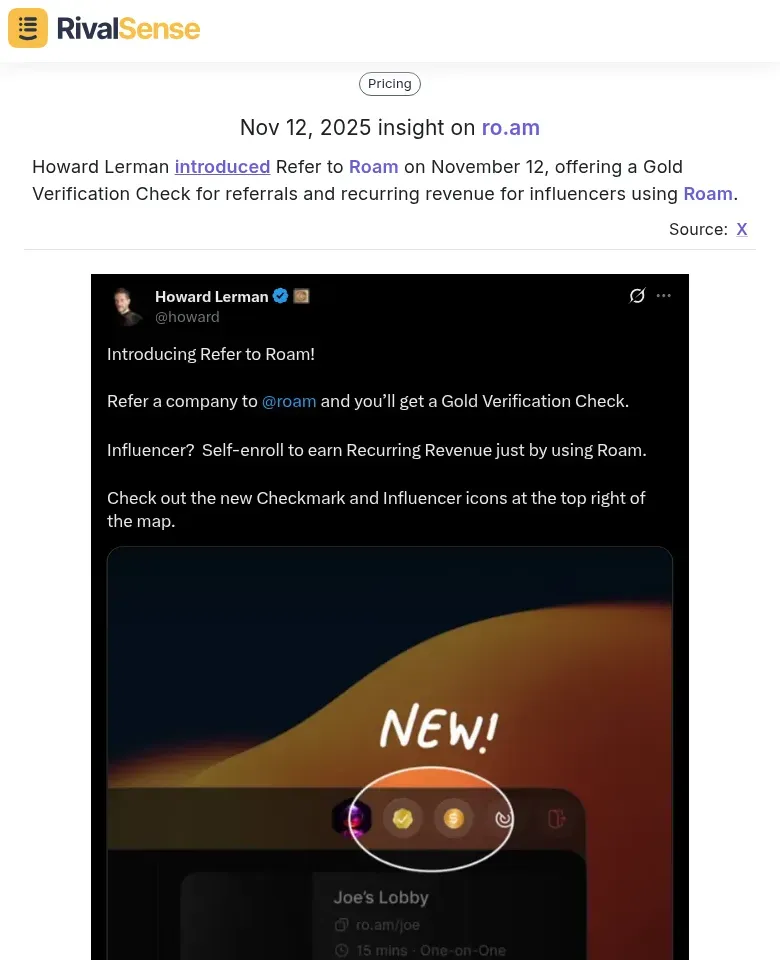
Why this insight matters: Monitoring competitor referral programs helps you understand their partnership incentives and benchmark your own structures, ensuring you remain competitive in attracting and retaining key partners.
For key partners, develop recognition programs that go beyond financial rewards. Create "Partner of the Quarter" awards with public recognition, exclusive access to beta features, or co-marketing opportunities. Establish partner advisory boards where top advocates can influence product development.
Build ecosystem partnerships that extend your value proposition. For example, a SaaS company could partner with complementary tools to offer integrated solutions, creating stickier customer experiences. Develop joint go-to-market strategies with implementation partners who can help customers maximize your product's value.
Practical checklist:
- Map your ideal partner profiles and value exchange
- Create clear program guidelines and incentive structures
- Implement tracking mechanisms for attribution
- Develop onboarding and enablement resources
- Establish regular communication cadence and feedback loops
- Measure partnership ROI through metrics like referral conversion rates and partner satisfaction scores
Tip: Start small with 3-5 strategic partners, refine your approach based on learnings, then scale systematically.
Community Building and Strategic Engagement Events
Transform key account management from transactional to relational through strategic community building. Exclusive events and interactive experiences can deepen engagement and position your company as an industry leader. Design invitation-only events that facilitate peer connections and co-created content, such as quarterly executive roundtables focused on emerging tech trends.
Learn from successful demo nights by creating interactive experiences with live voting. For instance, Roam and The AI Collective will host the SF Demo Night on December 9, featuring 8 elite early stage founders and live voting.
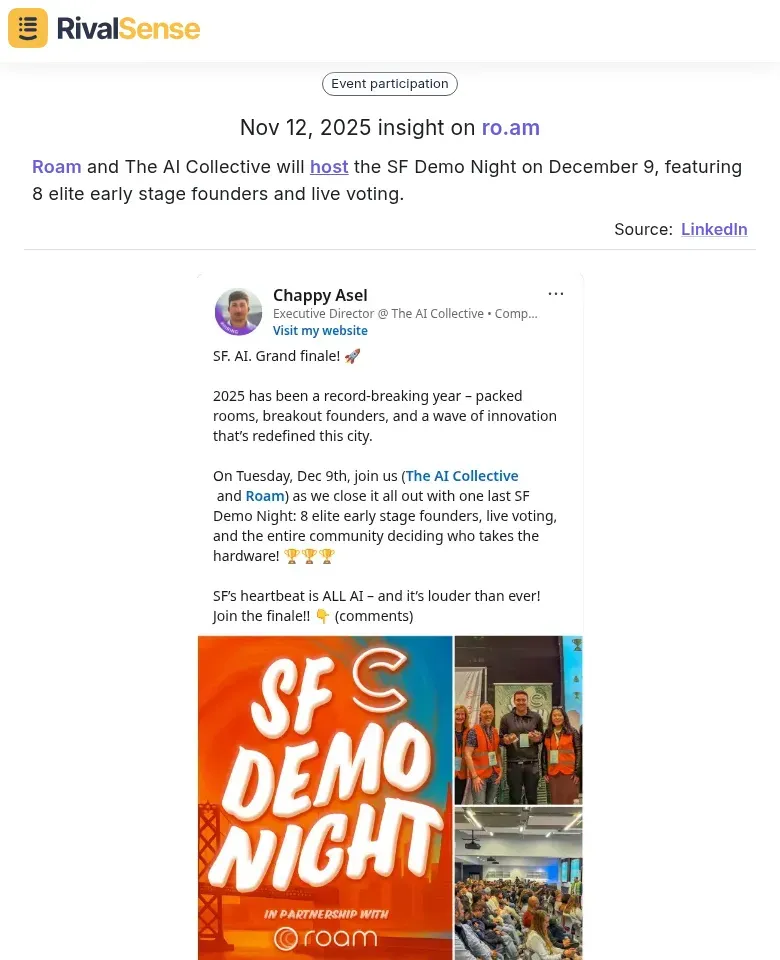
Why this insight matters: Tracking competitor events like this reveals how they foster innovation and community engagement, providing models for designing your own high-impact gatherings that strengthen key account relationships and industry influence.
📚 Read more
👉 Beginner's Guide to Analyzing Competitor Product Offerings for Market Share
👉 Leveraging Management Changes for Competitive Advantage: A Case Study on Safran
👉 The Complete Guide to Competitor Patent Analysis: How to Decode Your Rivals' Innovation Strategy
👉 Maximizing Warehousing & Distribution Competitor Benchmarking: Best Practices for B2B Leaders
👉 How to Counter Competitor Advances Like Xometry's Formlabs SLA Partnership