
Optimize Twitter Monitoring for Competitor Industry Award Insights
In today's fast-paced digital landscape, Twitter monitoring has become indispensable for competitive intelligence, especially when tracking industry awards. While traditional sources like press releases or industry publications often lag, Twitter provides real-time insights into competitor recognition patterns. By monitoring hashtags, mentions, and announcements, you can identify emerging trends and validate market positioning before your rivals do.
Tracking competitor awards offers strategic advantages beyond mere awareness. Each award announcement reveals how competitors position themselves—whether emphasizing innovation, customer satisfaction, or sustainability. This intelligence helps you refine your own messaging and identify gaps in the market. For example, if a competitor consistently wins awards for user experience, it signals a market demand you can address.
Connect these insights to broader business strategy by analyzing award frequency, categories, and jury feedback. Use tools like Twitter Lists for key competitors and industry influencers, set up alerts for relevant hashtags (e.g., #IndustryAwards2024), and create a dashboard to track patterns over time. Practical steps include:
- Monitor competitor handles and industry event accounts daily.
- Analyze award announcements for underlying themes (e.g., tech innovation vs. social impact).
- Cross-reference Twitter insights with market data to validate trends.
By integrating Twitter monitoring into your competitive intelligence framework, you turn real-time data into actionable strategy, ensuring you stay ahead in a recognition-driven market.
Setting Up Your Twitter Monitoring Framework for Award Tracking
To build an effective Twitter monitoring framework for award tracking, start by identifying key accounts to follow. Create a master list of: 1) All direct competitors, 2) Industry award organizations (like SaaS Awards, G2, Capterra), 3) Industry publications that announce awards, and 4) Influential voices in your niche.
Next, organize these accounts into specialized Twitter lists. Create separate lists for 'Competitors,' 'Award Organizations,' and 'Industry Media.' Use Twitter's advanced search operators to set up alerts for award-related keywords like "wins award," "named best," "industry recognition," or "top [your industry] tool."
Establish baseline metrics to distinguish significant recognition from routine mentions. Track: 1) Engagement spikes (sudden increases in likes/retweets), 2) Verified account mentions (awards from official organizations carry more weight), 3) Media coverage (when industry publications share the news), and 4) Competitor response patterns (how they promote their wins).
Pro tip: Set up Google Alerts alongside Twitter monitoring for comprehensive coverage. Create a weekly review checklist to analyze award mentions, update your competitor intelligence database, and identify emerging award opportunities for your own company.
Analyzing Award Announcements for Strategic Insights
Award announcements reveal more than just accolades—they're strategic signals. Decode what different award types reveal: innovation awards signal R&D focus, sustainability awards indicate ESG priorities, and customer service awards highlight retention strategies. For example, a competitor winning multiple 'Best Place to Work' awards likely invests heavily in talent retention.
Track audience engagement metrics to gauge market validation. Monitor:
- Retweet ratios vs. follower count
- Comment sentiment analysis
- Award-specific hashtag adoption rates
High engagement suggests genuine market recognition, not just PR noise.
Identify patterns in award timing and frequency. Create a simple tracking checklist:
- Log all award announcements with dates
- Categorize by award type and prestige level
- Note any clustering around product launches
- Track year-over-year frequency changes
Practical tip: Set up Twitter alerts for competitor mentions + 'award', 'won', 'recognized' keywords. Watch for patterns—quarterly award surges may indicate planned PR campaigns, while consistent recognition suggests sustained market leadership. Analyze which awards competitors highlight most prominently in their bios and pinned tweets—these reveal their desired market positioning.
Learning from Competitor Innovation Recognition Patterns
Innovation awards reveal more than just bragging rights—they signal where competitors are investing their R&D dollars and what technological directions they're pursuing. When a rival wins recognition for AI-powered analytics or sustainable tech, it's a clear indicator of their strategic priorities. Track these patterns quarterly to spot emerging trends before they hit the market.
Look beyond traditional awards to open-source contributions and academic research recognition. Competitors who receive grants or publish award-winning papers are often testing new technologies that could become commercial products. Monitor GitHub repositories and research databases for these early signals.
Example from RivalSense: Microsoft researchers introduced Majorana 1, the world's first quantum processor built with topological qubits, shared Aurora to predict extreme weather faster, and developed FCDD to improve early detection. 
Tracking such research breakthroughs is valuable for business strategy because it reveals long-term R&D investments that could disrupt your industry. By monitoring these innovations, you can anticipate future product lines and adjust your own technology roadmap accordingly.
Practical steps:
- Create a tracking spreadsheet with award categories, technologies recognized, and jury comments
- Set up Google Alerts for "[competitor name] + award" and "[industry] innovation recognition"
- Analyze award timelines—are they accelerating certain technology development?
- Connect award-winning innovations to their recent partnerships or market expansions
- Use award jury composition to identify potential industry influencers to watch
Award-winning innovations often precede market moves. When a competitor's AI tool wins recognition, expect them to launch related enterprise solutions within 6-12 months. These validated innovations also attract partnership opportunities—track which companies collaborate with award winners for potential alliance patterns.
Expanding Your Intelligence: Product Launches and Open-Source Releases
While award tracking is crucial, monitoring broader competitor moves like product launches and open-source releases can provide complementary strategic insights. These initiatives often signal market expansion, technological shifts, or new partnership strategies.
Example from RivalSense: Roku announces the launch of its first-ever FAST channels on its platform for UK viewers, rolling out next month with 40+ channels offering free 24/7 streaming on all Roku devices. 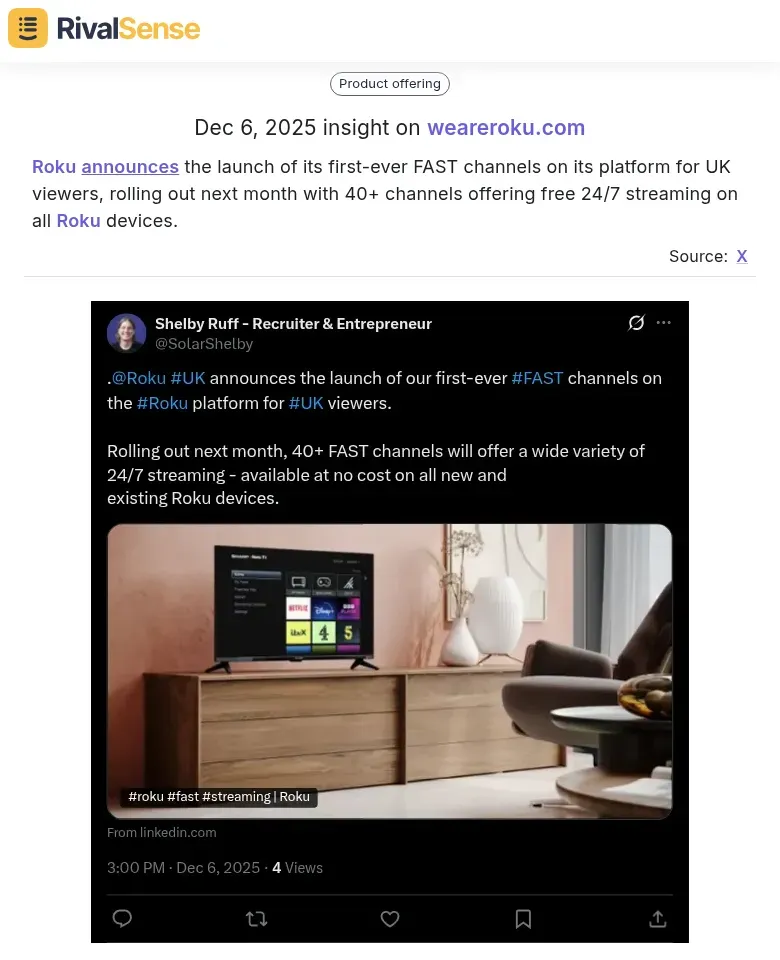
Monitoring product launches helps you understand competitor growth strategies and geographic expansions. For instance, Roku's move into the UK market with free streaming channels indicates a push for international audience growth, which could affect competitive dynamics in the streaming industry.
Another example: Block's VP of Engineering, AI Tools & Enablement shared that the company released an open-source AI agent framework called goose, initially for coding, to redistribute access to problem-solving and reduce bottlenecks. 
Open-source releases like this are valuable for business strategy as they reveal a competitor's commitment to ecosystem building and talent attraction. By contributing to open-source, companies like Block position themselves as innovators and can influence industry standards, which you need to factor into your competitive response.
To track such insights efficiently, consider using automated tools like RivalSense, which monitors competitor websites, social media, and various registries for product launches, pricing updates, partnerships, and more, delivering consolidated reports weekly.
Integrating Award Insights into Your Competitive Strategy
Integrating award insights into your competitive strategy transforms passive monitoring into proactive market positioning. Start by benchmarking your achievements against competitor recognition patterns. Create a spreadsheet tracking which competitors win awards in specific categories, when, and from which organizations. This reveals industry validation trends and helps you identify where you're underperforming.
Next, identify gaps in award categories where you can establish thought leadership. If competitors consistently win "innovation" awards but none target "customer success," that's your opportunity. Develop case studies and metrics around underserved categories, then proactively submit to relevant award programs 3-6 months before deadlines.
For proactive responses to competitor award announcements, prepare templated responses in advance. When a competitor wins, immediately share your own relevant achievements on social media with a congratulatory tone that highlights your complementary strengths. Update your sales enablement materials to address potential customer questions about the competitor's award, emphasizing your unique value propositions.
Practical checklist:
- Track award categories, winners, and timelines quarterly
- Identify 2-3 underserved award categories for targeted submissions
- Prepare response templates for competitor award announcements
- Train sales teams on positioning against award-winning competitors
- Schedule award submissions 6 months in advance based on industry patterns
Advanced Monitoring Techniques and Actionable Implementation
To optimize Twitter monitoring for competitor industry award insights, implement these advanced techniques:
-
Automated Award Tracking: Use social listening tools like Brandwatch or Sprout Social to set up keyword alerts for "[competitor name] + award", "industry awards 2024", and "[your industry] recognition". Create sentiment analysis rules to categorize reactions as positive, neutral, or negative.
-
Competitive Intelligence Dashboards: Build dashboards in Tableau or Power BI that visualize:
- Award frequency patterns by competitor
- Award types (innovation, customer service, sustainability)
- Geographic distribution of wins
- Social media engagement metrics for award announcements
-
Cross-Departmental Implementation:
- Marketing: Analyze award messaging strategies and adjust your positioning
- Product: Identify award-winning features to benchmark against
- Sales: Use award recognition in competitive battle cards
- Leadership: Schedule quarterly reviews of award intelligence
Actionable Checklist:
✓ Set up automated alerts for 5+ key competitors
✓ Create dashboard with 3+ visualization types
✓ Establish monthly cross-functional review meetings
✓ Develop response playbook for competitor award wins
✓ Track award-to-business impact correlation over 6 months
Conclusion and Next Steps
By systematically monitoring Twitter for competitor award insights, you can gain a competitive edge in understanding market validation and strategic positioning. However, manual tracking can be time-consuming and may miss broader competitor moves.
To streamline your competitive intelligence efforts, consider using a dedicated tool like RivalSense. It tracks competitor product launches, pricing updates, event participations, partnerships, regulatory aspects, management changes, and media mentions across company websites, social media, and various registries, delivering all in a weekly email report.
Try RivalSense for free today at https://rivalsense.co/ and get your first competitor report to start leveraging these insights for your business strategy.
📚 Read more
👉 Optimizing Key Account Management for Tech Companies: A Strategic Playbook
👉 Beginner's Guide to Analyzing Competitor Product Offerings for Market Share
👉 Leveraging Management Changes for Competitive Advantage: A Case Study on Safran
👉 The Complete Guide to Competitor Patent Analysis: How to Decode Your Rivals' Innovation Strategy
👉 Maximizing Warehousing & Distribution Competitor Benchmarking: Best Practices for B2B Leaders