
Optimize Pricing with Competitor Insights to Boost Key Account Metrics
In today's hyper-competitive B2B landscape, pricing optimization isn't just about internal cost structures—it's a dynamic battlefield where competitor moves directly determine your key account success. Real-time competitor intelligence has become the critical link between pricing decisions and key account metrics like Net Revenue Retention (NRR) and expansion MRR.
When competitors slash prices or introduce aggressive bundling for enterprise clients, your key accounts notice immediately. Without proactive monitoring, you risk losing expansion opportunities or, worse, facing churn as clients seek better value elsewhere. For instance, if a rival launches a 20% discount for annual contracts and you're unaware, your NRR could plummet as accounts delay renewals or reduce spend.
Practical steps to leverage competitor insights:
- Monitor competitor pricing pages, press releases, and customer reviews weekly
- Track feature additions that might justify price changes in your market
- Set alerts for competitor funding announcements that could fuel aggressive pricing
- Analyze win/loss data to identify pricing patterns in key account deals
By integrating competitor tracking into your pricing process, you can make informed adjustments before accounts are at risk—turning competitive threats into retention opportunities and driving sustainable growth through your most valuable relationships.
Learning from Real-World Competitor Pricing Strategies
Real-world competitor pricing strategies reveal sophisticated approaches to capturing market share and optimizing revenue. Analyzing these tactics provides actionable insights for refining your own pricing models. Here’s how to dissect and implement these strategies effectively.
Seasonal & Event-Based Pricing Tactics
Monitor competitors during peak seasons, holidays, and industry events. Look for patterns like limited-time promotions that drive acquisition and engagement. For example, RivalSense tracked that Yango in Pakistan offered free rickshaw rides and deliveries with subsidies up to PKR 200 per trip during the Basant festival from February 6th to 8th.
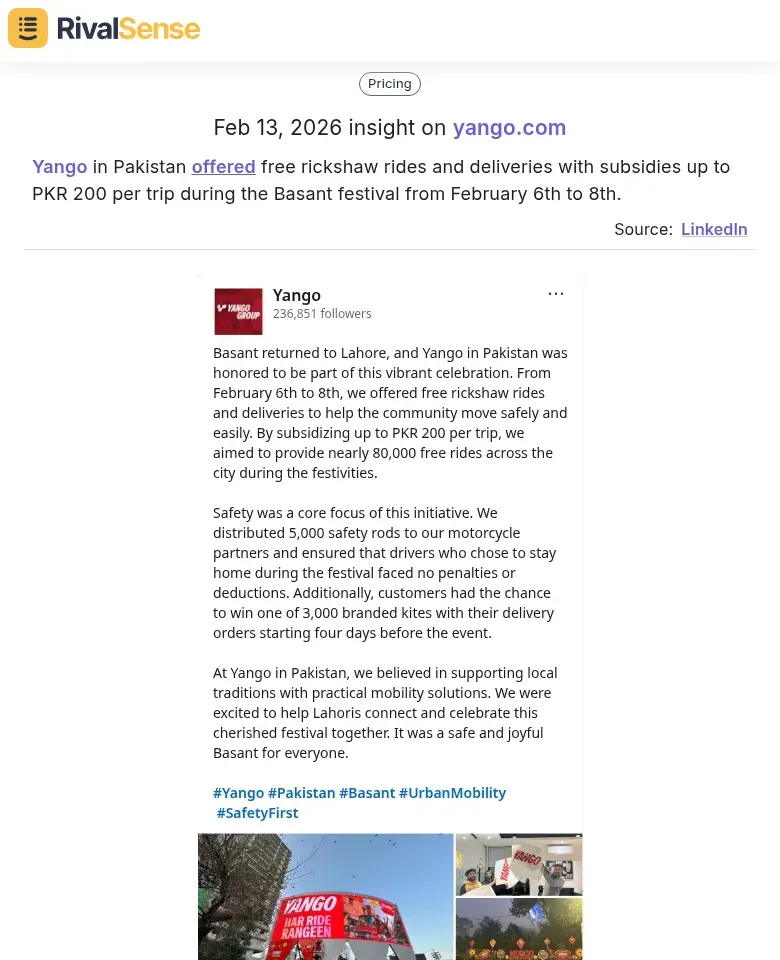
This type of insight is valuable for understanding how competitors leverage local events to test promotional strategies and capture seasonal demand. By tracking such moves, you can identify opportunities for similar time-sensitive offers or counter-promotions.
Actionable Checklist:
✅ Track 3-5 key competitors during major industry events
✅ Document discount percentages and duration
✅ Analyze conversion rate impact through web traffic patterns
✅ Test similar promotions with A/B testing
Tiered Pricing Structures
Successful competitors segment customers by usage patterns and willingness to pay. Tiered pricing allows for capturing value across different customer segments. For instance, All Nippon Airways will renew its domestic fares starting on May 19, 2026, offering three types of fares to suit different travel styles.
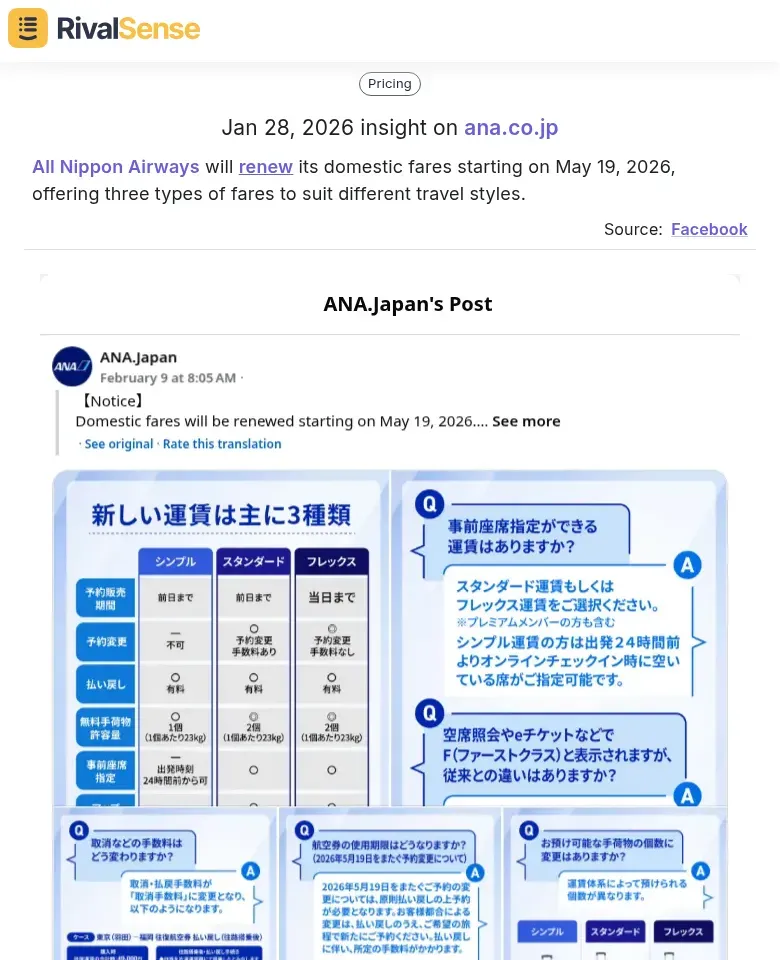
Monitoring such tiered pricing updates helps you analyze how competitors design tiers to appeal to diverse customer needs, informing your own segmentation and pricing adjustments.
Implementation Steps:
- Map competitor tiers against your customer segments
- Identify feature gaps in your current structure
- Price tiers based on perceived value, not just cost
- Include usage-based components for scalability
Strategic Fee Restructuring
Leading companies balance fee reductions with new revenue streams to optimize overall profitability. A recent example from RivalSense shows Hargreaves Lansdown cut its platform fees from 0.45% to 0.35% and reduced share dealing costs from £11.95 to £6.95 starting March 1, 2026, while introducing a £1.95 charge on fund trades and increasing annual caps for certain accounts.
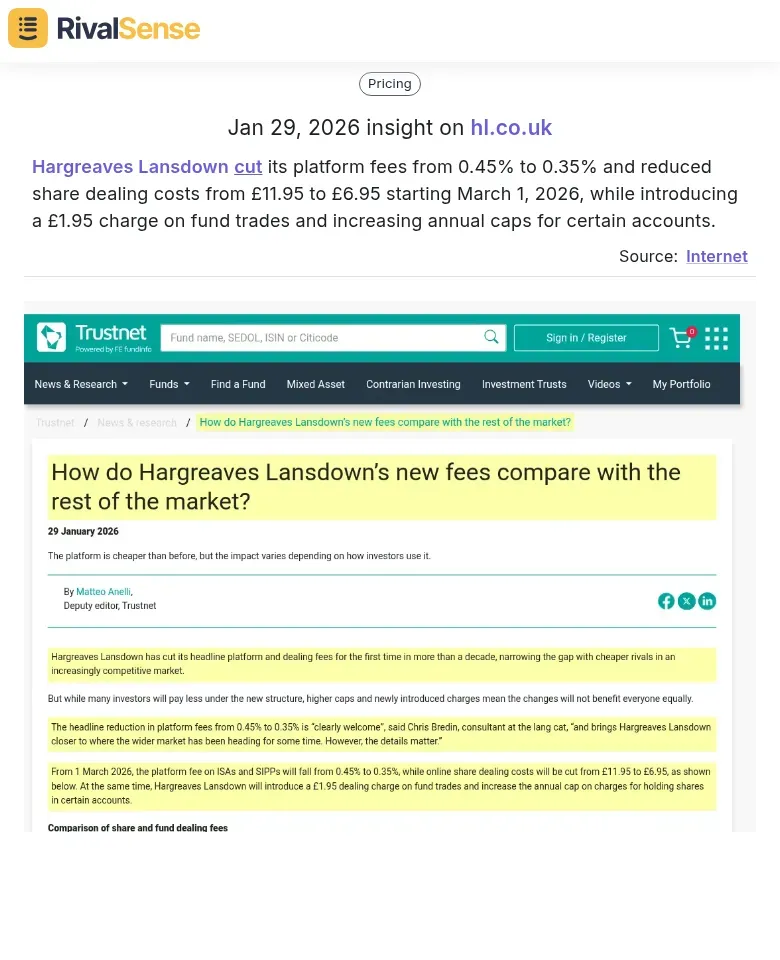
This insight into fee restructuring reveals how competitors adjust pricing components to attract customers while maintaining revenue, providing lessons for your own pricing model evolution.
Key Metrics to Monitor:
- Customer acquisition cost (CAC) changes
- Lifetime value (LTV) impact
- Churn rate variations
- Revenue per user (RPU) trends
Pro Tip: Use competitor tracking tools like RivalSense to automate monitoring of pricing changes across multiple competitors simultaneously, enabling real-time strategy adjustments.
Integrating Competitor Insights into Key Account Pricing Decisions
Integrating competitor insights into key account pricing decisions transforms reactive negotiations into strategic partnerships. This approach ensures that your pricing decisions are data-driven and aligned with market dynamics. Here’s how to leverage competitive intelligence for optimal pricing outcomes.
Practical Implementation Steps:
-
Monitor Competitor Pricing Changes: Set up automated alerts for competitor price adjustments across your key accounts' industries. Track not just published prices but also special terms, discounts, and bundled offerings that competitors use in negotiations.
-
Anticipate Negotiation Points: Before key account reviews, analyze competitor pricing trends to predict where clients might push for concessions. Create a "competitive pricing playbook" with data-backed responses for common negotiation scenarios.
-
Align with Value Perception: Map your pricing against competitive alternatives while highlighting unique value differentiators. Use competitor intelligence to demonstrate why premium pricing is justified based on superior features, service levels, or ROI.
-
Develop Strategic Pricing Approaches:
- Defensive Strategy: When competitors lower prices, prepare value reinforcement materials showing total cost of ownership advantages rather than matching price cuts.
- Offensive Strategy: Identify competitor weaknesses (poor service, feature gaps) to justify price increases while offering enhanced solutions.
Quick Checklist:
- [ ] Weekly competitor pricing dashboard review
- [ ] Quarterly competitive value analysis for each key account
- [ ] Pre-negotiation competitive intelligence briefing
- [ ] Documented pricing justification tied to competitive gaps
- [ ] Regular win/loss analysis against specific competitors
Pro Tip: Use tools like RivalSense to track 80+ competitor data sources, ensuring you’re never surprised by competitor moves during critical account negotiations. This intelligence enables proactive pricing adjustments that protect margins while maintaining account satisfaction.
Key Account Metrics That Drive Pricing Optimization
To optimize pricing with competitor insights, focus on three key account metrics that directly impact revenue and retention. These metrics provide a clear lens through which to assess the effectiveness of your pricing strategies.
1. Expansion MRR Growth vs. Competitor Pricing Moves
Track how competitor price changes impact your expansion revenue. When competitors lower prices, monitor if your key accounts delay upgrades or reduce add-on purchases. Practical tip: Create a dashboard comparing your expansion MRR growth rate against competitor pricing announcements. Set alerts for when competitor moves correlate with your expansion slowdown.
2. Price Elasticity by Key Account Segment
Measure willingness-to-pay across different account tiers. Use A/B testing with small price variations to gauge elasticity. Checklist: Segment accounts by size/industry, test price sensitivity quarterly, analyze competitor positioning in each segment, and adjust pricing based on elasticity findings.
3. Churn Risk Indicators During Competitor Value Propositions
When competitors enhance features or messaging, monitor your accounts for increased support tickets, reduced usage, or contract negotiation delays. Practical steps: Implement a churn risk scoring system that weights competitor moves heavily, conduct quarterly value perception surveys, and create competitor response playbooks for high-risk accounts.
Key action: Integrate competitor tracking tools with your CRM to automate these insights, enabling proactive pricing adjustments before revenue impacts occur.
Building a Competitor-Aware Pricing Framework for Key Accounts
Building a competitor-aware pricing framework for key accounts requires systematic integration of competitive intelligence into your pricing processes. This framework ensures that your pricing remains competitive and value-aligned over time. Here’s a practical approach:
-
Dynamic Pricing Models: Create tiered pricing structures that respond to competitor positioning. For example, if competitors offer volume discounts at 100+ users, adjust your thresholds to 75+ users for competitive advantage. Use competitor price tracking tools to monitor changes in real-time and trigger automated pricing adjustments.
-
Account-Specific Strategies: Develop customized pricing for each key account based on their competitive landscape. Create a competitive matrix for each account showing where you stand against 2-3 main competitors on price, features, and value. Use this to justify premium pricing or identify where to match competitors.
-
Pricing Governance Process: Establish quarterly competitor intelligence reviews with your pricing committee. Use a simple checklist: (a) Review top 5 competitor pricing changes, (b) Analyze win/loss data against pricing, (c) Update competitive positioning maps, (d) Adjust pricing guardrails for sales teams.
Pro Tip: Implement a "competitive pricing alert" system that notifies your team when key competitors change pricing for similar account sizes or industries. This enables proactive rather than reactive pricing decisions.
Key Metrics to Track: Competitive price positioning index, win rate against specific competitors, and account-level price realization versus competitive benchmarks.
Implementation: Turning Competitor Insights into Pricing Actions
To implement competitor insights into pricing actions, start with automated alerts and structured processes. This ensures that intelligence translates into timely and effective pricing decisions. Follow these steps to operationalize your insights.
Set up real-time monitoring for competitor pricing changes affecting your key accounts. Use tools that track specific competitors, products, and regions relevant to your accounts. Configure alerts for price drops, promotions, or bundling changes that could impact renewal or expansion discussions.
Conduct quarterly pricing reviews with key accounts using competitor intelligence data. Before each review, gather data on competitor pricing, discounts, and contract terms. Prepare a one-page summary showing how your pricing compares and where you add unique value. Use this to justify pricing adjustments or defend against discount requests.
Create competitive response playbooks for different scenarios. For example:
- If a competitor undercuts on price: Emphasize your ROI, support, or integration advantages
- If a competitor offers a promotion: Match strategically with add-ons or extended terms
- For enterprise vs. SMB accounts: Tailor responses based on account size and needs
Tips: Involve sales and account teams in playbook creation, test scenarios quarterly, and update alerts as account portfolios evolve. This turns insights into actionable pricing strategies that protect and grow key account revenue.
Ready to Optimize Your Pricing Strategy?
Leveraging competitor insights is essential for pricing optimization and key account success. By monitoring real-time changes and integrating intelligence into your processes, you can stay ahead of market shifts and protect your revenue.
Take the next step: Try RivalSense for free at https://rivalsense.co/ to get your first competitor report today. With tracking across company websites, social media, and registries, RivalSense delivers weekly insights on product launches, pricing updates, partnerships, and more—helping you make informed pricing decisions effortlessly.
📚 Read more
👉 Turning Competitor Partnerships into Strategic Insights
👉 The Ultimate Key Account Tracking User Guide: Practical Strategies for 2026
👉 Air Freight Case Study: How Competitor Partnerships Build Winning Ecosystems
👉 How RivalSense Empowered Placet Group to Defend Against E-Invoicing Disruption
👉 Competitor Brand Perception Mastery: The Ultimate Internet Insights Guide