
Mastering Key Account Management with Commercial Banks for B2B Companies
Introduction: The Critical Role of Key Account Management with Commercial Banks
For B2B companies, commercial banking relationships are more than just transactional—they're strategic partnerships that fuel growth and stability. Key accounts with banks provide essential services like financing, cash management, and advisory support, making effective management crucial. By treating these relationships as key accounts, you can unlock better terms, proactive solutions, and valuable insights for your business.
To excel in key account management, start by identifying which banking relationships are truly strategic based on growth potential, alignment with your business goals, and depth of engagement. Then, implement these practical steps:
- Conduct quarterly strategic reviews with your bank to align on your business objectives and financial needs.
- Assign dedicated relationship managers from your side who understand both your industry and banking products.
- Develop customized value propositions for the bank, highlighting how your business can be a profitable and long-term client.
- Establish clear success metrics such as cost savings, access to credit, and satisfaction scores.
In today's competitive landscape, effective KAM drives retention, enables access to better services, and fosters advocacy that can lead to referrals. The most successful B2B companies treat their banks as partners, co-creating solutions that address immediate challenges and long-term ambitions.
Common Challenges in Managing Banking Relationships
B2B companies often struggle with several key challenges when managing commercial banking relationships. First, reactive communication leaves you vulnerable to missed opportunities or unfavorable terms. Instead of anticipating needs, you might only engage during crises. Solution: Implement quarterly strategic reviews with your bank, mapping your business cycles to proactively discuss relevant financial products.
Second, internal silos within your company can create friction. Finance, operations, and sales teams may not coordinate their banking needs, leading to inconsistent requests. Fix: Establish cross-functional teams with shared KPIs for banking relationships and use a centralized portal to track all interactions.
Third, inadequate tools hinder effectiveness. Many companies rely on spreadsheets or generic CRM systems not designed for complex banking relationships. Actionable steps:
- Invest in specialized relationship management platforms with features for tracking bank interactions and terms.
- Implement automated alerts for bank news, policy changes, or competitor activity in the banking sector.
- Create standardized dashboards to monitor account health, fees, and service levels.
Practical checklist:
✅ Conduct profitability analysis of banking services quarterly
✅ Map decision-makers and influencers at your bank
✅ Document relationship strength scores monthly
✅ Schedule proactive touchpoints before loan renewals or contract expirations
✅ Share success stories internally to align teams on banking strategies
Strategic Framework for Effective Bank Relationship Management
A strategic framework for managing bank relationships requires moving beyond transactions to become a valued client. Start by developing comprehensive account plans that align with your business objectives and share them with your bank. Conduct quarterly business reviews to discuss your growth targets, pain points, and industry challenges. Map banking solutions directly to your strategic goals, creating a customized roadmap for mutual success.
Adopt a client-centric approach by shifting from ad-hoc requests to structured engagements. Instead of just asking for loans, focus on how banking solutions can solve your business problems. Create internal cross-functional teams that include finance, operations, and strategy leads to provide holistic inputs to the bank. Use a consultative approach where you spend 70% of meetings discussing your needs and 30% on bank offerings.
Establish clear value reporting and communication protocols. Request quarterly value statements from your bank that quantify their impact—show ROI, cost savings, and growth enabled by their solutions. Maintain a communication cadence with monthly check-ins, quarterly strategic reviews, and annual planning sessions. Use a standardized template for reviews that includes: (1) Executive summary of value delivered, (2) Key metrics and KPIs, (3) Progress against strategic objectives, (4) Upcoming opportunities, and (5) Action items. This transparency builds trust and ensures alignment.
Technology and Data-Driven Solutions for Modern KAM
Modern Key Account Management with banks demands specialized technology beyond basic tools. Implement dedicated KAM platforms that integrate your financial data, relationship insights, and business intelligence in one dashboard. These platforms should track outcomes—like improved cash flow or reduced borrowing costs—to demonstrate the value of your banking relationships.
Leverage AI and data analytics to identify opportunities for better banking terms. Analyze your transaction patterns, industry trends, and relationship history to negotiate optimal products. For example, when your cash flow shows seasonal patterns, proactively discuss working capital solutions with your bank.
Practical steps:
- Audit your current tech stack—identify gaps between existing tools and KAM requirements for banking.
- Prioritize platforms with outcome-tracking features to quantify banking value.
- Implement AI-driven analytics for personalized product recommendations from banks.
- Train your team on data interpretation and technology use.
- Establish regular reviews of banking outcome metrics.
Key tip: Start with pilot relationships to refine your technology approach before full-scale implementation. Focus on platforms that integrate with your accounting systems while providing specialized KAM functionality.
Building Stronger Banking Relationships Through Cross-Selling
Cross-selling is key to deepening banking relationships for B2B companies. To identify opportunities, implement a systematic approach: First, analyze your transaction data to uncover hidden needs—if you process international payments but lack FX services, that's a clear opening. Second, conduct relationship mapping to understand your bank's decision-makers across departments. Third, leverage alerts for business events like expansions or acquisitions that signal new banking needs.
To consolidate relationships and become a priority client, adopt a 'strategic partner' mindset. Create a consolidated view of all your banking products, then identify gaps where you might use competitors. Discuss bundled solutions with pricing incentives for multi-product relationships. Ensure your relationship managers understand both your industry and the bank's full product suite.
Data insights transform relationships from transactional to strategic. Use predictive analytics to anticipate needs before they arise—if your cash flow patterns suggest equipment financing needs, proactively present solutions to your bank. Implement regular business reviews using data visualizations that demonstrate value delivered and identify growth opportunities. Track metrics like cost of services and access to credit to measure relationship depth.
Practical checklist:
- Audit existing banking portfolios monthly for cross-sell gaps
- Train your team on the bank's complete product ecosystem
- Develop industry-specific solution packages to discuss
- Implement trigger-based alerts for business milestones
- Create success stories showcasing multi-product relationships.
Implementation Roadmap and Best Practices
Implementing a successful Key Account Management program for banking relationships requires a structured approach. Start by establishing a company-wide KAM initiative with clear change management processes. Create a cross-functional steering committee, develop a phased rollout plan, and provide comprehensive training on new processes and tools. Use pilot programs with select banks to refine your approach before full implementation.
Develop internal evangelism to ensure organizational alignment on banking needs. Identify KAM champions across departments who can model best practices and share success stories. Regular communication through town halls, newsletters, and internal case studies helps reinforce the strategic mindset. Create shared dashboards that make banking needs and opportunities visible across the organization.
Measure progress and celebrate incremental improvements in account management. Establish clear KPIs such as satisfaction scores with banks, cost savings achieved, and relationship depth metrics. Implement quarterly reviews to track progress against goals. Recognize teams and individuals who demonstrate exceptional KAM practices through awards, spot bonuses, and public acknowledgment. Create a 'wins wall' to showcase successful outcomes and share lessons learned.
Practical checklist:
- Form a steering committee
- Develop a phased implementation plan
- Train KAM teams
- Identify internal champions
- Create shared dashboards
- Establish KPIs
- Implement quarterly reviews
- Create a recognition program
- Document and share success stories
- Continuously refine processes based on feedback.
Leveraging Competitive Intelligence for Strategic Advantage
In today's fast-paced business environment, competitive intelligence is a game-changer for key account management. By tracking competitors' moves, you can anticipate market shifts, identify opportunities, and strengthen your own strategies. This is where tools like RivalSense come in, providing real-time insights into competitor activities across product launches, event participations, and more.
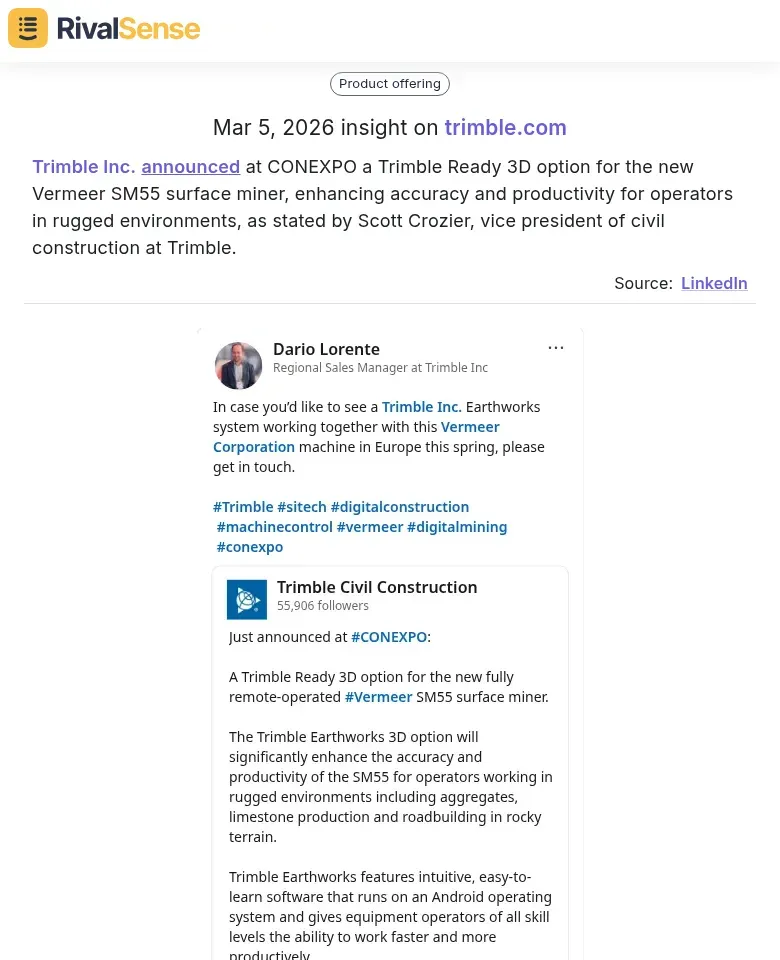
For instance, tracking product launches can help you understand new solutions that might affect your industry or client needs. Take Trimble Inc.'s announcement at CONEXPO for the Trimble Ready 3D option for the Vermeer SM55 surface miner. This insight shows how companies in rugged environments are enhancing accuracy and productivity.
Why it matters: Monitoring product launches helps you stay ahead of technological advancements and prepare competitive responses in your banking negotiations or business operations.
Similarly, knowing about competitors' event participations can inform your networking and positioning strategies. Trimble Inc.'s participation in The BIM Summit by Symetri highlights their industry engagement.

Why it matters: Event tracking reveals where competitors are building relationships, allowing you to plan your own presence or partnerships to counter their moves.
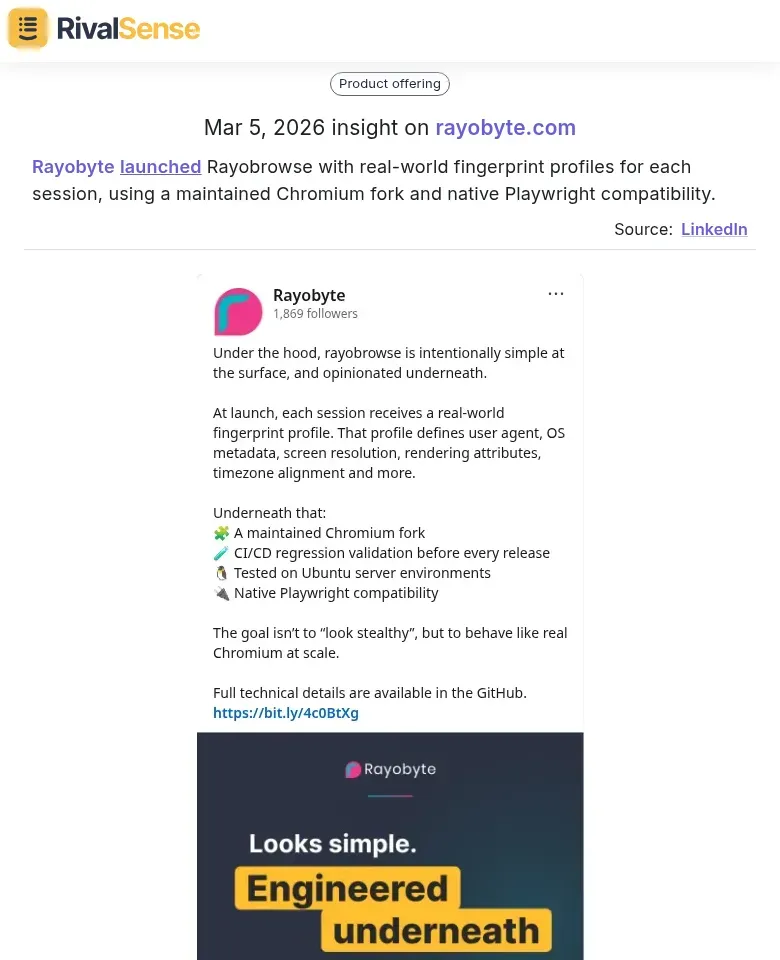
Finally, keeping an eye on product updates ensures you don't fall behind. Rayobyte's launch of Rayobrowse with advanced fingerprint profiles demonstrates innovation in web technology.
Why it matters: Product updates signal shifts in market offerings, helping you adapt your strategies and communicate evolving needs to your bank.
By integrating competitive intelligence into your KAM approach, you can make more informed decisions, anticipate client demands, and secure better banking terms.
Take Your Key Account Management to the Next Level
Effective key account management with commercial banks is essential for B2B growth, but it requires proactive strategies, the right tools, and keen market awareness. To assist with the challenges described, consider leveraging competitive intelligence to stay ahead.
Try out RivalSense for free at https://rivalsense.co/ to track competitor product launches, pricing updates, event participations, and more. Get your first competitor report today and gain actionable insights to enhance your business strategy and banking relationships.
📚 Read more
👉 How RivalSense Alerted Competitors to CrowdStrike's Browser Extension Control
👉 Instagram Competitor Insights: Actionable Strategies for Key Account Growth
👉 Predictive Cybersecurity Analysis: Key Account Tracking for Competitive Edge
👉 Step-by-Step Guide: Track Competitor Partnerships, Clients, and Executive Moves
👉 How to Analyze Competitor Innovations: A Case Study on IXI's Autofocus Eyewear