
Mastering Key Account Management in Security Technology: A Strategic Guide
In the high-stakes security technology sector, key account management (KAM) isn’t just a sales function—it’s a strategic imperative. Security companies face unique challenges: complex compliance requirements, lengthy sales cycles (often 6-18 months), and the critical need to build trust with clients protecting sensitive assets. Unlike other industries, security failures can have catastrophic consequences, making client relationships exceptionally fragile.
Effective KAM drives sustainable revenue growth through three mechanisms: 1) Expanding existing accounts (security upgrades and add-ons typically generate 30-40% of annual revenue), 2) Securing multi-year contracts that provide predictable cash flow, and 3) Generating high-quality referrals in a reputation-driven industry.
Practical tip: Create a 90-day onboarding checklist for new key accounts including security audits, compliance documentation review, and stakeholder mapping across IT, operations, and executive teams.
Competitor intelligence transforms KAM from reactive to proactive. Monitor competitors’ security certifications, incident response times, and pricing models. When you know a competitor is struggling with a recent breach or losing key personnel, you can proactively address those pain points with your clients.
Actionable step: Implement quarterly competitor analysis for each key account, tracking: 1) Competitor’s recent security incidents, 2) Their client retention rates in your vertical, 3) New product launches that might tempt your clients. This intelligence allows you to anticipate threats and reinforce your value proposition before clients even consider alternatives.
Learning from Market Moves: How Funding Insights Inform Account Strategy
Funding rounds reveal more than just capital—they expose strategic priorities and market opportunities. In the security technology sector, staying ahead means understanding not just what competitors are doing, but why they're doing it. Funding announcements provide a window into their future directions and market confidence.
When a competitor announces funding, analyze the investor lineup: Are they industry specialists or generalists? Which VCs are backing multiple players in your space? This investor participation pattern maps the competitive landscape and identifies emerging market segments worth targeting.
For example, RivalSense recently tracked that Augur raised $15 million in seed funding on March 9, 2026, to expand its AI-based analytics platform that uses anonymized data from CCTV and other sensors to detect national security threats in the 'grey-zone'.
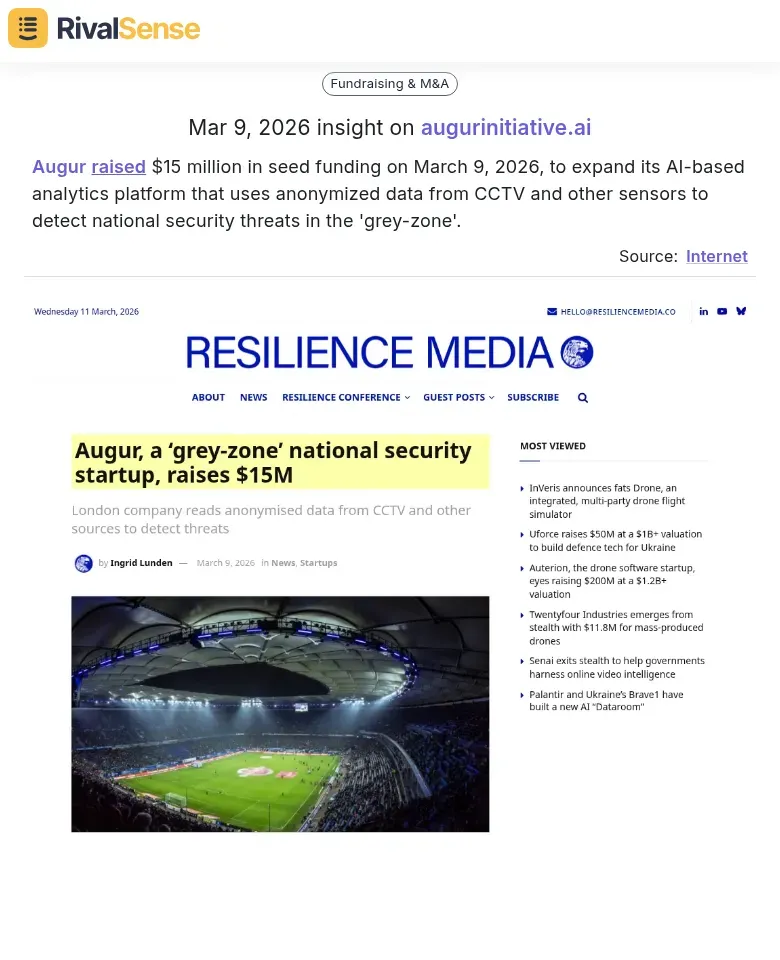
This type of funding insight is valuable for business strategy as it reveals competitor growth trajectories and market priorities, allowing you to anticipate shifts and adjust your account plans accordingly.
Additionally, RivalSense provided details on investor participation: On March 9, 2026, Plural led Augur's $15 million seed round with participation from SNR, 1st Kind, and Tiny Supercomputer Investment Company, as announced by Khaled Helioui, a partner at Plural.
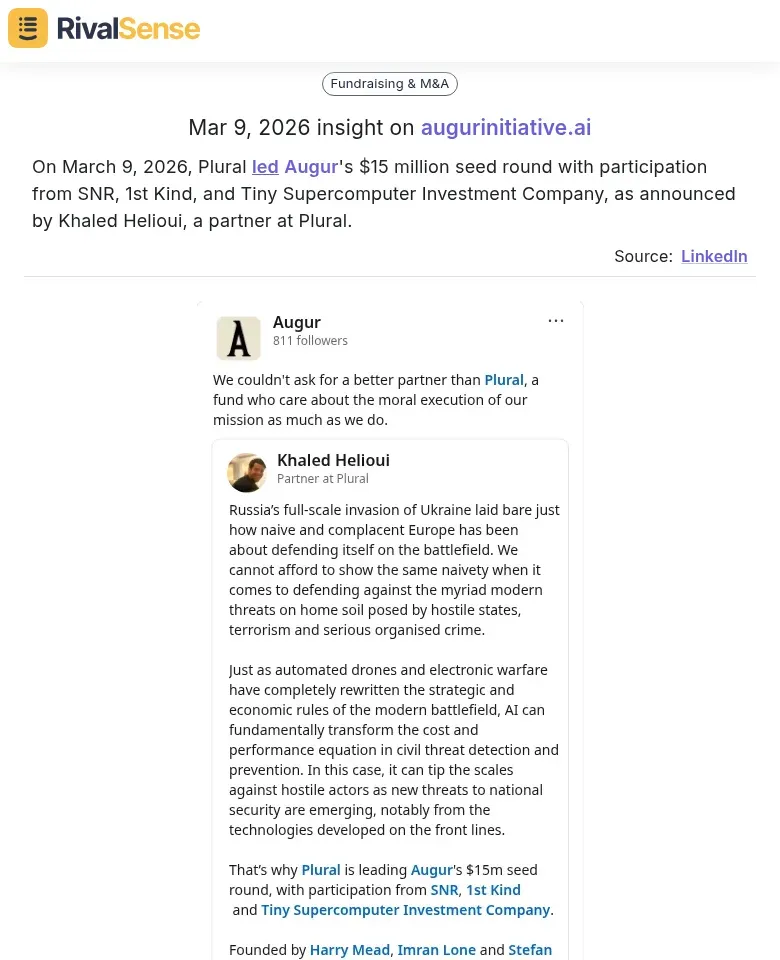
Understanding investor networks helps map the competitive landscape and identify emerging alliances or threats, informing your strategic partnerships and market positioning.
Practical steps for translating funding insights into account strategy:
- Track competitor funding announcements and investor participation
- Analyze use-of-funds statements for product development priorities
- Map investor networks to identify adjacent market opportunities
- Create targeted account expansion plans based on funded capabilities
For example, if a competitor secures funding for AI-powered threat detection, identify which of your accounts would benefit from similar capabilities and develop targeted upsell campaigns. Funding announcements often signal where the market is heading—use them to anticipate customer needs before they become obvious requirements. The key is moving beyond monitoring to action: convert funding intelligence into specific account expansion opportunities with clear timelines and ROI projections.
Technology Integration: Leveraging AI and Analytics for Account Intelligence
AI-powered analytics platforms are revolutionizing threat detection by analyzing billions of data points in real-time, identifying patterns invisible to human analysts. This technological leap is transforming how security providers deliver value to key accounts, making analytics a core component of account intelligence. Leading security providers now integrate anonymized data from multiple client environments to create comprehensive threat intelligence without compromising privacy. This aggregated intelligence enables proactive threat hunting and predictive analytics that deliver measurable ROI for key accounts.
Practical Implementation Checklist:
- Deploy AI analytics that correlate internal logs with anonymized external threat feeds
- Implement privacy-preserving data aggregation techniques (differential privacy, k-anonymity)
- Create client-specific dashboards showing threat detection rates and response times
- Quantify risk reduction metrics: mean time to detect (MTTD) and mean time to respond (MTTR)
- Calculate ROI by comparing prevented incidents against premium pricing
Value Demonstration Strategy:
- Present quarterly threat intelligence reports showing industry-specific attack patterns
- Benchmark client’s security posture against anonymized peer data
- Show correlation between investment levels and incident reduction rates
- Use predictive models to forecast future threat scenarios and required defenses
Advanced analytics transform security from a cost center to a strategic investment by providing tangible evidence of protection value, justifying premium pricing through demonstrable business impact.
Strategic Partnership Development: Building Multi-Layered Account Relationships
Strategic partnerships in security technology require moving beyond vendor-client dynamics to create multi-layered relationships that deliver sustained value. By embedding yourself in the client's strategic fabric, you can build alliances that withstand market volatility and competitive pressures. Start by establishing an executive advisory board with your top 5-10 accounts, meeting quarterly to discuss industry trends and strategic challenges. This positions your team as thought partners rather than just solution providers.
Develop co-innovation opportunities through joint R&D initiatives. Identify 2-3 high-impact security challenges your clients face and propose collaborative development projects. For example, work with a financial institution to create custom threat detection algorithms that address their specific regulatory requirements. These partnerships create proprietary solutions that competitors can’t easily replicate.
Implement a three-tier relationship model: technical teams handle implementation, business teams manage ROI and expansion, and executive sponsors focus on strategic alignment. Create a quarterly business review template that tracks not just product usage but strategic outcomes like reduced incident response times or improved compliance posture.
Practical checklist:
- Map client’s organizational structure and identify key decision-makers
- Schedule quarterly executive briefings with CISO/CTO level contacts
- Develop 2-3 joint white papers or case studies annually
- Create a shared innovation roadmap with measurable milestones
- Establish clear governance structure with defined roles and escalation paths
Remember: The most successful security partnerships become embedded in the client’s strategic planning process, creating relationships that withstand competitive pressures and market fluctuations.
Risk Mitigation and Compliance: Addressing Security Clients’ Core Concerns
For security technology providers, risk mitigation and compliance aren’t just checkboxes—they’re the foundation of trust with key accounts. Addressing these concerns proactively demonstrates your commitment to security and reliability, which is crucial in a high-stakes industry. Proactively addressing national security and ‘grey-zone’ threats requires a three-tiered approach: First, implement continuous threat intelligence monitoring that specifically tracks state-sponsored and ambiguous threat actors. Second, conduct quarterly vulnerability assessments focusing on supply chain risks and geopolitical exposure. Third, establish clear escalation protocols for potential grey-zone incidents.
Building adaptive compliance frameworks starts with modular architecture. Create core compliance modules (NIST CSF 2.0, ISO 27001) that can be customized with regional add-ons (GDPR, CCPA, sector-specific regulations). Practical tip: Maintain a compliance roadmap that maps upcoming regulatory changes 12-18 months in advance, allowing for proactive adjustments rather than reactive scrambling.
Demonstrating security posture requires tangible evidence, not just claims. Key account managers should provide: 1) Quarterly security posture reports with measurable metrics, 2) Third-party audit results and penetration testing outcomes, 3) Real-time compliance dashboards showing adherence status, and 4) Incident response timelines from recent security events. Checklist item: Always include specific examples of how your security controls prevented or mitigated actual threats relevant to the client’s industry and threat landscape.
Conclusion: Building Sustainable Competitive Advantage Through Account Excellence
Sustainable competitive advantage in security technology requires transforming key account management from reactive support to proactive strategic partnership. This transformation hinges on leveraging competitive intelligence and continuous improvement to stay ahead of market curves. Start by creating account-specific value propositions using competitive intelligence—analyze competitor offerings, pricing strategies, and regulatory developments to position your solutions as uniquely valuable.
Practical checklist:
- ✅ Monitor competitor product launches relevant to each account’s security needs
- ✅ Track pricing changes affecting purchasing decisions
- ✅ Stay updated on compliance requirements impacting security frameworks.
Develop measurable KAM success metrics beyond revenue: track Customer Lifetime Value (CLV) growth, competitive win rates, relationship health scores, and risk mitigation effectiveness. Security-specific metrics should include incident response times, compliance adherence rates, and threat detection improvements.
Monthly review tasks:
- ✅ Analyze CLV trends and competitive positioning
- ✅ Assess customer satisfaction and identify improvement areas
- ✅ Track market share movements and competitive threats.
Establish continuous improvement cycles using quarterly strategic reviews. Implement the 4-phase framework: 1) Account assessment & segmentation, 2) Competitive landscape mapping, 3) Account strategy development, 4) Execution & monitoring.
Weekly tracking:
- ✅ Review competitor activity alerts
- ✅ Update account health scores
- ✅ Scan for regulatory developments.
Quarterly analysis:
- ✅ Conduct comprehensive portfolio review
- ✅ Update competitive intelligence
- ✅ Benchmark against industry standards.
Integrate tools like RivalSense for automated competitor monitoring across 80+ sources, ensuring your account management always contains fresh, relevant insights. This transforms account relationships from transactional to transformational, delivering 15-25% improvement in retention and 40-50% reduction in competitive surprises.
To effectively implement these strategies and stay ahead of competitors, consider using tools like RivalSense. It automates competitor monitoring across 80+ sources, delivering insights like funding rounds, product launches, and more in a weekly email report. Try RivalSense for free at https://rivalsense.co/ and get your first competitor report today to start transforming your key account management.
📚 Read more
👉 Competitor Partnership Analysis: Strategic Tracking for Key Account Renewals
👉 Turning Competitor Event News into Strategic Advantages
👉 The Ultimate Key Account Management Whitepaper: Practical Strategies for 2026
👉 Automate Key Account Reporting: 5 Actionable Strategies for Custom Software Development
👉 How RivalSense Enabled a Proactive Counter to Supliful's Branding Revolution