
Mastering Key Account Management: A Practical Implementation Guide for B2B Leaders
Key Account Management (KAM) represents a fundamental shift from transactional sales to strategic B2B partnership models. This systematic approach focuses on nurturing your most valuable client relationships—the 20% of customers that typically drive 80% of revenue. The business case is compelling: while traditional sales teams chase one-off deals, KAM builds enduring partnerships that deliver predictable revenue streams, higher lifetime value, and competitive insulation.
Practical implementation starts with three critical steps:
- Account Identification: Use revenue contribution, strategic alignment, and growth potential criteria to identify your true key accounts
- Relationship Mapping: Document all stakeholder connections, decision-making processes, and mutual value drivers
- Value Proposition Customization: Move beyond generic solutions to co-create offerings that address each account's unique business challenges
💡 Tip: Begin with a pilot program focusing on 3-5 strategic accounts before scaling. This allows you to refine processes, measure ROI, and build internal buy-in. Remember, successful KAM requires executive sponsorship, dedicated resources, and a shift from short-term wins to long-term relationship building.
Governance Framework: Building Accountability and Structure
A robust governance framework transforms key account management from reactive to strategic. Establishing clear structures ensures accountability and aligns every interaction with business objectives. Start by defining decision-making hierarchies: designate an executive sponsor for each key account, create a steering committee for portfolio oversight, and define escalation protocols for critical issues.
Implement performance tracking with a balanced scorecard approach. Track metrics like revenue growth, customer satisfaction (NPS/CSAT), and strategic alignment. Use portfolio management systems to categorize accounts by potential and risk, allocating resources accordingly. Monthly business reviews should analyze performance against targets and adjust strategies.
Create cross-functional collaboration through structured mechanisms:
- Joint planning sessions where sales, customer success, and operations co-create account plans
- Shared dashboards with real-time customer health scores and opportunity pipelines
- Quarterly business reviews involving all stakeholders to align on objectives
✅ Practical Checklist:
- Define RACI matrix for each key account
- Implement CRM integration for unified customer view
- Establish regular cadence for cross-functional meetings
- Create shared success metrics across departments
- Develop escalation workflow for customer issues
💡 Tip: Start with your 3-5 most strategic accounts to pilot governance structures before scaling. Document processes in a playbook to ensure consistency across your portfolio.
Strategic Visioning: Aligning KAM with Business Objectives
Strategic visioning transforms KAM from reactive account handling to proactive growth partnerships. It involves co-creating long-term roadmaps that drive mutual success. Start by developing 3-year strategic account plans that align with your organization's top 3 business objectives. For each key account, map their strategic priorities against your capabilities to identify mutual growth zones.
Implement a 4-stage relationship maturity model:
- Transactional (price-focused)
- Reactive (service-driven)
- Proactive (solution-oriented)
- Strategic (innovation partnership)
Assess each account quarterly using this framework and create specific action plans to advance relationships by at least one stage annually. Create value-based roadmaps that demonstrate mutual ROI. For each key account, develop a 12-month roadmap showing: quarterly business reviews, joint innovation projects, shared metrics dashboard, and co-marketing initiatives.
✅ Practical Checklist:
- Conduct annual strategic alignment workshops with key accounts
- Map account decision-makers to your executive sponsors
- Create shared success metrics dashboard
- Establish quarterly innovation review sessions
- Develop joint business case templates for new initiatives
💡 Tip: The most successful KAM programs allocate 20% of account time to strategic visioning activities, ensuring relationships evolve from tactical execution to strategic partnership.
Benchmarking Best Practices: Learning from Industry Leaders
Benchmarking against industry leaders provides a roadmap for effective KAM implementation. It helps you identify gaps and adopt proven strategies. Start by analyzing successful frameworks like the Miller-Heiman Strategic Selling model or the SAMA maturity assessment, which help evaluate your current KAM capabilities against best-in-class standards.
For practical resource allocation, benchmark account manager ratios: high-tech companies typically maintain 1:3-5 ratios for strategic accounts, while manufacturing averages 1:8-12. Allocate resources based on account tiers—top-tier accounts should receive 40-50% of your KAM resources, with dedicated support teams and executive sponsorship.
Adopt proven methodologies for account selection:
- Use the RFM (Recency, Frequency, Monetary) model to identify high-value accounts
- Apply the GE-McKinsey matrix for strategic prioritization
- Implement a scoring system (0-100) based on revenue potential, strategic fit, and growth trajectory
✅ Checklist for Benchmarking Success:
- Document current KAM processes and gaps
- Research 3-5 industry leaders in your sector
- Compare account penetration rates and retention metrics
- Analyze competitor resource allocation patterns
- Identify 2-3 actionable improvements to implement quarterly
Leveraging Competitive Intelligence for KAM Advantage
Integrating competitive intelligence into your KAM strategy provides a critical edge. Understanding competitor moves—like product launches, pricing updates, and market positioning—helps you anticipate shifts and adapt your approach. For instance, tracking industry recognition can reveal market trends and competitor credibility, informing your value proposition.
Example: Facephi has been recognized as a representative vendor in Gartner's 2024 Market Guide for KYC Platforms for Banking, and new blog posts cover topics such as UX design trends and digital identity trends for 2026. This insight is valuable for business strategy as it highlights competitor thought leadership and market alignment, which you can benchmark against in your KAM discussions.

Monitoring product updates ensures you stay ahead in technology and innovation. Competitor enhancements can signal industry standards or unmet needs that you can address in your key accounts.
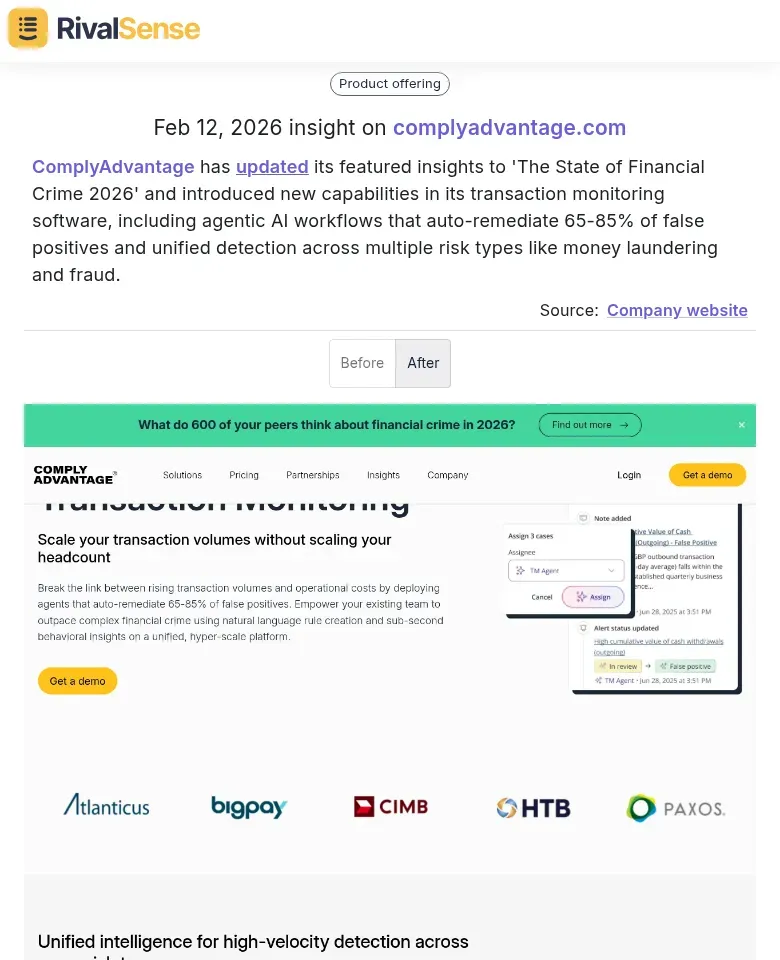
Example: ComplyAdvantage has updated its featured insights to 'The State of Financial Crime 2026' and introduced new capabilities in its transaction monitoring software, including agentic AI workflows that auto-remediate 65-85% of false positives. This type of insight is valuable for strategic visioning, as it shows where competitors are investing, allowing you to tailor your innovation roadmaps accordingly.
Analyzing messaging shifts helps you understand competitor positioning and adapt your communications. When competitors pivot their value propositions, it can indicate market demands that you should incorporate into your KAM strategy.
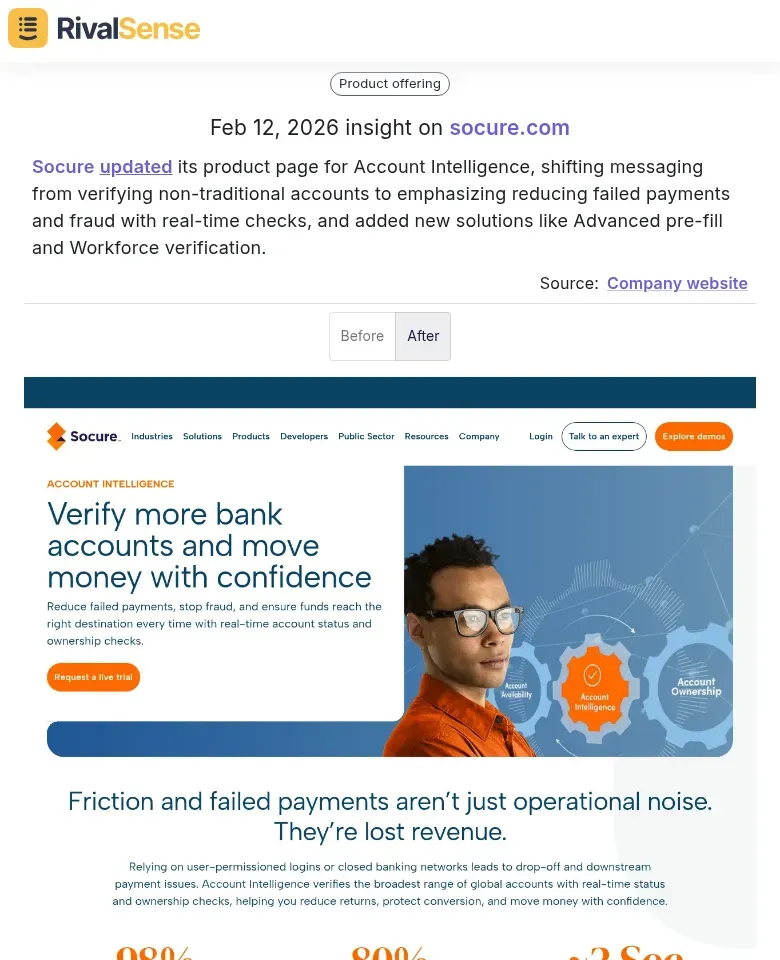
Example: Socure updated its product page for Account Intelligence, shifting messaging from verifying non-traditional accounts to emphasizing reducing failed payments and fraud with real-time checks. This insight is valuable for governance and benchmarking, as it reveals competitor priorities that can influence your account plans and performance metrics.
Implementation Roadmap: From Strategy to Execution
A successful Key Account Management (KAM) implementation requires a structured roadmap that evolves from strategy to execution. Following a phased approach minimizes risk and maximizes learning. Here's a practical guide with actionable steps:
Phased Implementation:
| Phase | Timeline | Key Actions | Tips |
|---|---|---|---|
| Getting Started | 0-3 months | Identify 3-5 pilot accounts, define basic metrics (e.g., revenue growth), assign dedicated KAMs | Use a simple CRM to track interactions |
| Nascent | 3-6 months | Expand to 10-15 accounts, implement quarterly business reviews (QBRs), develop account plans with SWOT analysis | Start with your most loyal customers to build early wins |
| Budding | 6-12 months | Scale to 20+ accounts, integrate KAM with sales/marketing teams, use predictive analytics for risk assessment | Ensure cross-functional alignment via regular sync meetings |
| Blooming | 12+ months | Optimize with AI-driven insights, establish executive sponsorship programs, benchmark against industry leaders | Leverage competitive intelligence tools for continuous improvement |
Technology Enablement:
Select KAM platforms that offer: account planning templates, communication tracking, and integration with existing CRM/Marketing tools. Prioritize tools with analytics dashboards to monitor account health scores. 🛠️ Hint: Avoid over-customization early on—start with out-of-the-box features.
Change Management:
Drive adoption by: creating a KAM playbook with clear roles, offering training workshops, and incentivizing teams with metrics tied to account growth. Foster a cultural shift by celebrating success stories and involving leadership in key account meetings. 💡 Tip: Use pilot results to build internal advocacy and address resistance proactively.
Measuring Success: KPIs and Continuous Improvement
Effective KAM requires clear KPIs and continuous refinement to stay aligned with business goals. Tracking the right metrics ensures you can demonstrate value and make data-driven adjustments. Focus on three core metrics: 1) Retention rate (target: 95%+), 2) Expansion revenue (cross-sell/upsell growth), and 3) Relationship health scores (via quarterly surveys measuring satisfaction, strategic alignment, and advocacy).
Implement regular review cycles: Conduct Quarterly Business Reviews (QBRs) with key accounts to assess performance against goals, identify growth opportunities, and address challenges. Complement QBRs with annual strategic account assessments evaluating long-term fit, competitive positioning, and partnership potential.
Establish a continuous improvement framework:
- Monthly KPI dashboards for real-time monitoring
- Bi-annual strategy reviews adjusting approaches based on performance data
- Post-mortem analyses for lost accounts to identify systemic issues
- Market intelligence integration ensuring strategies adapt to competitive shifts
✅ Continuous Improvement Checklist:
- Update KPI dashboards weekly
- Schedule QBRs 4-6 weeks in advance
- Complete relationship surveys quarterly
- Review competitive intelligence monthly
- Adjust account plans based on performance data
💡 Pro Tip: Automate KPI tracking where possible and dedicate 15% of KAM team time to strategic analysis rather than just execution. Successful KAM evolves through data-driven iteration, not static planning.
Accelerate Your KAM Strategy with Competitive Insights
Implementing and refining Key Account Management is an ongoing journey that benefits immensely from external intelligence. By tracking competitor activities—like product launches, pricing changes, event participations, and media mentions—you can anticipate market shifts and proactively adapt your KAM approach. Tools like RivalSense deliver these insights in weekly reports, helping you stay ahead without manual effort.
🚀 Ready to enhance your KAM strategy? Try RivalSense for free and get your first competitor report today to uncover actionable insights that drive growth and strengthen your key account relationships.
📚 Read more
👉 How IDnow's Regulatory Hire Enabled Competitors to Counter EU Wallet Strategy
👉 Website Change Intelligence: A Proactive Framework for Key Account Success
👉 2026 Social Media Key Account Monitoring: Essential Checklist for B2B Leaders
👉 Competitor Financials & M&A Benchmarking: Key Account Growth Insights for 2026
👉 Leveraging Competitor Insights: A Case Study on Spotify's Instagram Feature