
Mastering Key Account Lifecycles in Semiconductor Design: Actionable Strategies
In semiconductor design, key accounts are strategic partners driving innovation—typically chipmakers, OEMs, or system integrators with multi-year design cycles. Their importance extends beyond revenue: they influence technology roadmaps, validate design tools, and provide critical feedback that shapes product development. To effectively manage these relationships, it's crucial to map the complete lifecycle from prospecting to renewal.
| Lifecycle Stage | Key Activities | Semiconductor-Specific Touchpoints |
|---|---|---|
| Prospecting 🎯 | Identify accounts with upcoming design starts (check industry roadmaps, conference presentations) | Technology node transitions (e.g., 7nm→5nm→3nm) as decision points for tool upgrades |
| Evaluation 🔍 | Technical validation where design teams test EDA tools against specific process nodes | Design tape-outs for tool performance validation |
| Design-in ⚙️ | Integration into actual chip design projects (monitor design wins through industry publications) | Industry conferences (DAC, ISSCC) for relationship-building |
| Production 🚀 | Volume deployment across design teams | Quarterly business reviews to align tool capabilities with customer's technology roadmap |
| Renewal 🔄 | Strategic review of tool performance and roadmap alignment | Patent filings for new architectures to anticipate future needs |
Practical checklist: ✅ Track design wins by node, ✅ Monitor patent filings for new architectures, ✅ Attend technical working groups, ✅ Establish executive sponsorship at both companies.
Proactive Monitoring Strategies for Early-Stage Accounts
Proactive monitoring of early-stage semiconductor design accounts requires a systematic approach to detect emerging opportunities before they become mainstream. Start by tracking design project announcements through industry publications, conference proceedings, and regulatory filings. Setting up alerts for R&D investment announcements from target companies can reveal focus areas like AI accelerators or IoT processors.
Monitoring industry awards and recognitions can provide valuable insights into competitor credibility and market positioning. For example, RivalSense tracked that Cyble has been recognized as a 2026 Gartner® Peer Insights™ Strong Performer in 'Voice of the Customer' for Brand Protection Software. 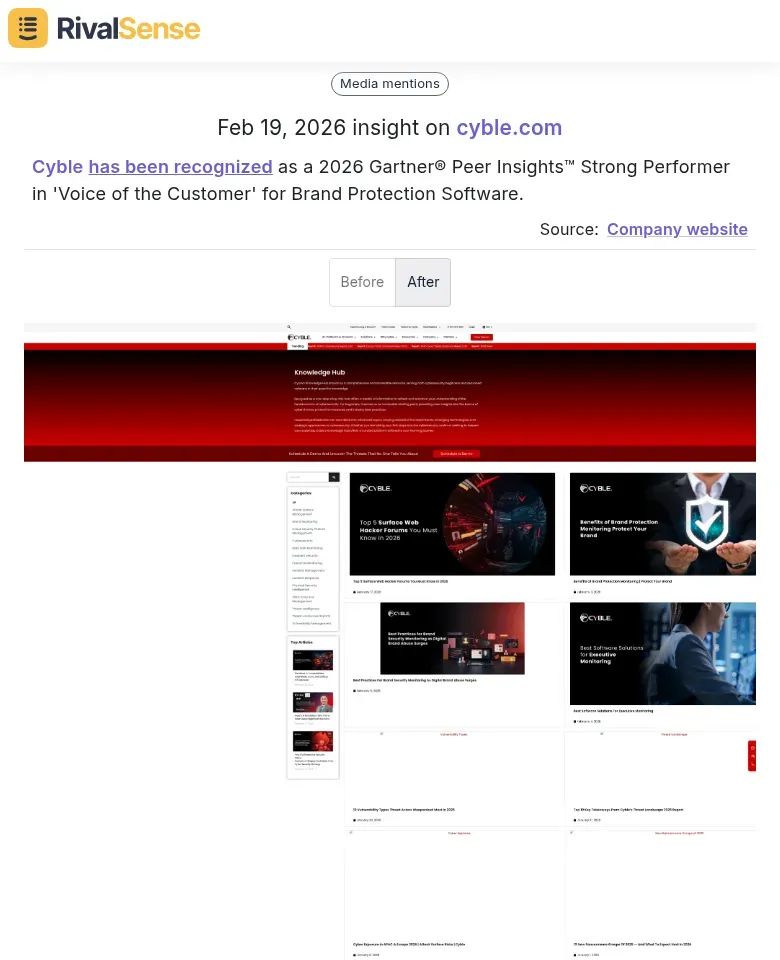 This type of insight is valuable because it highlights market validation, helping you benchmark competitors and identify potential threats or partnership opportunities in your strategy.
Create a monitoring checklist:
- Track EDA tool usage patterns through industry reports and partner insights
- Analyze patent filings for emerging IP portfolios
- Monitor hiring trends for specialized design roles
- Follow conference presentations for technology roadmap hints
- Use competitive intelligence tools to analyze IP portfolio growth rates
Practical tip: Look for patterns in design tool adoption—companies shifting to cloud-based EDA platforms or adopting AI-assisted design tools signal readiness for new solutions. Early detection allows you to position your offerings ahead of competitors.
Intelligence Gathering During Active Design Engagements
During active design engagements, intelligence gathering becomes critical for anticipating competitive moves and identifying expansion opportunities. Tracking design complexity by monitoring node transitions and project milestones like tape-out dates ensures you stay aligned with customer progress. It's also essential to watch for feature launches and partnerships that enhance collaboration.
For instance, RivalSense captured that Harvey launched Shared Spaces with design partners to enable real-time collaboration and transparency for legal and professional services teams, as highlighted by leading organizations like Gleiss Lutz, Deutsche Telekom, PwC, IFS, King & Wood Mallesons, IAG, Thompson Hine LLP, and Flex.  This insight is valuable because it reveals how competitors are leveraging partnerships to improve customer engagement, offering lessons for your own collaboration strategies in semiconductor design.
Practical steps for intelligence gathering:
- Set up alerts for competitor press releases and technical conference presentations
- Monitor LinkedIn for team growth and skill set changes
- Track patent filings and technical publications for project insights
- Analyze quarterly earnings calls for design win announcements
- Create a dashboard tracking key metrics across all active engagements
Focus on multi-vendor strategies where companies mix tools from different providers, as this can reveal cost optimization or technical advantage opportunities.
Advanced Analytics for Account Health Assessment
Advanced analytics transform account health assessment from subjective guesswork to data-driven precision. For semiconductor design accounts, focusing on critical dimensions like design productivity, IP reuse, and support patterns provides a comprehensive view. By correlating these metrics, you can predict expansion opportunities and flag at-risk accounts early.
Here’s a framework for advanced analytics:
-
Design Productivity & Time-to-Market 📈
- Track metrics: design cycle time reduction, tape-out frequency, project milestone adherence
- Practical tip: Create a dashboard comparing customer's historical vs. current performance using your solutions
-
IP Reuse & Quality Metrics 🔧
- Measure: IP block reuse rates, design rule check (DRC) violations, correlation with fab yield data
- Checklist:
• Track IP repository access patterns
• Correlate DRC errors with yield reports
• Benchmark against industry averages
-
Support Patterns & Engagement Depth 🤝
- Analyze: ticket volume by severity, resolution time, topic clusters, training completion rates
- Actionable step: Implement a scoring system weighting ticket trends (40%), training metrics (30%), and collaborative projects (30%) for quarterly health scores
Key insight: Declining support tickets alongside rising IP reuse often predicts account expansion opportunities. Use predictive analytics to proactively address issues before they escalate.
Competitive Intelligence Integration for Strategic Positioning
Integrating competitive intelligence into your semiconductor design strategy transforms reactive monitoring into proactive market positioning. Start by establishing automated tracking for competitor tool adoption patterns, pricing shifts, and partnership announcements. This reveals displacement opportunities where your solutions can address pain points competitors overlook.
Monitoring product updates is crucial for staying ahead. For example, RivalSense identified that Transifex introduced TQI Tasks Update with 50% more efficiency, Origin distribution for reviewed word count, and creating resources and PO file format for creating strings/resources. 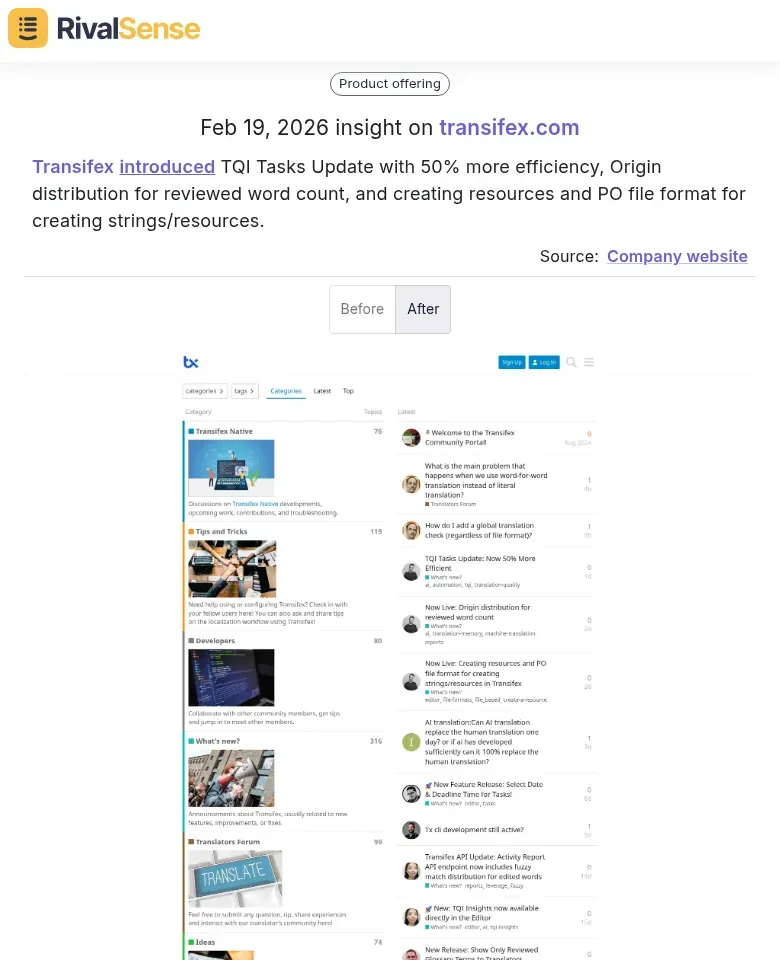 This type of insight is valuable because it shows how competitors are enhancing efficiency, informing your own product roadmap and competitive responses.
Practical steps for competitive intelligence integration:
- Track industry partnerships through joint announcements, co-marketing events, and shared customer case studies
- Monitor ecosystem developments via patent filings, research collaborations, and university partnerships
- Analyze pricing strategies across different semiconductor segments (e.g., AI accelerators vs. memory chips)
- Set up alerts for competitor executive changes in sales and pricing roles
- Create a competitive dashboard mapping value proposition differentiation
Focus on key areas: competitor pricing model shifts, partnership announcements with foundries, and customer dissatisfaction signals from reviews. Implement quarterly competitive war-gaming sessions to test response strategies.
Actionable Framework for Lifecycle Optimization
To optimize semiconductor design account lifecycles, implement a three-pronged framework that combines automation, cross-functional reviews, and proactive interventions. This ensures you maintain healthy relationships and capitalize on opportunities throughout the engagement.
1. Deploy Automated Tracking Systems 🤖
- Use real-time dashboards to monitor key metrics: design project milestones, IP utilization rates, support ticket resolution times, and contract renewal windows
- Leverage tools like RivalSense to track competitor activity and market positioning automatically
- Create weekly automated reports highlighting account health scores based on engagement frequency, project velocity, and satisfaction indicators
2. Establish Monthly Cross-Functional Reviews 📅
- Include representatives from engineering, sales, and customer success teams
- Develop clear escalation protocols:
- Tier 1 issues (technical delays) → engineering leads
- Tier 2 issues (budget concerns) → sales directors
- Tier 3 issues (relationship risks) → executive sponsors
- Use a standardized account review template covering technical progress, business alignment, and relationship dynamics
3. Implement Proactive Intervention Strategies 🚨
- Create early warning triggers: 30+ days without design activity, declining IP usage, or missed milestone deadlines
- When triggered, initiate a 5-step intervention:
- Immediate technical assessment
- Executive sponsor engagement
- Resource reallocation if needed
- Contract flexibility discussions
- Recovery plan development with 30/60/90-day checkpoints
- Maintain a risk mitigation playbook with proven solutions for common challenges like tool integration issues
Conclusion: Leverage Competitive Insights for Success
Mastering key account lifecycles in semiconductor design requires a blend of strategic monitoring, advanced analytics, and competitive intelligence. By adopting the actionable strategies outlined above, you can proactively manage relationships, identify opportunities, and mitigate risks. To streamline this process, consider using automated tools that provide real-time insights into competitor movements and market trends.
Ready to enhance your competitive edge? Try out RivalSense for free to track competitor product launches, pricing updates, partnerships, and more—all delivered in a weekly email report. Get your first competitor report today and stay ahead in the dynamic semiconductor landscape! 🚀
📚 Read more
👉 How BASF's €11B R&D Success Drives Competitor Innovation Acceleration
👉 Facebook Competitor Trend Analysis: Uncover Key Insights for B2B Strategy
👉 Data-Driven Competitive Intelligence: Winning in Licensed Pop Culture Apparel
👉 Avoid These Regulatory Competitor Insight Mistakes That Are Hurting Your ROI
👉 Analyzing Harvey's Shared Spaces Launch: A Practical Competitor Insight