
Mastering Competitor Tracking in Pharma Logistics: A Strategic Guide to Promotional Offers
In the fiercely competitive pharmaceutical logistics sector, tracking competitor promotional offers isn't just a tactical exercise—it's a strategic imperative. 🌡️ With profit margins under constant pressure and customer loyalty increasingly fragile, promotional intelligence directly determines market share and retention rates. When competitors offer volume discounts, seasonal rebates, or value-added services like expedited temperature-controlled shipping, these moves can trigger immediate customer defections if not matched or countered strategically.
Pharma logistics presents unique tracking challenges due to strict regulatory environments. Promotional offers must comply with Good Distribution Practice (GDP) regulations, anti-bribery laws, and transparency requirements. Unlike other industries where promotions are publicly advertised, pharma logistics deals are often negotiated privately with healthcare providers and distributors, making intelligence gathering more complex.
📋 Practical Checklist for Effective Tracking:
- ✅ Monitor competitor pricing structures for temperature-sensitive shipments
- ✅ Track seasonal promotions around peak pharmaceutical demand periods
- ✅ Analyze value-added service offerings (real-time tracking, compliance documentation)
- ✅ Document regulatory-compliant promotional language used by competitors
- ✅ Establish alerts for competitor contract renewals with key healthcare clients
💡 Pro Tip: Focus on understanding the strategic intent behind promotions—are competitors targeting specific therapeutic areas, geographic regions, or customer segments? This insight enables proactive counter-strategies rather than reactive responses.
Identifying Key Competitors and Their Promotional Channels
To effectively track competitor promotional offers in pharma logistics, you must first map the competitive landscape across categories. Start by identifying major 3PL providers, specialized pharma logistics firms, and emerging players focusing on digital solutions. This foundational step ensures you monitor the right entities and their evolving strategies.
Systematically monitor promotional channels to capture real-time intelligence. Track direct sales team activities through LinkedIn updates and industry contacts, and keep an eye on digital platforms like company websites and LinkedIn pages. Follow key industry events such as the Pharma Supply Chain & Logistics Innovation Programme, as these often reveal promotional trends and new service launches.
| Competitor Category | Examples | Key Promotional Channels |
|---|---|---|
| Major 3PL Providers | DHL, FedEx, UPS | Corporate websites, global sales teams |
| Specialized Pharma Logistics | Knipper, Cardinal Health | Industry conferences, direct B2B outreach |
| Emerging Players | Digital cold-chain startups | Social media, partnership announcements |
🔄 Identify Seasonal Patterns:
- Q4: Year-end promotions and contract renewal incentives
- Q1: New service launches aligned with annual planning cycles
- Flu season (Q4-Q1): Cold chain capacity promotions
- Back-to-school (Q2-Q3): Pediatric pharmaceutical logistics offers
Create a promotion calendar to anticipate competitor moves and time your counter-strategies effectively.
Best Practices for Systematic Promotional Offer Monitoring
Establishing a structured tracking framework is essential for consistent competitor monitoring. Begin by identifying key competitors and their promotional channels, then create standardized templates to capture pricing discounts, service bundles, and seasonal offers. Assign team ownership and set up weekly review cadences to ensure no critical intelligence slips through the cracks.
Leverage automated monitoring tools to track competitor websites, email campaigns, and social media with minimal manual effort. Configure alerts for price changes, new service offerings, and promotional announcements to stay ahead of market shifts. Integrating data from these tools into centralized BI platforms provides executive visibility and enables data-driven decisions.
Tracking product updates can reveal new promotional angles. For instance, RivalSense detected that Dust's UK Lead Faateh Dhillon announced on April 1 that the company rebuilt its Chrome extension to let agents read and act on browser content across tabs, integrate tools like Gmail and Notion in the sidebar, and offer full parity with the web app.
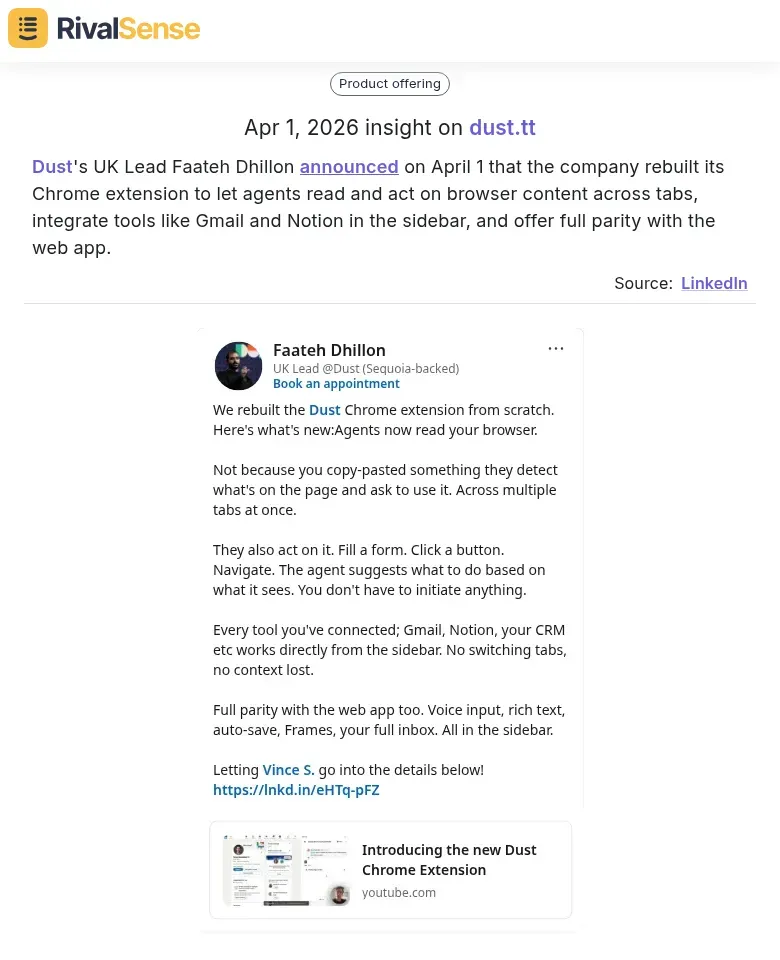
This type of insight is valuable because it shows how competitors are enhancing user experience, which often precedes promotional campaigns to drive adoption and can signal where they're investing resources.
🔧 Practical Checklist for Systematic Monitoring:
- ✅ Map competitor digital touchpoints (websites, social media, email lists)
- ✅ Configure automated monitoring tools with custom alerts
- ✅ Define alert triggers for pricing, service changes, and promotions
- ✅ Create dashboard KPIs for real-time competitive metrics
- ✅ Establish a weekly review process with assigned owners
- ✅ Document competitive responses and outcomes
- ✅ Update tracking framework quarterly to adapt to market changes
Analyzing and Interpreting Competitor Promotional Strategies
Decoding promotional messaging requires looking beyond surface-level discounts to understand the underlying value propositions. By analyzing competitor offers across channels, you can identify consistent themes and strategic priorities that reveal their operational strengths and target segments.
Assess promotional effectiveness through market response analysis, monitoring customer feedback on review platforms and social media for sentiment shifts. Track key metrics like customer acquisition rates and contract renewals to gauge the impact of competitor campaigns, and implement feedback loops by surveying customers who switched to understand their decisions.
For example, RivalSense tracked Unify's launch of 'Unify for Lifecycle Outbound' on September 3-4, designed to help users engage net new prospects, active deals, and expansion opportunities by turning signals into revenue at each customer journey stage.
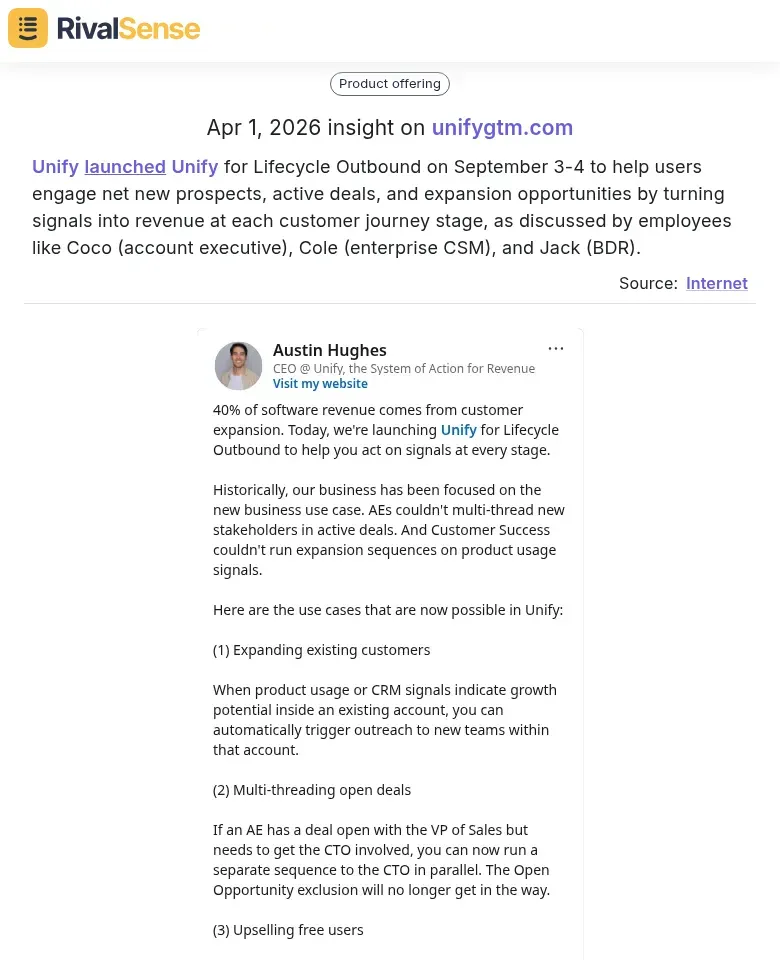
This product launch insight is valuable as it highlights how competitors are positioning new solutions to capture revenue across the lifecycle, often accompanied by promotional offers to incentivize early adoption and lock in customers.
📊 Analysis Framework:
- Messaging Consistency: Compare promotional language across websites, sales materials, and events
- Value Proposition Matrix: Map stated benefits (speed, compliance, cost) against actual capabilities
- Gap Identification: Look for underserved customer segments or service weaknesses in competitor offers
- Regulatory Alignment: Monitor how promotions comply with GDP and other pharma logistics regulations
🔍 Practical Checklist for Interpretation:
- ✅ Map competitor promotions against their service portfolio strengths/weaknesses
- ✅ Calculate the true cost-to-benefit ratio of their offers
- ✅ Identify underserved customer segments they're ignoring
- ✅ Monitor how promotions align with regulatory changes affecting pharma logistics
Turning Competitive Intelligence into Strategic Advantage
Turning competitive intelligence into strategic advantage requires moving beyond passive monitoring to proactive response. Here's how to transform competitor insights into actionable strategies that reinforce your market position and highlight your unique value in pharma logistics.
🎯 Develop Responsive Promotional Strategies:
- Monitor competitor promotional cycles (seasonal offers, new service launches)
- Create a response matrix: For each competitor promotion type, define your response (match, exceed, or differentiate)
- Example: If a competitor offers 15% off cold-chain logistics, counter with 20% off plus free temperature monitoring for the first 3 months
🚀 Create Differentiated Value Propositions:
- Identify gaps in competitor offerings (e.g., they focus on price but lack real-time tracking)
- Develop counter-promotions that highlight your unique strengths like compliance expertise or specialized handling
⚡ Implement Agile Adjustments:
- Establish a rapid response team with authority to approve tactical changes
- Use tiered pricing: Maintain premium pricing for core services while creating targeted promotional packages
- Tip: Test small-scale responses before full rollout—run a pilot promotion in one region to gauge effectiveness
📈 Practical Implementation Steps:
- ✅ Hold weekly competitive intelligence review meetings
- ✅ Use pre-approved promotional response templates for common scenarios
- ✅ Define clear metrics to measure response effectiveness (conversion rates, customer retention)
- ✅ Conduct regular value proposition audits against competitor positioning
Building a Sustainable Competitive Intelligence Program
Building a sustainable competitive intelligence program for pharma logistics requires establishing systematic workflows and centralized dashboards. This ensures that competitor tracking is consistent, integrated, and actionable over the long term, evolving with market dynamics to maintain a competitive edge.
Integrate promotional tracking with broader market intelligence by correlating competitor offers with customer feedback, regulatory changes, and supply chain disruptions. For example, if a rival launches expedited shipping discounts, cross-reference this with customer satisfaction surveys to assess impact and anticipate trends rather than just react.
Tracking management and team changes can provide early signals of strategic shifts. RivalSense identified that 1Password's Senior Talent Acquisition Specialist Brian Spaulding announced on April 1 that the company is expanding its Enterprise sales team in New York City.
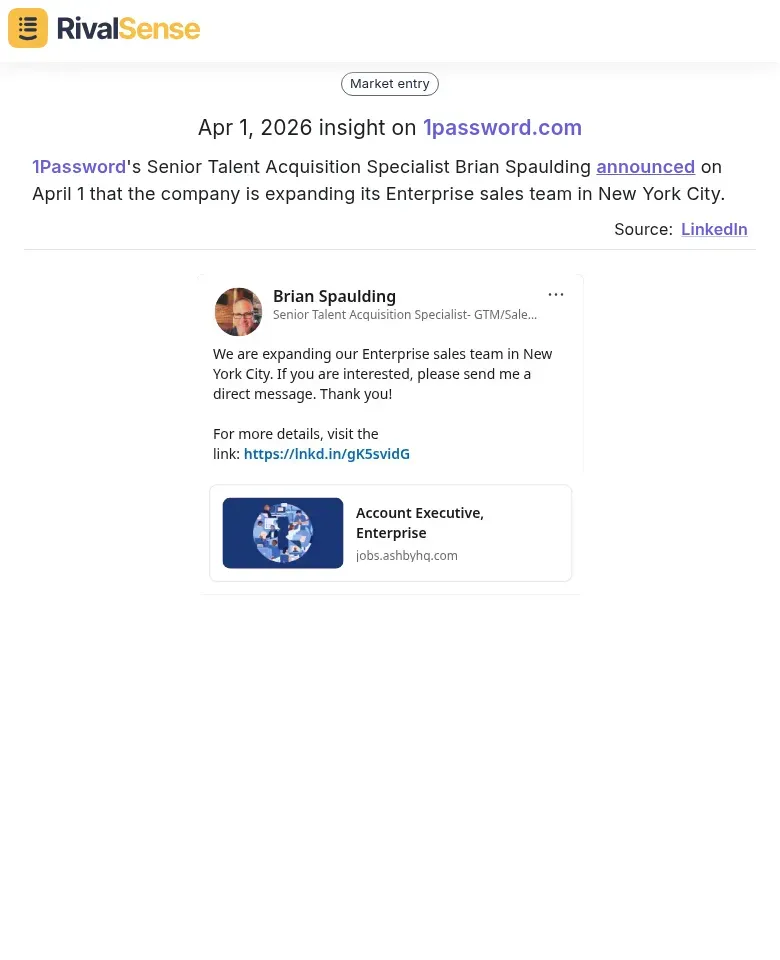
This insight is valuable because it indicates a focused push into a key market, which likely involves targeted promotional efforts to build presence and can alert you to increased competition in specific regions or segments.
📋 Sustainable Program Elements:
- Centralized Dashboard: Aggregate competitor offers, pricing changes, and service updates in real-time
- Dedicated Team: Assign members to review data weekly and flag significant shifts
- ROI Measurement: Track metrics like detection speed, churn reduction, and cost savings
- Continuous Optimization: Conduct quarterly reviews to refine processes and adopt new tactics
🔁 Optimization Cycle:
- Collect: Automate data gathering from multiple sources
- Analyze: Interpret insights with cross-functional teams
- Act: Implement strategic responses based on intelligence
- Review: Measure outcomes and refine approaches
Putting It All Together: Leveraging Tools for Competitive Edge
To streamline your competitor tracking efforts and ensure you capture critical insights like product launches, team expansions, and regulatory changes, consider using a dedicated competitive intelligence tool. These tools automate monitoring across company websites, social media, and various registries, delivering consolidated reports that save time and enhance strategic decision-making.
For instance, RivalSense tracks competitor product launches/updates, pricing updates, event participations, partnerships, regulatory aspects, management changes, and media mentions, delivering all in a weekly email report. This holistic view helps you stay ahead of promotional trends and respond proactively.
Ready to transform your competitive intelligence approach? Try RivalSense for free at https://rivalsense.co/ and get your first competitor report today to start gaining strategic insights that drive growth in pharma logistics. 🚀
📚 Read more
👉 How Real-Time Competitive Intelligence Enabled a Swift Response to Airalo's Flight Promotion
👉 Step-by-Step Guide: Extract Competitor Insights from Instagram for Strategic Advantage
👉 Auto Lending Competitors: Strategic Marketing Analysis for Financial Services
👉 Quick Tips: Uncover Competitor Partnerships to Win Key Accounts
👉 Strategic Competitor Analysis in 2026: Mastering Media Mentions and Content Marketing Trends