
Mastering Competitor Intelligence: Leveraging Customer Reviews in Systems Software Development
In the competitive landscape of systems software development, competitor customer reviews represent an untapped intelligence goldmine. While most companies focus on their own feedback, analyzing competitor reviews reveals critical market insights that directly inform strategic development decisions. These reviews expose real-world pain points, feature gaps, and integration challenges that customers face with existing solutions.
For enterprise software teams, competitor reviews provide a direct window into market demands. When customers complain about complex deployment processes or integration limitations with rival products, they're revealing unmet needs your development team can address. Systematic analysis of these reviews helps identify patterns: Are multiple customers struggling with specific API limitations? Do they consistently request better monitoring capabilities?
Practical steps to leverage this intelligence:
- 🛠️ Create a structured review tracking system across major platforms (G2, Capterra, TrustRadius)
- 📊 Categorize feedback by product features, integration issues, and support experiences
- 🗺️ Map recurring complaints to potential development opportunities
- ⚡ Prioritize features that address the most frequent pain points mentioned in competitor reviews
This approach transforms customer feedback from competitors into actionable development priorities, giving your team a competitive edge in delivering solutions that truly address market gaps.
Building Your Competitor Review Monitoring Framework
Establishing a robust monitoring system is essential for continuous competitive insight. By systematically tracking competitor reviews, you can uncover real-time market feedback. To build an effective competitor review monitoring framework for systems software, start by identifying your top 3-5 direct competitors and monitoring their G2 and Capterra profiles. These platforms host the most valuable B2B software reviews. For enterprise systems software, also consider Gartner Peer Insights.
Set up automated monitoring using tools like Visualping or Reviewflowz to track competitor review pages every 2-3 days. Configure alerts for new reviews and store data in Airtable or Google Sheets. Create a workflow that automatically captures review text, ratings, dates, and reviewer details.
Establish key metrics: track average rating trends monthly, sentiment distribution (percentage of 5-star to 1-star reviews), and emerging themes. Monitor for new complaints appearing in reviews and track whether existing weaknesses persist or improve. Use AI analysis to extract top praised features and top criticisms automatically.
Practical checklist:
- ✅ Identify top competitors and their review page URLs
- ✅ Set up automated monitoring with daily/weekly checks
- ✅ Create a database to store historical review data
- ✅ Implement monthly AI sentiment analysis
- ✅ Generate competitive digests with trend comparisons
- ✅ Assign action items based on emerging opportunities or threats
This systematic approach transforms scattered review data into actionable competitive intelligence for product strategy and sales messaging.
Analyzing Review Patterns for Technical and Market Insights
Extracting actionable insights requires moving beyond surface-level reading. By categorizing and analyzing review patterns, you can identify technical gaps and market trends. To extract actionable insights from competitor reviews, start by categorizing feedback into technical pain points, feature requests, and integration needs. Use sentiment analysis tools to quantify recurring issues—look for patterns like "memory leaks," "API instability," or "deployment complexity" that signal deeper technical flaws. For example, if multiple reviews mention "poor container orchestration," this reveals a market gap for better Kubernetes integration.
Create a checklist to track feature requests: note frequency, technical specificity, and user segments (e.g., DevOps vs. sysadmins). Spot trends like rising demand for "edge computing support" or "multi-cloud management" to anticipate market shifts. Practical tip: Use a spreadsheet to log reviews monthly, tagging keywords like "scalability" or "security" to identify emerging requirements.
Analyze review volume and sentiment shifts over time—a sudden spike in negative reviews about "legacy system compatibility" might indicate a technology transition. Steps: 1) Aggregate reviews from platforms like G2 or Capterra, 2) Apply sentiment scoring (positive/negative/neutral), 3) Cluster feedback by theme, 4) Map trends to your product roadmap. This approach helps you proactively address gaps and align development with real-world needs.
Leveraging Negative Reviews for Product Improvement Opportunities
Negative competitor reviews are goldmines for systems software improvement. They reveal precisely where competitors fall short and where your product can excel. When customers complain about competitors' reliability issues, performance bottlenecks, or integration challenges, they're revealing exactly where your product can excel. Here's how to systematically leverage these insights:
Step 1: Systematic Collection
Monitor 15+ platforms including G2, Capterra, GitHub discussions, and Reddit communities. Use AI-powered tools to track mentions of competitor reliability failures, performance complaints, and integration headaches. Create a centralized dashboard categorizing complaints by type (bug, UX, missing feature, performance) and severity.
Step 2: Prioritization Framework
Apply this formula: Priority Score = (Severity × Frequency) + Trend Multiplier. For example, if competitors receive widespread complaints about database connection timeouts (High severity × Widespread frequency) with increasing mentions (2x trend), that's your top priority.
Step 3: Transform Complaints into Features
When customers say "competitor's API crashes under heavy load," translate this into specific improvements: implement connection pooling, add automatic retry logic, and build comprehensive error logging. If they complain about "slow query performance," prioritize query optimization, indexing strategies, and caching layers.
Practical Checklist:
- 🔍 Weekly review of top 10 competitor complaint themes
- 🗺️ Map each complaint to specific architectural improvements
- 📊 Benchmark your performance against competitor failure points
- 🎯 Set reliability targets 20% above industry complaints
- 💡 Create "competitive advantage" features addressing common pain points
Key Insight: The 70/20/10 rule applies: 70% of development should fix existing reliability issues, 20% on performance optimization, and 10% on new features. Most competitors do the opposite, leaving you with superior stability as your differentiator.
Actionable Tip: When you ship improvements based on competitor complaints, update release notes with specific references: "Enhanced database resilience in response to industry reliability concerns." This demonstrates market awareness and positions your software as the solution to known industry problems.
Capitalizing on Positive Reviews for Strategic Positioning
Positive reviews highlight what the market values most. Analyzing these can guide your strategic positioning to match or exceed competitor strengths. Start by analyzing competitor reviews on platforms like G2, Capterra, and industry forums to identify consistently praised features. Create a feature matrix tracking what customers value most in systems software—reliability, scalability, or specific integrations.
Practical steps:
- 📝 Extract recurring positive themes (e.g., "easy deployment" or "excellent API documentation")
- ⚖️ Benchmark these against your current value proposition
- 🔍 Identify gaps where you can match or exceed these strengths
- 🎯 Incorporate validated language into your marketing messaging
For example, if competitors receive praise for robust monitoring capabilities, enhance your own monitoring features and highlight this in positioning. Use sentiment analysis tools to quantify positive feedback patterns. This approach transforms competitor strengths into your strategic advantage while ensuring your messaging resonates with proven customer preferences.
Expanding Your Competitive Intelligence: Beyond Customer Reviews
While customer reviews provide valuable feedback, comprehensive competitive intelligence includes tracking broader competitor activities. Tools like RivalSense offer insights into management changes, product updates, partnerships, and more, which can complement review analysis. Here are real examples from RivalSense:
-
Management Changes at Uklon:
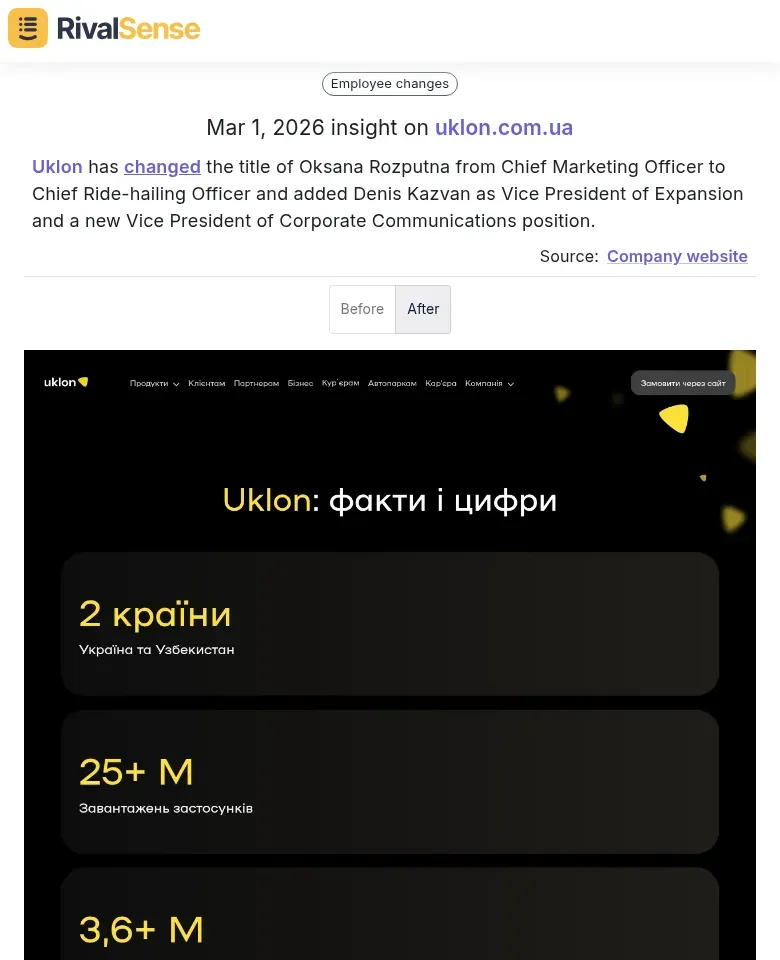
Uklon has changed the title of Oksana Rozputna from Chief Marketing Officer to Chief Ride-hailing Officer and added Denis Kazvan as Vice President of Expansion and a new Vice President of Corporate Communications position.
Why it matters: Management changes can signal strategic shifts, such as new focus areas or organizational restructuring, helping you anticipate competitor priorities and adjust your strategy accordingly. -
Product Discontinuation at Hemköp:
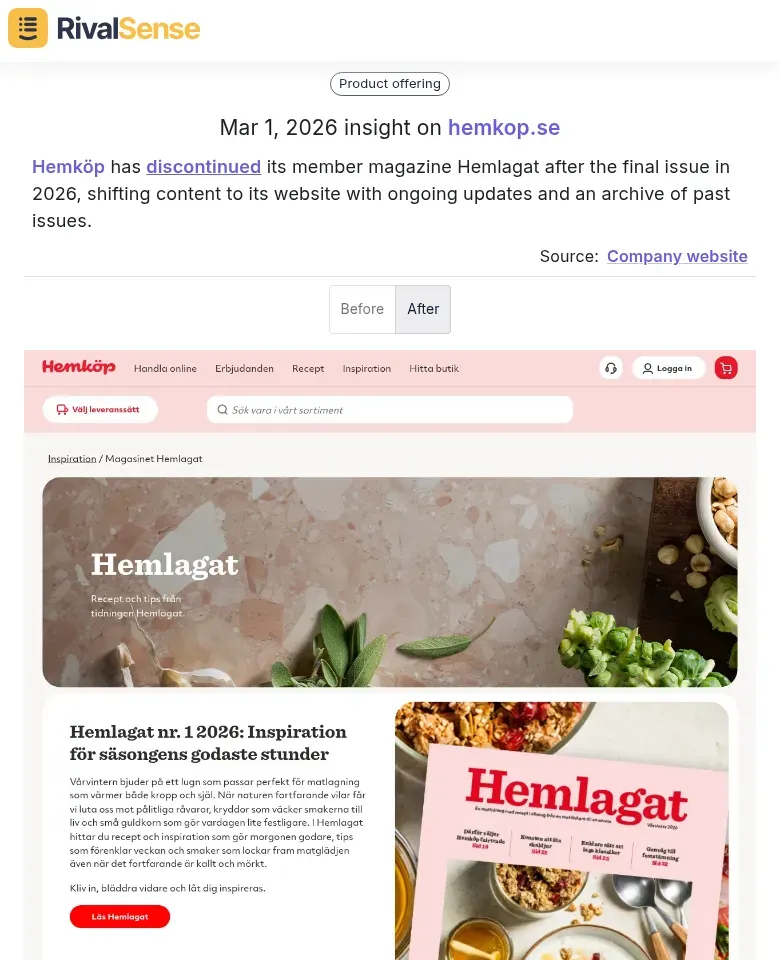
Hemköp has discontinued its member magazine Hemlagat after the final issue in 2026, shifting content to its website with ongoing updates and an archive of past issues.
Why it matters: Discontinuing a product or service may indicate cost-cutting, digital transformation, or changes in customer engagement strategies, revealing competitor adjustments that could impact market positioning. -
Promotional Offer from Lyft:

Lyft is offering 50% off rides this week for transgender and gender-nonconforming Kansas residents impacted by a new state law that invalidates driver's licenses with gender markers differing from birth records.
Why it matters: Promotional offers in response to external events show how competitors adapt to regulatory or social changes, highlighting their agility and market responsiveness, which can inform your own tactical moves.
Integrating such insights with customer reviews gives a holistic view of competitor strategies, enabling more informed decision-making.
Implementation: Turning Insights into Actionable Development Roadmaps
Turning insights into action requires a structured approach. By integrating competitor analysis into your development process, you can align your roadmap with market needs. To effectively integrate competitor review insights into your development process, start by creating a structured analysis framework. Each sprint planning session should include a review of top competitor complaints and feature requests. Use a scoring system that weighs frequency, severity, and strategic alignment to prioritize development items.
Create a prioritized feature backlog with three categories:
- 🚀 Quick wins addressing competitor weaknesses (2-4 week implementation)
- ⚙️ Core improvements matching competitor strengths (1-2 quarters)
- 🌟 Differentiating innovations where competitors consistently fail (strategic roadmap)
For example, if multiple competitors receive complaints about complex API documentation, prioritize developer experience improvements.
Establish validation feedback loops by implementing beta testing with users who previously used competitor solutions. Track key metrics like adoption rates, support ticket reductions, and customer satisfaction scores specifically comparing your solution to competitor alternatives. Use A/B testing to validate that your improvements actually outperform competitor offerings in real-world scenarios.
Practical checklist:
- 📅 Weekly competitor review analysis sync with product and engineering leads
- 🏢 Quarterly competitive gap analysis workshops
- 💬 Customer validation interviews focused on competitor switching decisions
- 📊 Performance benchmarking against competitor feature sets
- 📈 Regular win/loss analysis against key competitors
Conclusion: Streamline Your Competitive Intelligence with RivalSense
By leveraging competitor customer reviews and broader intelligence, you can make informed strategic decisions that drive product development and market positioning. To streamline this process, consider using a tool like RivalSense, which tracks competitor product launches/updates, pricing updates, event participations, partnerships, regulatory aspects, management changes, and media mentions across company websites, social media, and various registries, delivering all in a weekly email report.
Ready to gain a competitive edge? Try RivalSense for free at https://rivalsense.co/ and get your first competitor report today!
📚 Read more
👉 How BASF's Fungicide Registration in Italy Enabled Smarter Competitor Strategies
👉 Quick Website Monitoring Hacks for Key Account Intelligence
👉 AI Agent Productivity: Analyzing Competitor UX for Enterprise Advantage
👉 Predictive Analysis: Forecast Competitor Churn via Media & Content Insights
👉 Decoding Competitor Moves: How Hiring Insights Reveal Strategic Shifts