
LinkedIn Competitor Benchmarking: Transform Executive Moves into Product Insights
In today's competitive B2B environment, relying solely on traditional market research leaves you reacting to yesterday's news. LinkedIn provides real-time intelligence on competitor product strategies through executive announcements, team expansions, and strategic hires. When a competitor's VP of Product posts about 'revolutionizing our platform,' or their engineering team grows by 30%, you're seeing product direction signals before official launches.
Practical steps for LinkedIn product intelligence:
- Monitor competitor leadership accounts for strategic announcements
- Track hiring patterns in product, engineering, and design roles
- Analyze content themes in competitor company pages and employee posts
- Set up alerts for key competitor personnel changes
- Cross-reference LinkedIn insights with other competitive data sources
Executive moves often precede major product shifts. A new Chief Product Officer from a different industry may signal expansion into new markets. Engineering team expansions in specific technologies hint at upcoming feature development. By connecting these dots, you move from reactive market research to proactive competitive intelligence, anticipating competitor moves 3-6 months before public announcements.
Decoding Executive Moves: What Hiring Patterns Reveal About Product Roadmaps
Executive hiring patterns offer a crystal ball into competitor product roadmaps. When a rival hires a VP of AI from Google or a Head of Enterprise Sales from Salesforce, they're signaling strategic pivots months before product launches. A 2025 Gartner study found that companies hiring specific technical roles shipped related features within two quarters 78% of the time.
For example, consider this real insight from RivalSense:
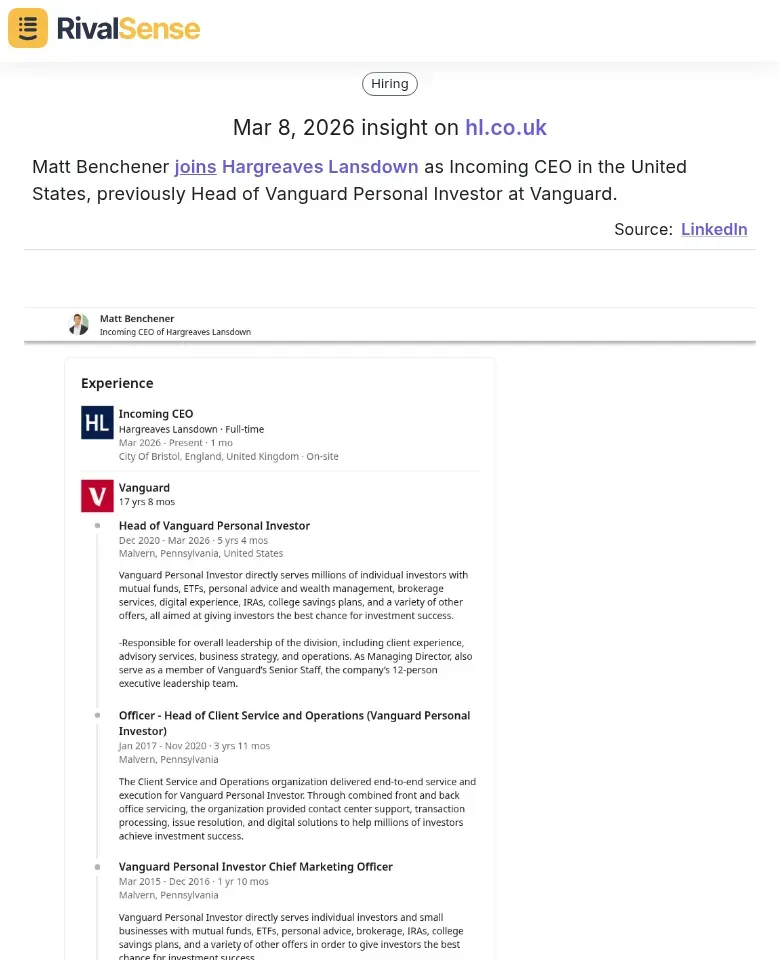
Matt Benchener joins Hargreaves Lansdown as Incoming CEO in the United States, previously Head of Vanguard Personal Investor at Vanguard.
This type of executive change insight is valuable because a new CEO often brings fresh strategies and expertise, potentially indicating a shift in market focus or product direction. By monitoring such moves, you can anticipate competitors' next steps and adjust your own strategy accordingly.
Practical Analysis Framework:
- Track Executive Transitions: Monitor LinkedIn for C-suite and VP-level moves at your top 5 competitors
- Analyze Industry Expertise: When a competitor hires an executive from healthcare tech, expect healthcare-focused product features within 6-9 months
- Identify Talent Clusters: 3+ senior hires in a new function (like AI safety or quantum computing) signals major investment
- Cross-reference Signals: Validate hiring patterns with funding rounds, patent filings, and partnership announcements
Actionable Checklist:
- [ ] Set up LinkedIn alerts for competitor executive team changes
- [ ] Map new hires' previous company expertise to predict product direction
- [ ] Track hiring velocity spikes (3x normal rate indicates urgent initiatives)
- [ ] Create quarterly "Executive Hiring Impact" reports for your product team
Key Insight: Microsoft's 2022-2023 AI hiring surge (40% increase in AI roles) predicted their Copilot strategy 6 months before launch. By analyzing where competitors recruit talent, you can anticipate their next market moves and adjust your roadmap accordingly.
From Personnel Changes to Product Signals: The Intelligence Pipeline
Transform personnel data into strategic intelligence by connecting leadership changes to product development patterns. When a competitor hires a new VP of Product from a fintech company, anticipate AI-powered payment features within 6-9 months. Tracking these talent flows systematically can reveal hidden product strategies.
Take this RivalSense insight as an example:
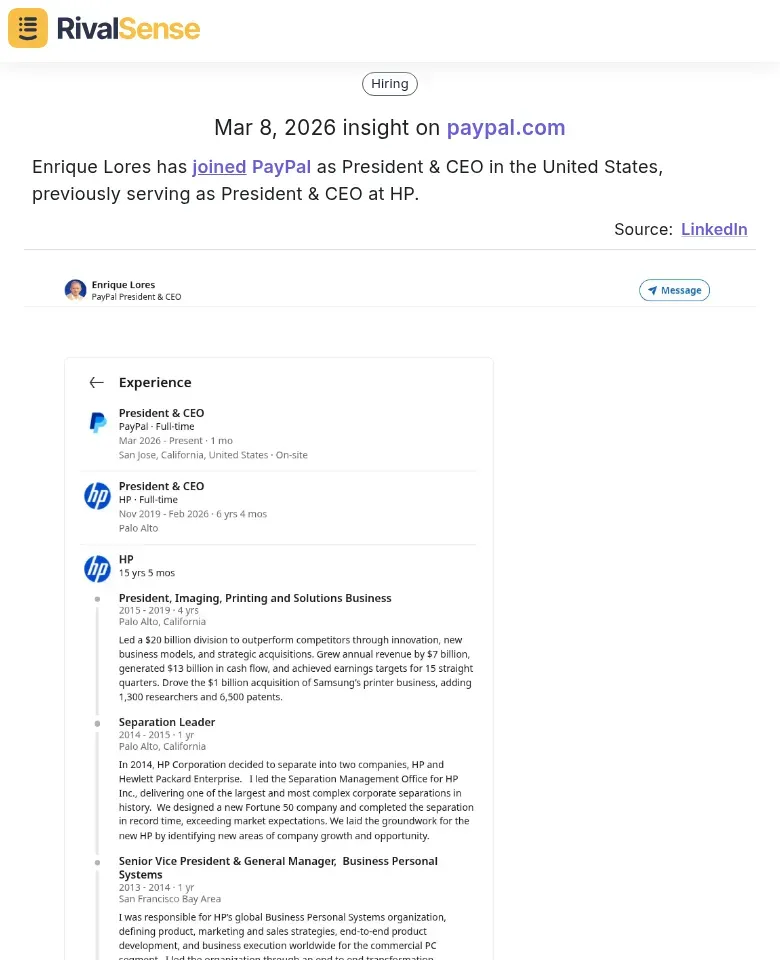
Enrique Lores has joined PayPal as President & CEO in the United States, previously serving as President & CEO at HP.
This high-profile hire is valuable for business strategy because it signals a potential strategic pivot or expansion into new markets, given Lores' background in technology and leadership at HP. Such insights help you understand competitors' long-term visions and prepare your response.
Practical steps for building your intelligence pipeline:
- Monitor LinkedIn for C-suite and director-level changes at competitors
- Document previous companies and industries of new hires
- Cross-reference with product roadmap announcements and feature releases
- Identify patterns in talent acquisition (e.g., multiple AI specialists = upcoming AI features)
Organizational restructuring often signals market shifts before public announcements. When a competitor creates a new "Blockchain Solutions" division, expect crypto-related offerings within the year. Similarly, merging marketing and sales departments may indicate a shift toward product-led growth strategies.
Key indicators to watch:
- Department creation/elimination
- Reporting structure changes
- Geographic expansion of teams
- Sudden hiring sprees in specific roles
Maintain a quarterly review of these signals to anticipate competitor moves and adjust your own product roadmap accordingly. This proactive approach turns LinkedIn monitoring from passive observation into active competitive intelligence.
Benchmarking Framework: Turning LinkedIn Insights into Actionable Intelligence
To transform LinkedIn insights into actionable intelligence, implement this three-part benchmarking framework. Start by establishing baselines for competitor activity, then track deviations that signal strategic shifts.
1. Track Product Development Cycles:
- Monitor competitor engineering teams for hiring spikes signaling new initiatives
- Track product managers posting about "sneak peeks" or beta testing
- Set alerts for keywords like "launch," "update," and "feature" in competitor posts
- Create a timeline of competitor releases to predict their development cadence
2. Alert on Key Personnel Changes:
- Set up alerts for CTO, VP Product, and Head of Engineering role changes
- Monitor when competitors hire from specific companies (e.g., hiring from AWS may signal cloud infrastructure focus)
- Track departures of key technical talent that could indicate strategic shifts
Consider this RivalSense insight on talent movement:
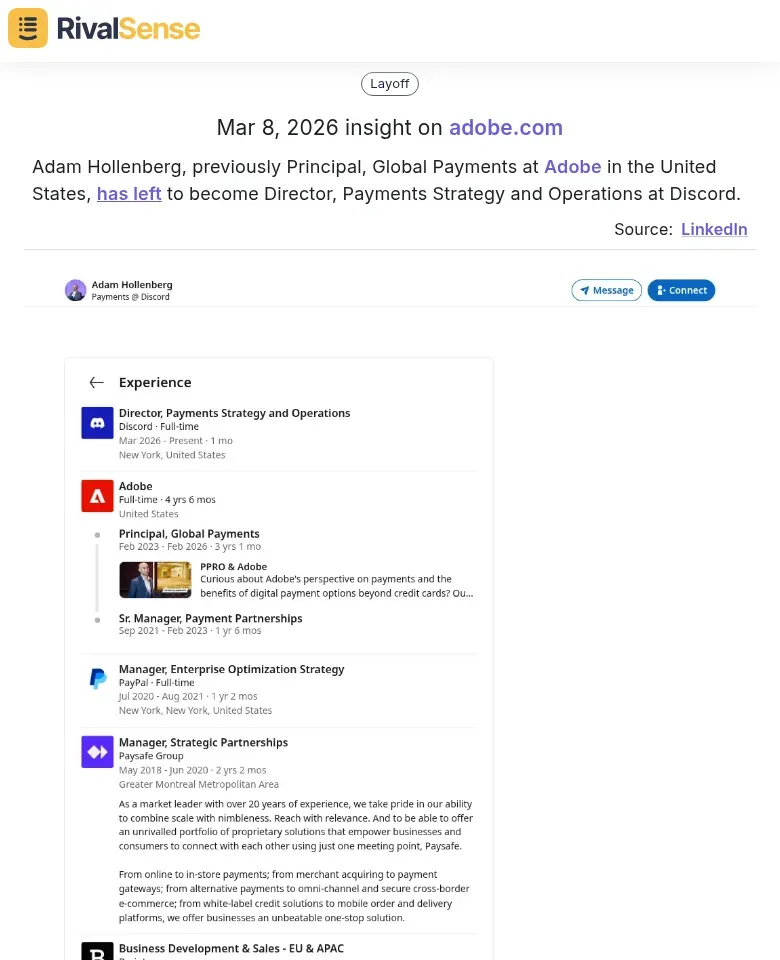
Adam Hollenberg, previously Principal, Global Payments at Adobe in the United States, has left to become Director, Payments Strategy and Operations at Discord.
This insight is valuable because it highlights cross-industry talent flow, indicating Discord's potential expansion into payments and financial services. By tracking such departures and new roles, you can spot emerging trends and competitive threats early.
3. Analyze Talent Acquisition Patterns:
- Map hiring concentrations (e.g., 5+ AI engineers = AI product focus)
- Identify skill gaps in competitor teams that represent market opportunities
- Benchmark your talent acquisition speed against competitors
- Create a "talent radar" tracking where competitors recruit from (universities, companies)
Actionable Checklist:
- [ ] Set up weekly competitor LinkedIn monitoring sessions
- [ ] Create a spreadsheet tracking key personnel changes
- [ ] Establish baseline metrics for competitor hiring velocity
- [ ] Identify 3-5 strategic hiring patterns to watch
- [ ] Schedule quarterly competitive positioning reviews based on talent insights
Case Studies: How Top Companies Leverage LinkedIn for Product Advantage
Real-world examples demonstrate how LinkedIn monitoring can yield tangible product advantages. Companies that systematically track executive moves and hiring patterns gain early warnings of competitor initiatives, allowing them to adapt swiftly.
Case Study 1: AI Governance Product Launch
A SaaS competitor hired three AI ethics specialists and a prompt engineering lead. An enterprise software company, monitoring these hires, anticipated an AI governance product launch and accelerated their own compliance features by six months, capturing market share.
Case Study 2: Fintech Expansion into Mobility
When a fintech company lost its head of blockchain to a mobility platform, competitors recognized this cross-industry talent flow as signaling Bolt's expansion into financial services. This prompted immediate adjustments in competitive positioning and messaging.
Case Study 3: ESG-Focused Solutions
A healthcare tech company noticed a competitor's new "Sustainability Partnerships" division through LinkedIn hiring patterns. They launched their own ESG-focused solutions first, gaining first-mover advantage in a growing market segment.
Practical Implementation Framework:
- Weekly executive movement alerts for top 5 competitors
- Monthly analysis of hiring patterns by function and seniority
- Quarterly competitive positioning adjustments based on organizational changes
- Immediate response protocols for critical talent movements
By transforming LinkedIn insights into proactive strategy, companies gain 3-6 month lead time on competitor moves, turning competitive intelligence into sustainable market advantage.
Building Your LinkedIn Competitor Monitoring System
Building an effective LinkedIn competitor monitoring system requires automation, integration, and actionable reporting. Start by identifying your top competitors and key personnel to track, then leverage tools to streamline the process.
1. Automate Executive Movement Tracking
- Use tools like RivalSense to monitor competitor leadership pages automatically
- Set up alerts for C-suite changes, product leadership transitions, and key technical hires
- Track patterns: Are they hiring more AI engineers? Expanding into new markets?
2. Integrate with Competitive Intelligence Workflows
- Combine LinkedIn insights with product announcements, funding news, and market data
- Create a centralized dashboard showing personnel changes alongside product releases
- Use timeline analysis: Do executive hires precede major product launches by 3-6 months?
3. Create Actionable Reports
- Connect personnel changes to product implications:
- New VP of Engineering → Likely technical infrastructure overhaul
- Head of AI/ML hire → Potential AI feature development
- Sales leadership expansion → Market penetration strategy
- Include checklists:
- [ ] Verify LinkedIn profile changes against official announcements
- [ ] Cross-reference with job postings for confirmation
- [ ] Analyze team growth patterns (departments expanding/contracting)
- [ ] Monitor competitor alumni networks for talent flow patterns
Pro Tip: Focus on timing correlations. When a competitor hires a specialist in a particular technology, expect related product updates within 6-12 months. Document these patterns to predict their strategic direction.
Put Insights into Action with RivalSense
Manually tracking LinkedIn for competitor insights can be time-consuming and error-prone. RivalSense automates this process by tracking competitor product launches, pricing updates, event participations, partnerships, regulatory aspects, management changes, and media mentions across company websites, social media, and various registries. It delivers all this intelligence in a weekly email report, saving you hours of manual research.
By using RivalSense, you can quickly identify patterns like the executive moves highlighted in this post, allowing you to anticipate competitor strategies and adjust your product roadmap proactively.
Ready to transform your competitive intelligence? Try RivalSense for free at https://rivalsense.co/ and get your first competitor report today to start uncovering valuable insights that drive your business strategy.
📚 Read more
👉 Remote Work Software: Key Account Tracking Automation Trends 2026
👉 Solving Regulatory Compliance Gaps: How Competitor Insights Drive Proactive Account Management
👉 How to Decode Competitor Moves from Event Announcements: A DataDome Case Study
👉 The Strategic Guide to Tracking Key Account Milestones for B2B Leaders
👉 Mastering Key Account Management with Commercial Banks for B2B Companies