
Key Account Tracking Integration: A Complete Guide for B2B Success in 2026
In today's hyper-competitive B2B landscape, your key accounts represent more than just revenue—they're strategic assets that can make or break your business. Research shows that just 20% of your accounts typically generate 80% of your revenue. Yet most companies still manage these critical relationships with fragmented systems and manual processes that leave them vulnerable to competitive threats.
The reality is stark: Without integrated key account tracking, you're essentially flying blind. You miss early warning signs of account dissatisfaction, overlook expansion opportunities, and remain unaware of competitive movements that could jeopardize your most valuable relationships.
The 5-Pillar Framework for Effective Key Account Tracking Integration
Implementing integrated key account tracking requires a structured approach. The following five pillars provide a comprehensive framework to ensure you capture all critical aspects and turn data into strategic advantage.
Pillar 1: Centralized Data Management
Your first step is creating a single source of truth for all account information. This goes beyond basic CRM data to include comprehensive details that paint a full picture of each relationship. Centralized data eliminates silos and ensures every team member operates with the same insights, leading to more coordinated and effective account management.
Practical Checklist for Data Centralization:
✅ Contact Intelligence: Track all decision-makers, influencers, and operational contacts with their roles, influence levels, and relationship history
✅ Communication Repository: Log every interaction—emails, calls, meetings, and important conversations—with timestamps and context
✅ Contract Management: Document terms, renewal dates, pricing structures, and service level agreements
✅ Usage Analytics: Monitor product adoption rates, feature utilization, and engagement patterns
✅ Financial Tracking: Record revenue history, profitability metrics, and growth trends
Pro Tip: Don't rely on spreadsheets or basic CRMs. Use dedicated account management platforms that provide the structure needed for comprehensive tracking. The goal is to eliminate data silos that prevent a unified view of each account.
Pillar 2: Real-Time Health Scoring and Automated Alerts
Proactive account management requires instant insights into account health. Implement a scoring system that automatically assesses account health based on multiple data points. This allows you to identify risks early and take corrective action before issues escalate, ensuring sustained account loyalty and growth.
Health Scoring Implementation Steps:
- Define Scoring Criteria: Weight factors based on business priorities (e.g., engagement 40%, usage 30%, financial health 30%)
- Set Up Automated Data Feeds: Connect your CRM, support system, and product analytics
- Establish Alert Thresholds: Create triggers for at-risk accounts (e.g., score drops below 70)
- Design Escalation Procedures: Define actions for different risk levels
- Validate with Historical Data: Test the system using past account outcomes
Key Metrics to Track:
- Engagement frequency and quality
- Product adoption and feature utilization
- Customer satisfaction scores and sentiment
- Payment history and contract value trends
- Support ticket volume and resolution times
Pillar 3: Competitive Intelligence Integration
Your key accounts are constantly being courted by competitors. Effective tracking must include monitoring competitive movements that could impact your relationships. Integrating competitive intelligence into your account tracking ensures you're not caught off guard by rival actions, allowing you to defend and grow your accounts proactively.
Why Competitive Monitoring is Non-Negotiable:
- 68% of lost key accounts cite competitor offers as a primary reason for switching
- Early detection of competitive threats allows proactive response
- Understanding competitor strategies helps you anticipate account needs
Practical Implementation Strategy:
Competitive Intelligence Checklist for Your Reports:
✅ Product Innovation Tracking: Monitor competitor launches of features or products that appeal to your accounts' industries
✅ Strategic Moves Monitoring: Track acquisitions, partnerships, or executive changes that signal strategy shifts
✅ Pricing and Service Updates: Watch for competitor pricing adjustments or service term changes
✅ Market Expansion Signals: Monitor geographic expansion and new market entries
✅ Regulatory Changes: Follow industry regulations that impact your competitive landscape
Real-World Examples from RivalSense Insights:
-
Pricing and Service Updates: Netcredit updated its representative example for a credit card limit of 1,000.00 zł, reducing the annual percentage rate (RRSO) from 39.55% to 38.97% and the variable annual interest rate from 15.00% to 14.50%, with the calculation date changed from 04.12.2025 to 05.03.2026.
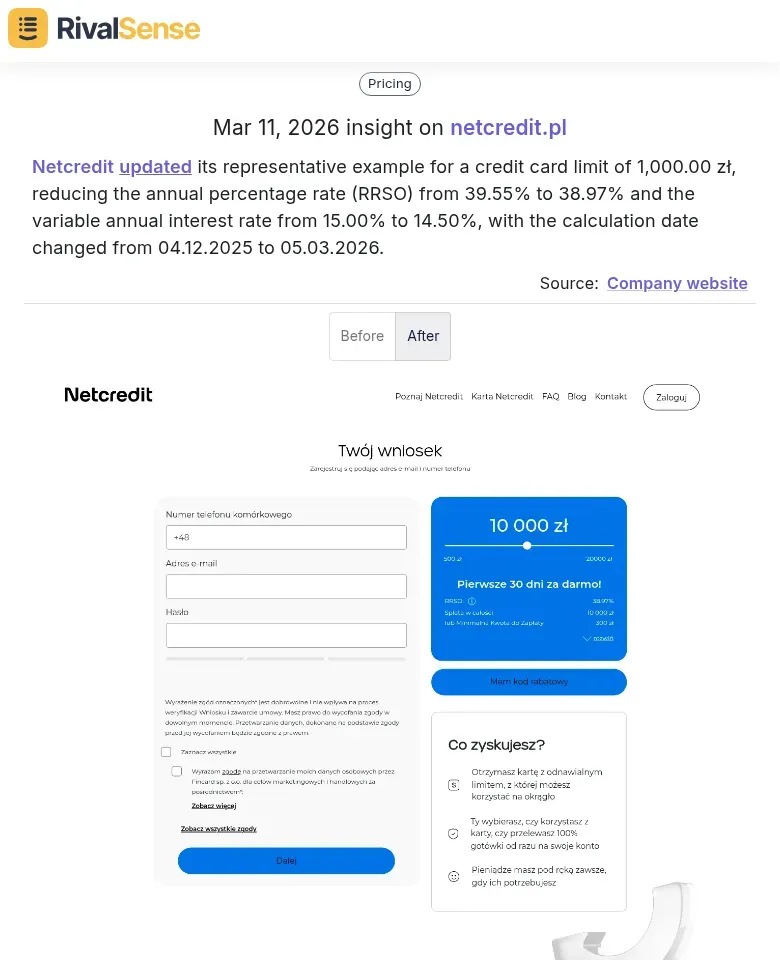
Why it's valuable: Tracking such pricing adjustments is crucial for understanding competitor cost structures and value propositions. This insight helps you anticipate how competitors might attract your key accounts with better rates, enabling you to adjust your own pricing strategies or highlight your unique value to defend your relationships. -
Strategic Moves Monitoring: Revolut is hiring a Market & Liquidity Risk Manager in Colombia to build its financial risk framework from scratch as it prepares to launch operations in the country.
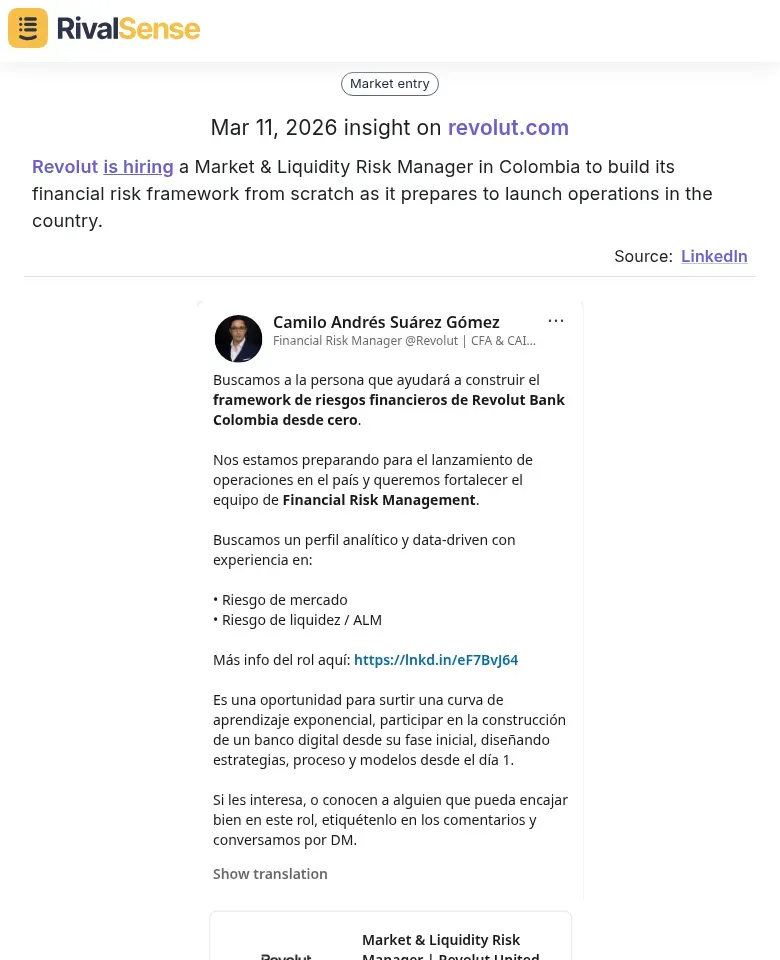
Why it's valuable: Monitoring hiring activities like this signals competitor expansion into new markets. For your key accounts in or related to Colombia, this could mean increased competitive pressure. Early detection allows you to reinforce your relationships and showcase your stability and commitment before competitors gain a foothold. -
Product Innovation Tracking: Glean integrated directly with ChatGPT and Claude using MCP to embed real company context into dialogues while being permission-aware and current.

Why it's valuable: This type of product innovation shows how competitors are leveraging AI to enhance their offerings. For your key accounts, such integrations might represent increased efficiency or new capabilities. By tracking these moves, you can assess if you need to innovate similarly or differentiate your product to meet evolving customer expectations.
Pillar 4: Workflow Automation and CRM Integration
Transform your key account tracking from administrative burden to strategic growth engine through automation. Integrated workflows save time, reduce errors, and ensure consistent follow-ups, allowing your team to focus on high-value activities that strengthen account relationships.
Workflow Automation Implementation Checklist:
✅ Audit Current Processes: Identify manual bottlenecks in your account tracking workflows
✅ Implement AI-Powered Intelligence: Use conversation analysis to detect early churn signals
✅ Set Up Automated Health Scoring: Configure risk thresholds and intervention triggers
✅ Integrate Whitespace Analytics: Identify expansion opportunities before competitors do
✅ Establish Real-Time Benchmarking: Compare performance against industry standards
Key Advantage: Automated systems save account managers 20+ hours weekly while providing predictive insights. By 2026, integrated automation isn't optional—it's the foundation for sustainable 15-25% annual revenue growth from existing accounts.
Pillar 5: Actionable Reporting and Dashboard Design
Create reports that drive action, not just collect data. Different stakeholders need different insights to make informed decisions. Well-designed dashboards provide at-a-glance visibility into account health, enabling quick responses to opportunities and threats.
Step-by-Step Reporting Framework:
Step 1: Define Your Reporting Objectives
- Strategic Reports: For executive leadership focusing on portfolio health and growth opportunities
- Operational Reports: For account managers tracking day-to-day relationship management
- Tactical Reports: For cross-functional teams needing specific insights
Step 2: Select Key Performance Indicators
Limit your core KPIs to 5-7 per report type to maintain focus:
- Financial KPIs: Account revenue growth rate, customer lifetime value, profitability per account
- Relationship KPIs: Net Promoter Score, stakeholder engagement levels, executive alignment scores
- Operational KPIs: Response time to account issues, opportunity win rates, competitive threat detection time
Step 3: Design Your Reporting Dashboard
Executive Dashboard Example:
- Portfolio Health Overview with color-coded account status
- Revenue Concentration showing distribution across top accounts
- Growth Opportunities with pipeline value by account
- Competitive Landscape tracking recent competitor activities
- Risk Assessment highlighting accounts requiring immediate attention
Account Manager Dashboard Example:
- My Accounts Overview with quick status of all assigned accounts
- Upcoming Activities calendar for renewals and important dates
- Health Score Trends with historical tracking
- Action Items with priority tasks and deadlines
- Competitive Alerts for recent competitor movements
Step 4: Establish Reporting Cadence
- Daily: Real-time alerts for critical issues
- Weekly: Operational updates for account managers
- Monthly: Performance reviews and strategic planning
- Quarterly: Executive business reviews
- Annually: Comprehensive account planning
Advanced Techniques for 2026
Predictive Analytics for Proactive Management
Move beyond reactive tracking to predictive insights. Leveraging historical data and machine learning, you can anticipate account behaviors and outcomes before they happen. This proactive approach allows you to address risks and seize opportunities with precision, enhancing account retention and growth.
Implementation Steps:
- Collect historical data on account behaviors and outcomes
- Build predictive models for churn risk and expansion opportunities
- Integrate predictions into your tracking dashboards
- Establish protocols for acting on predictive insights
AI-Powered Relationship Intelligence
Leverage artificial intelligence to enhance your tracking capabilities. AI can analyze vast amounts of data to uncover patterns and insights that humans might miss, providing a deeper understanding of account dynamics and improving decision-making.
AI Applications in Key Account Tracking:
- Sentiment Analysis: Automatically assess tone in communications
- Interaction Pattern Recognition: Identify optimal engagement frequencies
- Stakeholder Mapping: Use AI to track influence networks within accounts
- Automated Insight Generation: Have AI highlight important trends and anomalies
Implementation Roadmap: Getting Started
Phase 1: Foundation (Weeks 1-4)
Start small to build momentum and refine your approach before scaling. Focus on establishing core tracking processes and training your team to ensure buy-in and effectiveness.
- Select 5-10 most important accounts to start
- Set up basic tracking and health scoring
- Train your team on the new system
- Establish baseline metrics for comparison
Phase 2: Scaling (Months 2-3)
Expand your system to cover more accounts and integrate additional data sources. This phase solidifies your tracking infrastructure and begins to deliver comprehensive insights across your portfolio.
- Expand tracking to all key accounts
- Integrate data sources (CRM, support, product analytics)
- Implement competitive monitoring tools
- Refine reporting based on initial feedback
Phase 3: Optimization (Months 4-6)
Enhance your system with advanced capabilities and automation. Continuous optimization ensures your tracking remains relevant and effective as your business and the market evolve.
- Add predictive capabilities and AI insights
- Enhance automation to reduce manual work
- Conduct regular reviews and updates
- Scale best practices across the organization
Common Pitfalls to Avoid
-
Data Overload: Tracking too many metrics without clear purpose
Solution: Focus on actionable KPIs that drive specific decisions -
Siloed Information: Account data scattered across different systems
Solution: Implement centralized platforms that integrate multiple data sources -
Lack of Action Orientation: Reports that don't lead to concrete actions
Solution: Include clear recommendations and next steps in every report -
Ignoring Competitive Context: Tracking account health without considering competitive landscape
Solution: Integrate competitive intelligence into your regular reporting
The Future of Key Account Tracking: 2026 and Beyond
Technology is rapidly evolving, and key account tracking must keep pace. Emerging tools and trends will enable even deeper insights and more automated responses, transforming how businesses manage their most valuable relationships.
📚 Read more
👉 2026 Brand Sentiment Analysis for Management Consulting Competitors
👉 How RivalSense Helped a Competitor Counter Lendermarket's Fee Elimination
👉 Best Practices for Instagram Competitor Loyalty Program Analysis
👉 Mastering Key Account Management in Security Technology: A Strategic Guide
👉 Competitor Partnership Analysis: Strategic Tracking for Key Account Renewals