
Key Account Tracking Best Practices: The 2026 Strategic Guide for Business Leaders
In today's hyper-competitive B2B landscape, key accounts aren't just customers—they're strategic assets that can make or break your company's success. With 80% of revenue typically coming from just 20% of customers (the Pareto principle in action), effective key account tracking has never been more critical. Yet most companies still rely on outdated methods that leave them vulnerable to competitive threats and missed opportunities.
This comprehensive guide explores the essential best practices for key account tracking in 2026, providing practical steps, checklists, and actionable strategies that transform account management from reactive support to proactive strategic partnership.
The Evolution of Key Account Tracking: Beyond Basic Metrics
Traditional account management focused primarily on internal metrics like revenue growth and customer satisfaction. Today's landscape demands a more holistic approach that incorporates competitive intelligence and real-time market dynamics. By tracking beyond basic metrics, you can anticipate shifts and protect your most valuable relationships from competitors.
- Competitive intelligence: Understanding how competitors are positioning themselves with your key accounts
- Market dynamics: Tracking industry trends that could impact account relationships
- Real-time alerts: Immediate notifications about changes that could affect account health
- Cross-platform monitoring: Comprehensive tracking across websites, social media, and industry registries
The 4-Pillar Framework for Comprehensive Key Account Tracking
1. Financial Performance Tracking
Monitoring financial performance is essential for assessing the value and stability of your key accounts. It involves analyzing metrics that reveal revenue trends, payment efficiency, and long-term profitability. By keeping a close eye on these indicators, you can make informed decisions about resource allocation and risk management.
Days Sales Outstanding (DSO)
- Formula: (Accounts Receivable / Total Credit Sales) × Number of Days
- Why it matters: Tracks payment efficiency—critical for cash flow management with key accounts
- Industry benchmarks:
- High DSO (60+ days): Construction, Engineering, Professional Services
- Moderate DSO (40-60 days): Healthcare, Manufacturing, Technology
- Low DSO (<40 days): Utilities, Telecommunications
Customer Lifetime Value (CLV)
- Tracking method: Monitor revenue trends, contract extensions, and upsell opportunities
- Strategic importance: Helps prioritize resource allocation to highest-value accounts
2. Relationship Health Monitoring
Relationship health monitoring goes beyond simple satisfaction scores to gauge the depth and strength of your account partnerships. It involves tracking engagement levels, feedback, and interaction quality to ensure you're meeting client needs and fostering loyalty.
Customer Satisfaction Score (CSAT)
- Measurement: Regular surveys and feedback mechanisms
- Best practice: Track changes over time and correlate with competitor activities
Strategic Engagement Rate
- What to track: Response rates to strategic outreach, content downloads, meeting attendance
- Pro tip: Monitor how your engagement compares to competitors' outreach efforts
3. Competitive Positioning Analysis
Competitive positioning analysis helps you understand how you stack up against rivals in the eyes of your key accounts. By tracking competitor moves, you can identify threats and opportunities to refine your strategy and maintain a competitive edge.
Competitor Activity Index
- What it measures: Frequency and impact of competitor interactions with your key accounts
- Why it's critical: Early detection of competitive threats allows for proactive response
- How to track: Use tools like RivalSense to monitor competitor product launches, pricing changes, and executive movements that could affect your account relationships
Market Share Movement
- Tracking method: Regular analysis of account spending patterns and vendor preferences
- Strategic value: Identifies opportunities for account expansion or risk of contraction
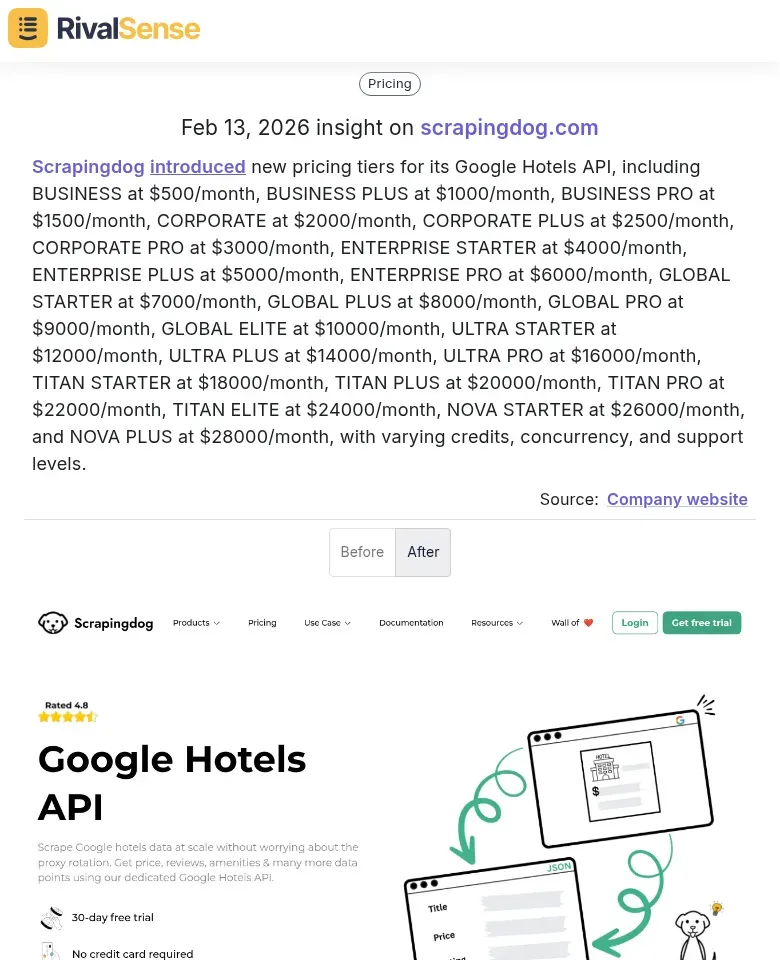
Example: Pricing Changes – Tracking competitor pricing updates is vital for adjusting your own offers and preventing customer churn. For instance, RivalSense detected that Scrapingdog introduced new pricing tiers for its Google Hotels API, ranging from $500 to $28,000 per month with varying features. This insight allows you to analyze how such pricing shifts might influence your key accounts' budget decisions and competitive positioning.
4. Operational Efficiency Metrics
Operational efficiency metrics ensure that your team is delivering timely and effective service to key accounts. By measuring resolution times and coverage ratios, you can optimize processes and enhance account satisfaction.
Time to Resolution
- Measurement: Average time to resolve account issues or support requests
- Industry benchmark: Aim for <24 hours for critical issues
Account Coverage Ratio
- Formula: (Number of contacts engaged / Total contacts in account) × 100
- Target: Maintain >80% coverage for strategic accounts
Practical Implementation Checklist
✅ Weekly Tracking Activities
Weekly tracking keeps you agile and responsive to immediate changes. Dedicate time each week to review critical metrics and alerts to stay ahead of potential issues.
- Review DSO and aging reports for key accounts
- Monitor competitor activity alerts (product launches, pricing changes, executive movements)
- Check customer engagement metrics and response rates
- Update account health scores based on recent interactions
- Scan for regulatory developments affecting key accounts
✅ Monthly Review Tasks
Monthly reviews provide a broader perspective on account performance and trends. Use this time to analyze cumulative data and adjust strategies accordingly.
- Analyze CLV trends and identify growth opportunities
- Review competitive positioning across all key accounts
- Assess customer satisfaction scores and identify improvement areas
- Evaluate market share movements and competitive threats
- Track partnership announcements and event participations
✅ Quarterly Strategic Analysis
Quarterly analysis allows for deep dives into account portfolios and long-term planning. Involve cross-functional teams to align on strategic adjustments and risk mitigation.
- Conduct comprehensive account portfolio review
- Update competitive intelligence and market positioning
- Review and adjust account strategies based on KPI trends
- Identify accounts at risk and develop mitigation plans
- Benchmark performance against industry standards
Modern Tools for Key Account Tracking Excellence
While traditional tools like CRM systems handle basic tracking, 2026 demands more sophisticated solutions. Modern platforms integrate real-time data, automation, and predictive analytics to provide a holistic view of account health and competitive landscape.
Essential Features Checklist
✅ Real-time competitor monitoring across multiple sources
✅ Automated alerts for critical account developments
✅ Cross-platform integration with existing CRM systems
✅ Predictive analytics for trend identification
✅ Comprehensive reporting with customizable dashboards
The RivalSense Advantage
Unlike basic monitoring tools, RivalSense provides comprehensive competitor intelligence across 80+ sources including company websites, social media, regulatory filings, industry registries, and media mentions. All delivered in a consolidated weekly report, saving account managers hours of manual research while providing actionable insights into competitor product launches, pricing changes, executive movements, partnership announcements, and regulatory developments.
Tactical Strategies for KPI-Driven Success
🛡️ Proactive Account Defense Strategies
Proactive defense involves anticipating and mitigating risks before they impact your accounts. By monitoring signals like competitor hiring and regulatory changes, you can develop preemptive responses.
- Monitor competitor hiring patterns: Early detection of competitor account manager changes
- Track regulatory developments: Stay ahead of compliance issues affecting key accounts
- Analyze social media sentiment: Gauge account satisfaction relative to competitors
- Set up early warning systems: Alerts for competitor activities targeting your key accounts
📈 Growth Opportunity Identification
Growth identification focuses on spotting white spaces and expansion signals in the market. Leverage competitive intelligence to uncover areas where competitors are weak or where new partnerships are forming.
- Use competitive intelligence: Identify accounts where competitors are weak
- Leverage partnership tracking: Discover collaboration opportunities before competitors
- Monitor industry events: Plan strategic attendance and engagement
- Analyze expansion signals: Track competitor growth patterns for market opportunities
⚠️ Risk Mitigation Framework
Risk mitigation requires regular assessments and contingency planning. By involving multiple teams and continuously improving processes, you can safeguard account relationships.
- Regular health assessments: Quarterly reviews of all KPI metrics
- Contingency planning: Develop response strategies for various competitive scenarios
- Cross-functional collaboration: Involve sales, marketing, and product teams in account strategy
- Continuous improvement: Regular refinement of tracking processes based on performance data
Real-World Competitive Intelligence Examples
🚀 Expansion Signals Market Opportunities
When companies expand operations or create new job opportunities in specific sectors, this signals market growth and potential account expansion opportunities. Tracking such expansions helps identify new decision-makers and budget allocations early.
⚖️ Regulatory Developments Impact Account Stability
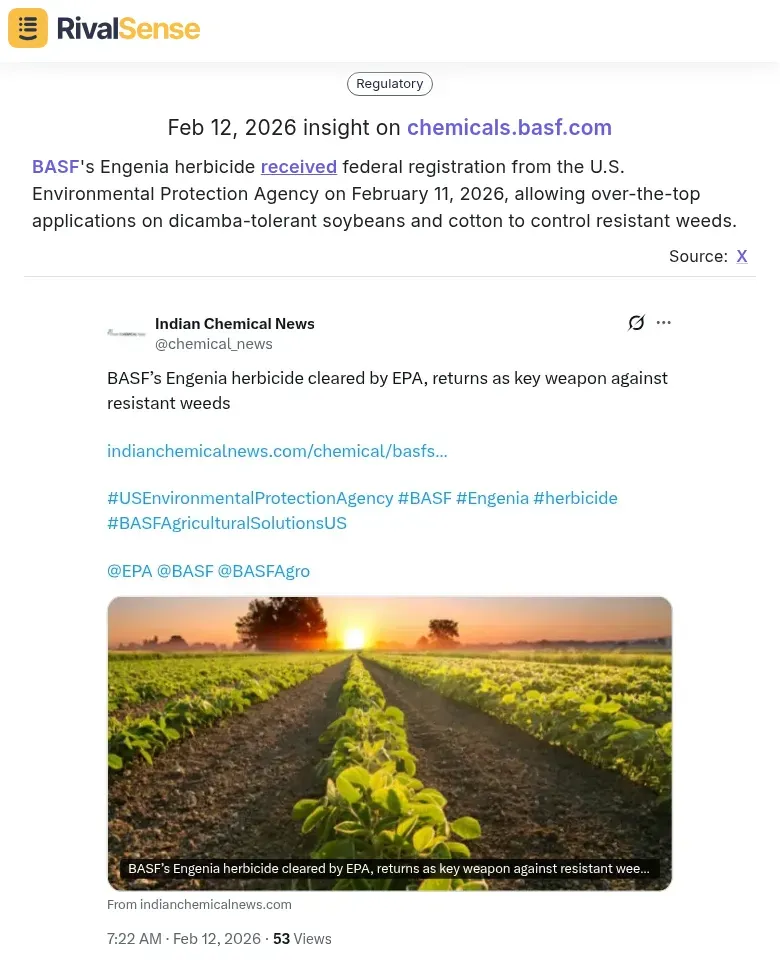
Regulatory approvals can significantly affect account stability and purchasing behavior. For example, RivalSense tracked that BASF's Engenia herbicide received federal registration from the U.S. Environmental Protection Agency in February 2026, allowing over-the-top applications on dicamba-tolerant crops. This insight is valuable for assessing how regulatory changes might impact key accounts in the agriculture sector and anticipating shifts in product demand.
🤝 Partnership Announcements Reveal Strategic Shifts
Partnerships often indicate strategic shifts and new competitive advantages. Monitoring these announcements helps you understand evolving market dynamics. For instance, RivalSense detected that Tilray's CC Pharma entered an agreement with Smartway Pharmaceuticals to expand product availability in the UK. This partnership insight reveals strategic moves that could affect key accounts in pharmaceutical distribution, allowing you to adjust your value proposition accordingly.
Best Practices for Sustainable Key Account Tracking
1. Focus on Quality Over Quantity
Track the vital few indicators that truly reflect strategic success. A good rule of thumb is to have 3-5 primary KPIs for the company as a whole, with each department tracking an additional 3-5 KPIs specific to its function.
2. Ensure Data Accuracy and Integrity
Your tracking system is worthless if the underlying data is unreliable. Implement data governance policies and use automated data integration tools to eliminate human error.
3. Contextualize Your Data for Deeper Insights
Don't just report numbers—provide context. Always analyze KPIs in the context of goals, historical trends, and business activities to turn data into a compelling story.
4. Foster Open Communication and Collaboration
Use KPI review meetings as collaborative sessions to discuss what's working, what isn't, and how to improve. When teams feel safe to discuss underperforming KPIs without fear of punishment, you foster a culture of transparency and continuous learning.
5. Be Flexible and Adapt as Business Goals Evolve
Conduct annual or semi-annual reviews of your entire KPI framework. Ask critical questions: Are these KPIs still relevant? Do they still align with our current objectives?
Common Pitfalls and How to Avoid Them
❌ Avoiding Vanity Metrics
For every KPI, ask the "So what?" question. If this number goes up, what is the tangible impact on revenue, profit, or customer satisfaction? Tie every KPI back to a core business objective.
❌ Setting Unrealistic Targets
Use historical data and industry benchmarks to set challenging but achievable goals. Ensure targets are specific and time-bound, following the SMART framework.
❌ Overlooking Data Governance
Create a data dictionary that clearly defines each KPI and its calculation method. Assign clear ownership for each data source and KPI.
❌ Tracking in Silos
Invest in tools that can provide a single, unified view of performance. Effective tracking must integrate data from across the entire customer lifecycle.
❌ Forgetting the "Why"
Regularly communicate the strategic narrative behind your KPIs during review meetings. Constantly reinforce how improving a specific indicator contributes to the company's overarching mission.
Advanced Strategies for Competitive Edge
Predictive Analytics and Forecasting
Instead of just looking at past performance, use historical data, statistical algorithms, and machine learning techniques to identify the likelihood of future outcomes. Apply this to your KPIs to forecast future revenue, predict customer churn, or estimate future demand.
AI-Powered Competitive Intelligence
Artificial Intelligence can analyze vast datasets far more quickly and effectively than a human analyst. AI-powered tools can automatically detect anomalies in your KPI trends, identify hidden correlations between different metrics, and even suggest specific actions to improve performance.
Automated Reporting Cycles
Using reporting automation tools, you can schedule and automatically distribute customized reports to different stakeholders via email, Slack, or other channels. This eliminates countless hours of manual report building and ensures consistent, timely communication.
Frequently Asked Questions
How often should we review key account KPIs?
- Weekly: DSO, engagement metrics, competitor alerts
- Monthly: CLV, satisfaction scores, market positioning
- Quarterly: Comprehensive portfolio analysis and strategy adjustment
Can automation improve KPI tracking accuracy?
Absolutely. Modern tools provide:
- Real-time dashboard updates
- Automated competitor monitoring
- Predictive analytics for trend identification
- Integrated CRM synchronization
How does competitive intelligence enhance account management?
Competitive tracking allows you to:
- Anticipate competitor moves before they happen
- Position your solutions more effectively
- Identify white space opportunities
- Develop more compelling value propositions
What's the ROI of comprehensive KPI tracking?
Companies that implement full-spectrum KPI tracking typically see:
- 15-25% improvement in account retention
- 20-30% faster identification of growth opportunities
- 40-50% reduction in competitive surprise incidents
- Significant time savings on manual research
Conclusion: Transforming Account Management in 2026
In 2026, key account management success isn't just about what you know about your accounts—it's about what you know about everything affecting your accounts. The most successful account managers leverage comprehensive KPI tracking that combines financial metrics, relationship health indicators, and competitive intelligence.
By implementing the framework outlined above and leveraging modern tools, you can transform your account management from reactive to proactive, from guesswork to data-driven strategy, and from customer service to strategic partnership.
Ready to transform your key account tracking strategy? Try RivalSense for free at https://rivalsense.co/ to get your first competitor report today and gain comprehensive insights into your competitors' moves. Start by implementing one new practice from this guide each week, and see how competitive intelligence can give you the edge in today's competitive landscape.
📚 Read more
👉 Mastering Key Account Management: A Practical Implementation Guide for B2B Leaders
👉 How IDnow's Regulatory Hire Enabled Competitors to Counter EU Wallet Strategy
👉 Website Change Intelligence: A Proactive Framework for Key Account Success
👉 2026 Social Media Key Account Monitoring: Essential Checklist for B2B Leaders
👉 Competitor Financials & M&A Benchmarking: Key Account Growth Insights for 2026