
Key Account Management Webinar: Transforming Strategy with Competitive Intelligence
Key account management is the cornerstone of B2B growth, yet many companies operate with blind spots that leave their most valuable clients exposed. The silent threat often comes from competitors who are actively targeting your accounts with tailored offers and innovations. If your fiercest competitor called your biggest customer tomorrow with a better deal, how confident are you that they'd stick with you? This isn't a hypothetical question—it's the daily reality for B2B companies managing key accounts. While every sales organization claims their key accounts are their lifeblood, the gap between saying and doing often leaves critical relationships exposed.
The real problem isn't mindset—it's systemic. Organizations talk endlessly about protecting top customers while maintaining one-size-fits-all processes that treat small and large accounts identically. This operational disconnect creates vulnerability where you can least afford it.
Why Traditional Webinars Fail Key Accounts
Most key account management webinars focus on relationship-building techniques, communication strategies, and account planning frameworks. While valuable, they miss the critical competitive dimension that defines modern B2B landscapes. Your key accounts aren't operating in a vacuum—they're constantly being courted by your competitors who are launching targeted initiatives to sway them. Competitors are:
- Launching new features specifically targeting your weaknesses
- Adjusting pricing to undercut your value proposition
- Forming partnerships that create ecosystem advantages
- Participating in industry events your accounts attend
Practical Insight: The most effective key account managers don't just understand their clients—they understand their competitors' strategies toward those same clients. This intelligence transforms webinars from generic trainings into strategic sessions that preempt threats.
5-Step Competitive Intelligence Framework for Key Account Webinars
Step 1: Pre-Webinar Competitive Analysis
Before you even schedule your webinar, conduct this competitor audit to ground your content in reality:
- Feature Benchmarking Matrix: Create a quarterly comparison of 5-7 key competitors' features mapped to your key accounts' specific pain points
- Integration Strategy Analysis: Document how competitors embed solutions within existing workflows to reduce adoption friction
- Design Innovation Tracking: Monitor conceptual launches and design patents for early signals of competitor positioning shifts
Pro Tip: Use automated tools like RivalSense to track competitor product launches, pricing updates, and partnership announcements across 80+ sources, delivering insights in weekly email reports. This ensures your analysis is based on real-time data, not outdated assumptions.
Step 2: Webinar Content That Addresses Competitive Threats
Structure your webinar around these competitive intelligence insights to deliver immediate value:
- Segment 1: "What Your Competitors Are Doing Right Now" - Share real-time competitor moves affecting your industry
- Segment 2: "The 3 Competitive Gaps You Need to Close" - Based on benchmarking data from your analysis
- Segment 3: "Proactive Response Planning" - Develop "if-then" scenarios for competitor moves
Practical Checklist for Webinar Content:
- ✓ Include specific competitor examples relevant to your audience
- ✓ Provide comparison matrices showing competitive advantages
- ✓ Offer preemptive response templates
- ✓ Share monitoring frameworks attendees can implement immediately
Step 3: Post-Webinar Competitive Action Plans
Transform webinar insights into account-specific strategies that protect revenue:
- Account Vulnerability Assessment: For each key account, identify 2-3 areas where competitors outperform you
- Response Timeline: Create 30/60/90-day action plans based on competitive threats
- Value Proposition Enhancement: Use benchmarking data to quantify your advantages
Example Framework:
| Competitor Move | Your Response | Timeline | Account Impact |
|---|---|---|---|
| Feature Launch X | Enhance Y feature | 45 days | High-risk accounts A, B, C |
| Price Reduction | Value-add service | 30 days | Price-sensitive accounts |
| Partnership | Ecosystem integration | 60 days | Strategic accounts |
Step 4: Monitoring and Alert Systems
Implement these practical monitoring steps to stay ahead of competitor moves:
- Set up automated alerts for 3-5 key competitor activities
- Create a simple template to document insights and actions
- Schedule recurring review meetings with your team
- Start small with 2-3 key competitors and 1-2 critical metrics, then expand
Weekly Monitoring Checklist:
- ✓ Competitor product updates/launches
- ✓ Pricing changes
- ✓ Event participations
- ✓ Partnership announcements
- ✓ Media mentions
- ✓ Management changes
Step 5: Measuring Competitive Impact
Track these key metrics to validate your approach and demonstrate ROI:
- Competitive Win Rate: Percentage of deals won against specific competitors
- Account Retention Rate: Key account retention post-competitive threats
- Response Time: How quickly you address competitor moves
- Value Proposition Strength: Quantitative advantages over competitors
Real-World Examples: Strategic Insights from Competitor Moves
Learning from actual competitor activities provides concrete lessons for key account strategy. Here are insights tracked by RivalSense that demonstrate the value of competitive intelligence:
Insight 1: Product Enhancement for Market Positioning
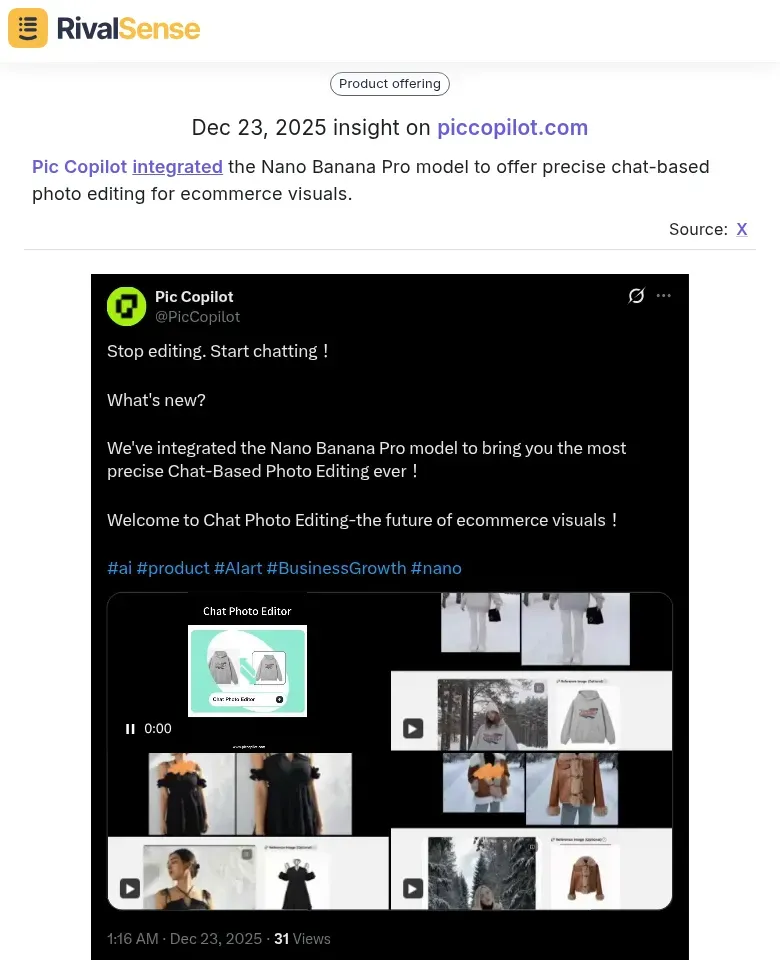
Pic Copilot integrated the Nano Banana Pro model to offer precise chat-based photo editing for ecommerce visuals. Why this insight matters: Tracking product integrations like this reveals how competitors are leveraging AI to enhance user experience and target specific verticals. For key account managers, such intelligence helps anticipate feature demands and adjust your own product roadmap to stay competitive, especially when serving clients in visual-heavy industries like ecommerce.
Insight 2: Partnership for Unique Offerings

Abercrombie & Kent partnered with MATERIAL to create a limited-edition vinyl for the launch of their new Amazon travel destination, recorded in the Peruvian rainforest and composed by Brian D’Souza (Auntie Flo). Why this insight matters: Monitoring partnership announcements uncovers how competitors build ecosystem advantages and create exclusive value propositions. For key account strategies, this highlights opportunities to collaborate or differentiate through unique experiences, ensuring your offerings remain compelling against such innovative moves.
Insight 3: Organizational Transformation and Analyst Recognition
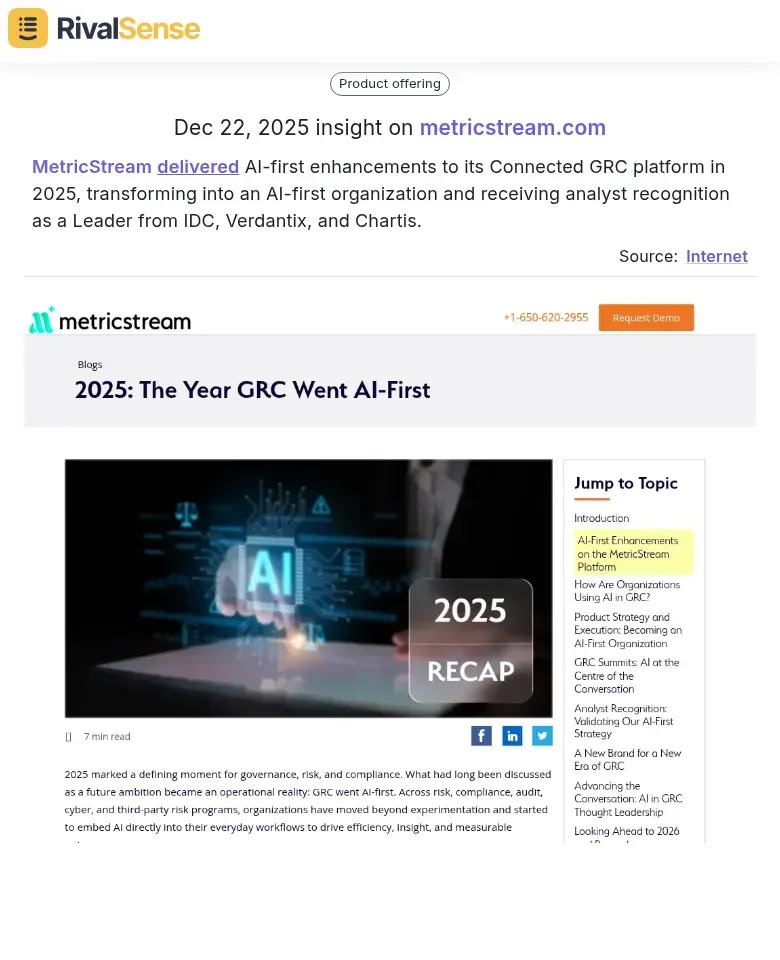
MetricStream delivered AI-first enhancements to its Connected GRC platform in 2025, transforming into an AI-first organization and receiving analyst recognition as a Leader from IDC, Verdantix, and Chartis. Why this insight matters: Following competitor transformations and analyst validations provides insights into market trends and credibility shifts. For key account protection, this intelligence helps you benchmark your own positioning and prepare responses to competitor claims of industry leadership, which can influence client perceptions.
The RivalSense Advantage: Automated Competitive Intelligence
While manual competitor tracking is possible, it's inefficient and often incomplete for today's fast-paced markets. RivalSense provides systematic competitive intelligence by automating the collection and analysis of critical data. This tool tracks 80+ sources including company websites, social media, registries, and industry publications to deliver actionable insights.
Practical Implementation: Start by monitoring 2-3 key competitors affecting your most vulnerable accounts. Use the insights to inform webinar content, account strategies, and response planning. The weekly reports consolidate competitive moves like product launches, pricing updates, event participations, partnerships, regulatory aspects, management changes, and media mentions, saving you hours of manual research.
Webinar Success Metrics: Beyond Attendance Numbers
Measure your key account webinar success with these competitive metrics to ensure tangible outcomes:
- Competitive Intelligence Adoption: Percentage of attendees implementing monitoring systems
- Response Plan Development: Number of account-specific competitive response plans created
- Retention Improvement: Key account retention rates post-webinar implementation
- Win Rate Enhancement: Competitive win/loss ratio improvements
The Ultimate Checklist: Protecting Key Accounts Through Competitive Intelligence
Pre-Webinar Preparation:
- [ ] Conduct competitor feature benchmarking
- [ ] Analyze integration strategies affecting your accounts
- [ ] Review recent competitor moves in your industry
- [ ] Set up basic monitoring alerts
Webinar Content Must-Haves:
- [ ] Specific competitor examples
- [ ] Actionable response frameworks
- [ ] Monitoring implementation guides
- [ ] Account-specific application exercises
Post-Webinar Implementation:
- [ ] Create account vulnerability assessments
- [ ] Develop competitive response timelines
- [ ] Establish regular monitoring cadence
- [ ] Train teams on competitive positioning
Ongoing Optimization:
- [ ] Quarterly competitor deep dives
- [ ] Monthly strategic analysis sessions
- [ ] Weekly tactical reviews
- [ ] Continuous metric tracking
Conclusion: From Reactive to Proactive Key Account Management
The most effective key account webinars don't just teach relationship management—they provide competitive intelligence frameworks that transform how organizations protect and grow their most valuable relationships. By understanding competitor moves before they impact your accounts, you shift from reactive firefighting to proactive strategy. This approach not only safeguards revenue but also strengthens partnerships through demonstrated foresight and value.
Final Insight: The companies winning key account battles aren't necessarily those with the best relationships—they're those with the best competitive intelligence. They know what their competitors are planning, how it affects their accounts, and what actions to take before threats materialize.
Start your competitive intelligence journey today by trying out RivalSense for free at https://rivalsense.co/. Implement one monitoring system, conduct one competitor analysis, and apply those insights to your next key account conversation. Get your first competitor report today and see the difference in retained revenue and strengthened partnerships.
📚 Read more
👉 Optimizing Telecom Infrastructure Key Account Task Tracking: A Strategic Process Guide
👉 How Nextiva's EHR Integration Strategy Enabled Competitors to Counterattack
👉 Internet Intelligence Workflow: Uncovering Why Competitors Succeed
👉 Best Practices for Mobility Trade Show Strategy to Outpace Competitors
👉 Quick Tips: Monitor Competitor Hiring & Layoffs via Regulatory Filings