
Key Account Management for SaaS: The Complete 2026 Guide to Strategic Growth
Your largest SaaS customers might represent 30-50% of your revenue today, but size only tells part of the story. In the fast-paced SaaS world, where subscription models and customer lifetime value reign supreme, identifying true key accounts requires looking beyond current revenue to future potential.
Consider Portrait Software's journey: a small client acquired by Pitney Bowes became a key account, and within 18 months, that partnership led to winning the larger Pitney Bowes business. This is the power of strategic key account management in SaaS—finding customers who will generate long-term revenue growth and become true strategic partners.
The SaaS-Specific Challenge: Why Traditional KAM Falls Short
SaaS businesses face unique challenges that traditional key account management approaches don't address. These dynamics require a more nuanced strategy to retain and grow accounts effectively.
- Subscription Dynamics: Monthly/Annual recurring revenue requires continuous value delivery
- Product-Led Growth: Adoption and usage metrics matter as much as contract size
- Competitive Switching Costs: Customers can churn with a click
- Market Intelligence Gap: You need to understand not just your accounts, but what your competitors are offering them
The 15-Point SaaS Key Account Identification Framework
Adapted from traditional KAM principles with SaaS-specific enhancements, this framework uses three categories: Growth, Harmony, and Value Creation. Score each customer 1-10 on these criteria to objectively identify your most strategic accounts.
GROWTH (Commercial Potential)
- Expansion Revenue Potential: How much can they spend on additional seats, features, or modules? Look at their employee growth rate and department expansion plans.
- Cost to Serve Efficiency: Can you serve them profitably at scale? Consider their technical sophistication and self-service capability.
- Usage Stability & Growth: Are adoption rates increasing? Monitor feature usage, login frequency, and data volume growth.
- Market Access Potential: Can they help you enter new verticals or geographies? Enterprise customers often have multiple business units across industries.
HARMONY (Strategic Fit)
- Product-Market Fit: Is your solution solving their core business problems? Track support ticket frequency and feature request alignment.
- Innovation Partnership: Will they beta test new features or participate in product development? Early adopters are gold.
- Reference & Case Study Value: Are they willing to be a public reference? This is especially valuable for SaaS social proof.
- Brand Alignment: Do their values and market position complement yours? This affects partnership longevity.
- Procurement Process Compatibility: Is their buying process compatible with your SaaS sales cycle?
VALUE CREATION (Partnership Orientation)
- Strategic Alignment: Can you help them achieve their digital transformation goals?
- Relationship Stability: Do they work collaboratively during challenges rather than issuing ultimatums?
- Long-Term Orientation: Do they view you as a strategic partner rather than a vendor?
- Joint Planning Behavior: Do they engage in mutual goal setting and regular business reviews?
- Mutual Success Mindset: Do they believe in win-win outcomes?
- Information Sharing: Do they provide valuable feedback and market intelligence?
The Competitive Intelligence Gap in SaaS KAM
Here's where most SaaS companies stumble: they evaluate accounts in a vacuum. But your key accounts are also being courted by your competitors. Without competitive intelligence, you're flying blind and risk surprise churn or missed expansion opportunities.
Practical Checklist: What You Need to Know About Your Competitors
- Product Updates: Are competitors launching features your key accounts want?
- Pricing Changes: Have competitors adjusted pricing that makes them more attractive?
- Partnership Announcements: Are competitors forming alliances that threaten your position?
- Event Participation: Where are competitors speaking that your key accounts attend?
- Management Changes: Has competitor leadership changed, signaling new strategic directions?
- Media Coverage: What narratives are competitors pushing that might resonate with your accounts?
Real-World Examples of Competitive Insights
To see how competitive intelligence directly impacts strategy, consider these real insights. Each type reveals opportunities or threats for your key account management approach.
-
Partnership Announcements: When Pfizer teamed up with TrumpRx to lower drug costs, it signaled a strategic move to capture market share through affordability. For SaaS, similar partnerships can indicate competitors expanding their value proposition, which you must counter in your accounts.

-
Management Changes: OneTrust appointed John Heyman as Chief Executive Officer on February 9, 2026, to advance its AI-Ready Governance Platform innovation. Leadership changes often precede product or market shifts; tracking these helps you anticipate competitor moves and reassure your accounts of your stability.
-
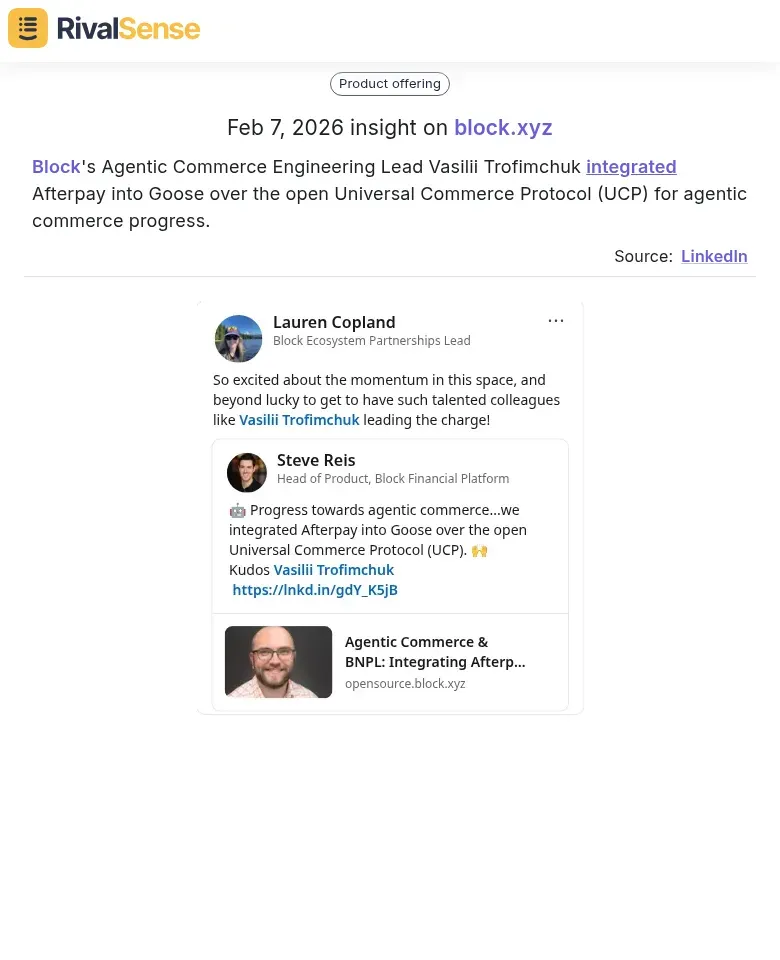
Product Integrations: Block's Agentic Commerce Engineering Lead Vasilii Trofimchuk integrated Afterpay into Goose over the open Universal Commerce Protocol (UCP) for agentic commerce progress. Such integrations show competitors enhancing their ecosystems, which could lure your accounts seeking seamless solutions.
How RivalSense Fills the Competitive Intelligence Gap
While you're busy managing key accounts, RivalSense tracks what matters most: your competitors' moves that could impact those relationships. Our platform monitors 80+ sources to deliver actionable insights in a weekly email report, ensuring you stay proactive.
- Competitor product launches and updates
- Pricing strategy changes
- Event participation and speaking engagements
- Partnership announcements
- Regulatory developments
- Management team changes
- Media mentions across websites, social media, and registries
The SaaS KAM Action Plan: 7 Steps to Implementation
Step 1: Score Your Accounts
Use the 15-point framework above. Be ruthless—not every customer can be a key account.
Step 2: Set Competitive Intelligence Alerts
For each key account, identify their likely alternative solutions and set up monitoring. With RivalSense, you can track specific competitors mentioned in discovery calls or RFPs.
Step 3: Create Account-Specific Value Propositions
Based on your scoring, tailor your value proposition. High-growth potential accounts need different messaging than high-stability accounts.
Step 4: Implement Regular Business Reviews
Schedule quarterly business reviews (QBRs) that include:
- Usage analytics review
- ROI demonstration
- Competitive landscape update (using RivalSense insights)
- Joint roadmap planning
Step 5: Develop Expansion Playbooks
For each key account, create a documented expansion strategy including:
- Next logical product adoption
- Department expansion opportunities
- Integration possibilities
- Competitive defense tactics
Step 6: Establish Cross-Functional Teams
Key accounts need attention from multiple departments:
- Product: For feature requests and roadmap alignment
- Engineering: For technical integration support
- Marketing: For case studies and co-marketing
- Executive: For C-level relationship building
Step 7: Measure What Matters
Track these SaaS-specific KPIs:
- Net Revenue Retention (NRR): Target >120% for key accounts
- Expansion MRR: Monthly revenue growth from existing accounts
- Product Adoption Rate: Feature usage across the organization
- Strategic Initiative Participation: Are they beta testing or co-developing?
Common SaaS KAM Mistakes (And How to Avoid Them)
Mistake #1: Treating All Enterprise Accounts as Key
Not every large customer has strategic potential. Use the scoring framework to identify true partners.
Mistake #2: Ignoring Competitive Threats
Your competitors are actively targeting your key accounts. Regular competitive intelligence (like RivalSense provides) is non-negotiable.
Mistake #3: Focusing Only on Renewals
Key account management is about growth, not just retention. Aim for expansion in every renewal conversation.
Mistake #4: Under-Resourcing
True key accounts require significant time investment. Limit each account manager to 5-8 strategic accounts maximum.
The Future of SaaS KAM: Data-Driven Partnership
In 2026, successful SaaS key account management combines deep customer understanding with proactive strategies. This integration ensures long-term partnerships and sustainable growth.
- Deep Customer Understanding (through usage analytics)
- Strategic Partnership Mindset (beyond vendor-client relationships)
- Competitive Intelligence (knowing what alternatives your accounts are considering)
- Proactive Value Delivery (anticipating needs before they're expressed)
Getting Started: Your 30-Day SaaS KAM Implementation Plan
Week 1-2: Assessment Phase
- Score your top 20 accounts using the 15-point framework
- Identify 3-5 true key accounts
- Set up competitive monitoring for those accounts' likely alternatives
Week 3-4: Planning Phase
- Create account-specific value propositions
- Schedule initial QBRs
- Form cross-functional teams for each key account
Month 2: Execution Phase
- Conduct first round of strategic business reviews
- Implement expansion playbooks
- Begin regular competitive intelligence briefings using tools like RivalSense
The Bottom Line
Key account management in SaaS isn't about managing your biggest customers—it's about cultivating strategic partnerships with customers who have mutual growth potential. By combining traditional relationship management with modern competitive intelligence, you can protect and grow your most valuable assets in an increasingly competitive market.
Remember: In SaaS, your key accounts aren't just revenue sources—they're innovation partners, market validators, and competitive moats. Treat them accordingly, and always stay one step ahead of what your competitors are offering them.
Ready to elevate your key account strategy? Try RivalSense for free at https://rivalsense.co/ to get your first competitor report today and start proactively managing competitive threats.
📚 Read more
👉 Predictive Analytics for Water Treatment Key Account Risk: A Strategic Guide
👉 How Block's UCP Integration Accelerated Competitors in Agentic Commerce
👉 LinkedIn Competitor Insights Case Study: A Practical Key Account Tracking Workflow
👉 5 Event Participation Mistakes That Sabotage Your Competitor Intelligence