
Key Account Management Best Practices 2024: The Strategic Playbook for B2B Growth
8 minutes read
December 17, 2025
By RivalSense Team
Content
- What is Key Account Management in 2024?
- The 80/20 Rule in Modern Account Management
- 4 Key Account Management Stages Every Manager Must Master
- 2024 KAM Best Practices: Practical Checklist
- The Competitive Intelligence Gap in Key Account Management
- Competitive Intelligence in Action: RivalSense Insights
- How Technology is Transforming KAM in 2024
- Implementing Your KAM Strategy: Step-by-Step Guide
- Measuring Success: KPIs That Matter
- Key Takeaways for 2024
Key Account Management (KAM) has evolved from a simple sales function to a strategic business discipline that drives 80% of revenue for most B2B companies. In 2024, with increasing competition and economic uncertainty, mastering KAM isn't just nice-to-have—it's essential for survival and growth. This playbook provides actionable strategies to help founders, CEOs, and business owners elevate their account management game.
What is Key Account Management in 2024?
Key Account Management is the systematic process of managing and growing your company's most important B2B customers to maximize mutual value. Unlike traditional sales that focus on closing deals, KAM focuses on building strategic partnerships where you help customers "buy" rather than just selling to them. This approach requires deep understanding and proactive engagement.
The 2024 Difference: Today's KAM is data-driven, technology-enabled, and requires deep competitive intelligence. It's no longer enough to know your customer—you need to understand their competitive landscape, market pressures, and strategic challenges better than they do. Embracing this holistic view is key to sustaining long-term partnerships.
The 80/20 Rule in Modern Account Management 🔍
The Pareto Principle applies perfectly to KAM: 20% of your accounts typically generate 80% of your revenue. But here's the critical insight most companies miss: not all high-revenue accounts are "key accounts." Identifying the right accounts is the foundation of effective KAM strategy.
A true key account has:
- Growth potential beyond current revenue
- Strategic alignment with your business goals
- Relationship depth that creates mutual dependency
- Competitive insulation (they're hard for competitors to poach)
Practical Tip: Use this scoring matrix to identify true key accounts:
| Criterion | Score (1-10) |
|---|---|
| Revenue Potential | |
| Strategic Fit | |
| Relationship Strength | |
| Competitive Vulnerability | |
| Growth Trajectory |
Scoring Guide:
- Score 40+ = Key Account Priority 🚀
- Score 30-39 = Growth Account 📈
- Score <30 = Maintain or Re-evaluate ⚠️
4 Key Account Management Stages Every Manager Must Master 📊
Understanding where your accounts stand in the relationship lifecycle is crucial for effective management. Each stage requires different tactics and focus areas to progress toward strategic partnership. Here’s a breakdown of the four essential stages.
1. Tactical Relationship (The Foundation)
- Characteristics: Transactional, price-focused, single point of contact
- Goal: Move to cooperative stage
- Action Items:
- Map organizational structure
- Identify additional stakeholders
- Demonstrate value beyond price
2. Cooperative Relationship (Building Trust)
- Characteristics: Multiple touchpoints, still price-sensitive
- Goal: Achieve interdependence
- Action Items:
- Regular business reviews
- Joint planning sessions
- Value quantification
3. Interdependent Relationship (Strategic Partnership)
- Characteristics: You're their preferred vendor, involved in planning
- Goal: Cement strategic relationship
- Action Items:
- Executive sponsorship alignment
- Innovation workshops
- Risk mitigation planning
4. Strategic Relationship (The Ultimate Goal)
- Characteristics: Win-win strategy, high exit barriers, open communication
- Goal: Maintain and deepen
- Action Items:
- Joint market development
- Co-innovation projects
- Succession planning
2024 KAM Best Practices: Practical Checklist ✅
Implementing these best practices will streamline your key account management and drive growth. Focus on actionable steps that deliver measurable results for your B2B business.
Focus on the Right Accounts
- Limit true key accounts to 5-10 per manager (not 20-50)
- Use data-driven selection criteria, not just revenue
- Regularly re-evaluate account portfolio (quarterly)
Build Relationship Intelligence
- Map organizational charts with influence levels
- Track relationship health scores
- Document decision-making processes
Conduct White Space Analysis
- Identify untapped opportunities within accounts
- Map your solutions to customer pain points
- Calculate expansion potential
Implement Account Planning
- Create 90-day action plans
- Set mutual success metrics
- Establish regular review cadence
The Competitive Intelligence Gap in Key Account Management 🕵️♂️
Here's where most KAM programs fail in 2024: they focus inward on the customer relationship but neglect the external competitive landscape. Your key accounts are being courted by competitors daily, and if you're not monitoring this activity, you're flying blind. This gap can lead to unexpected churn and missed opportunities.
Critical Questions Most KAMs Can't Answer:
- Which competitors are targeting our key accounts?
- What new solutions are they pitching?
- Have they changed pricing or terms?
- Are they forming partnerships that threaten our position?
- What market shifts are creating new competitive threats?
This is where competitive intelligence tools like RivalSense become game-changers. While traditional KAM tools help you manage relationships internally, RivalSense provides the external intelligence you need to protect and grow your key accounts.
Competitive Intelligence in Action: RivalSense Insights 🌐
Real-time competitive insights are invaluable for shaping business strategy and safeguarding key accounts. Here are examples from RivalSense that demonstrate how monitoring competitor moves can inform proactive KAM decisions.
Insight 1: Product Launch Tracking
Example: Vanta launched AI-powered policy drafting, multiple risk registers, data inventories with ROPA support, vendor intake forms, Slack Q&A preview, and new integrations in December 2025.

Why it matters for KAM: Tracking product launches helps you anticipate when competitors might pitch new solutions to your key accounts. This allows you to prepare counter-messaging, highlight your unique value, and reinforce your partnership before competitors gain traction.
Insight 2: Program and Service Updates
Example: Noom introduced Proactive Health Microdose GLP-1ᴿˣ, a program with microdose GLP-1, at-home biomarker testing, and digital health tools.
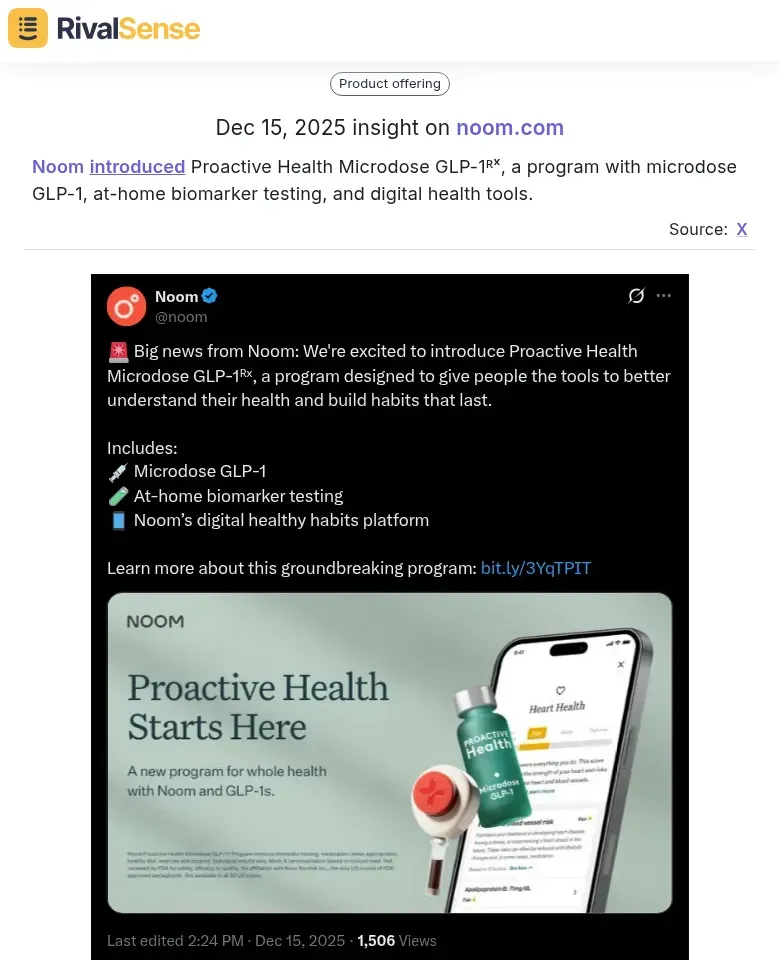
Why it matters for KAM: Monitoring service expansions reveals how competitors are evolving their offerings to meet market demands. For KAMs, this intelligence can identify upsell opportunities or prompt discussions with accounts about emerging needs, keeping you ahead of the curve.
Insight 3: Regulatory and Legal Movements
Example: Reddit moves the High Court against Australia's under-16 social media ban, arguing the law misclassifies the platform and restricts political participation.

Why it matters for KAM: Regulatory changes can impact your key accounts' industries and strategies. Being aware of such developments helps you advise accounts proactively, positioning yourself as a strategic partner who understands broader market dynamics.
How Technology is Transforming KAM in 2024 💻
Technology is revolutionizing key account management by automating processes and providing deeper insights. In 2024, leveraging the right tools is no longer optional—it's a competitive necessity for scaling KAM efforts effectively.
The Old Way vs. The 2024 Way
| Aspect | The Old Way | The 2024 Way |
|---|---|---|
| Relationship Tracking | Manual spreadsheets | Automated mapping tools |
| Competitive Threats | Guesswork and rumors | Real-time alerts and monitoring |
| Account Management | Reactive and siloed | Proactive and integrated |
| Customer Intelligence | Limited to internal data | Combined internal and external insights |
Practical Implementation:
- Start with CRM integration - Your KAM tool should connect seamlessly with Salesforce, HubSpot, or your existing CRM.
- Add competitive monitoring - Tools like RivalSense track competitor movements across 80+ sources including websites, social media, registries, and news.
- Implement account dashboards - Single view of account health, opportunities, and threats.
- Automate reporting - Weekly competitive intelligence reports delivered automatically to stay informed without manual effort.
Implementing Your KAM Strategy: Step-by-Step Guide 🗺️
A structured implementation plan ensures your KAM strategy moves from theory to practice. Follow these phases to build a robust framework that drives consistent growth across your key accounts.
Phase 1: Assessment (Weeks 1-2)
- Audit current account portfolio using the scoring matrix.
- Identify true key accounts based on data-driven criteria.
- Assess competitive landscape for each account with tools like RivalSense.
- Evaluate current relationship depth and gaps.
Phase 2: Planning (Weeks 3-4)
- Develop account-specific growth plans with clear objectives.
- Set mutual success metrics aligned with customer goals.
- Create stakeholder engagement maps to identify influencers.
- Establish monitoring systems for ongoing competitive intelligence.
Phase 3: Execution (Ongoing)
- Implement regular touchpoint cadence based on relationship stage.
- Conduct quarterly business reviews to align on progress.
- Monitor competitive threats and adjust strategies in real-time.
- Leverage insights from competitive monitoring to proactively address risks.
Phase 4: Optimization (Quarterly)
- Review account performance against KPIs.
- Update competitive intelligence with latest market data.
- Refine engagement strategies based on feedback and results.
- Scale successful approaches to other accounts in your portfolio.
Measuring Success: KPIs That Matter 📈
Tracking the right metrics ensures your KAM strategy delivers tangible results. Focus on a mix of leading and lagging indicators to predict success and measure outcomes accurately.
Leading Indicators (Predict Success)
- Relationship health score (e.g., from surveys or engagement metrics)
- Stakeholder engagement level (number of active contacts)
- White space coverage (percentage of potential solutions deployed)
- Competitive threat awareness (time to detect and respond to threats)
Lagging Indicators (Measure Results)
- Account revenue growth (year-over-year increase)
- Expansion deal win rate (percentage of upsell/cross-sell successes)
- Customer satisfaction (NPS/CSAT scores)
- Account retention rate (percentage of key accounts retained)
Competitive Intelligence Metrics
- Competitor mentions in account conversations (frequency and context)
- Competitive threat detection time (how quickly you learn of moves)
- Win/loss analysis against specific competitors (root causes)
- Market share changes within accounts (your footprint vs. competitors)
Key Takeaways for 2024 🎯
- Quality over quantity - Focus on 5-10 truly strategic accounts per manager to ensure deep engagement.
- Data-driven decisions - Use scoring matrices and competitive insights, not gut feelings, to guide actions.
- Competitive awareness - Monitor external threats as diligently as internal relationships to protect your position.
- Technology enablement - Leverage tools for relationship mapping AND competitive intelligence to stay ahead.
- Continuous optimization - Regularly review and adjust your KAM strategy based on performance metrics and market changes.
The most successful key account managers in 2024 won't just be relationship builders—they'll be strategic intelligence officers who understand their customers' worlds better than anyone else, including the customers themselves.
Ready to transform your key account management with competitive intelligence? Discover how RivalSense can help you protect and grow your most valuable accounts. Try RivalSense for free today and get your first competitor report to start gaining actionable insights immediately!
📚 Read more
👉 Actionable Strategies: Analyze Competitor Laundry Equipment Features to Win
👉 How Roblox's The Block Launch Prompted Rivals' Immersive Strategy Shift
👉 How Top Brands Use Twitter to Analyze Competitor Customer Support
👉 Airbnb vs Hotels: Real-World Content Marketing Advantages Revealed
👉 Competitor Product Benchmarking: Actionable Insights for Key Account Management