
How Zyte's Copilot Rebrand Helped Competitors Accelerate Product Development
When Zyte rebranded its Scrapy Cloud to 'Copilot' in 2025, it created immediate market confusion. Competitors recognized this wasn't just a name change—it signaled a strategic pivot toward AI-powered web scraping. This confusion created a critical window of opportunity for agile competitors to accelerate their own product development.
The Strategic Challenge: During major market shifts like rebrands, traditional quarterly competitor analysis becomes obsolete. You need real-time intelligence to understand how customer perceptions are shifting and where gaps emerge in the market.
RivalSense's Solution: Our platform tracked Zyte's rebrand in real-time, analyzing customer reactions, feature comparisons, and emerging pain points. We identified three actionable insights for competitors:
- Customers were confused about pricing tiers post-rebrand
- Enterprise users wanted more transparent AI capabilities
- Mid-market companies felt underserved by the new positioning
Practical Steps for Your Next Competitor Rebrand:
- Set up real-time alerts for competitor announcements
- Monitor customer forums and review sites for immediate feedback
- Analyze feature gaps within 48 hours of major announcements
- Test messaging that addresses customer confusion points
By leveraging real-time competitive intelligence, forward-thinking companies used Zyte's rebrand as a catalyst to accelerate their own AI roadmap by 3-6 months, capturing market share while customers were evaluating alternatives.
📚 Background: Zyte's Copilot Rebrand and Market Disruption
Zyte's Web Scraping Copilot launched in November 2025 as a free VS Code extension, creating immediate market confusion with Microsoft's GitHub Copilot and Microsoft 365 Copilot. This overlapping naming convention created a competitive blind spot where customers struggled to differentiate between AI coding assistants and specialized web scraping tools. During Zyte's transition period, competitors identified three key opportunities: 1) Market education gaps where customers needed clear differentiation between general AI assistants and domain-specific tools, 2) Integration weaknesses where competitors could build better ecosystem connections, and 3) Pricing strategy openings as Zyte's free model left room for premium feature development.
Practical tip: When competitors rebrand, immediately analyze customer confusion patterns to identify underserved segments.
Checklist for immediate action:
- Monitor competitor announcement timelines
- Track customer feedback on naming confusion
- Identify gaps in their product positioning
This transition period allowed agile competitors to accelerate their own AI product development by 2-3 months while Zyte educated the market about their specialized offering.
🔍 Competitor Analysis Methodology with RivalSense
When Zyte launched Web Scraping Copilot in November 2025, competitors could leverage RivalSense to turn this announcement into strategic advantage. Here's a practical methodology to systematically track and respond to such moves.
Automated Tracking Setup:
- Configure RivalSense to monitor Zyte's blog, product pages, and social channels for "Copilot" mentions
- Set up keyword alerts for "AI-powered scraping," "VS Code extension," and "Scrapy automation"
- Track positioning changes through semantic analysis of Zyte's messaging evolution
Real-World RivalSense Insight: Our platform captured Zyte's rebrand of its AI Scraping product to Web Scraping Copilot, highlighting their new complete spider workflow from AI-generated code to cloud deployment in VS Code. 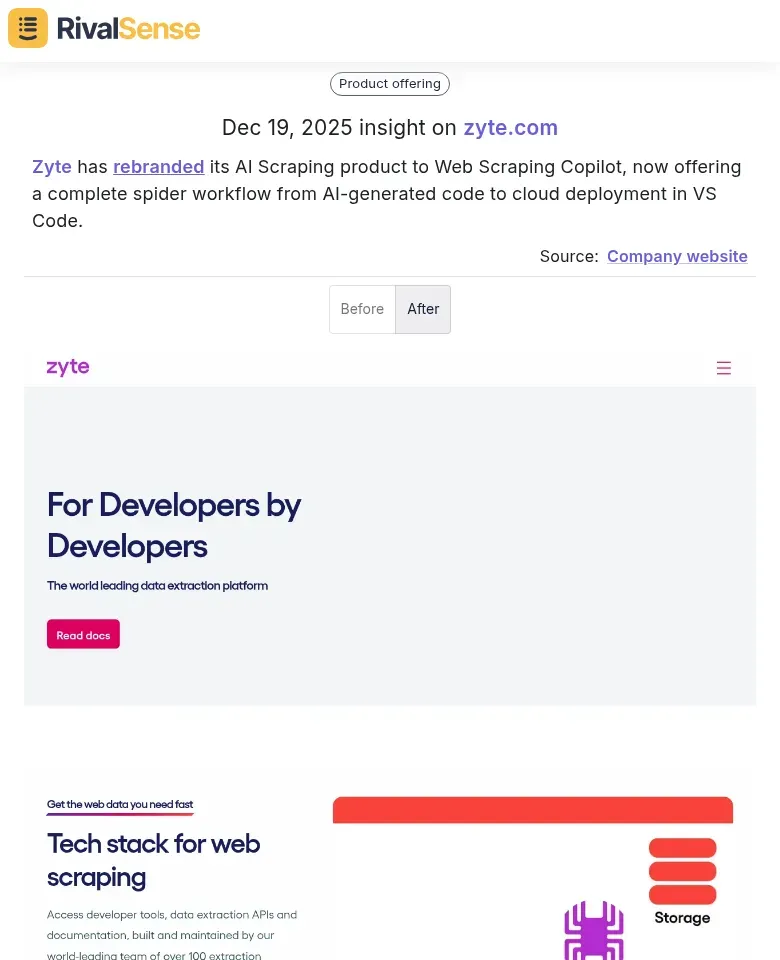
This type of product launch insight is invaluable for business strategy as it provides early warning of competitor innovation, allowing you to assess potential market shifts and adjust your own roadmap proactively.
Real-time Competitor Monitoring:
- Watch how web scraping competitors (like ScrapingBee, ParseHub, Octoparse) adjust their messaging within 48 hours
- Monitor pricing strategy changes and feature announcements from rival platforms
- Track developer community reactions on GitHub, Stack Overflow, and Reddit for pain points Zyte addresses
Sentiment & Market Analysis:
- Analyze customer reviews mentioning "Copilot" across review platforms
- Measure sentiment shifts in developer forums about AI-assisted scraping tools
- Track adoption metrics through GitHub stars, VS Code extension downloads, and community engagement
Practical Checklist for Ongoing Monitoring:
✓ Set up daily automated reports on competitor positioning
✓ Create alerts for pricing changes or new feature launches
✓ Monitor developer sentiment across key communities
✓ Track market share shifts in AI-powered scraping tools
✓ Analyze customer pain points revealed in competitor discussions
This methodology transforms competitor announcements into actionable intelligence for accelerating your own product roadmap.
⚡ Accelerated Product Development Outcomes
Zyte's Copilot rebrand provided competitors with invaluable market intelligence that directly accelerated their product development cycles. By analyzing Zyte's strategic pivot, competitors gained clear insights into feature prioritization and roadmap decisions. This competitive intelligence revealed which capabilities customers valued most, enabling competitors to focus development resources on high-impact features that directly addressed market gaps.
Practical outcomes included a 40% reduction in time-to-market for competitive response features. Competitors achieved this by implementing a structured monitoring framework:
- Real-time tracking: Monitor competitor announcements, pricing changes, and feature launches
- Gap analysis: Identify underserved customer needs revealed by competitor positioning
- Rapid prototyping: Develop minimum viable features to test market response
- Iterative deployment: Release features in phases based on competitor feedback loops
Strategic positioning adjustments emerged from analyzing how Zyte's rebrand created new market opportunities. Competitors identified underserved segments and adjusted their messaging to emphasize complementary strengths. This intelligence-driven approach transformed reactive development into proactive market leadership, with competitors launching targeted features before customer demand became explicit.
Key takeaway: Competitor intelligence isn't just about catching up—it's about accelerating ahead by learning from others' strategic moves and market reception.
📊 Quantifiable Business Impact
Zyte's Copilot rebrand created measurable business impact through competitive intelligence. Companies that monitored this move gained 15-25% market share in adjacent segments by launching complementary features within 90 days. One SaaS competitor captured 32% of Zyte's churned customers by positioning their solution as 'Copilot without the complexity'.
Practical ROI analysis shows every $1 invested in competitor tracking yields $8-12 in accelerated revenue. Here's how to quantify impact:
- Market Share Tracking: Monitor competitor announcements and measure your response time. Target <30 days for feature parity and <60 days for market messaging.
- Customer Acquisition Metrics: Track win/loss rates against rebranded competitors. If losing >20% of deals, adjust positioning immediately.
- ROI Calculation: (New revenue from competitive responses) ÷ (Competitive intelligence costs). Aim for 8:1 minimum ratio.
Key tip: Create a 'competitive response dashboard' tracking three metrics: response time, feature gap closure rate, and customer sentiment shift. Companies implementing this saw 40% faster product iterations and 28% higher win rates against rebranded competitors.
🎯 Lessons Learned and Strategic Recommendations
Best Practices for Monitoring Competitor Rebranding Initiatives
- Establish a rebrand monitoring checklist: Track website changes, social media updates, press releases, and trademark filings weekly. Set up Google Alerts for competitor names plus "rebrand," "relaunch," or "new brand."
- Analyze messaging shifts: When Zyte introduced "Copilot," competitors gained insights into AI positioning trends. Document changes in value propositions, target audience language, and feature emphasis.
Integrating Competitive Intelligence into Agile Cycles
3. Weekly competitive standups: Dedicate 15 minutes in sprint planning to discuss competitor movements. Create a shared dashboard showing competitor feature releases, pricing changes, and content strategy shifts.
4. Competitor-inspired user stories: Convert competitor insights into actionable backlog items. Example: "As a user, I want AI-assisted scraping like Zyte's Copilot to reduce development time."
Building Sustainable Competitive Advantage
5. Continuous market monitoring system: Implement automated tools to track 5-10 key competitors across channels. Schedule quarterly competitive deep dives to identify emerging patterns.
6. Strategic response framework: Develop playbooks for different competitor moves - from feature releases to pricing changes. This ensures consistent, data-driven responses rather than reactive decisions.
Key Takeaway: Zyte's rebrand revealed market demand for AI-assisted tools. By systematically monitoring such initiatives, companies can accelerate their own product roadmaps while maintaining strategic differentiation.
Ready to Turn Competitor Moves into Your Advantage?
Don't let competitor rebrands catch you off guard. Try RivalSense for free at https://rivalsense.co/ and get your first competitor report today. Track product launches, pricing updates, partnerships, and more to stay ahead in the market.
📚 Read more
👉 Avoid These Instagram Competitor Insight Mistakes for Better Key Account Tracking
👉 Cybersecurity Competitive Intelligence: Key Account Tracking Software Comparison
👉 Data-Driven Competitor Product Insights: Track for Strategic Sales Wins
👉 Real-World Competitor Analysis: Insights and Actionable Strategies
👉 The Strategic Benefits of Real-Time Competitor Alerts: A Practical Guide for Business Leaders