
How Top Brands Automate Competitor Insights from Twitter for Key Account Wins
In today's hyper-competitive B2B landscape, traditional competitor research methods are too slow and often outdated. While quarterly reports and market analyses provide historical context, they miss the real-time signals that drive key account decisions and strategic moves. Twitter has emerged as a critical intelligence source where competitors reveal their strategic moves, client wins, product launches, and pain points—often before official announcements, giving you a crucial edge.
Real-time Twitter monitoring delivers insights 10-15x faster than conventional sources, allowing you to spot opportunities and threats as they unfold. This social media intelligence directly fuels key account acquisition by revealing which competitors are targeting your dream clients, what messaging resonates, and where gaps exist in their offerings. Automated competitor tracking isn't just convenient—it's essential for modern business strategy, as manual monitoring consumes valuable resources and introduces human error.
Practical Tip: Set up automated alerts for competitor mentions, executive tweets, and industry hashtags. Track when competitors announce new features or client wins—these signals often precede formal RFP processes. Create a simple checklist:
- ✅ Identify 3-5 key competitors
- ✅ Monitor their Twitter accounts daily
- ✅ Track mentions of your target accounts
- ✅ Analyze engagement patterns on their content
Key Competitor Insights You Can Extract from Twitter
Twitter provides a wealth of real-time competitor intelligence that can directly drive key account wins. By systematically tracking specific signals, you can uncover strategic opportunities and threats that inform your business decisions. From industry awards to merger announcements, each insight type offers unique value for refining your approach.
Track Industry Awards for Market Positioning: Monitoring when competitors win awards helps validate their market positioning and reveals underserved segments. For example, seeing a competitor consistently recognized in enterprise sectors might highlight a gap in mid-market focus. Set up alerts for keywords like "wins award" or "industry recognition" to catch these moments.
Monitor Merger and Integration Announcements: Partnerships and mergers signal shifting competitive landscapes and potential collaboration opportunities. By watching for hashtags related to mergers or executive changes, you can anticipate market consolidation and adjust your strategy. This type of insight is valuable for identifying new partnership avenues or competitive threats early.
Analyze AI Search Optimization Strategies: As AI tools like Perplexity and ChatGPT reshape search, tracking how competitors appear in AI-generated responses becomes crucial. Monitor mentions in AI platforms and note which content formats get amplified. This insight helps you optimize your own content for AI visibility, ensuring your brand surfaces in key conversations.
Practical Checklist for Twitter Insights:
- 🐦 Create Twitter lists for competitors, award bodies, and potential partners
- 🔔 Set up keyword alerts for award wins, mergers, and AI search mentions
- 📊 Track engagement metrics to distinguish significant announcements from noise
- 📈 Analyze quarterly patterns to predict competitor moves
- 🛠️ Update sales enablement materials with real-time insights
Automating Twitter Monitoring for Real-Time Intelligence
Automating Twitter monitoring transforms reactive tracking into proactive intelligence that fuels daily decisions. By leveraging tools and systematic processes, you can capture insights without manual effort, ensuring consistency and accuracy. This approach allows your team to focus on strategy rather than data collection.
Start by setting up automated alerts using social listening tools to monitor competitor mentions, industry keywords, and award-related hashtags. Create specialized Twitter lists for three key categories: direct competitors, industry award organizations, and key influencers. Implement sentiment analysis to categorize reactions to competitor announcements—positive sentiment may indicate market validation, while negative reactions reveal potential weaknesses.
Practical Checklist for Automation:
- ✅ Set up alerts for 5+ competitors and 10+ industry keywords
- ✅ Create three specialized Twitter lists with 15-20 accounts each
- ✅ Configure sentiment analysis rules to flag positive/negative spikes
- ✅ Schedule weekly dashboard reviews of engagement metrics
- ✅ Prepare response templates for competitor award announcements
Turning Twitter Insights into Key Account Wins
Twitter's award announcements and merger updates reveal underserved market segments and partnership opportunities that your competitors might overlook. By analyzing what competitors celebrate or ignore, you can identify positioning gaps and tailor your messaging to fill them. This targeted approach directly increases your chances of winning key accounts.
For instance, if a competitor consistently wins awards from enterprise clients but never mentions mid-market companies, you've identified a gap to exploit. Develop messaging that positions you as the specialist for that segment, emphasizing faster implementation or personalized support.
Practical Steps to Leverage Insights:
- 🔍 Track competitor award hashtags (#awardwin, #industryaward) and analyze recipient patterns
- 🎯 Identify industries or company sizes competitors consistently ignore
- 🗺️ Map these gaps to your existing capabilities and strengths
Battle Card Creation Framework:
- 📋 Document competitor award patterns (industries, geographies, company sizes)
- ✨ List your unique capabilities for underserved segments
- 💬 Include customer testimonials from similar companies you've successfully served
- 🏆 Add competitive positioning statements validated by market recognition gaps
Pro Tip: Use Twitter's advanced search to filter by location, company size mentions, and industry keywords in award announcements. This creates battle cards with validated market intelligence, not just assumptions.
Integrating Twitter Intelligence into Your Business Strategy
Integrating Twitter intelligence into your business strategy requires cross-functional collaboration and systematic processes to ensure insights drive action. By aligning marketing, sales, and product teams around real-time data, you can respond swiftly to competitive moves and capitalize on opportunities.
Cross-Departmental Implementation:
- Marketing: Track competitor campaigns, content themes, and audience engagement patterns. Use insights to refine your messaging and identify content gaps.
- Sales: Monitor competitor announcements, customer complaints, and partnership news. Equip sales teams with real-time alerts for key account opportunities.
- Product: Analyze feature discussions, user feedback, and pain points mentioned in competitor conversations. Prioritize development based on market demands.
Building Competitive Intelligence Dashboards:
- Centralize Twitter data with tools to track mentions, sentiment, and share of voice.
- Visualize competitor activity trends, engagement metrics, and topic clusters.
- Set up automated alerts for spikes in competitor mentions or negative sentiment.
Quarterly Review Process:
- Schedule quarterly meetings with all teams to review dashboard insights.
- Assess what worked, identify missed opportunities, and adjust tracking parameters.
- Update competitive battle cards and sales playbooks based on new intelligence.
Practical Checklist for Integration:
- ✅ Define key competitors and relevant hashtags/keywords
- ✅ Assign team members responsible for monitoring specific competitors
- ✅ Create standardized reporting templates
- ✅ Establish escalation protocols for critical insights
- ✅ Document learnings and strategy adjustments quarterly
Beyond Twitter: Comprehensive Insights from Multiple Sources
While Twitter is a powerful real-time source, combining it with insights from other channels provides a fuller competitive picture. Tools like RivalSense aggregate data from company websites, social media, registries, and more, delivering comprehensive weekly reports that complement Twitter monitoring. This holistic approach ensures you never miss critical updates that could impact your strategy.
Example: Award Recognition Insights

Tracking awards like ComplyAdvantage's inclusion in the RegTech100 list for 2026 is valuable for business strategy because it validates market positioning and highlights industry trends. Such insights help you benchmark against competitors and identify areas where you can differentiate or improve your offerings.
Example: Merger and Partnership Updates

Monitoring mergers, such as Korean Air and Asiana Airlines' cabin refit to unify interiors, provides early signals of market consolidation and operational changes. This type of insight is valuable for anticipating competitive shifts, exploring partnership opportunities, or adjusting your service offerings to meet evolving customer expectations.
Example: AI and Media Strategy Insights
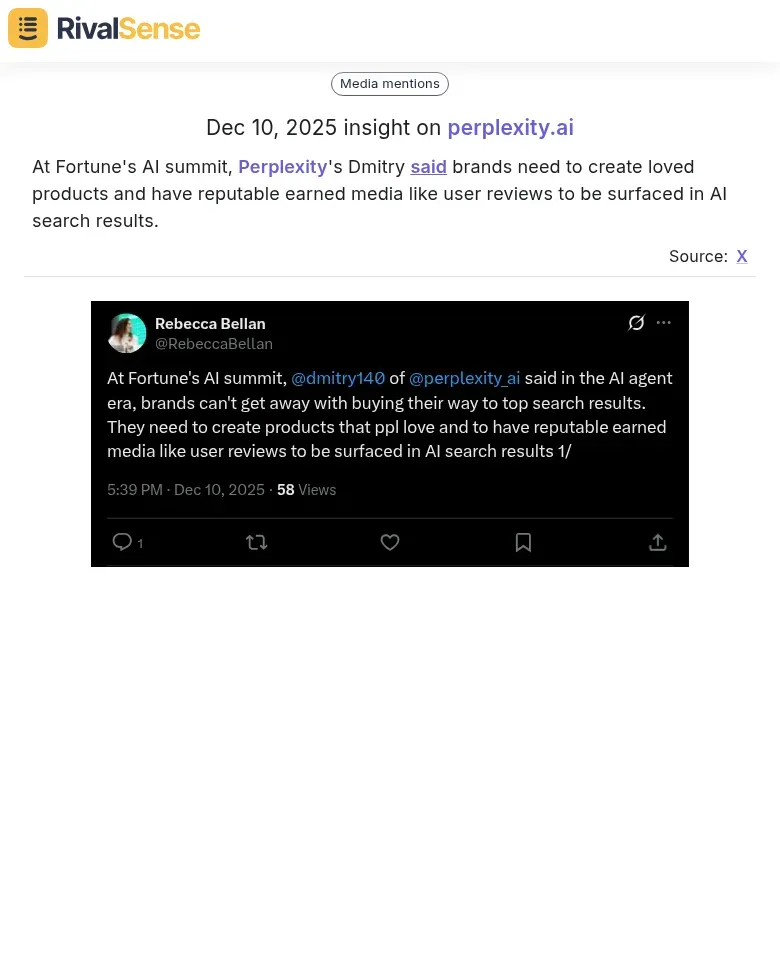
Insights from events like Fortune's AI summit, where Perplexity's Dmitry emphasized the need for loved products and reputable earned media, are crucial for optimizing AI search visibility. Understanding these strategies helps you align your content and product development to surface in AI-generated results, driving brand awareness and lead generation.
Advanced Techniques and Implementation Framework
To maximize the impact of automated competitor insights, implement a structured framework that ties intelligence to tangible outcomes. This involves multi-tier tracking, response playbooks, and ROI measurement to ensure your efforts translate into key account wins. By systematizing your approach, you can scale competitive intelligence across your organization.
Start with a three-tier tracking system: 1) Core monitoring of competitor accounts for product launches and pricing changes, 2) Sentiment analysis of customer conversations mentioning competitors, and 3) Influencer tracking to identify brand advocates shifting allegiances. Use tools to set up real-time alerts for specific keywords and hashtags.
Develop Response Playbooks for Common Scenarios:
- When a competitor announces a feature, immediately share your superior alternative with targeted accounts.
- For negative sentiment about competitors, engage with helpful content (not direct attacks).
- Create templated responses for speed while maintaining authenticity.
Measure ROI by Correlating Intelligence with Key Account Wins:
- 📊 Track the number of competitive insights generated monthly.
- 💬 Monitor engagement rate with target accounts after competitor announcements.
- 📈 Calculate conversion rate of accounts where you used competitive intelligence in outreach.
- Use UTM parameters to trace account acquisitions back to specific competitive intelligence campaigns.
- Aim for a 3:1 ROI ratio within six months—every dollar spent on monitoring should generate three dollars in new account revenue.
Take Action with Comprehensive Competitor Tracking
Automating competitor insights from Twitter is a powerful starting point, but to truly stay ahead, you need a tool that aggregates data from multiple sources in one place. RivalSense tracks competitor product launches, pricing updates, event participations, partnerships, regulatory aspects, management changes, and media mentions across company websites, social media, and various registries, delivering all in a weekly email report.
Ready to transform your competitive intelligence? Try out RivalSense for free to assist with the challenges described in this post. Get your first competitor report today and start turning insights into key account wins!
📚 Read more
👉 Key Account Planning Framework for Tech & Proxy Industry Leaders
👉 Market Entry Mistakes: Avoiding Competitor Blind Spots with Centralized Intelligence
👉 Mastering Competitor Analysis: Insights from Real-World Examples
👉 Air Freight Podcast Intelligence: A Strategic Guide to Tracking Competitors