
How to Use AI Meeting Transcription for Competitor Market Research
AI meeting transcription is revolutionizing competitive intelligence by transforming raw conversation data into actionable competitor insights. This technology enables businesses to move beyond manual methods and gain a systematic edge in understanding market dynamics. While traditional methods rely on manual note-taking and reactive win/loss reports, AI transcription systematically extracts patterns from every customer interaction—discovery calls, demos, pricing discussions, and renewals.
Practical steps to leverage AI transcription for competitor research:
- 📊 Structure conversation data by categorizing competitive mentions by context (not just frequency)
- 📈 Track sentiment changes when competitors are mentioned
- 🗺️ Map competitor mentions to specific sales cycle stages
- 🔍 Identify recurring objection themes across accounts
- 🚨 Monitor emerging competitor positioning claims
Real-world example: A SaaS company discovered through AI analysis that security certification objections correlated with 48% of enterprise deal losses when competitors were mentioned. By enhancing security documentation and adding compliance-focused demos, they improved win rates by 17% within two quarters. The key insight: competitive intelligence isn't a quarterly report—it's a continuous listening system that transforms meeting noise into strategic advantage.
Setting Up Your AI Transcription System for Competitor Research
Implementing an effective AI transcription system requires careful tool selection and workflow design. Proper setup ensures accurate data capture and seamless integration into your competitive intelligence processes.
Choosing the Right Transcription Tools
Select AI transcription tools based on three key criteria: accuracy (aim for 95%+), integration (must work with Zoom, Teams, Google Meet), and privacy features. Top 2026 tools include Otter.ai for real-time transcription, Fireflies.ai for universal compatibility, and Tactiq.io for custom prompts.
Checklist for tool evaluation:
- [ ] 90%+ accuracy rate
- [ ] Multi-platform support (Zoom, Teams, Meet)
- [ ] GDPR/CCPA compliance features
- [ ] API access for automation
- [ ] Built-in consent mechanisms
Configuring Ethical Data Collection
Ethical data collection is non-negotiable for sustainable competitor research. Always obtain affirmative consent before recording and implement clear compliance protocols.
Legal compliance checklist:
- [ ] Identify two-party consent states in your jurisdiction
- [ ] Establish data retention policies (30-90 days maximum)
- [ ] Implement data anonymization for sensitive information
- [ ] Conduct regular compliance audits
- [ ] Use tools with built-in consent features like Fathom or Circleback
Establishing Capture Workflows
Automated workflows maximize efficiency and ensure consistent data collection. Create systematic processes for transcript management and analysis.
Workflow steps:
- Set up transcription bots to join scheduled meetings automatically
- Configure keyword alerts for competitor names and product mentions
- Route transcripts to centralized storage (Notion, Airtable, CRM)
- Implement weekly review cycles for continuous insight extraction
Pro tip: Use automation platforms like Zapier or Make.com to connect transcription tools with your competitive intelligence dashboard. Standardize naming conventions: "[Date][Platform][Competitor]_[Topic].txt" for easy searchability.
Analyzing Competitor Product Strategies Through Meeting Transcripts
AI meeting transcription transforms customer conversations into a goldmine of competitor product intelligence. By analyzing how customers discuss competitor offerings, you can identify gaps, track innovations, and uncover weaknesses.
1. Identify Product Feature Gaps
When customers mention competitors, AI can flag specific feature comparisons that reveal market expectations.
Actionable checklist:
- [ ] Track mentions of competitor features your product lacks
- [ ] Note customer frustrations with competitor limitations
- [ ] Identify "wish list" features customers mention
- [ ] Use sentiment analysis to gauge feature importance
2. Track Innovation Cycles
Monitoring competitor release patterns helps you anticipate market shifts and adjust your product roadmap.
What to analyze:
- Mentions of "new features" or "recent updates"
- Customer questions about upcoming releases
- Timing patterns in competitor discussions
- Set up alerts for competitor name mentions with date tracking
3. Learn from Competitor Limitations
Customer complaints about competitors reveal strategic opportunities for differentiation.
Extract these insights:
- Document specific pain points mentioned
- Note workarounds customers create
- Track recurring issues across multiple conversations
- Prioritize development based on competitor weaknesses
Practical Implementation: Use tools like Fireflies.ai's Competitor Analyzer AI Skill to automatically extract competitor mentions, context, and comparison points from transcripts. Set up rules to flag competitor discussions and export insights to your CRM or product management tools.
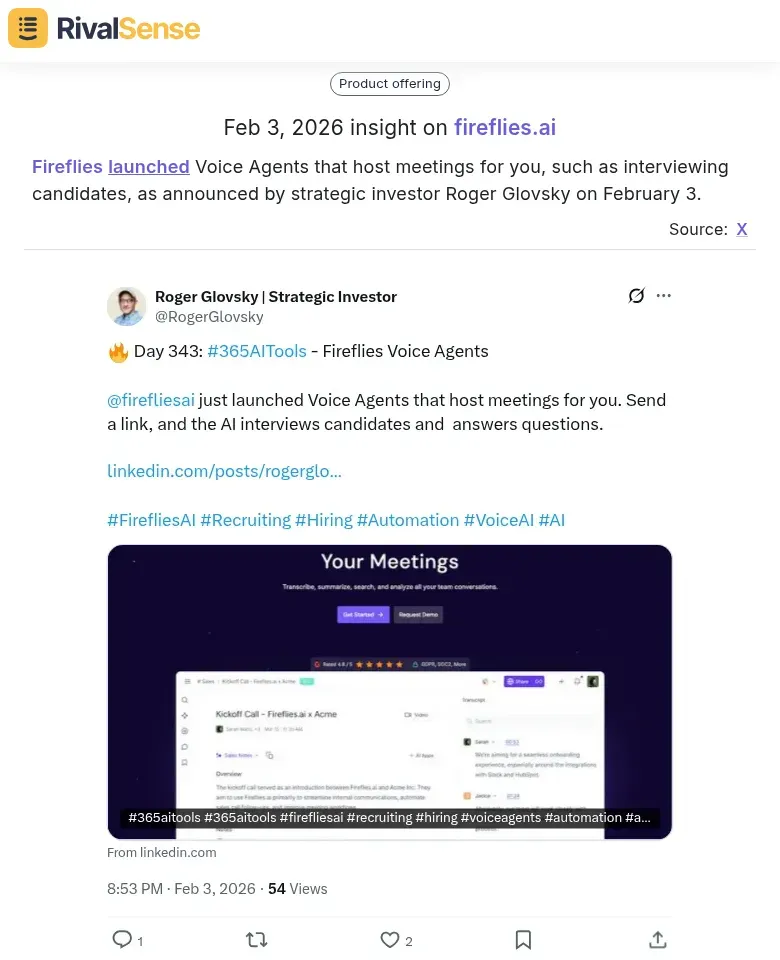
RivalSense Insight Example: Tracking competitor product launches helps you stay ahead of innovation cycles. For instance, RivalSense detected that Fireflies launched Voice Agents that host meetings for you, such as interviewing candidates, as announced by strategic investor Roger Glovsky on February 3. This type of insight is valuable for business strategy as it alerts you to new competitor capabilities that might affect your market position.
Extracting Pricing and Positioning Insights from Customer Conversations
Customer conversations reveal invaluable pricing intelligence and positioning data. By systematically analyzing how prospects discuss costs and value comparisons, you can refine your pricing strategy and marketing messages.
Listen for phrases like "Company X charges $Y but includes Z" or "We're paying $A for B features." Track these data points to map competitor pricing tiers and identify where they're positioning themselves as premium vs. budget options. Analyze how customers describe competitor value to uncover perception gaps you can exploit.
Practical steps:
- 📋 Create a spreadsheet to log competitor pricing mentions with context
- 🏷️ Tag conversations by market segment (SMB, enterprise, industry vertical)
- 📊 Track sentiment trends - are customers increasingly dissatisfied with a competitor?
- 🔎 Identify which segments mention competitors most frequently
Tip: Use AI transcription tools to automatically flag competitor mentions and extract pricing data. Set up alerts for when customers discuss switching costs or specific competitor weaknesses.
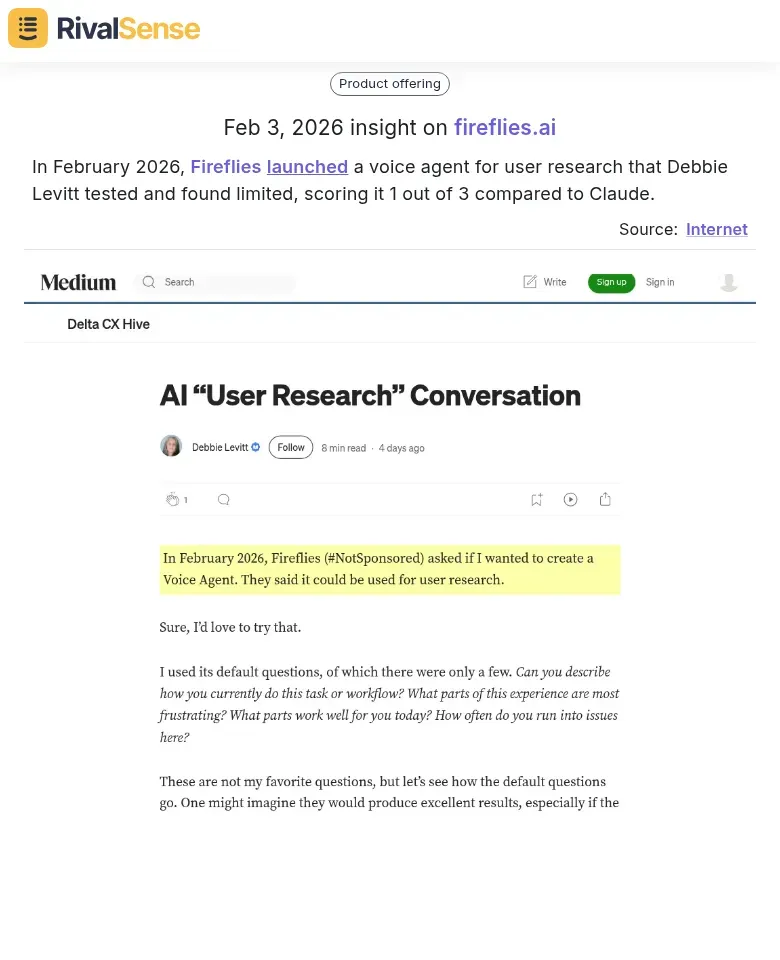
RivalSense Insight Example: Monitoring competitor product reviews can reveal market reception and areas for improvement. RivalSense captured that in February 2026, Fireflies launched a voice agent for user research that Debbie Levitt tested and found limited, scoring it 1 out of 3 compared to Claude. This insight is valuable for business strategy as it helps you assess competitor weaknesses and identify opportunities to highlight your strengths.
Ethical Considerations and Legal Compliance in AI-Powered Research
When using AI meeting transcription for competitor research, ethical and legal compliance is paramount. Voice data collection triggers biometric privacy laws that require careful handling to avoid legal exposure and maintain trust.
Practical compliance checklist:
- [ ] Always obtain explicit written consent from all meeting participants before recording
- [ ] Provide clear written notice about voice data collection and storage purposes
- [ ] Implement data minimization - only collect what's necessary for analysis
- [ ] Establish secure data handling protocols with encryption and access controls
- [ ] Create and publish a retention policy with automatic deletion timelines
- [ ] Avoid speaker identification features unless absolutely necessary for research
- [ ] Conduct regular compliance audits of your transcription tools
Ethical boundaries: Never misrepresent your identity in meetings, respect confidential information, and focus on publicly available insights rather than proprietary data. Balance competitive intelligence with privacy protection by anonymizing data where possible.
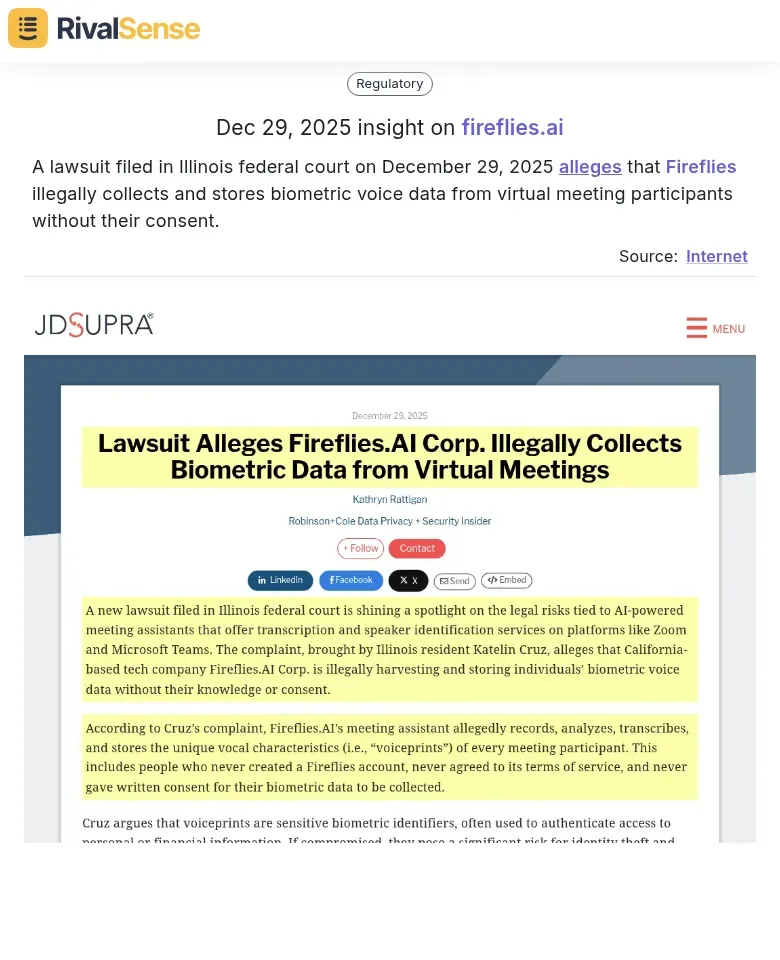
RivalSense Insight Example: Tracking legal and regulatory developments is crucial for risk assessment. RivalSense identified a lawsuit filed in Illinois federal court on December 29, 2025 alleging that Fireflies illegally collects and stores biometric voice data from virtual meeting participants without their consent. This type of insight is valuable for business strategy as it helps you avoid similar compliance pitfalls and adjust your own data practices accordingly.
Actionable Intelligence: Turning Transcripts into Competitive Strategy
Transform AI meeting transcripts into actionable competitive intelligence with systematic analysis and strategic implementation. Moving from data collection to decision-making requires structured approaches and regular review cycles.
Create Competitor Intelligence Dashboards
- Aggregate meeting insights into a centralized dashboard using tools like FineBI or Tableau
- Tag transcripts by competitor, product, and strategic theme for easy filtering
- Visualize patterns using heat maps (showing competitor focus areas) and trend lines (tracking strategic shifts over time)
Develop Response Strategies
- SWOT Analysis Checklist: Identify competitor weaknesses mentioned in meetings (e.g., "customer service gaps," "delivery delays")
- Opportunity Matrix: Prioritize response actions based on impact vs. effort
- Counter-Move Playbook: Create pre-approved responses for common competitor tactics revealed in transcripts
Measure Impact
- 📈 Track decisions influenced by transcript insights (document in a decision log)
- 💰 Calculate ROI by comparing outcomes before/after implementing competitor-informed strategies
- 🔄 Set quarterly review cycles to assess how transcript insights improved market positioning
Pro Tip: Use AI prompts like "Extract competitor pricing mentions from Q3 transcripts" to automate insight extraction. Regular dashboard reviews (bi-weekly) ensure timely response to emerging competitive threats.
Putting It All Together
AI meeting transcription offers a powerful method for continuous competitor monitoring, but it's just one piece of the competitive intelligence puzzle. To gain a comprehensive view of your competitive landscape, consider supplementing transcript analysis with broader market monitoring.
Ready to enhance your competitor research? Try RivalSense for free to track competitor product launches, pricing updates, event participations, partnerships, regulatory aspects, management changes, and media mentions—all delivered in a weekly email report. Get your first competitor report today and stay ahead of the competition!
📚 Read more
👉 Competitor Pricing Workflow: How to Leverage Insights for Content Strategy
👉 Decoding Competitor Strategy Through Hires: Lessons from Adobe's New Appointment
👉 How to Track Key Account Renewal Dates: A Strategic Guide for 2026
👉 IT Asset Management Competitor Benefits Cheat Sheet: Turn Insights into Advantage
👉 How Proactive Competitive Intelligence Counters Rivals' Market Moves