
How to Identify Key Accounts: A Practical Guide for B2B Leaders
In today's competitive B2B landscape, your biggest customers aren't necessarily your best customers. According to industry research, while large customers may represent 30-50% of your revenue, they might not offer the growth potential or strategic alignment that truly defines a key account.
Key accounts are those special relationships where both parties invest in mutual growth, co-create value, and build partnerships that neither could achieve alone. They're the 20% of customers that should drive 80% of your strategic growth—if you can identify them correctly.
The 3-Step Framework for Identifying Key Accounts
Identifying key accounts requires a methodical approach beyond gut feeling. This three-step framework ensures you base decisions on data and strategic insight, not just historical revenue.
Step 1: Move Beyond Revenue Metrics
Many companies start their key account selection by looking at who spends the most. This is a reactive approach that misses future potential and strategic fit. Instead, adopt a multi-dimensional scoring system across three categories to get a holistic view.
Growth Potential (0-40 points)
- Revenue Potential (0-10 points): Look beyond current spend to future wallet share
- Cost to Serve (0-10 points): Can you service them efficiently?
- Demand Stability (0-10 points): Consistent adoption vs. sporadic purchases
- Market Access (0-10 points): Can they help you enter new markets or verticals?
Strategic Harmony (0-30 points)
- Solution Fit (0-10 points): How well does your offering match their needs?
- Innovation Culture (0-10 points): Are they early adopters or beta testers?
- Benchmarking Value (0-5 points): Can they serve as case studies?
- Corporate Reputation (0-5 points): Does their brand enhance yours?
Value Creation (0-30 points)
- Strategic Alignment (0-10 points): Can you help them achieve their goals?
- Partnership Orientation (0-10 points): Do they view you as strategic?
- Long-term Focus (0-5 points): Are they committed to multi-year relationships?
- Information Sharing (0-5 points): Do they proactively share insights?
Practical Tip: Create a spreadsheet with all current customers and score them 1-10 on each criterion. Customers scoring 70+ points are likely your true key accounts.
Step 2: Conduct Competitive Intelligence Analysis
This step is where most companies miss critical insights. You need to understand not just your relationship with the account, but also the competitive forces surrounding it. A comprehensive analysis includes the account's position relative to your competitors and market trends.
Here’s where competitive intelligence tools like RivalSense provide unique value: Our platform monitors 80+ sources to give you real-time intelligence on competitor movements that could affect your key accounts. For example, tracking product launches can reveal when a competitor is pivoting to serve a new customer segment that overlaps with your accounts.
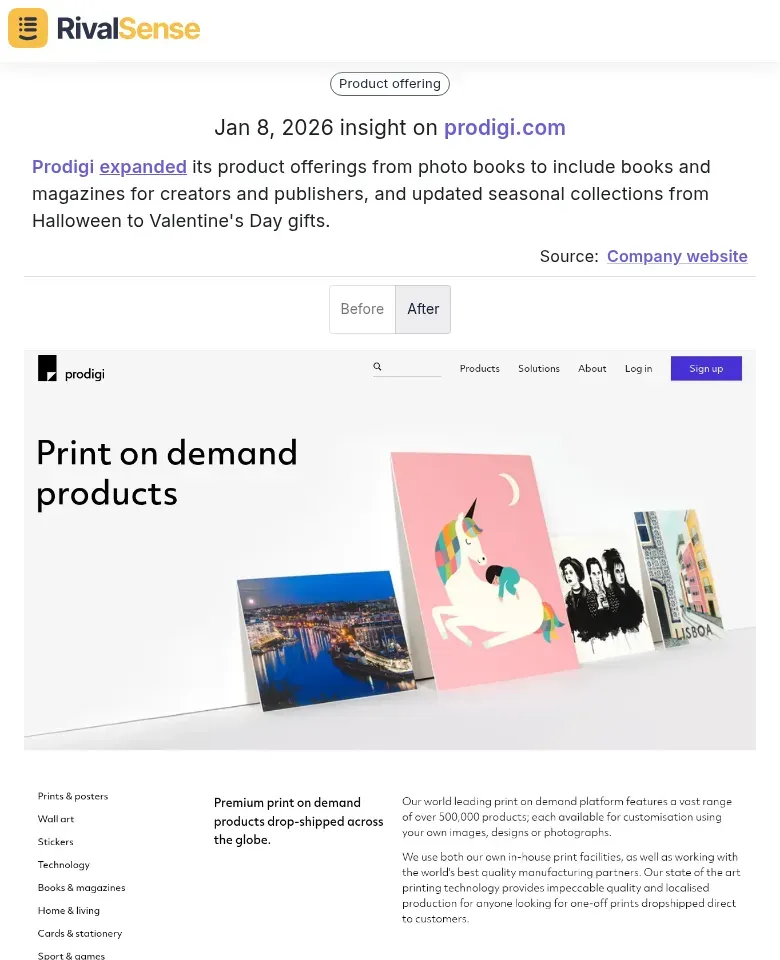
Insight Example: When Prodigi expanded its product offerings from photo books to include books and magazines for creators and publishers, it signaled a strategic move into adjacent markets. Understanding such product expansions is valuable because it helps you anticipate which competitors might be targeting your key accounts with new or improved solutions, allowing you to proactively defend your position.
Practical Checklist: For each potential key account, answer:
- ✓ Who are their current suppliers besides us?
- ✓ What competitive threats exist in their industry?
- ✓ Are they expanding into new markets where we could follow?
- ✓ What regulatory changes might affect their business?
Step 3: Validate with Cross-Functional Input
Avoid making this decision in a sales vacuum by gathering diverse perspectives. Different departments hold pieces of the puzzle that, when combined, provide a complete picture of an account's true value and potential.
Bring together:
- Sales Team: Current relationship status and deal history
- Customer Success: Usage patterns and satisfaction metrics
- Marketing: Engagement with content and campaigns
- Product: Feature requests and usage data
- Finance: Profitability analysis and payment history
Practical Exercise: Hold a quarterly "Key Account Review" meeting where each department presents data on top 20 potential accounts. Use a weighted scoring system to make objective decisions.
The 4 Types of Accounts You’ll Identify
Based on your analysis, you'll typically segment accounts into distinct categories. This classification helps in allocating resources appropriately and setting realistic expectations for each relationship.
1. Strategic Accounts (Score: 80-100)
- High growth potential + strong strategic alignment
- Invest maximum resources here
- Assign your best account managers
2. Growth Accounts (Score: 60-79)
- Strong growth potential but weaker current relationship
- Focus on relationship building
- Monitor competitor activity closely
3. Maintenance Accounts (Score: 40-59)
- Stable revenue but limited growth potential
- Efficient service delivery focus
- Watch for competitive threats
4. Transactional Accounts (Score: <40)
- Low strategic value
- Standardized service approach
- Consider profitability before investing
5 Red Flags That Signal “Not a Key Account”
Recognizing warning signs early can save you from misallocating precious strategic resources. Some accounts may look attractive on the surface but lack the fundamentals for a true key partnership.
- Price-First Mentality: They constantly push for discounts without valuing strategic partnership
- Limited Information Sharing: They treat you as a vendor, not a partner
- High Churn Risk: Multiple competitors have equal footing
- Declining Industry Position: Their market share is shrinking
- Cultural Misalignment: Values and innovation pace don’t match
How to Monitor Your Key Accounts Continuously
Identifying key accounts isn’t a one-time exercise. You need ongoing monitoring to protect these valuable relationships and capitalize on new opportunities as they arise. Continuous vigilance ensures you can respond to changes in the account's business or the competitive landscape.
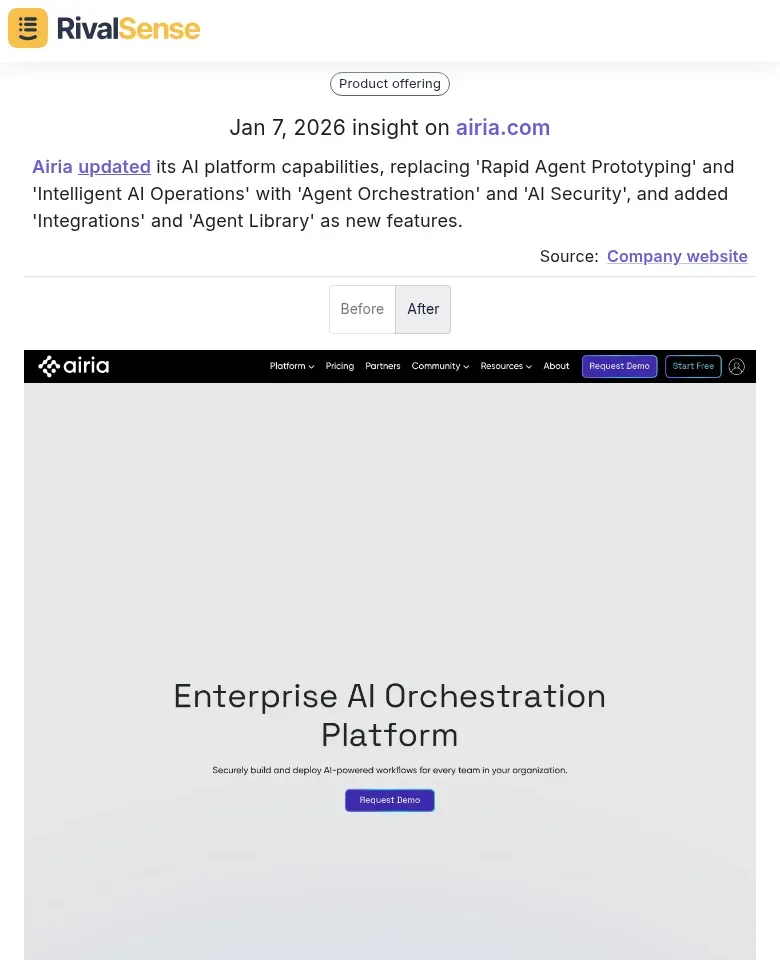
Insight Example: When Airia updated its AI platform capabilities, replacing features with 'Agent Orchestration' and 'AI Security', it highlighted a shift in their product strategy. Monitoring such feature updates is crucial because it reveals how competitors are evolving their offerings to meet market demands, which could directly impact your value proposition to shared key accounts.
Weekly Activities:
- Review account health metrics
- Check for competitor movements affecting the account
- Monitor industry news and regulatory changes
Monthly Activities:
- Update relationship maps and stakeholder analysis
- Review expansion opportunities
- Assess competitive threats
Quarterly Activities:
- Formal business reviews with key accounts
- Strategic planning sessions
- Portfolio re-evaluation
Pro Tip: Tools like RivalSense automate much of this monitoring by tracking competitor product launches, pricing updates, event participations, partnerships, regulatory changes, and management movements—delivering actionable intelligence in weekly email reports.
Common Pitfalls to Avoid
Even with a good framework, mistakes can happen. Being aware of these common pitfalls will help you navigate the key account identification process more effectively and avoid costly errors.
1. Too Many “Key” Accounts
If everyone is special, no one is special. Limit true key accounts to what your team can realistically manage with strategic focus (typically 5-10 per account manager).
2. Ignoring Competitive Context
A great account today might be vulnerable tomorrow if competitors are making strategic moves you’re not tracking.
3. Static Evaluation
Markets change, companies evolve, and relationships develop. Re-evaluate your key account portfolio quarterly.
4. Missing Early Warning Signs
Competitor product launches, pricing changes, or partnership announcements can signal impending account vulnerability.
Actionable Checklist for Implementation
Turning theory into practice requires a phased approach. This checklist breaks down the implementation into manageable steps, ensuring you don't overlook critical activities.
Phase 1: Initial Identification (Week 1-2)
- [ ] Gather financial data on all current accounts
- [ ] Create scoring template with 12 criteria
- [ ] Conduct cross-functional scoring session
- [ ] Identify top 20 potential key accounts
Phase 2: Competitive Analysis (Week 3-4)
- [ ] Research competitor relationships with each account
- [ ] Analyze market position and growth trajectory
- [ ] Identify regulatory and industry factors
- [ ] Validate with customer interviews
Phase 3: Portfolio Design (Week 5-6)
- [ ] Categorize accounts (Strategic/Growth/Maintenance/Transactional)
- [ ] Assign resources and account managers
- [ ] Set KPIs and success metrics
- [ ] Establish monitoring protocols
Phase 4: Ongoing Management (Ongoing)
- [ ] Implement weekly competitive intelligence review
- [ ] Schedule quarterly portfolio re-evaluation
- [ ] Establish early warning system for account risks
- [ ] Continuously track relationship health metrics
The Competitive Intelligence Advantage
In today’s market, identifying key accounts isn’t just about understanding your customers—it’s about understanding the competitive landscape around those customers. The most successful B2B companies leverage external data to make informed decisions and stay ahead of threats.

Insight Example: When Spotify launched a new Distribution API enabling publishers to distribute video without switching platforms, it created a new competitive dynamic in the content distribution space. Tracking such partnership and integration launches is valuable because it can reveal ecosystem shifts that may alter your key accounts' priorities or open doors for competitors.
By combining traditional relationship analysis with competitive intelligence, you create a 360-degree view of each account’s true strategic value and vulnerability.
Final Thought: It’s About Quality, Not Quantity
Remember: Key account management is resource-intensive. It’s better to have 5 truly strategic accounts receiving exceptional attention than 20 “key” accounts getting mediocre service. Use data-driven analysis, competitive intelligence, and cross-functional input to make objective decisions about where to invest your limited strategic resources.
Ready to protect and grow your key accounts with real-time competitive insights? Try out RivalSense for free (here: https://rivalsense.co/) to assist with the challenges described in this post. Get your first competitor report today and stay ahead of the moves that matter.
📚 Read more
👉 2026 Trend Analysis: Tracking Competitor Glassdoor Reviews for Branding Consultancies
👉 How Hubstaff's SCIM Move Forced Competitors to Accelerate Enterprise Security
👉 Advanced Competitor Intelligence: Uncover Why Customers Choose Competitors
👉 Workflow Automation CRM Benchmarking: Key Account Tracking Insights
👉 Regulatory Competitor Insights: 5 Common Mistakes Key Account Managers Must Avoid