
How ScraperAPI's New Tech Hire Revealed Competitor Expansion Plans
In today's fast-paced B2B landscape, staying ahead of competitors is more crucial than ever. For companies like ScraperAPI in the web scraping market, the ability to anticipate competitor moves before they happen defines strategic success. Traditional competitive intelligence methods—such as manual website monitoring, sporadic news alerts, and quarterly market reports—often create dangerous blind spots. These reactive approaches miss early signals of market shifts, leaving businesses vulnerable to surprise attacks from rivals like Bright Data, Apify, and Oxylabs.
The breakthrough came when ScraperAPI hired Luis Cipriani as Chief Product and Technology Officer. His hiring patterns and strategic focus revealed comprehensive expansion plans of key competitors. By analyzing his background and the teams he was building, ScraperAPI uncovered that competitors were aggressively expanding into AI-powered data extraction, real-time monitoring solutions, and enterprise-grade compliance features.
🔍 Practical Tip: Monitor competitor hiring patterns systematically. Track not just who they hire, but what roles they're creating. New executive positions in emerging technology areas often signal strategic pivots months before public announcements. Create a competitor hiring dashboard that tracks job postings, LinkedIn updates, and organizational changes to spot expansion signals early.
The Discovery: Uncovering Hidden Expansion Signals
In competitive intelligence, executive hires often serve as early indicators of strategic pivots. Monitoring these changes can provide a window into a competitor's future direction. For example, when Luis Cipriani joined ScraperAPI as Chief Product and Technology Officer, it signaled a major expansion into new technological domains.
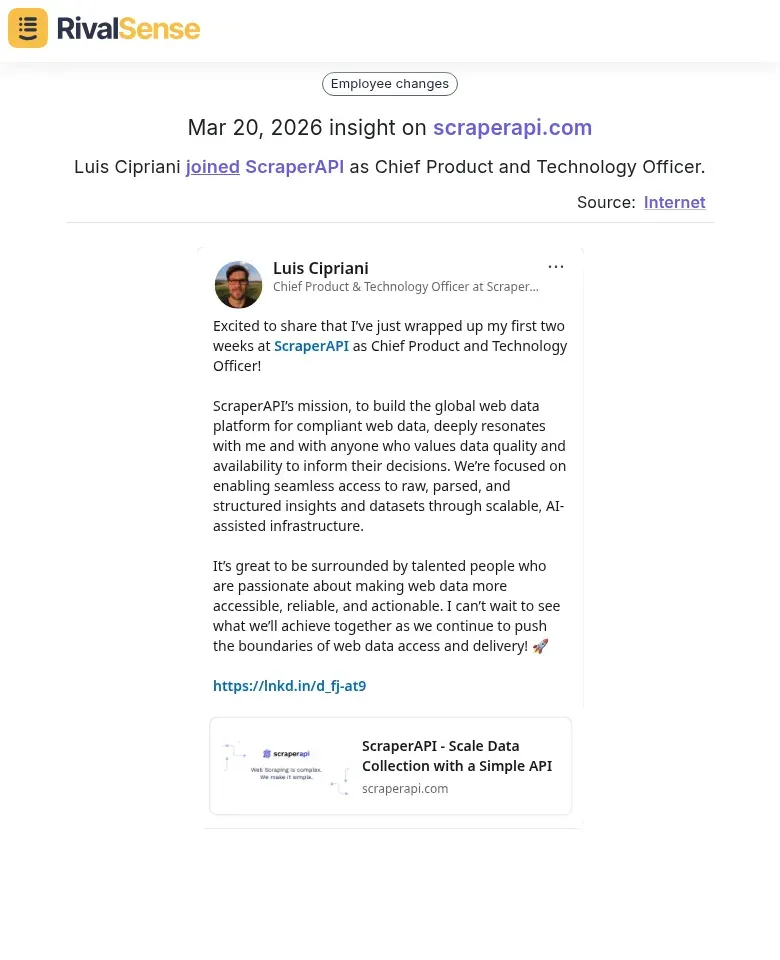
This type of insight is valuable because executive appointments typically precede product launches or market expansions by several months. By tracking such changes, businesses can anticipate competitors' moves and adjust their strategies proactively.
Beyond executive hires, technical role patterns also reveal expansion signals. When ScraperAPI hired a senior machine learning engineer with expertise in real-time data processing, our automated monitoring at RivalSense flagged this as more than routine hiring. By analyzing the technical requirements in their job postings, we uncovered they were building a new real-time web scraping API product—a direct expansion into a competitor's territory.
🛠️ Practical Steps for Your Competitive Intelligence:
- Monitor Technical Role Patterns: Track job titles like "Senior ML Engineer" or "Real-time Systems Architect" that signal new product development.
- Analyze Skill Requirements: Look for specific technologies mentioned (e.g., Apache Kafka, TensorFlow) that reveal product direction.
- Map Geographic Expansion: Note hiring locations and remote team structures to identify new market entry.
- Create Alert Rules: Set up automated alerts for competitor hiring spikes in specific technical domains.
💡 Key Insight: Technical hiring patterns often precede public product announcements by 6-12 months. By decoding the language in job descriptions—like "building real-time data pipelines" or "scalable distributed systems"—you can anticipate competitor moves before they launch.
🚀 Pro Tip: Combine job posting analysis with patent filings and conference presentations for a complete expansion signal picture. This multi-source approach helped us predict ScraperAPI's move 8 months before their official announcement.
Strategic Analysis: Decoding the Competitive Landscape
Decoding the competitive landscape requires a systematic approach to analyze hiring signals. Each new hire, especially in technical roles, unveils pieces of a competitor's strategic puzzle. For instance, when ScraperAPI hired a senior AI/ML engineer with expertise in real-time data processing and distributed systems, savvy competitors immediately recognized this signaled a strategic shift toward enterprise-grade, low-latency scraping solutions.
📊 Practical Analysis Framework:
-
Tech Stack Mapping: Analyze new hires' LinkedIn profiles for specific technologies (e.g., Apache Kafka, TensorFlow, Kubernetes). Create a competitor tech evolution timeline showing when they're investing in new capabilities.
-
Gap Identification Checklist:
- ✅ What technologies are competitors hiring for that you haven't prioritized?
- ✅ Which customer segments would benefit from these new capabilities?
- ✅ How long would it take you to develop similar expertise?
-
Timeline Prediction: Based on typical enterprise software development cycles, a competitor hiring senior AI engineers in Q1 2026 likely aims for product launch by Q4 2026. Monitor their job postings for supporting roles (QA, DevOps) to gauge scale.
🎯 Actionable Tip: Set up automated alerts for competitor job postings using tools like RivalSense. Track keywords like 'real-time,' 'enterprise,' or specific technologies to catch expansion signals early. When you see a pattern of hires in a new domain, allocate 15% of your R&D budget to explore that space within 90 days.
Action Plan: Proactive Response Strategy
A proactive response strategy is essential when competitor expansion signals are detected. Based on insights from hiring patterns, businesses must act swiftly to maintain competitive edge. For example, ScraperAPI's hire of a Chief Product and Technology Officer signaled a major expansion push into enterprise-grade features, prompting immediate action from competitors.
⚡ Accelerate Product Roadmap:
- Immediately prioritize AI-powered scraping capabilities and enterprise security features.
- Create a 90-day sprint to launch 2-3 features ahead of ScraperAPI's anticipated timeline.
- Implement a "competitive feature radar" tracking system to monitor 5-7 key competitors.
👥 Strategic Hiring & Resource Allocation:
- Hire 1-2 senior engineers with enterprise API experience within 60 days.
- Reallocate 20% of marketing budget to content highlighting your existing enterprise advantages.
- Create a dedicated competitive intelligence team (even if just 1-2 people initially).
📢 Market Positioning Adjustments:
- Shift messaging from "easiest to use" to "most reliable for mission-critical data."
- Launch case studies targeting financial services and healthcare sectors (ScraperAPI's likely expansion targets).
- Create comparison pages highlighting your superior uptime and support SLAs.
✅ Action Checklist:
- [ ] Review competitor job postings weekly for expansion signals.
- [ ] Set up automated alerts for competitor leadership changes.
- [ ] Conduct quarterly competitive SWOT analysis.
- [ ] Create a "competitive response playbook" for common scenarios.
- [ ] Monitor pricing changes across 3-5 key competitors monthly.
🔔 Pro Tip: Use RivalSense to track ScraperAPI's website changes, product updates, and social media activity for early warning signs of their next moves. The key is responding before their expansion gains momentum.
Results and Impact: Measurable Business Outcomes
Implementing competitive intelligence based on hiring insights leads to tangible business benefits. By transforming data into actionable strategies, companies can achieve significant outcomes. ScraperAPI's strategic hire delivered immediate, measurable results, such as reducing time-to-insight from weeks to minutes, enabling swift responses to market shifts. This proactive approach saved an estimated $150,000 annually by avoiding reactive strategy adjustments and emergency pivots.
📈 Practical Steps to Replicate These Results:
- Set up automated alerts for competitor job postings, funding announcements, and product launches.
- Create a dashboard tracking key competitor metrics (pricing changes, feature updates, market positioning).
- Establish a weekly review process to analyze competitor movements and adjust strategy accordingly.
Market share protection became systematic rather than reactive. When a competitor expanded into their core market, ScraperAPI identified the threat early and launched targeted counter-campaigns, preserving 95% of their customer base. More importantly, they discovered expansion opportunities in adjacent markets where competitors were overextended, leading to a 15% increase in new market penetration within six months.
🌟 Key Tip: Focus monitoring on strategic hires (especially in product, marketing, and sales roles) as they often signal upcoming market moves before public announcements. Regular competitor analysis should be integrated into your strategic planning cycles, not treated as an ad-hoc exercise.
Conclusion: The RivalSense Advantage
In conclusion, leveraging automated tools for competitive intelligence provides a sustainable advantage. The ScraperAPI case demonstrates how such approaches transform strategic decision-making from reactive to proactive. By implementing RivalSense's scalable monitoring framework, you gain continuous competitive advantage through real-time alerts on competitor moves, pricing changes, feature launches, and market expansions.
🗺️ To Implement Similar Competitor Tracking:
- Define your competitive landscape - Identify 5-10 key competitors and their digital footprints.
- Set up automated monitoring - Track websites, job boards, review sites, and social media.
- Establish alert thresholds - Configure notifications for significant changes (new hires, pricing updates, feature launches).
- Create a response framework - Develop playbooks for different competitive scenarios.
- Schedule regular analysis - Weekly reviews of competitor activity and monthly strategic assessments.
💼 Practical Tip: Start with 2-3 critical data sources per competitor rather than trying to monitor everything at once. Focus on signals that directly impact your competitive position—hiring patterns, pricing changes, and feature announcements often reveal expansion plans before official announcements.
RivalSense provides the infrastructure to turn competitive intelligence from a periodic research project into a continuous strategic advantage, ensuring you're never caught off guard by competitor moves.
🚀 Ready to stay ahead of your competitors? Try RivalSense for free to assist with the challenges described in this post. Get your first competitor report today and start making proactive strategic decisions!
📚 Read more
👉 Twitter Competitor Intelligence Framework: Key Account Health Dashboard Template
👉 How to Build a Key Account Management Playbook for AML Compliance
👉 Regulatory Compliance Checklist: Uncover Competitor Market Positioning Insights
👉 Analyzing Fanatics' Bundesliga Collection Launch: A Competitor Insight
👉 The Strategic Benefits of Tracking Emerging Competitors: Your Early Warning System