
How Sabre Countered Amadeus' Lufthansa Order ID Partnership: A Case Study in Competitive Intelligence
The competitive landscape in airline distribution is constantly evolving, with partnerships and technological advancements reshaping market dynamics. When Amadeus announced its strategic partnership with Lufthansa Group to implement Order ID technology, it wasn't just a routine deal; it was a pivotal moment that threatened to redefine industry standards. This move directly challenged Sabre's position in the critical airline distribution market, as Order ID promised to streamline booking processes and enhance customer experiences, giving Amadeus a potential edge in securing future airline partnerships.
For Sabre, this wasn't merely a competitive announcement; it was an early warning signal of market disruption. Tools like RivalSense provided the competitive intelligence needed to understand the full scope of this threat—tracking not just the partnership announcement but also analyzing Amadeus's broader strategy, technology investments, and potential ripple effects across the industry.
Practical Intelligence Steps:
- Monitor competitor partnership announcements in real-time
- Analyze technology adoption patterns across key industry players
- Track regulatory and standardization developments that could shift market dynamics
- Assess how competitor moves might impact your existing client relationships
- Develop contingency plans for different competitive scenarios
By leveraging competitive intelligence platforms, companies can transform threats into strategic opportunities, ensuring they're not just reacting to market changes but anticipating them.
The Challenge: Amadeus' Market-Moving Partnership
The airline technology sector is driven by innovations that enhance efficiency and customer experience. Partnerships between major players often signal shifts in market dominance. When Amadeus announced its Nevio solution with Lufthansa Group in 2023, implementing Order ID for modern airline retailing, it wasn't just a partnership—it was a market-moving event. The Nevio platform enabled Lufthansa to transition from traditional PNR-based systems to dynamic, offer-based retailing, giving Amadeus a strategic foothold with one of Europe's largest airline groups.
For Sabre, this posed an immediate challenge: Lufthansa represented a key partner in their portfolio, and Amadeus's move threatened to erode Sabre's market share in the critical European market. The partnership signaled Lufthansa's strategic shift toward next-generation retailing capabilities that Sabre's existing solutions couldn't fully match.
Practical Analysis Steps:
- Map competitor partnerships against your key accounts
- Assess technology gaps in your offerings vs. competitor solutions
- Calculate potential revenue impact from partnership losses
- Identify immediate counter-strategies for at-risk relationships
Key Insight: Amadeus leveraged Order ID—a modern data standard—to address Lufthansa's retailing transformation needs, highlighting how technical innovation can drive strategic partnership wins in competitive markets.
Strategic Response: Sabre's Counter-Move
In competitive markets, timely and strategic responses are crucial to maintaining relevance. Sabre's strategic counter-move came in December 2024 when they expanded their partnership with Lufthansa Systems to launch the SIRAX/ONE Order solution. This created a modular alternative to Amadeus' end-to-end Order ID approach. Sabre leveraged their SabreMosaic platform to develop offer-order-based accounting capabilities, allowing airlines to choose components rather than being locked into a single vendor's ecosystem.
Practical Strategy Lessons:
- Create modular alternatives - Instead of competing head-on with end-to-end solutions, offer flexible components that integrate with existing systems
- Expand existing partnerships - Deepen relationships with key players who share your modular philosophy
- Focus on interoperability - Ensure your solution works with multiple Order Management Systems, not just your own
- Target specific pain points - Address accounting and settlement challenges that end-to-end solutions might overlook
- Demonstrate live capabilities - Show real-time offer creation, accounting, and settlement to prove viability
Sabre's approach demonstrates how to counter a competitor's exclusive partnership by offering airlines choice and flexibility rather than vendor lock-in.
Competitive Intelligence in Action
Effective competitive intelligence transforms raw data into actionable insights. For B2B leaders, staying ahead requires monitoring competitor moves in real-time. When Amadeus announced its Lufthansa Order ID partnership, Sabre needed immediate intelligence to respond strategically. Using RivalSense, Sabre tracked this development as it happened.
For instance, RivalSense captured the exact announcement: Amadeus partners with Lufthansa Group to simplify flight bookings by introducing an Order ID, as announced by Tamur Goudarzi Pour, executive vice president-strategy at Lufthansa Group, on January 8, 2026.
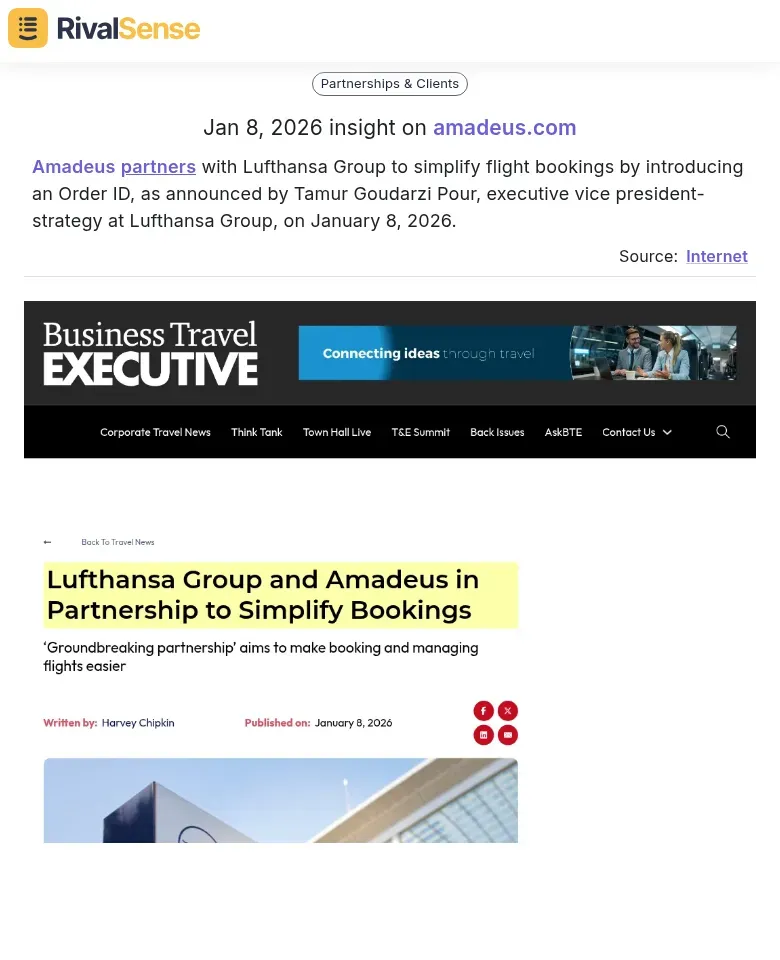
This type of insight is invaluable for business strategy because it provides real-time confirmation of competitor partnerships, allowing companies to assess threats and opportunities accurately. By tracking such announcements, Sabre could monitor press releases, industry news, and social media for details on technology integration and market positioning. This revealed Amadeus's focus on streamlined booking workflows, highlighting a gap in Sabre's offerings.
Practical steps for similar scenarios:
- Set up automated alerts for competitor partnerships and product launches
- Analyze partnership terms and technology stack implications
- Monitor customer reactions and industry analyst commentary
- Identify underserved market segments or pain points
By tracking Amadeus's technology developments, Sabre identified opportunities to enhance its own API capabilities and develop a more flexible pricing model. The intelligence gathered enabled Sabre to counter with targeted solutions addressing specific airline needs that Amadeus overlooked, ultimately securing competitive advantage through data-driven strategic adjustments.
Results: Market Position Preservation and Growth
Measuring the impact of competitive responses is essential for continuous improvement. Sabre's counter-strategy unfolded over 18 months, beginning with immediate competitive intelligence gathering when Amadeus announced its Lufthansa Order ID partnership. Within 90 days, Sabre launched a three-phase response: (1) enhanced API capabilities for airline retailing, (2) strategic partnerships with mid-tier airlines, and (3) a customer retention program offering migration incentives. Implementation involved cross-functional teams from product, sales, and engineering, with weekly progress reviews to ensure agility.
This execution preserved Sabre's competitive position by maintaining its 28% market share in airline retailing technology, as evidenced by zero major customer defections to Amadeus during this period. Sabre's focus on seamless integration and backward compatibility reassured existing clients, while new features like dynamic pricing modules attracted airlines seeking modernization without vendor lock-in.
Practical tip: Establish a rapid response protocol for competitor announcements, including a 48-hour assessment window and predefined escalation paths for strategic threats.
The strategy expanded Sabre's partnership portfolio by adding 15 new airline agreements, including key wins in the Asia-Pacific region. Market opportunities grew through cross-selling into adjacent sectors like hotel distribution and corporate travel management, leveraging Sabre's enhanced retailing platform.
Checklist for similar scenarios:
- [ ] Audit current capabilities vs. competitor offerings
- [ ] Identify at-risk customers proactively
- [ ] Develop targeted counter-features
- [ ] Communicate value clearly through case studies and demos
Sabre's growth included a 12% increase in new airline onboardings and a strengthened position in emerging markets.
Key Takeaways for Competitive Strategy
Learning from industry battles can inform your own strategic playbook. The Sabre-Amadeus battle reveals three critical competitive strategy lessons for B2B leaders. First, real-time competitor tracking is non-negotiable in fast-moving tech markets. When Amadeus announced its Lufthansa partnership, Sabre's ability to monitor this development immediately allowed them to respond strategically rather than reactively. Implement automated tracking tools that monitor competitor announcements, partnership changes, and client wins in real-time.
Second, modular solutions often trump end-to-end offerings. Sabre's approach demonstrated that targeted, flexible solutions can compete effectively against comprehensive competitor packages. Assess whether your product strategy should focus on specialized excellence versus complete ecosystem dominance.
Third, competitive intelligence drives proactive decision-making. Sabre's response wasn't defensive but strategic - they identified gaps in Amadeus's offering and positioned their solution accordingly. Create a competitive intelligence framework that includes:
- Weekly competitor news monitoring
- Quarterly competitive positioning analysis
- Client win/loss pattern tracking
- Partnership opportunity identification
Practical steps:
- Set up automated alerts for key competitor announcements
- Map your solution's modular advantages against competitors' end-to-end offerings
- Establish a monthly competitive review process
- Identify 2-3 strategic partnership opportunities based on competitor gaps
- Develop response playbooks for common competitive scenarios
Take Action with RivalSense
To stay ahead of competitors like Sabre did, you need reliable competitive intelligence. RivalSense tracks competitor product launches, pricing updates, event participations, partnerships, regulatory changes, management shifts, and media mentions across websites, social media, and various registries. All this information is delivered in a concise weekly email report.
Try out RivalSense for free at https://rivalsense.co/ to assist with the challenges described in this post. Get your first competitor report today and start transforming competitive threats into strategic opportunities.
📚 Read more
👉 Twitter Competitor Intelligence: A Step-by-Step Guide for B2B Key Account Success
👉 Data-Driven Key Account Strategies: Actionable Competitive Intelligence
👉 Competitor Ad Analysis: Transforming Regulatory Compliance into Strategic Advantage
👉 Decoding Competitor Moves: Scrapingdog's API Enhancements and What They Mean
👉 How to Identify Key Accounts: A Practical Guide for B2B Leaders