
How Roblox's The Block Launch Prompted Rivals' Immersive Strategy Shift
Roblox's launch of 'The Block' as a permanent immersive entertainment hub—garnering 12.7 million visits in under two months—signaled a seismic shift in the digital landscape. This move wasn't just about user engagement; it represented a strategic pivot toward owned, persistent virtual spaces that blend gaming, social interaction, and creator monetization. The competitive response was immediate and telling: Epic Games accelerated Fortnite's creator economy changes, while other platforms began reevaluating their immersive content strategies.
For B2B companies, this case study offers critical lessons in competitive intelligence. First, track platform feature launches as leading indicators of market direction—not just as product updates, but as strategic positioning moves. Second, monitor creator economy changes (revenue splits, tool accessibility) as these directly impact ecosystem health and competitive moats. Third, analyze user engagement metrics beyond surface numbers; 12.7 million visits represents not just traffic, but validated user behavior toward immersive experiences.
Practical steps for your competitive tracking:
- Set up alerts for major platform feature announcements
- Track creator monetization changes across rival ecosystems
- Benchmark user engagement metrics against industry shifts
- Map feature adoption timelines to identify strategic patterns
The Block's success demonstrates how single platform decisions can force entire industry recalibrations. Your competitive intelligence should capture not just what rivals do, but why they're doing it—and what market realities they're anticipating.
The Catalyst: Roblox's 'The Block' Launch and Market Impact
Roblox's 'The Block' launch served as a powerful catalyst that forced competitors to rethink their immersive strategy. The numbers were undeniable: 12.7 million visits in under two months, 469.6K average daily visits, and a remarkable 96.6% approval rating that placed it among the top 20 most popular Roblox games. What made The Block particularly disruptive was its strategic positioning as a 24/7 music, fashion, and social discovery hub within gameplay—not just another game, but a destination for cultural discovery.
For instance, competitive intelligence tools like RivalSense provide timely insights into such launches. RivalSense tracked that "Roblox launched The Block, its official immersive entertainment venue, on December 13." 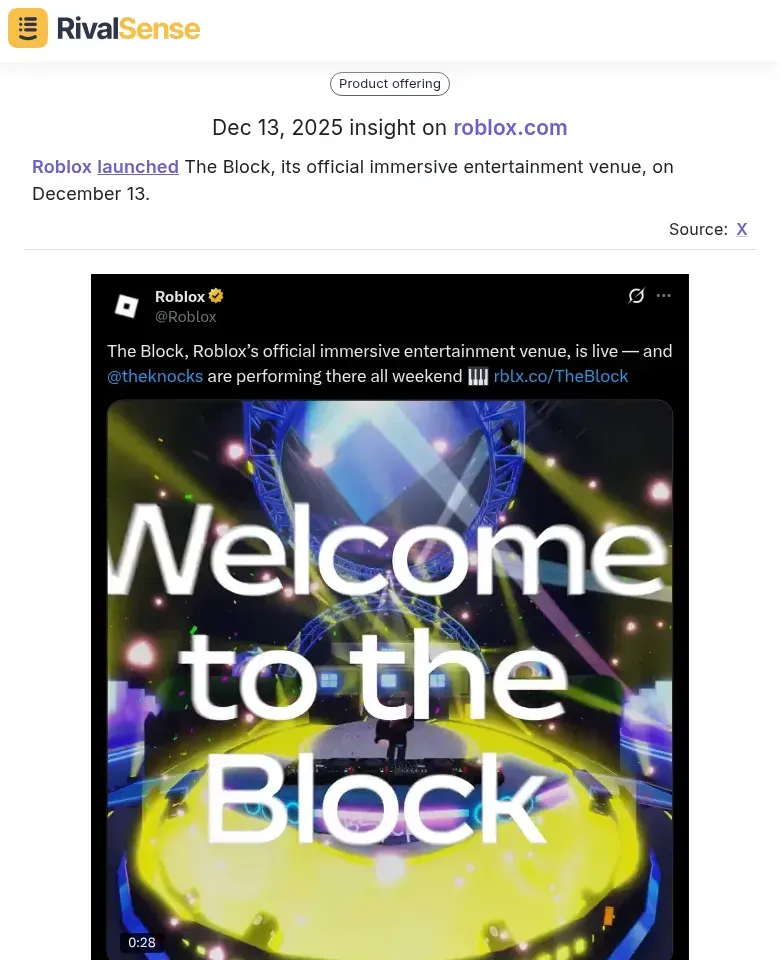 This type of product launch insight is invaluable for business strategy because it allows you to monitor competitor moves in real-time, understand market trends, and anticipate strategic shifts before they impact your business.
Practical advice for competitive analysis: Track not just user numbers but engagement quality metrics like approval ratings. Monitor how competitors integrate partnerships with high-profile creators (like Laufey, Sofi Tukker) and IP collaborations (Netflix's Kpop Demon Hunters).
Create a checklist:
- Identify emerging platform-native content formats
- Analyze partnership strategies that blend entertainment and commerce
- Measure community sentiment beyond raw traffic
- Study how successful platforms create 'always-on' social spaces rather than isolated experiences
The Block demonstrated that immersive strategy now requires blending entertainment, social connection, and cultural relevance in a single ecosystem.
Competitive Response Analysis: Epic Games/Fortnite's Strategic Pivot
When Roblox launched The Block in late 2023, Epic Games responded with a strategic pivot that reveals how market leaders counter disruptive threats. Fortnite's announcement of creator item sales with a 74% revenue share (first year) directly challenged Roblox's 25% model, creating immediate pressure on creator economics.
Epic's 'thin client' strategy shifted focus from traditional battle royale to creator-made content, mirroring Roblox's UGC success. This timing correlated with Fortnite's player decline and Roblox's growth surge from viral hits like 'Adopt Me!' and 'Brookhaven'.
Practical Insights for Competitor Analysis:
- Monitor Revenue Model Changes – Track competitor pricing and revenue share adjustments as early warning signals
- Analyze Strategic Pivots – When rivals shift core offerings (like Fortnite's 'thin client'), assess if they're responding to your growth
- Correlate Timing with Metrics – Map competitor announcements against your own user/engagement trends to identify reactive moves
- Evaluate Creator Ecosystem Moves – Changes in creator incentives often precede broader platform strategy shifts
Epic's response demonstrates how established players can rapidly adapt their business models when faced with disruptive competition, offering a case study in reactive strategy execution.
Market Dynamics: The Creator Economy Arms Race
The creator economy arms race has reached a critical inflection point. Roblox's $923M creator payouts in 2024 dwarfed Fortnite's $288M annual creator compensation, highlighting a significant disparity. This 3.2x financial gap reveals fundamental platform differentiation: Roblox's UGC-first foundation empowers creators to build entire economies, while Fortnite's battle royale heritage prioritizes curated experiences with creator tools layered on top.
Practical Insight: Analyze your competitors' creator economy investments as leading indicators of platform strategy. Roblox's The Block launch signals a shift toward immersive, sponsored placement blocks where brands pay for premium virtual real estate. Meanwhile, engagement-based payout models are becoming standard across platforms.
Actionable Checklist:
- Track creator payout ratios relative to platform revenue
- Monitor sponsored placement innovations (virtual billboards, branded experiences)
- Analyze engagement metrics driving creator compensation
- Benchmark UGC tool investments against curated content strategies
- Identify emerging creator economy monetization patterns before competitors
Key Takeaway: The Block represents more than a feature launch—it's a strategic move forcing rivals to accelerate their immersive strategy shifts or risk creator defection to higher-paying ecosystems.
Strategic Implications for B2B Competitor Intelligence
Roblox's The Block launch—a permanent music/fashion hub with 12.7M visits and 96.6% approval—triggered immediate competitive responses. Epic Games responded by overhauling Fortnite's creator economy, introducing new economic models to counter Roblox's UGC dominance. This demonstrates three critical B2B competitor intelligence principles:
1. Track Platform Feature Launches: Monitor major feature releases like The Block's music partnerships and social discovery tools. These signal strategic pivots that force competitors to respond. Create a feature-tracking dashboard with launch dates, adoption metrics, and competitor reaction timelines.
2. Analyze Revenue Model Changes: When Fortnite shifted creator payouts (from $288M to more competitive rates), it revealed a strategic counter-move. Track revenue model adjustments as leading indicators of market positioning shifts. Set up alerts for pricing, commission, and payout structure changes.
3. Monitor Engagement Metrics: The Block's 469.6K daily visits and 2.86K concurrent players signaled market opportunity. Use engagement data to predict competitor responses—Fortnite's 50-60% engagement drop preceded their strategic overhaul. Implement weekly engagement scorecards tracking DAU, session length, and retention rates.
Actionable Checklist:
- Weekly competitor feature release monitoring
- Quarterly revenue model analysis
- Daily engagement metric tracking
- Competitive response timeline mapping
- Strategic pivot prediction scoring
Conclusion: Lessons for Competitive Strategy in Digital Platforms
The Block's success demonstrates that integrated entertainment ecosystems create powerful competitive moats. Roblox's seamless blend of gaming, social interaction, and live events forced rivals like Fortnite and Minecraft to accelerate their own immersive feature development. This shows how market leaders must adapt when competitors introduce compelling new capabilities.
For B2B companies, the strategic takeaways are clear:
- Monitor Feature Innovation: Track competitor launches like The Block that could redefine market expectations
- Assess Ecosystem Impact: Evaluate how new features integrate with existing platforms and user behaviors
- Develop Response Scenarios: Prepare for feature-based competition with contingency plans
- Prioritize Integration: Focus on how new capabilities complement your existing ecosystem
- Measure User Adoption: Use competitor tracking tools to monitor engagement metrics
Practical Checklist:
- [ ] Set up alerts for competitor feature launches
- [ ] Analyze how new features affect user retention
- [ ] Benchmark your ecosystem integration against competitors
- [ ] Develop rapid response capabilities for feature-based competition
- [ ] Regularly assess whether to match, differentiate, or ignore competitor innovations
The Block case proves that in digital platforms, competitive advantage comes from integrated experiences, not isolated features. Successful companies anticipate these shifts and respond strategically rather than reactively.
Ready to elevate your competitive intelligence? Try out RivalSense for free to get insights like product launches, pricing updates, and more, delivered in a weekly email report. Get your first competitor report today!
📚 Read more
👉 How Top Brands Use Twitter to Analyze Competitor Customer Support
👉 Airbnb vs Hotels: Real-World Content Marketing Advantages Revealed
👉 Competitor Product Benchmarking: Actionable Insights for Key Account Management
👉 Decoding Competitor Pricing Moves: A Real-World Example from EmpMonitor