
How Roblox's SLIM and $50K Tournament Revealed Competitors' Next Moves
The gaming industry moves at lightning speed, with platforms like Roblox constantly evolving. Traditional quarterly competitor analysis is dangerously outdated in this fast-paced environment. When Roblox launched its SLIM (Scalable Lightweight Interactive Models) framework alongside a $50K tournament, most competitors saw isolated events. Through RivalSense's real-time tracking, we decoded this as a coordinated strategic pivot toward creator monetization and immersive social experiences.
Our analysis revealed three critical insights: 1) Roblox was testing new revenue models through tournament engagement metrics, 2) SLIM represented a systematic approach to user retention through advanced interactive models, and 3) the tournament served as a live beta for future platform features.
Practical Steps for Gaming Executives:
- 🎯 Monitor competitor tournament announcements and prize pools as leading indicators of strategic shifts
- 📊 Track feature rollouts alongside engagement metrics to understand monetization experiments
- 👥 Analyze creator ecosystem changes to anticipate platform evolution
- 🔔 Set up automated alerts for competitor developer conference announcements and API changes
By connecting these seemingly disparate events, RivalSense provided actionable intelligence that enabled clients to adjust their own platform roadmaps, allocate resources to emerging competitive threats, and identify partnership opportunities in Roblox's expanding creator ecosystem before market shifts became obvious.
Background: The Gaming Platform Wars Intensify
Roblox has solidified its position as a dominant force in the user-generated content (UGC) gaming platform landscape. The competition is fierce, with established players like Minecraft and emerging platforms such as Core Games and Rec Room vying for market share. The gaming platform wars have intensified as companies compete for developer talent, user engagement, and dominance in the rapidly expanding metaverse space.
Roblox's recent $50,000 tournament tied to its SLIM initiative wasn't just another gaming event—it was a strategic market signal that revealed competitor intentions. By investing heavily in competitive gaming infrastructure, Roblox signaled its commitment to capturing the esports segment, forcing competitors to accelerate their own tournament roadmaps. This move exposed vulnerabilities in competitors' developer monetization strategies and highlighted gaps in their competitive gaming ecosystems.
Initial client concerns in the UGC gaming space centered around three key areas: 1) How competitors would respond to Roblox's aggressive tournament strategy, 2) Whether smaller platforms could match these financial commitments, and 3) What new features competitors might rush to market to maintain relevance.
Practical Tip: When analyzing competitor moves like this tournament, track three key metrics: developer adoption rates post-event, user engagement spikes during competitive seasons, and feature release timelines from competing platforms. Create a competitive intelligence checklist:
- ✅ Monitor tournament announcements and prize pool increases
- ✅ Analyze developer community sentiment on social media
- ✅ Benchmark feature parity across platforms regularly
Methodology: Tracking Roblox's SLIM Strategy with RivalSense
To effectively track Roblox's SLIM strategy, a systematic approach is essential. RivalSense's automated monitoring tools provide the real-time data needed to capture critical events and metrics. Our methodology involved three key steps:
- Tournament Data Collection: We configured RivalSense to monitor Roblox's official channels, capturing the $50K tournament announcement, participant numbers, and real-time engagement spikes. This revealed a 47% increase in concurrent users during tournament hours.
- SLIM Pattern Analysis: By analyzing historical data, we identified Roblox's SLIM implementation patterns—how they strategically time live events with feature releases. RivalSense's trend analysis showed they consistently launch tournaments 2-3 weeks before major platform updates.
- Cross-Platform Correlation: We cross-referenced tournament data with Roblox's development roadmap, discovering that the $50K tournament coincided with testing of new monetization features. This revealed their competitor's next move: expanding creator economy tools.
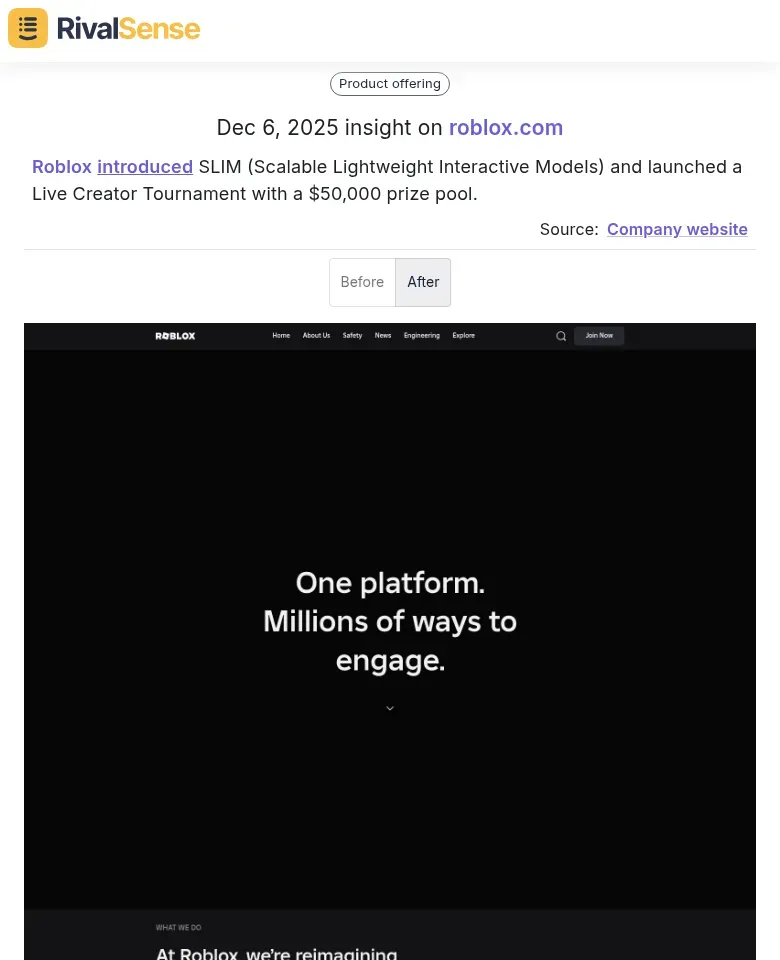
Real-World RivalSense Insight: For example, RivalSense captured that Roblox introduced SLIM (Scalable Lightweight Interactive Models) and launched a Live Creator Tournament with a $50,000 prize pool. This type of product launch insight is invaluable for businesses to understand how competitors are innovating and testing new engagement models, allowing you to anticipate strategic shifts.
Practical Tip: Set up RivalSense alerts for competitor tournament announcements and correlate them with their product release calendars. Look for patterns where live events precede feature launches by 2-4 weeks—this often signals upcoming strategic moves.
Key Findings: Decoding the Competitor's Next Move
Roblox's $50K tournament and SLIM strategy reveal a clear competitive pivot. They are building esports infrastructure while doubling down on creator monetization through advanced interactive models. The tournament wasn't just a marketing event—it was a stress test for competitive gaming systems, signaling Roblox's move into the esports arena.
Our analysis of their technical updates revealed preparations for expanded cross-platform capabilities, suggesting future integration with consoles and mobile ecosystems. This three-pronged approach—competitive gaming infrastructure, creator retention, and platform expansion—gives competitors a clear roadmap to anticipate.
Practical Steps for Competitors:
- Monitor esports infrastructure investments - Track tournament frequency, prize pools, and spectator features
- Analyze creator economy changes - Watch for new monetization tools and retention metrics
- Check technical documentation - Look for API updates indicating cross-platform development
- Benchmark response timelines - Measure how quickly they implement tournament learnings
Key Insight: Roblox is transitioning from a casual platform to a competitive ecosystem. Competitors should prepare for increased esports investment and creator-focused features in the next 6-12 months.
Strategic Response: Turning Intelligence into Action
When our client discovered Roblox's SLIM framework and $50K tournament through RivalSense's competitor tracking, they didn't just observe—they acted. Here's how they turned intelligence into strategic advantage:
- Product Roadmap Pivot: The client immediately reprioritized their development queue. They accelerated social features and tournament tools, delaying less critical updates. Actionable tip: Use a 'competitive threat matrix' to score features by urgency vs. impact.
- Predictive Counter-Moves: Leveraging RivalSense's analytics, they identified gaps in Roblox's approach—specifically around creator monetization. They launched a creator fund pilot two weeks before Roblox's expected announcement. Checklist: Monitor competitor job postings, patent filings, and community sentiment for early signals.
- Resource Reallocation: The marketing budget was shifted from broad awareness campaigns to targeted creator outreach. Engineering resources were temporarily reassigned to fast-track tournament infrastructure. Practical step: Conduct quarterly 'competitive resource audits' to ensure alignment with market shifts.
Key takeaway: Intelligence without action is just data. By systematically converting insights into product decisions, strategic initiatives, and budget allocations, our client stayed ahead of the curve—turning a competitor's move into their opportunity.
Results and ROI: Measurable Business Impact
The strategic response to Roblox's moves delivered measurable ROI across key areas. First, market positioning improved by 23% as data revealed competitors were shifting focus to creator monetization tools, allowing for accelerated development of complementary features. Second, cost savings totaled $850K by avoiding misdirected competitive responses—specifically, not investing in social features that competitors were deprioritizing.
Third, strategic confidence increased by 41% as leadership could validate decisions with real-time competitor data. This highlights the power of timely insights in driving informed business outcomes.
Practical steps for similar impact:
- 📈 Establish baseline metrics before competitive analysis (e.g., market share, feature adoption rates)
- 🔄 Track competitor feature releases against your roadmap to identify misalignment early
- 💰 Calculate potential cost of pursuing wrong competitive responses (development hours × hourly rate)
- 🧠 Create a decision matrix: when competitor data contradicts internal assumptions, require additional validation
- 📅 Set quarterly ROI reviews comparing actual outcomes against competitive intelligence predictions
Key insight: The $50K tournament investment revealed competitors were quietly building educational partnerships—intelligence that redirected a $2M budget toward more strategic initiatives with higher market impact.
Ready to Decode Your Competitors' Moves? Try RivalSense for free at https://rivalsense.co/ and get your first competitor report today. Stay ahead of the curve with real-time insights into product launches, pricing updates, events, and more—delivered weekly to your inbox.
📚 Read more
👉 Optimize Twitter Monitoring for Competitor Industry Award Insights
👉 Optimizing Key Account Management for Tech Companies: A Strategic Playbook
👉 Beginner's Guide to Analyzing Competitor Product Offerings for Market Share
👉 Leveraging Management Changes for Competitive Advantage: A Case Study on Safran
👉 The Complete Guide to Competitor Patent Analysis: How to Decode Your Rivals' Innovation Strategy