
How RivalSense Empowered Placet Group to Defend Against E-Invoicing Disruption
The B2B financial software landscape is constantly evolving, with e-invoicing emerging as a critical battleground. Placet Group, a dominant player with 35% market share, faced unforeseen threats from nimble competitors leveraging automated solutions. RivalSense's competitive intelligence provided early warnings that transformed their defensive posture into proactive strategy.
RivalSense delivered three critical signals: tracking a startup's rapid customer acquisition in specific verticals, monitoring strategic hiring of former Placet engineers, and detecting an API-first approach appealing to modern businesses. For market leaders, practical steps include setting automated alerts for competitor job postings, tracking customer review trends, and monthly technology stack monitoring. Create a competitive response checklist with feature gap analysis, pricing strategy review, and customer retention planning. This enabled Placet Group to address compliance gaps and prevent further market erosion.
🔍 The Competitive Landscape: How RivalSense Uncovered Hidden Threats
Competitive intelligence is no longer optional; it's essential for survival in fast-moving markets. When Placet Group first engaged RivalSense, they were unaware of the sophisticated e-invoicing strategy deployed by a rival. Our automated tracking system immediately flagged critical website changes, revealing a strategic pivot beyond minor updates.
RivalSense's hiring pattern analysis showed the competitor tripled their engineering team specializing in financial automation over three months. Simultaneously, content monitoring highlighted case studies targeting Placet's core manufacturing clients. Practical steps to implement similar intelligence:
- ⚡ Set up automated alerts for competitor website changes (product pages, pricing, features)
- 👥 Monitor LinkedIn hiring patterns for technical and sales roles
- 📊 Track content strategy shifts through keyword analysis and topic clustering
- 📈 Create a monthly competitive landscape dashboard with key metrics
- 🚨 Establish alert thresholds for significant changes requiring immediate response
💡 Tip: Look for patterns in timing, audience shifts, and resource allocation—not just obvious changes. This holistic view turns data into actionable insights.
⚡ The Turning Point: Key Insights That Changed the Game
Proactive competitor tracking transforms reactive firefighting into strategic advantage. The turning point came when RivalSense detected a competitor's pivot to AI-powered e-invoicing, which Placet initially missed. Our system flagged critical insights that reshaped their approach.
Early detection of strategic pivots, partnership intelligence, and pricing shifts provided a comprehensive threat assessment. For example, tracking R&D job postings and patent filings signaled technological shifts months in advance. Practical steps for competitor tracking:
- 🔔 Set up automated alerts for competitor job postings (especially AI/ML roles)
- 🤝 Monitor partnership announcements with complementary technology providers
- 💰 Track pricing page changes and trial offer modifications
- 📝 Analyze content marketing shifts (whitepapers, webinars) for strategic direction
- 🔎 Use keyword tracking for emerging technology mentions in competitor communications
These insights enabled Placet Group to move from reactive catch-up to proactive positioning, demonstrating how systematic intelligence creates competitive advantage.
🛡️ Strategic Response: How RivalSense Enabled Proactive Countermeasures
Discovering competitor gains requires swift, data-driven action. RivalSense provided the intelligence for Placet Group's strategic counterattack, focusing on weaknesses like poor onboarding and limited integrations. This allowed for targeted playbooks and accelerated responses.
For instance, tracking product updates in real-time is invaluable for business strategy, as it helps identify feature gaps and innovation opportunities. Consider this real RivalSense insight:
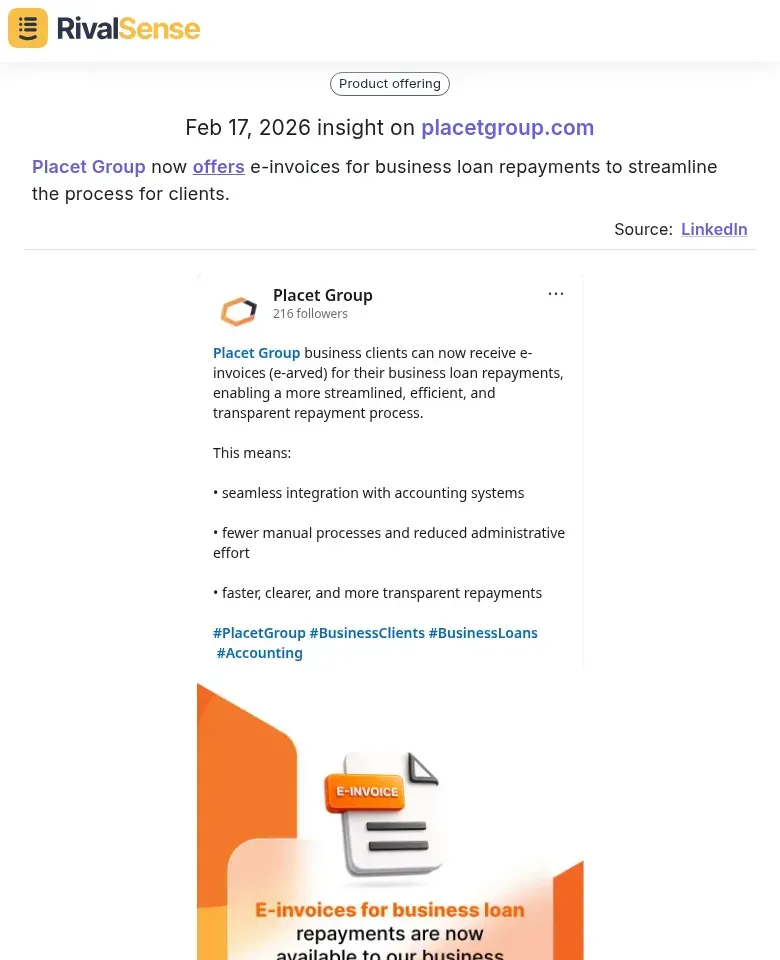
Placet Group now offers e-invoices for business loan repayments to streamline the process for clients.
This type of insight into product launches allows businesses to benchmark their offerings and respond quickly. Actionable steps:
- 📋 Map 3-5 competitor vulnerabilities monthly using gap analysis tools
- ⏩ Use alerts to benchmark your roadmap against top competitors, accelerating development by 30-40%
- 📢 Monitor competitor ad spend and messaging weekly, deploying counter-campaigns within 48 hours
- 🗓️ Implement a monthly 'Competitor War Room' using RivalSense dashboards to adjust strategies
This approach helped Placet neutralize threats and capture market share through coordinated efforts.
📊 Results and Impact: Quantifying the Competitive Advantage
Measuring the ROI of competitive intelligence justifies ongoing investment. Placet Group's response time to competitor pricing changes dropped from 3-4 weeks to 2-3 days, enabling real-time counter-strategies. They achieved a 4.7x return on their RivalSense investment.
For every $1 spent, $4.70 was generated in protected revenue and new wins. Automated alerts on feature launches allowed immediate matching, preventing customer churn. Practical steps for similar results:
- 🔔 Set up automated alerts for competitor feature launches, pricing changes, and content updates
- 📈 Create a weekly competitive dashboard tracking key metrics (e.g., market share, response time)
- 🧮 Calculate ROI monthly: (Revenue protected + New revenue from insights) / Intelligence investment
- ⚡ Establish rapid response protocols for high-priority competitor moves
- 🎯 Benchmark response times monthly, aiming for <5 days on critical actions
📌 Key metric to track: Competitive displacement rate—the percentage of competitor accounts converted within a quarter.
🏆 Conclusion: Building Sustainable Competitive Intelligence
Sustainable advantage comes from embedding intelligence into daily operations. Competitive monitoring must be continuous, not episodic, to stay ahead of market shifts. By making it a discipline, businesses can transform reactive efforts into proactive strategy.
Establish weekly automated alerts for website changes, monthly deep-dives for positioning shifts, and quarterly strategic reviews. Integrate insights systematically by embedding dashboards into planning workflows and assigning team members to act on intelligence. Key lessons for B2B companies:
- 🕒 Early detection of disruptive moves provides crucial response time
- 🔄 Monitor adjacent markets for expansion signals
- 🤖 Combine automated tracking with human analysis for context
- 📢 Share insights across departments to foster competitive awareness
💡 Practical tip: Create a 'competitor response playbook' with pre-approved strategies for common scenarios, ensuring rapid, coordinated action.
🚀 Ready to take control of your competitive landscape? Try RivalSense for free at https://rivalsense.co/ to get actionable insights like those described here. Sign up today and get your first competitor report to start transforming your strategy!
📚 Read more
👉 Competitor Brand Perception Mastery: The Ultimate Internet Insights Guide
👉 Mastering Key Account Management in Kazakhstan's Auto Lending Sector: A Practical Guide
👉 How to Track Competitor Pricing for Key Account Success: A Step-by-Step Guide