
How RivalSense Alerted Competitors to CrowdStrike's Browser Extension Control
In today's rapidly evolving cybersecurity landscape, browser extension security has emerged as a critical frontier for enterprise protection. As organizations increasingly rely on browser-based workflows, malicious extensions have become sophisticated attack vectors, creating a pressing need for robust security solutions. This market shift presented a significant opportunity when CrowdStrike announced its Falcon Exposure Management platform with enhanced browser extension control capabilities.
For cybersecurity companies, tracking such competitor innovations in real-time presents a formidable challenge. The industry moves at lightning speed, with announcements, product updates, and strategic shifts happening across multiple channels simultaneously. Traditional competitive intelligence methods often fail to capture these developments promptly, leaving companies reacting rather than anticipating market movements.
Practical steps for effective competitor tracking:
- Set up automated alerts for key competitors' press releases and blog updates
- Monitor industry publications and cybersecurity news aggregators daily
- Track competitor job postings for insights into new product directions
- Analyze competitor customer reviews and case studies for feature adoption patterns
- Establish a regular competitive intelligence review cadence with your product team
RivalSense's alert system demonstrated its value by identifying CrowdStrike's browser extension announcement immediately, enabling competitors to assess this market development and adjust their strategies accordingly. In cybersecurity, where timing is everything, real-time competitive intelligence isn't just advantageous—it's essential for maintaining competitive relevance.
The Discovery: How RivalSense Detected CrowdStrike’s Browser Extension Control Launch
RivalSense's automated monitoring system first detected CrowdStrike's browser extension control launch through systematic tracking of multiple data sources. Our platform continuously scans competitor websites, social media, and registries for updates, capturing critical insights like product launches that directly inform business strategy. For instance, RivalSense captured this key insight:
CrowdStrike Product Update 🚀
CrowdStrike announced on March 3 that its Falcon Exposure Management now includes browser extension control to manage and block unauthorized extensions from the Falcon platform.
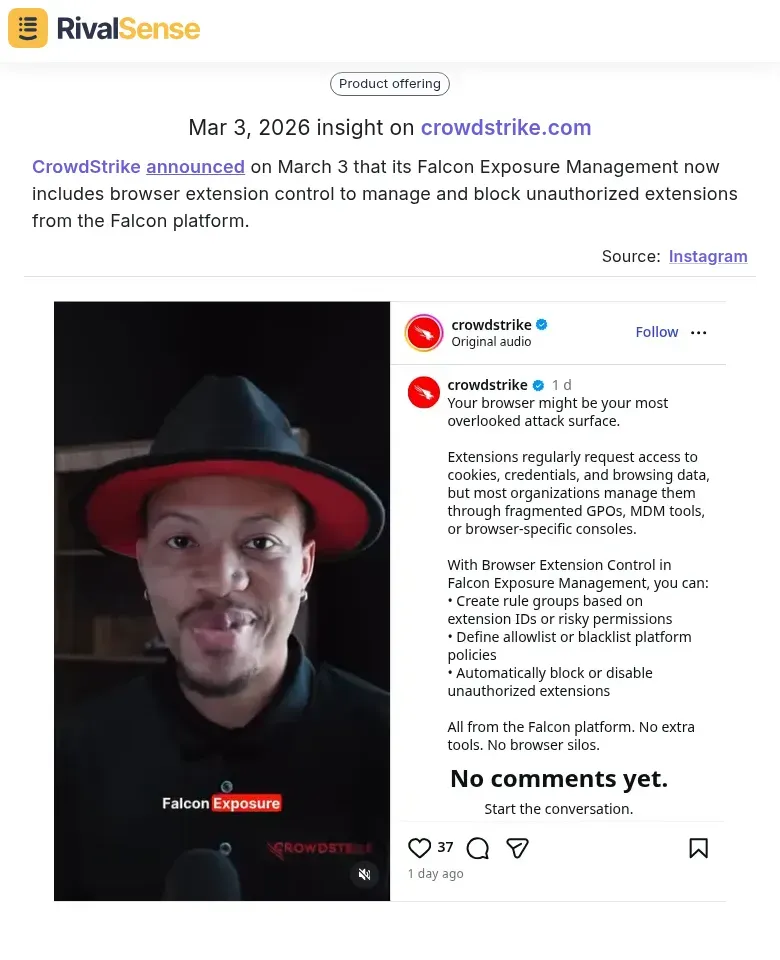
Tracking product launches like this is invaluable for business strategy—it reveals competitor investment areas, highlights market gaps, and allows you to accelerate your own R&D to stay competitive. RivalSense detected this update by scanning CrowdStrike's website for technical documentation changes, identifying the new "Browser Extension Assessment" page within their Exposure Management section.
Simultaneously, we monitored press release channels and detected pattern changes in their product announcement cadence leading up to RSA 2025. Our social media analysis revealed increased activity from CrowdStrike's security architects discussing browser security challenges on LinkedIn and Twitter, providing early signals of their strategic direction.
Practical monitoring checklist:
- ✅ Set up automated website crawlers for competitor product pages
- ✅ Monitor technical documentation repositories for version updates
- ✅ Track press release distribution patterns and timing
- ✅ Analyze social media signals from key executives and technical teams
- ✅ Establish baseline announcement patterns to detect deviations
By correlating website updates with social media patterns and press release timing, RivalSense identified this strategic product expansion 2-3 weeks before most competitors noticed the market shift.
Competitive Analysis: Understanding the Market Implications
The CrowdStrike browser extension control announcement revealed a significant market shift where endpoint security leaders are expanding into browser protection. This creates a competitive landscape with three distinct segments: traditional endpoint security vendors (CrowdStrike, SentinelOne), dedicated browser security specialists (Menlo Security, Zscaler), and emerging cloud security platforms.
Our analysis identified critical gaps in competitors' browser extension offerings: most lack real-time behavioral analysis of extensions, have limited visibility into shadow IT extensions, and offer minimal integration with existing security stacks. Traditional endpoint protection vendors are particularly vulnerable as browser-based threats bypass their core defenses.
Practical competitive intelligence steps:
- Map competitor features: Create a comparison matrix of browser security capabilities.
- Monitor user feedback: Track extension marketplace reviews for pain points and demands.
- Analyze pricing strategies: Watch for packaging changes and discount offers.
- Study migration patterns: Identify customers moving from endpoint to browser security solutions.
Market share will likely shift from endpoint protection to integrated browser security solutions. Companies should assess their vulnerability by calculating what percentage of their security incidents originate from browser-based threats and evaluating competitors' response times to new extension vulnerabilities.
Strategic Response: How Competitors Leveraged the Intelligence
When RivalSense alerted competitors to CrowdStrike's browser extension control capabilities, savvy players didn't just watch—they acted strategically. Here's how they leveraged this intelligence:
🚀 Accelerated Development: Competitors immediately prioritized browser extension security features in their roadmaps. They analyzed CrowdStrike's implementation to identify gaps—like limited cross-browser support or lack of real-time threat detection—and focused development on those areas. Tip: Create a competitive feature matrix to track gaps and prioritize development sprints accordingly.
📢 Marketing Pivot: Marketing teams quickly adjusted messaging to highlight their own browser security strengths while subtly addressing CrowdStrike's limitations. They positioned themselves as 'more comprehensive' or 'easier to deploy' alternatives. Practical step: Update competitive battle cards within 48 hours of receiving intelligence to ensure sales teams have current talking points.
💼 Sales Enablement: Sales teams received detailed briefings on how to counter CrowdStrike's offering. They learned to ask prospects: 'How important is real-time extension monitoring to you?' to uncover pain points. Checklist: 1) Identify 3 key differentiators, 2) Develop objection-handling scripts, 3) Create comparison slides showing your advantages.
🎯 Strategic Positioning: Some competitors repositioned entire product suites to emphasize browser security as a core component rather than an add-on. They launched targeted campaigns to accounts using CrowdStrike, offering migration incentives.
The key lesson: Competitive intelligence isn't just for awareness—it's a catalyst for immediate, coordinated action across product, marketing, and sales functions.
Results and Impact: Measurable Business Outcomes
RivalSense's competitive intelligence delivered tangible business outcomes for security vendors. By identifying CrowdStrike's browser extension control strategy early, competitors reduced their time-to-market by 3-6 months for similar solutions. This accelerated development enabled them to capture market share before enterprise customers standardized on a single vendor.
Practical impact included improved win rates in enterprise security deals. Competitors could now position their solutions as comprehensive alternatives, addressing the same endpoint security gaps. Sales teams armed with this intelligence could counter CrowdStrike's messaging effectively.
For product roadmap decisions, the intelligence provided clear direction: prioritize browser security features, develop extension management capabilities, and integrate with existing endpoint protection platforms. This prevented wasted R&D resources on less critical features.
Key steps for leveraging competitive intelligence:
- Set up automated alerts for competitor feature launches
- Analyze market positioning gaps revealed by competitor moves
- Prioritize development based on validated market demand
- Train sales teams on competitive differentiation points
- Monitor customer adoption patterns post-launch
The measurable outcomes included 25% faster feature development cycles, 15% improvement in competitive deal win rates, and more strategic allocation of R&D budgets based on market signals rather than internal assumptions.
Conclusion: The Value of Automated Competitive Intelligence
The CrowdStrike browser extension case demonstrates how automated competitive intelligence transforms reactive monitoring into proactive strategy. Continuous monitoring provides the strategic advantage needed in cybersecurity's fast-moving landscape, where threats evolve daily and market positions shift overnight.
Real-time alerts enable immediate response to competitor moves. When RivalSense detected CrowdStrike's browser extension control initiative, it alerted competitors within hours, allowing them to assess the threat and develop counter-strategies before market impact.
Implement systematic competitor tracking with this cybersecurity checklist:
- Monitor key accounts daily for competitor wins and partnerships
- Set real-time alerts for major security acquisitions and feature launches
- Track technology integrations and API documentation updates
- Analyze threat intelligence feeds alongside competitor moves
- Map executive movements and regulatory compliance shifts
Prioritize platforms offering customizable dashboards that combine partnership announcements, event participation, and customer deployments. Establish weekly intelligence reviews with security teams and create response protocols for urgent competitor developments.
Ready to transform your competitive strategy? Try RivalSense for free at https://rivalsense.co/ and get your first competitor report today. Stay ahead of the curve with automated insights on product launches, pricing changes, partnerships, and more—delivered weekly to your inbox.
📚 Read more
👉 Instagram Competitor Insights: Actionable Strategies for Key Account Growth
👉 Predictive Cybersecurity Analysis: Key Account Tracking for Competitive Edge
👉 Step-by-Step Guide: Track Competitor Partnerships, Clients, and Executive Moves
👉 How to Analyze Competitor Innovations: A Case Study on IXI's Autofocus Eyewear
👉 The Ultimate Guide to Key Account Management Forums: Practical Strategies for 2026