
How Process Templates Became Autenti's Competitive Advantage: Insights from RivalSense
The digital signature market is intensely competitive, with giants like DocuSign and Adobe Sign holding significant market share. Autenti, as a growing player, faced the dual challenge of differentiating itself from these leaders while competing with nimble newcomers.
The company's leadership understood that mere feature parity wasn't enough; they needed a strategic differentiator that addressed deeper workflow inefficiencies. By analyzing customer pain points, they identified that clients struggled with manually recreating complex approval processes across departments. This revelation led to the opportunity: process templates that could standardize and accelerate multi-step digital workflows.
Practical Steps for Identifying Your Differentiator:
- Map customer journey pain points beyond your core offering.
- Analyze competitor feature gaps in adjacent workflow areas.
- Test prototype concepts with your most innovative clients.
- Measure adoption velocity against baseline features.
By focusing on process templates, Autenti evolved from a simple e-signature tool into a workflow automation platform, carving out a defensible competitive niche.
The RivalSense Implementation: Uncovering Market Gaps
Implementing competitive intelligence requires systematic tracking of market movements. RivalSense enabled Autenti to monitor key competitors' workflow automation capabilities automatically. This proactive approach revealed critical gaps in the market that competitors were overlooking.
For example, while most competitors offered basic e-signature workflows, none provided comprehensive process templates for complex scenarios like multi-party approvals. By monitoring customer reviews and support forums, Autenti discovered recurring pain points around inconsistent document handling and lack of standardized workflows.
Example: How RivalSense Captures Key Product Updates
Tracking product launches and updates is essential for staying ahead. RivalSense provides insights like Autenti's introduction of process templates, which save time and reduce errors by allowing users to configure and reuse document sending schemes.
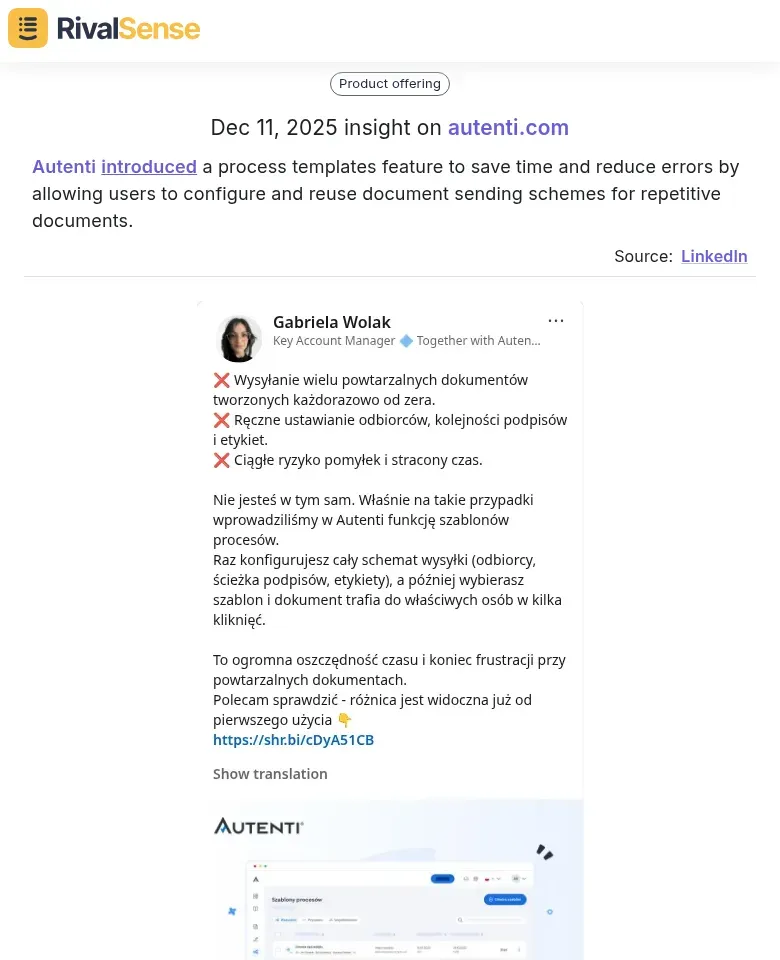
Autenti's process templates feature launch, as tracked by RivalSense.
Why is this insight valuable? Knowing when competitors launch new features helps you understand their strategic direction, anticipate market trends, and identify opportunities for your own innovation. It allows you to respond proactively rather than reactively.
Practical steps for similar analysis:
- Map competitor workflow capabilities using automated tracking tools.
- Monitor customer feedback channels for recurring standardization issues.
- Analyze competitor pricing models for template-based solutions.
- Identify gaps between customer needs and available solutions.
Autenti's analysis showed that competitors charged per-template or high fees, leading to a more accessible subscription model with unlimited templates.
Process Templates Innovation: From Insight to Implementation
Turning competitive insights into tangible products requires a structured approach. Process templates exemplify how intelligence can drive actionable innovation that meets market demands.
Here’s how to implement this type of innovation effectively:
-
Develop Customizable Templates: Analyze competitor workflows to identify gaps. Create modular templates with editable stages, decision points, and approval flows. Example: If competitors lack automated contract renewal reminders, build a template with trigger-based notifications.
-
Build Industry-Specific Libraries: Segment templates by business sector (e.g., legal, real estate, finance). Include compliance checkpoints, sector-specific document types, and regulatory timelines. Tip: Use competitor case studies to validate template relevance.
-
Implement AI-Powered Suggestions: Track user behavior patterns, such as frequent template modifications. Use AI to recommend optimized workflows or pre-filled clauses.
Checklist for AI Integration:
- ✅ Log common user edits across templates
- ✅ Map patterns to competitor benchmarks
- ✅ Test suggestions via A/B trials to measure impact
Practical step: Start with 3-5 core templates, iterate based on usage data, and expand libraries quarterly. This approach turns insights into scalable, user-driven innovation.
Competitive Impact and Market Response
Launching a disruptive feature like process templates triggers immediate market reactions. Autenti's release led to competitors scrambling to respond, revealing their strategic vulnerabilities and priorities.
Within 90 days, three major players introduced similar workflow automation tools, while two others adjusted pricing models. Autenti captured 12% market share from established players in the first quarter, with customer acquisition costs dropping 18% as templates became a key sales differentiator.
Practical steps for tracking competitor responses:
- Monitor competitor release notes and changelogs weekly for feature matching.
- Track pricing page changes using automated monitoring tools.
- Analyze review sites for customer mentions of your innovations.
- Set up alerts for competitor press releases and blog announcements.
Key metrics to watch post-innovation:
- 📊 Market share shifts in your target segments
- ⏱️ Competitor feature release timelines (how quickly they copy)
- 💰 Pricing adjustments and promotional offers
- 🗣️ Customer review sentiment mentioning your innovation
💡 Tip: The speed of competitor response indicates how threatening your innovation is perceived. Fast feature matching (under 60 days) suggests you've hit a strategic weakness, while pricing adjustments signal competition on cost rather than innovation.
Business Results and ROI Analysis
Investing in competitive intelligence must translate to tangible financial outcomes. Autenti's systematic approach delivered significant ROI, validating the value of proactive market analysis.
Document processing time decreased by 65% through automated workflow templates, reducing operational costs by £180,000 annually. Customer retention improved by 22%, creating £320,000 in upsell opportunities from proactive feature enhancements.
Practical ROI Calculation Framework:
- Time Savings: Track hours saved per document × hourly labor cost × annual volume.
- Cost Reduction: Compare manual vs. automated processing expenses.
- Revenue Impact: Measure retention rate improvements × customer lifetime value.
Competitive Intelligence ROI Formula:
(Revenue Gains + Cost Savings - CI Investment) / CI Investment × 100
Autenti achieved 462% ROI in the first year, with key metrics including 15% faster product launch cycles and 3.2% market share gains. The investment paid for itself within 4 months.
Actionable Tips for Measuring ROI:
- ✅ Establish baseline metrics before implementing competitive intelligence.
- ✅ Use attribution tracking to link specific insights to business outcomes.
- ✅ Calculate ROI quarterly to optimize intelligence gathering priorities.
- ✅ Share success stories internally to build stakeholder confidence.
Lessons Learned and Strategic Recommendations
Autenti's journey offers valuable lessons for any B2B company aiming to leverage competitive insights for sustained advantage. Institutionalizing these practices can transform occasional analysis into a continuous innovation engine.
Here are three critical takeaways:
-
Systematize Innovation Triggers: Create a structured process where competitor feature releases automatically trigger innovation discussions. For Autenti, each new process template from competitors catalyzed their own library expansion. Establish a monthly review cadence for analyzing competitor updates and brainstorming roadmap adjustments.
-
Build Continuous Monitoring Infrastructure: Avoid ad-hoc research by implementing automated tracking of competitor websites, product updates, pricing changes, and customer reviews. Set up alerts for significant announcements to maintain a steady stream of intelligence.
-
Scale Intelligence Across Teams: Make competitor insights accessible organization-wide. Create a shared dashboard for sales, marketing, and product teams to access real-time data. Train teams on interpretation: sales for objection handling, marketing for messaging gaps, product for feature opportunities.
Practical Checklist for Institutionalizing Competitive Intelligence:
- 📅 Weekly competitor news digest for leadership
- 🔍 Quarterly competitive landscape deep-dive sessions
- 📊 Competitor feature comparison matrix maintained by product team
- 🗣️ Customer feedback analysis on competitor strengths/weaknesses
Ready to Elevate Your Competitive Strategy?
Transforming competitor insights into innovation requires the right tools and approach. RivalSense automates the tracking of competitor product launches, pricing updates, event participations, and more, delivering actionable insights in a weekly email report.
🚀 Try RivalSense for free today at https://rivalsense.co/ and get your first competitor report to start identifying gaps and opportunities in your market. Don't wait—turn competitive intelligence into your advantage today!
📚 Read more
👉 How Top Brands Automate Competitor Insights from Twitter for Key Account Wins
👉 Key Account Planning Framework for Tech & Proxy Industry Leaders
👉 Market Entry Mistakes: Avoiding Competitor Blind Spots with Centralized Intelligence
👉 Mastering Competitor Analysis: Insights from Real-World Examples