
How Proactive Competitive Intelligence Counters Rivals' Market Moves
In today's fast-paced cybersecurity market, strategic moves by competitors can disrupt your business as swiftly as any technical threat. When a major player like CrowdStrike recently launched an aggressive free trial strategy, it created immediate pressure on rivals, highlighting the need for proactive market intelligence. Traditional reactive approaches often leave companies blindsided, eroding market share and pipeline momentum.
Strategic Imperative: Enterprise security leaders must adopt proactive competitor intelligence with these actionable steps:
- Monitor competitor pricing and trial strategy changes weekly 📅
- Track feature releases and platform enhancements monthly 🔄
- Analyze customer reviews and win/loss data quarterly 📊
- Set up automated alerts for competitor website and pricing page changes ⚠️
- Benchmark your trial experience against market leaders ⚖️
Proactive intelligence isn't just about defense—it's about anticipating market shifts before they impact your pipeline. When you can see competitive moves forming, you can develop counter-strategies, adjust pricing models, or enhance your own trial offerings to maintain competitive advantage.
The Competitive Landscape: CrowdStrike's Market Move
When CrowdStrike launched a frictionless free trial, it wasn't just a marketing tactic—it was a strategic play targeting enterprise decision-makers. This move allowed security teams to experience premium capabilities without commitment, directly addressing the high-stakes evaluation process in cybersecurity. The immediate impact pressured competitors to justify their value propositions more clearly, forcing a market-wide reassessment of trial offerings and customer acquisition strategies.
Practical advice for cybersecurity providers facing similar competitive moves:
- Monitor trial launches immediately - Set alerts for competitor free trial announcements 🚨
- Analyze target audience - Identify which customer segments are being targeted (enterprise vs. mid-market) 🎯
- Evaluate feature gaps - Compare your trial offerings against the competitor's free access 🔍
- Prepare counter-messaging - Develop responses addressing why your solution remains superior 💬
- Consider matching offers - Assess whether to launch or enhance your own trial programs ⚡
Key insight: Free trials create 'try-before-buy' benchmarks that force competitors to emphasize specialized capabilities, better pricing, or superior support. Mid-market providers, in particular, need to articulate their unique value to counter enterprise-grade experiences.
RivalSense in Action: A Real-World Insight
Automated competitor tracking tools like RivalSense provide real-time alerts on critical market moves, enabling swift strategic responses. For example, RivalSense recently captured CrowdStrike's launch of a new 15-day free trial for its Falcon SaaS Security product, designed to help organizations identify and fix SaaS misconfigurations.
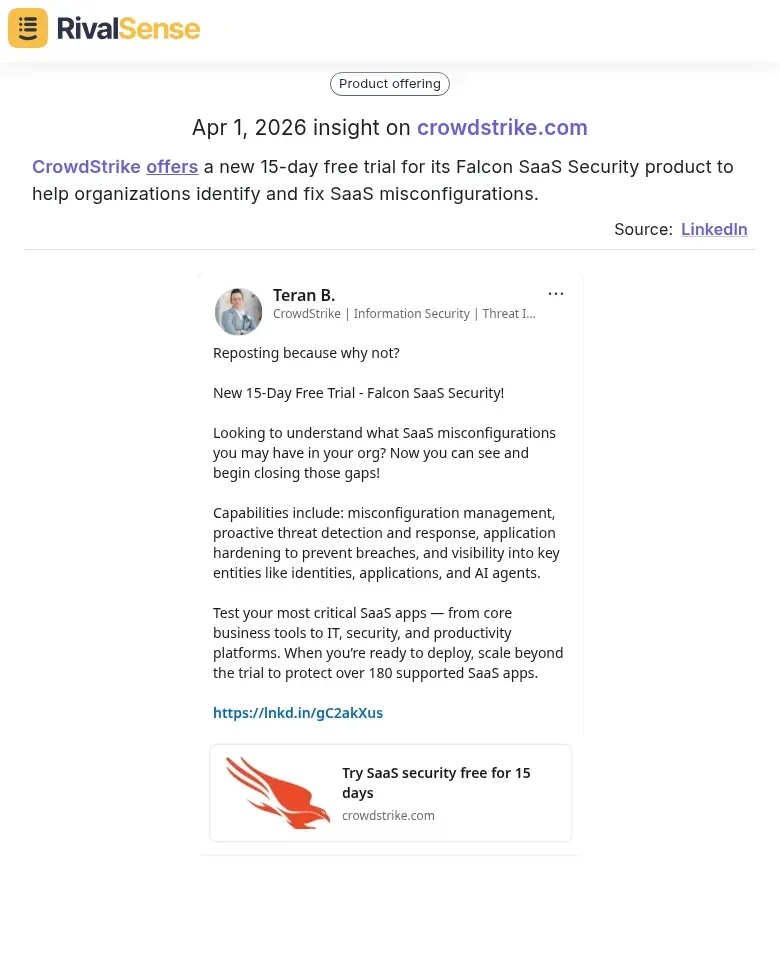
Why this insight is valuable for business strategy: Tracking competitor product launches and trial offers gives you an early warning system. It allows you to understand their targeting strategy—in this case, CrowdStrike's focus on SaaS security gaps—and quickly develop counter-measures, such as highlighting your own SaaS capabilities or adjusting trial terms. This type of intelligence turns reactive scrambling into proactive positioning, safeguarding your market share.
Implementing Real-Time Competitive Intelligence
Implementing a system for real-time competitive intelligence requires a structured approach. First, set up automated tracking for competitor pricing and trial strategies by creating custom alerts for keywords like 'free trial,' 'pricing changes,' and 'promotional offers' across digital channels. Second, configure ongoing monitoring for marketing campaigns, content distribution, and customer engagement patterns to anticipate broader market shifts.
Practical steps to get started:
- Create competitor profiles for key players in your niche, including their core offerings and target markets. 👥
- Set up alerts for pricing pages, trial signup flows, and promotional landing pages. 🔔
- Monitor content channels like blog posts, whitepapers, and webinar announcements. 📝
- Track customer sentiment across review platforms such as G2, Capterra, and TrustRadius. 😊
Analyze competitor response patterns by identifying how quickly rivals react to major moves. Tools like RivalSense reveal which competitors consistently counter-offer within days, enabling you to anticipate market reactions and adjust your positioning proactively.
Strategic Response: Countering the Free Trial Threat
When a competitor launches a free trial, immediate alerts enable targeted counter-offers. Here's how to implement strategic responses effectively. Developing a playbook beforehand ensures you can act swiftly without sacrificing strategic coherence.
Targeted Counter-Offer Strategies:
- Analyze competitor trial terms (duration, features, conversion triggers).
- Create tiered responses: match trial length for price-sensitive segments, offer premium features for enterprise clients.
- Example: If a competitor offers a 30-day trial, provide 45 days with dedicated onboarding support.
Product Positioning Adjustments:
- Update messaging to highlight your unique advantages immediately. ✨
- Create comparison pages showing superior features the competitor lacks. ⚙️
- Emphasize your proven track record versus their 'new' offering. 🏆
- Use customer testimonials addressing pain points the competitor's trial doesn't solve. 💬
Rapid Response Protocols:
- Set up automated alerts for competitor pricing/trial changes.
- Create pre-approved response templates for common scenarios.
- Establish a decision authority chain for quick approvals.
- Designate a 'competitive response team' with clear roles.
- Conduct quarterly competitive response drills.
Practical Checklist for Immediate Action:
- [ ] Monitor competitor trial landing pages weekly.
- [ ] Prepare a 3-tier response strategy before threats emerge.
- [ ] Update sales enablement materials within 48 hours of competitor moves.
- [ ] Track conversion rates of counter-offers versus business as usual.
- [ ] Document response effectiveness for future optimization.
Pro tip: The most effective responses combine immediate tactical offers with long-term strategic positioning that reinforces your core differentiators.
Results and Impact: Turning Intelligence into Market Advantage
Companies leveraging proactive competitive intelligence see tangible benefits. Quantitatively, they often experience improved win rates and reduced churn through strategic counter-moves. Qualitatively, they gain enhanced market positioning by anticipating competitor initiatives before they gain traction, allowing for preemptive messaging and offering adjustments.
ROI analysis highlights compelling economics: Proactive intelligence typically costs a fraction of reactive emergency campaigns. For instance, monthly competitive intelligence tools might average a few thousand dollars, while reactive responses to unexpected moves can cost tens of thousands in rushed marketing and sales retraining. This demonstrates why forward-looking intelligence pays dividends.
Practical steps to replicate this success:
- Set up alerts for competitor pricing, trial offers, and feature changes. 🔔
- Establish a weekly competitive intelligence review process. 📅
- Create response playbooks for common competitor moves. 📘
- Track win/loss reasons tied to competitive intelligence. 📊
- Calculate your proactive versus reactive cost differential. 💰
Key insight: The greatest advantage comes from anticipating competitor moves and positioning your solution as the superior alternative before customers even consider switching.
Key Takeaways and Future Recommendations
The cybersecurity case study underscores that automated competitor tracking is essential for survival in dynamic markets. Companies relying on manual monitoring risk missing critical signals like free trial launches or pricing changes that can reshape competitive dynamics overnight. Building a sustainable framework requires continuous effort and integration into core business functions.
Practical Implementation Checklist:
- Automate Core Monitoring: Use tools like RivalSense to set alerts for competitor website changes, pricing updates, and marketing campaigns. 🤖
- Establish Cross-Functional Review: Schedule weekly intelligence briefings with product, marketing, and sales teams. 👥
- Create Action Protocols: Develop predefined responses for common competitor moves (e.g., free trial launches trigger immediate win-back campaigns). 🚀
- Integrate with Strategy: Embed competitive insights into quarterly planning and product roadmap sessions. 📈
Sustainable Competitive Advantage Framework:
- Continuous Learning Loop: Monitor → Analyze → Adapt → Repeat. 🔄
- Early Warning System: Detect signals months before market impact. ⏰
- Proactive Positioning: Use competitor intelligence to anticipate and counter moves before they gain traction. 🎯
Key Recommendation: Treat competitive intelligence as a core business function, not an ad-hoc activity. Allocate dedicated resources, establish clear metrics (e.g., time-to-detection, response effectiveness), and build competitive awareness into your organizational DNA. The companies that win aren't just tracking competitors—they're anticipating their next moves.
Take Action with RivalSense
To start leveraging competitive intelligence for your business and avoid being blindsided by rivals' strategies, try RivalSense for free at https://rivalsense.co/. Get your first competitor report today and gain insights into product launches, pricing updates, and market moves that can inform your strategic decisions. Stay ahead of the curve by turning competitor tracking into a proactive advantage.
📚 Read more
👉 Instagram Competitor Insights Cheat Sheet: Track Like Backlinks
👉 2026 Web Data Gathering Industry Awards: Competitive Intelligence Trends
👉 Quick Market Entry Hacks: Competitor Insights for Startup Key Accounts
👉 How to Leverage Competitor Insights: A Real-World Example from n8n
👉 The Ultimate Guide to Key Account Tracking APIs: Automate Competitive Intelligence in 2026