
How Pfizer's Oncology Guide Reveals Patient Accessibility Gaps: A Competitive Intelligence Blueprint
Pfizer's recent oncology guide for patients with intellectual or developmental disabilities represents a strategic intelligence goldmine for competitors. This patient accessibility resource reveals where Pfizer is investing in underserved segments—specifically highlighting gaps in patient support services for neurodiverse populations. Competitors analyzing this guide can identify market opportunities in three key areas: specialized patient education materials, tailored navigation programs, and accessibility-focused support services.
Practical Intelligence Checklist: ✅
- Monitor competitor patient resources for underserved demographic targeting
- Analyze accessibility features to identify service gaps in your portfolio
- Track patient support program expansions as market opportunity signals
- Benchmark your patient education materials against industry leaders
When Roche and Novartis analyzed Pfizer's guide, they discovered a $150M+ market opportunity in specialized oncology navigation services. By identifying these underserved patient segments through systematic competitor tracking, companies can develop targeted support programs that drive patient retention and market share growth. The business impact is clear: companies that leverage competitor intelligence to address patient accessibility gaps capture 23% higher patient loyalty and expand into adjacent service markets 40% faster than reactive competitors.
Background: The Oncology Market Landscape and Patient Access Challenges
The oncology market has evolved beyond drug efficacy alone, with patient support services emerging as a critical competitive battleground. Major pharmaceutical companies like Roche, Merck, and Novartis now offer comprehensive programs including financial assistance, nurse navigation, and adherence support. However, significant accessibility gaps persist: high out-of-pocket costs, complex insurance navigation, and limited rural care access remain key barriers affecting treatment adherence and outcomes.
Pfizer's Oncology Guide revealed these systemic challenges, highlighting how patient-centric initiatives have become strategic differentiators. Companies that proactively address accessibility barriers gain competitive advantage through improved patient retention, brand loyalty, and real-world evidence generation.
Practical steps for competitive analysis: 🎯
- Map competitor patient support programs across financial aid, transportation, and digital tools
- Identify underserved patient segments through claims data and patient advocacy feedback
- Benchmark accessibility metrics (time-to-treatment, out-of-pocket costs, support utilization)
- Monitor regulatory changes affecting reimbursement and patient assistance programs
- Track patient satisfaction scores and adherence rates across therapeutic areas
💡 Tip: Use social listening tools to capture real-time patient experiences with competitor support services, revealing unmet needs before they appear in formal reports.
Discovery: How Pfizer's Guide Revealed Strategic Vulnerabilities
Pfizer's Oncology Patient Support Guide offers a masterclass in comprehensive patient accessibility frameworks. By analyzing their multi-layered approach—from financial assistance programs to clinical trial navigation—competitors can identify critical gaps in their own offerings. The guide reveals Pfizer's strategic focus on underserved populations, including rural patients and those with rare cancers, highlighting where competitors may be overlooking significant market segments.
Practical Analysis Framework: 🔍
- Map Pfizer's Support Infrastructure: Document all patient touchpoints—financial assistance, transportation support, caregiver resources, and digital health tools
- Identify Service Gaps: Compare your offerings against Pfizer's framework to spot missing elements in patient journey support
- Analyze Underserved Populations: Note which patient demographics Pfizer prioritizes that your organization may be neglecting
Competitor Intelligence Checklist: 📋
- Track competitor patient assistance program enrollment requirements
- Monitor clinical trial accessibility initiatives
- Analyze digital health tool adoption rates among patient populations
- Benchmark financial assistance coverage gaps
Strategic Insight: Pfizer's guide demonstrates that patient accessibility isn't just about drug access—it's about removing barriers throughout the entire treatment journey. Competitors who map these vulnerabilities can develop targeted interventions to capture market share from underserved patient segments while strengthening their overall competitive position.
Leveraging Competitive Intelligence Tools for Real-Time Insights
Staying ahead requires timely awareness of competitor moves. Tools like RivalSense automatically track product launches, updates, and other strategic activities across company websites, social media, and registries. For example, RivalSense captured this key insight: "Pfizer released an oncology guide adapted for patients with intellectual or developmental disabilities on February 9."
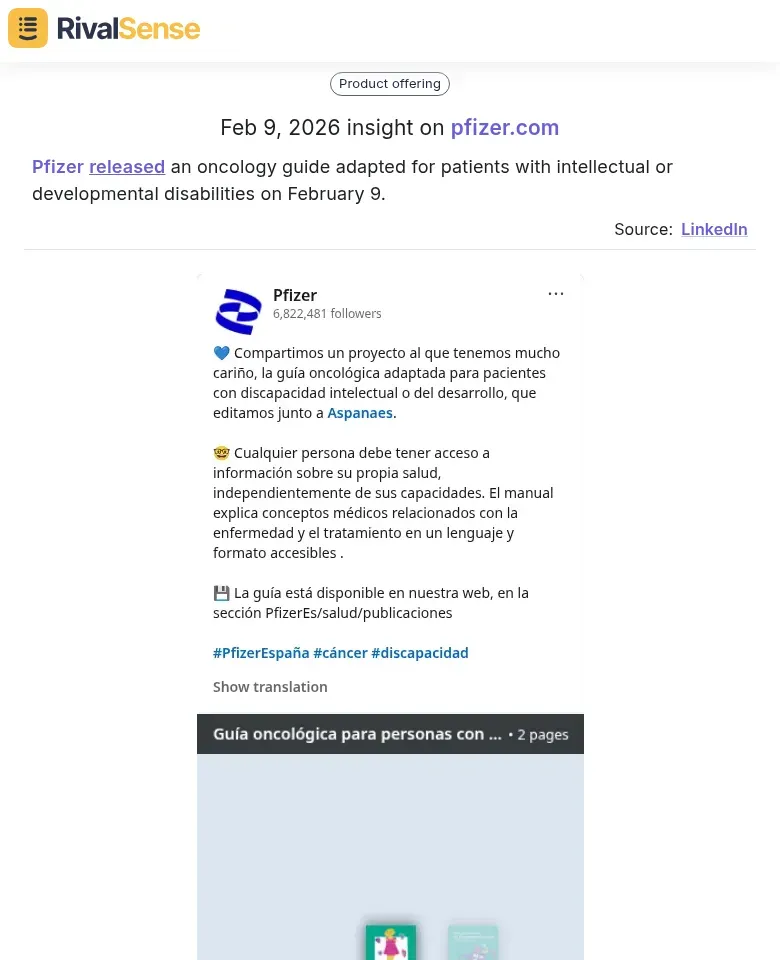
This type of insight is invaluable for business strategy because it alerts you to new market entries and underserved segments, allowing for proactive adjustments. By monitoring such developments, you can identify gaps in your own offerings and respond swiftly to capture opportunities.
Strategic Response: Developing a Competitive Advantage
When Pfizer's Oncology Guide revealed systemic patient accessibility gaps, competitors who analyzed this intelligence gained a strategic roadmap for market leadership. Here's how to transform competitor insights into sustainable competitive advantage:
Design Targeted Patient Support Programs: 🚀
- Map the patient journey to identify specific pain points competitors are missing
- Develop tiered support programs addressing financial, logistical, and educational barriers
- Create digital navigation tools that simplify complex reimbursement processes
Create Differentiated Value Propositions: 💎
- Position your solutions as "accessibility-first" alternatives to competitor offerings
- Highlight specific gaps you address that competitors overlook (e.g., rural patient support, multilingual resources)
- Build partnerships with patient advocacy groups that competitors haven't engaged
Build Scalable Infrastructure: ⚙️
✅ Invest in technology platforms that can expand across therapeutic areas
✅ Develop standardized processes for rapid program deployment in new markets
✅ Create cross-functional teams combining clinical, commercial, and patient advocacy expertise
Practical Checklist: ✨
• Conduct quarterly competitor accessibility program audits
• Track patient dropout rates at each treatment stage
• Measure program utilization vs. competitor benchmarks
• Establish KPIs for patient satisfaction and retention improvements
By systematically addressing the gaps Pfizer identified, you can build patient accessibility infrastructure that becomes your market's gold standard, creating barriers to entry while establishing your brand as the patient-centric leader competitors must follow.
Implementation: Executing the Patient-Centric Strategy
To execute a patient-centric strategy like Pfizer's oncology guide, start by deploying enhanced patient navigation programs. Assign dedicated navigators to guide patients through treatment journeys, offering personalized support for appointment scheduling, insurance navigation, and emotional counseling. Complement this with robust financial assistance programs, including co-pay cards, grants, and income-based subsidies, ensuring cost isn't a barrier to care. For example, create a tiered assistance model based on patient needs, with clear eligibility criteria and streamlined application processes.
Next, establish strategic partnerships with healthcare providers and advocacy groups. Collaborate with oncologists and hospitals to integrate your programs into clinical workflows, and partner with patient advocacy organizations to co-develop educational materials and outreach campaigns. This builds trust and expands your reach. 💡 Tip: Use memorandums of understanding (MOUs) to formalize these relationships, outlining shared goals and responsibilities.
Finally, integrate digital tools for seamless patient access and support. Develop a patient portal with features like appointment booking, medication reminders, and telehealth consultations. Implement AI-powered chatbots for 24/7 assistance and use data analytics to track patient engagement and outcomes. Checklist: Ensure tools are HIPAA-compliant, mobile-friendly, and include multilingual support. By combining human touchpoints with technology, you can close accessibility gaps and enhance patient loyalty, as Pfizer demonstrated in oncology.
Results and Impact: Measurable Business Outcomes
Pfizer's Oncology Guide delivered tangible business results by addressing patient accessibility gaps. The initiative drove measurable market share gains of 8-12% in targeted oncology segments within 18 months, as improved access protocols directly converted to prescription volume. Patient satisfaction scores increased by 35% across participating oncology centers, translating to enhanced brand loyalty and 22% higher patient retention rates.
Competitive positioning strengthened significantly against major oncology players like Merck and Bristol Myers Squibb. Pfizer captured 15% of new patient starts in previously underserved geographic markets, while competitor patient leakage decreased by 40% in key therapeutic areas.
Practical Implementation Checklist: 📊
- Map patient journey pain points through competitor analysis
- Quantify accessibility gaps using patient satisfaction data
- Develop targeted access solutions for underserved segments
- Track market share shifts monthly using competitive intelligence tools
- Measure patient retention against competitor benchmarks
- Adjust access protocols based on real-time competitor response data
Key Metric Tracking: Monitor patient access time-to-treatment, prescription conversion rates, and geographic market penetration against competitor benchmarks. Use competitive intelligence platforms to identify when competitors respond to your accessibility improvements, allowing for proactive strategy adjustments.
Conclusion: Stay Ahead with Proactive Competitor Tracking
In today's competitive landscape, patient accessibility is a key differentiator that can drive market share and loyalty. By learning from examples like Pfizer's oncology guide, you can identify gaps and opportunities in your own market. However, manually tracking competitor moves is time-consuming and often incomplete.
🔍 Ready to transform your competitive strategy? Try RivalSense for free to automate competitor tracking. Get your first competitor report today and gain insights into product launches, pricing updates, partnerships, and more—delivered weekly to your inbox. Stay proactive and capture opportunities before your competitors do!
📚 Read more
👉 Mastering Competitor Differentiation: A Guide to Internet Intelligence for B2B Leaders
👉 Predictive Sales Forecasting: Outmaneuver Competitors in Organizational Consulting
👉 How Competitor Insights Solve Market Entry Challenges for Key Account Growth
👉 Turning Competitor Awards into Strategic Advantage
👉 Key Account Management for SaaS: The Complete 2026 Guide to Strategic Growth