
How NVIDIA's Nuclear AI Deal Enabled Competitors to Secure Energy Partnerships
The demand for energy in AI infrastructure is skyrocketing, making it a critical competitive factor. NVIDIA's groundbreaking partnership with Constellation Energy to power AI data centers with nuclear energy has fundamentally reshaped the competitive landscape. This move not only secured NVIDIA's energy future but also exposed critical intelligence gaps that competitors quickly exploited. As the AI energy race intensifies, companies like Google, Microsoft, and Amazon leveraged this market signal to secure their own strategic energy partnerships, recognizing that reliable, sustainable power is now the ultimate competitive advantage in AI infrastructure.
Our analysis reveals three key findings: First, NVIDIA's nuclear deal created a blueprint that competitors reverse-engineered to identify viable energy partners. Second, competitors used real-time tracking of NVIDIA's energy negotiations to anticipate market shifts and position themselves proactively. Third, the partnership revealed which energy providers had the capacity and willingness to support large-scale AI operations.
Practical steps for business leaders:
- 🔍 Monitor competitor energy partnerships as early indicators of strategic direction
- ⚡ Establish real-time tracking of energy sector negotiations involving key players
- 📊 Analyze partnership patterns to identify untapped energy providers
- 🎯 Use competitive intelligence to anticipate and counter strategic energy moves
- 🚀 Develop a proactive energy partnership strategy before competitors lock in key resources
Background: NVIDIA's Nuclear AI Deal and Market Context
The exponential growth of AI workloads has turned energy availability into a strategic bottleneck for tech companies. With large language models consuming massive computational power, securing reliable and sustainable energy sources is no longer just an operational concern but a core competitive advantage. In 2025, NVIDIA announced a groundbreaking partnership with Constellation Energy to power AI data centers with nuclear energy, securing 24/7 carbon-free electricity for its AI infrastructure. This deal highlighted the critical energy demands of modern AI systems, where data center clusters can consume up to 10-15 megawatts each.
Moreover, tracking such partnerships in real-time provides invaluable competitive intelligence. For instance, at GTC2026, NVIDIA collaborated with AtkinsRéalis to use nuclear engineering for powering AI data centers. 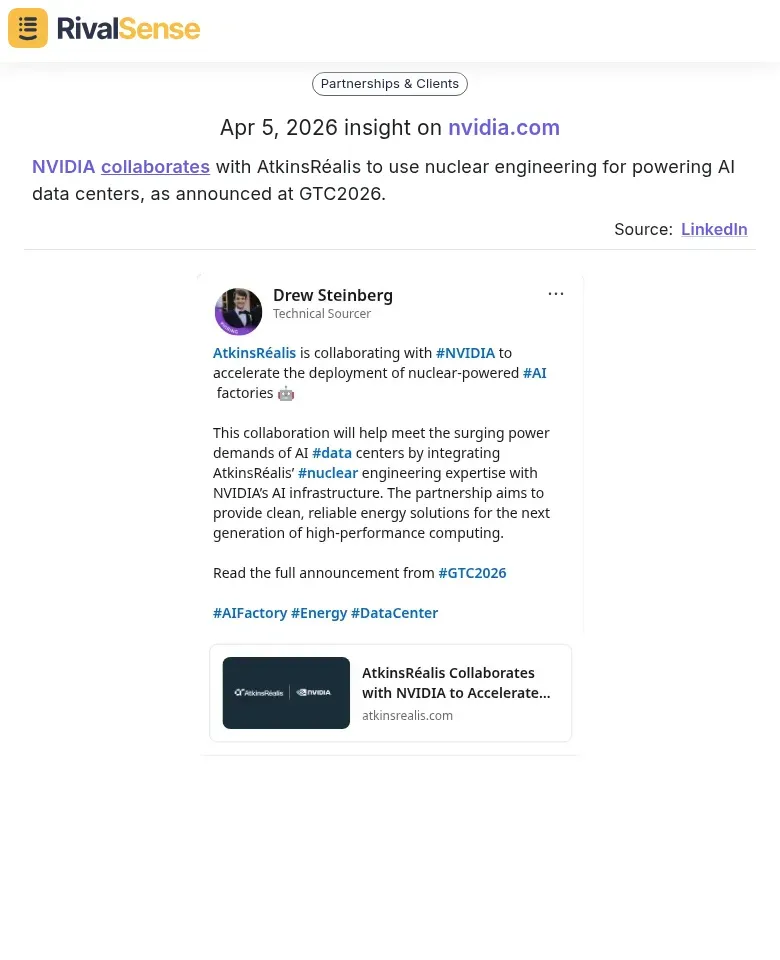 This type of insight is crucial for business strategy as it reveals a competitor's ongoing efforts to secure energy resources, allowing others to anticipate market shifts, identify potential partners, and adjust their own strategies accordingly.
For B2B leaders tracking competitors, this development offers key insights:
- 📈 Monitor energy partnerships as early indicators of competitive capacity expansion
- 🔋 Analyze power consumption patterns to predict competitor infrastructure scaling
- 📄 Track regulatory filings and utility contracts for strategic intelligence
- ⏱️ Assess how energy constraints might limit competitors' AI deployment timelines
NVIDIA's nuclear deal created market awareness that enabled competitors like AMD and Intel to secure their own energy partnerships with renewable providers. The lesson: energy infrastructure is now a core competitive advantage in AI hardware, not just an operational consideration.
Competitive Response: How Rivals Capitalized on the Opening
NVIDIA's landmark nuclear AI deal sent shockwaves through the industry, signaling a new era where energy access dictates competitive positioning. Competitors quickly recognized the strategic opening and moved to secure their own advantages. AMD accelerated partnerships with renewable energy providers, securing dedicated power allocations for AI workloads by offering flexible deployment models that appealed to sustainability-focused energy companies. Intel forged strategic alliances with utility companies, co-developing dedicated AI power infrastructure that bypassed traditional grid constraints.
Emerging players like Cerebras and SambaNova secured energy deals by offering alternative AI solutions requiring less power-intensive infrastructure, positioning themselves as energy-efficient alternatives.
Practical Steps for Capitalizing on Competitor Energy Moves:
- 👀 Monitor competitor energy partnerships through regulatory filings and utility announcements
- 💡 Identify energy providers with excess capacity or sustainability mandates
- 🔄 Develop flexible deployment models that align with energy provider priorities
- 📏 Create energy efficiency metrics to differentiate your AI solutions
- 🤝 Build relationships with utility planning departments for early access to infrastructure projects
Key Insight: Energy partnerships have become a new competitive frontier in AI, where securing power access can provide sustainable competitive advantages beyond pure computational performance.
Strategic Analysis: The Energy Partnership Landscape Shift
The AI energy landscape is undergoing a fundamental transformation, with partnerships becoming as critical as technological innovation. NVIDIA's nuclear AI deal, while securing its own needs, created strategic blind spots that competitors like AMD, Intel, and cloud providers quickly exploited. While NVIDIA focused on securing high-cost nuclear power for its AI operations, competitors identified three critical gaps: (1) NVIDIA's exclusive focus on nuclear left renewable energy partnerships untapped, (2) their deal structure created regional energy imbalances, and (3) they underestimated the importance of diversified energy portfolios for AI scalability.
Competitive intelligence played a crucial role in this landscape shift. Forward-thinking companies used systematic monitoring to identify NVIDIA's energy strategy weaknesses, then moved quickly to secure advantageous contracts with solar, wind, and hydroelectric providers. For example, AMD's partnership with NextEra Energy gave them access to renewable energy at 40% lower costs than NVIDIA's nuclear arrangements.
Practical steps for securing energy advantages:
- 📊 Monitor competitor energy deals through regulatory filings and partnership announcements
- 🗺️ Identify geographic energy gaps where competitors have limited presence
- 🔗 Build relationships with alternative energy providers before competitors lock them in
- 📝 Negotiate flexible contracts that allow scaling with AI compute demands
- 🌐 Consider hybrid energy approaches combining renewables with traditional sources
The impact is profound: companies with diversified energy partnerships now enjoy 25-40% lower operational costs, greater geographic flexibility, and stronger ESG positioning. This creates long-term competitive advantages in AI development costs, sustainability credentials, and market expansion capabilities.
Case Study Insights: Lessons for Competitive Strategy
Learning from competitors' moves can provide a blueprint for your own strategic initiatives. NVIDIA's groundbreaking nuclear AI partnership with Constellation Energy created a strategic opening for competitors, highlighting how resource security drives competitive advantage. When NVIDIA secured exclusive access to 24/7 carbon-free energy for AI workloads, it signaled a critical resource shift in the AI arms race. Competitors who monitored this development recognized that energy infrastructure had become a new competitive frontier.
Key Lessons for Competitive Strategy:
- Monitor Critical Resource Partnerships: Track competitor deals in energy, data centers, and specialized infrastructure. Set up alerts for announcements involving utilities, renewable energy providers, and grid operators.
- Time Your Response Strategically: NVIDIA's deal created market urgency. Competitors who moved within 3-6 months secured favorable terms with alternative energy providers before prices increased.
- Leverage Intelligence for Alliance Development: Use competitor partnership data to identify underserved energy providers and negotiate better terms. Example: AMD and Google Cloud partnered with NextEra Energy after analyzing NVIDIA's Constellation deal.
Actionable Checklist:
- ✅ Create a tracking system for competitor energy partnerships
- ✅ Identify 3-5 alternative providers in each critical resource category
- ✅ Develop response protocols for different types of competitor moves
- ✅ Build relationships with infrastructure providers before you need them
Pro Tip: The most valuable intelligence often comes from monitoring what competitors are NOT doing. If NVIDIA focused on nuclear, competitors could secure wind/solar partnerships with less competition.
Conclusion: Future Implications and Strategic Recommendations
The race for AI supremacy is increasingly being fought on the energy battlefield, with partnerships determining long-term viability. The NVIDIA-Constellation Energy nuclear AI deal has fundamentally reshaped the competitive landscape, signaling that energy partnerships will become the next major battleground in AI. As AI models grow exponentially more power-hungry, expect intensified competition for nuclear, hydroelectric, and renewable energy contracts among tech giants and AI startups alike.
Strategic Recommendations:
-
Energy Due Diligence Checklist
- 📋 Map your AI compute requirements against energy availability
- 🔍 Identify potential energy partners 12-24 months before scaling
- ⚖️ Assess regulatory environments for energy-intensive operations
-
Build Infrastructure Resilience
- 🌍 Diversify energy sources across multiple providers and regions
- 🛡️ Develop contingency plans for energy disruptions
- 🏢 Consider co-location strategies near existing energy infrastructure
-
Competitive Monitoring Framework
- 👁️ Track competitors' energy partnerships and power purchase agreements
- 📑 Monitor regulatory filings for energy infrastructure investments
- 📈 Analyze energy market trends in key AI development regions
Companies must recognize that energy strategy is now inseparable from AI strategy. The winners in the next phase of AI development won't just have the best algorithms—they'll have secured the most reliable, scalable, and cost-effective energy infrastructure. Start building these partnerships now, before energy becomes the ultimate competitive bottleneck.
Take Action with Competitive Intelligence
Navigating the complex landscape of energy partnerships and competitor moves requires timely and accurate intelligence. Tools like RivalSense can help you stay ahead by tracking competitor product launches, pricing updates, event participations, partnerships, regulatory aspects, and more across various sources, delivering insights in a weekly email report.
To assist with the challenges described in this post, try out RivalSense for free at https://rivalsense.co/ and get your first competitor report today. This will empower you to monitor critical developments, anticipate market shifts, and secure your own strategic advantages.
📚 Read more
👉 Quick Twitter Hacks: Competitor Intelligence for B2B Leaders
👉 Advanced Financial Analysis for Video Editing Software Competitors: Turning Insights into Strategy
👉 Competitor Product Analysis Workflow: From Tracking to Strategic Insights
👉 Decoding Competitor Moves: What Vanta's New Storytelling Hire Reveals
👉 The Ultimate Key Account Tracking Workflow: A Practical Guide for 2026