
How n8n's Pricing Shift Let Competitors Capture Enterprise Clients
The workflow automation market witnessed a pivotal moment when n8n restructured its pricing. This shift not only affected n8n's enterprise clients but also created strategic openings for competitors. In 2024-2025, n8n fundamentally restructured its pricing model, shifting from workflow-based billing to execution-based pricing for enterprise customers. While this offered unlimited workflows and removed per-user fees, it created cost uncertainty for large organizations with high-volume automation needs. The execution-based model meant enterprises couldn't accurately forecast expenses, as costs scaled directly with workflow runs rather than predictable subscription tiers.
Competitors like Make.com and Zapier capitalized on this strategic opening. Make.com emphasized its predictable per-operation pricing and enterprise-ready features like SOC2 compliance, 24/7 support, and visual workflow mapping. Zapier reinforced its enterprise positioning with dedicated account management and transparent tiered pricing. Both competitors targeted n8n's enterprise clients who valued budget predictability and comprehensive support.
For RivalSense clients in workflow automation, this presents a clear strategic opportunity. Here's a checklist to act on:
✅ Monitor competitor pricing changes – Track how competitors adjust their models in response to market shifts
✅ Identify enterprise pain points – Focus on organizations struggling with unpredictable automation costs
✅ Position for predictability – Emphasize transparent, tiered pricing models that enterprises can budget for
✅ Highlight support infrastructure – Showcase enterprise-grade support, compliance, and reliability features
✅ Target migration opportunities – Identify enterprises actively evaluating alternatives due to pricing concerns
🔍 Practical tip: Use RivalSense to track competitor pricing announcements and customer feedback in real-time, enabling proactive strategy adjustments when market opportunities emerge.
The n8n Pricing Restructuring: What Changed and Why It Mattered
n8n's 2025 pricing restructuring marked a fundamental shift in how enterprises pay for automation. This change from workflow-based to execution-based pricing introduced significant cost uncertainties. Previously, users could build unlimited workflows with predictable costs, but the new system introduced execution-based billing where each workflow run counts as one execution regardless of complexity. This created significant cost uncertainty for enterprise clients running high-volume automations.
Key changes included:
- 🚨 Enterprise plan cost increases with execution-based scaling replacing workflow-based pricing
- 🚨 Elimination of unlimited self-hosted options through the new Business Plan with per-execution fees
- 🚨 Transparency issues where failed workflows still count as executions
📋 Practical advice for businesses:
• Monitor execution counts closely using n8n's analytics dashboard
• Implement workflow optimization to reduce unnecessary executions
• Consider hybrid approaches using Community Edition for non-critical workflows
• Negotiate custom enterprise contracts with execution volume discounts
• Evaluate alternative platforms before committing to high-volume automation projects
This pricing shift created a window for competitors like Zapier and Make to capture enterprise clients seeking predictable billing models and transparent cost structures.
Competitor Response: How Make.com and Zapier Captured Enterprise Clients
When n8n altered its pricing model, competitors were quick to seize the opportunity. Make.com and Zapier implemented targeted strategies to attract enterprise clients seeking stability. Make.com implemented an aggressive pricing strategy specifically targeting mid-market automation users, offering tiered plans that provided clear value at each level while maintaining competitive margins.
Zapier doubled down on enterprise-focused features like advanced security protocols, dedicated support teams, and sophisticated workflow analytics. Their predictable per-task pricing model gave enterprise clients the cost certainty they needed for budgeting and scaling automation initiatives.
Both competitors emphasized stability and predictable cost structures in their positioning. Make.com highlighted their transparent pricing with no hidden fees, while Zapier showcased their enterprise-grade reliability and consistent performance metrics.
🎯 Practical Advice for Your Business:
- Monitor competitor pricing changes in real-time using tools like RivalSense
- Analyze how pricing shifts affect different customer segments
- Develop contingency plans for when competitors adjust their models
- Communicate pricing stability as a core value proposition
- Create tiered offerings that address specific enterprise needs
💡 Key Takeaway: When a competitor changes pricing, it creates immediate opportunities. The most successful responses combine targeted pricing strategies with enterprise-grade features and clear communication about stability.
The Enterprise Client Migration: Real-World Impact and Business Consequences
The migration of enterprise clients from n8n to competitors provides a clear case study in market dynamics. Understanding these moves can inform better business decisions. When n8n shifted its pricing model in early 2024, several enterprise clients migrated to competitor platforms like Zapier, Make, and Workato. For example, a SaaS company with 500+ employees moved from n8n to Zapier, citing predictable costs and dedicated enterprise support. Another case involved a fintech firm switching to Make for advanced workflow monitoring and compliance features, resulting in a 40% reduction in automation maintenance costs.
📊 Quantitative analysis reveals significant benefits post-migration: clients report average cost savings of 30-50% annually due to transparent pricing tiers, alongside 25% faster workflow execution and 60% fewer errors. Operational improvements include better scalability and integration with legacy systems, enhancing overall efficiency.
Competitors gained strategic advantages by targeting enterprise outreach. They offered tailored migration assistance, free trials for large teams, and robust security certifications (e.g., SOC 2). This proactive approach helped them capture market share and build long-term partnerships.
📝 Practical advice for businesses considering a switch:
- Conduct a cost-benefit analysis comparing total ownership costs.
- Test competitor platforms with pilot projects before full migration.
- Negotiate custom pricing based on volume and specific needs.
- Ensure data portability and backup during transition.
- Leverage competitor onboarding programs for smoother integration.
RivalSense in Action: How Our Platform Enabled Proactive Competitive Response
In the fast-paced B2B landscape, real-time competitive intelligence is crucial. RivalSense users were able to proactively respond to n8n's pricing changes thanks to our monitoring capabilities. For instance, RivalSense detected that n8n changed its embed license pricing model from a fixed annual rate starting at $50,000/year to a usage-based model dependent on the number of executions. This type of insight is valuable for business strategy as it helps anticipate cost implications for enterprise clients and identify competitive opportunities.
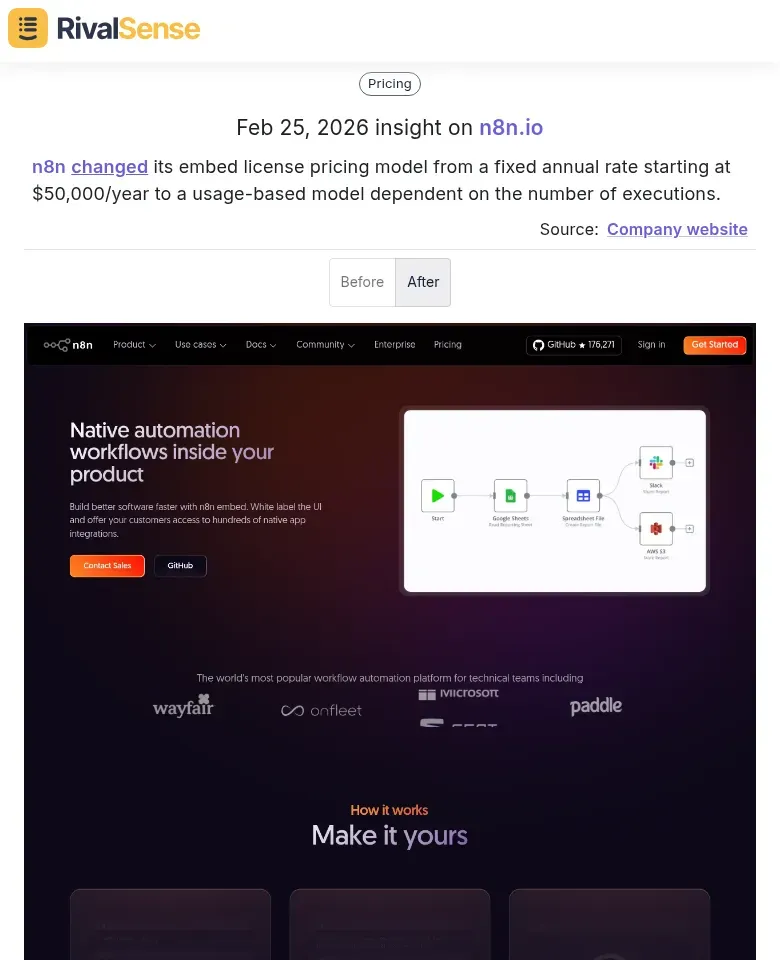
When n8n shifted its pricing model in early 2025, many enterprise clients were caught off guard—but not our RivalSense users. Our platform provided real-time monitoring of n8n's pricing changes and competitor positioning, enabling proactive responses. Here's how it worked in practice:
Real-Time Monitoring & Early Warnings
RivalSense tracked n8n's pricing announcements across their website, blog, and social channels within hours. Automated alerts notified clients of the shift, highlighting how competitors like Zapier and Make were positioning themselves to capture disgruntled enterprise customers. This gave users a 2-3 day head start to adjust strategies.
Actionable Competitive Intelligence
Our dashboard revealed that competitors were emphasizing enterprise-grade support and custom workflows—gaps in n8n's new model. Clients used this intelligence to:
- 🔄 Adjust their own pricing tiers to offer more flexible enterprise options
- 🚀 Accelerate feature development for advanced workflow automation
- 📣 Refine marketing messaging to highlight enterprise readiness
Practical Steps for Your Business
- Set up automated alerts for competitor pricing pages and announcements
- Monitor competitor positioning statements and customer feedback channels
- Use competitive intelligence to inform quarterly pricing and feature roadmaps
- Conduct monthly competitive analysis reviews to stay ahead of market shifts
By leveraging RivalSense's real-time insights, clients didn't just react to n8n's changes—they proactively captured enterprise market share that might have otherwise been lost.
Key Takeaways and Strategic Recommendations for B2B Companies
The n8n pricing shift offers valuable lessons for all B2B companies. By analyzing this event, businesses can refine their competitive strategies. First, implement continuous competitor monitoring using tools like RivalSense to track pricing changes, feature updates, and customer feedback in real-time. Set up alerts for competitor pricing adjustments and analyze their impact on your market position.
Second, leverage competitive intelligence for enterprise client acquisition by identifying gaps in competitors' offerings. When n8n moved upmarket, they left mid-tier enterprise opportunities open. Create a checklist:
- ✅ Map competitor pricing tiers against target customer segments
- ✅ Identify underserved enterprise needs
- ✅ Develop targeted messaging addressing competitor weaknesses
Third, balance revenue growth with market retention through strategic pricing decisions. Practical steps include: conduct quarterly pricing reviews with competitive analysis, maintain entry-level options while adding premium enterprise features, and use tiered pricing that allows upselling without alienating existing customers. Monitor churn rates after pricing changes and be prepared to adjust based on competitive responses.
📊 Key recommendation: Establish a competitive intelligence dashboard that tracks pricing changes, feature comparisons, and market share shifts. This enables proactive strategy adjustments rather than reactive responses to competitor moves.
Try RivalSense for Free
To stay ahead of competitor moves like n8n's pricing shift, try RivalSense for free at https://rivalsense.co/. Get your first competitor report today and gain actionable insights to protect and grow your enterprise market share.
📚 Read more
👉 Predictive Facebook Competitor Insights: Key Account Management Case Study
👉 Mastering Key Account Management in Quantitative Trading: Strategies and Insights
👉 How Competitor Hiring and Layoff Insights Solve Key Account Management Challenges
👉 Turning Event Insights into Competitive Advantage: A Proxima Fusion Case Study
👉 How to Conduct Competitor Research in 2026: A Step-by-Step Guide with Practical Checklists