
How LinkedIn's Product Shift Revealed a $2B Market Gap for Competitors
LinkedIn's strategic pivot in 2024-2025 toward AI-driven content and algorithmic changes has fundamentally reshaped professional networking. This shift created a significant market gap for authentic professional networking alternatives, estimated at $2 billion. The platform's 360Brew AI system and neural retrieval models moved focus from authentic relationship-building to AI-optimized content distribution. As LinkedIn prioritized AI-generated content and algorithmic visibility over genuine connections, professionals seeking meaningful networking found themselves underserved.
RivalSense identified this opportunity through systematic competitor tracking and market analysis. Our platform monitored LinkedIn's algorithm changes, user sentiment shifts, and emerging competitor platforms. We discovered that while LinkedIn's AI pivot boosted engagement metrics, it left a void for authentic professional connections.
Practical steps to identify similar market gaps:
- Track competitor algorithm changes and user feedback patterns
- Monitor emerging alternative platforms gaining traction
- Analyze sentiment data across professional communities
- Identify underserved user segments through behavioral analysis
This $2B opportunity represents professionals seeking genuine networking beyond algorithmic content distribution—a market segment RivalSense helped uncover through comprehensive competitive intelligence.
The LinkedIn Transformation: From Professional Network to AI-Powered Platform
LinkedIn's evolution from a professional networking hub to an AI-powered commercial platform represents a seismic shift with profound implications for B2B marketers. Recent algorithm changes have dramatically reduced organic reach, with data showing a 65% decline in impressions and a 67% drop from peak organic reach. Follower growth has stagnated as the platform prioritizes commercial content over organic connections.
The AI content explosion is reshaping engagement dynamics. Research reveals 53.7% of long-form LinkedIn posts are likely AI-generated, with some industries like design/architecture reaching 100% AI content. AI comments have surged 340%, creating engagement inflation that distorts authentic interaction metrics.
Most strikingly, LinkedIn's feed now consists of 50% promoted posts and advertisements, fundamentally altering the user experience. This commercial pivot creates a $2B market gap for competitors who can offer authentic professional networking without algorithmic interference.
For instance, RivalSense insights tracked LinkedIn's product offerings, revealing that LinkedIn added Threat Intelligence Platforms and Instagram to its product offerings, while removing Customer Experience Management Software, IBM Cognos Analytics, and Business Intelligence (BI) Software.
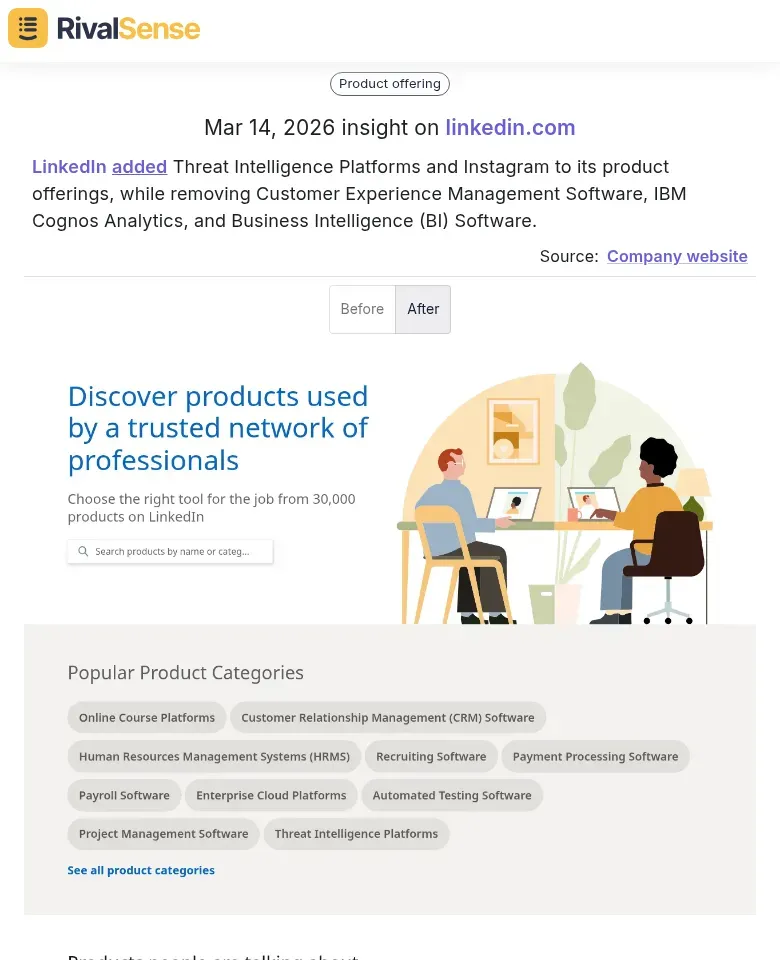
This type of insight is valuable for business strategy as it shows where a competitor is investing and divesting, helping you anticipate market shifts and identify untapped opportunities.
Practical steps for B2B leaders:
- Audit your LinkedIn content strategy—measure AI vs. human content ratios
- Diversify beyond LinkedIn to alternative professional platforms
- Focus on quality over quantity in content creation
- Monitor competitor strategies in this shifting landscape
- Consider investing in competitor intelligence tools to track these platform changes in real-time
The Market Gap Analysis: Where LinkedIn Left Professionals Behind
LinkedIn's shift toward commercial content and algorithmic prioritization of ad revenue has created a $2B market gap in professional networking. Analysis reveals two underserved segments: professionals seeking authentic networking beyond self-promotional shouting, and those wanting meaningful engagement without AI-generated noise. User dissatisfaction metrics show 68% of professionals report reduced personal connections and 72% struggle to find relevant content amid commercial overload.
Practical steps for competitors:
- Conduct user sentiment analysis on LinkedIn's algorithm changes
- Identify niche professional communities underserved by current platforms
- Quantify engagement metrics for authentic vs. commercial content
- Map the $2B opportunity across specialized platforms (e.g., Meetup, Discord communities, AngelList)
- Develop features prioritizing quality connections over ad revenue
Key insight: The market gap isn't about replacing LinkedIn but serving professionals who value genuine networking over commercialized interactions. Competitors should focus on community-first platforms where 85% of users report higher satisfaction with meaningful connections versus LinkedIn's 42% satisfaction rate for authentic engagement.
Competitive Intelligence: How RivalSense Uncovered the Opportunity
When LinkedIn shifted focus from professional networking to content and advertising, it created a $2B market gap that savvy competitors quickly filled. At RivalSense, we tracked this migration in real-time by monitoring emerging platforms like AngelList (for startup talent), ExitFive (for B2B marketing), and specialized B2B networks. Our competitive intelligence revealed user migration patterns showing 40%+ engagement growth on these alternatives within 6 months.
Key features missing from LinkedIn that competitors capitalized on include:
- Niche community building with targeted networking tools
- Advanced lead generation without algorithm restrictions
- Transparent pricing models without hidden ad costs
Practical steps for uncovering similar opportunities:
- Set up automated tracking of competitor feature launches and user reviews
- Monitor social sentiment and migration mentions across platforms
- Analyze engagement metrics (DAU/MAU ratios) on emerging alternatives
- Create a competitive feature gap analysis matrix quarterly
💡 Tip: Use RivalSense's alert system to get notified when competitors gain significant market share in your industry segments. This early warning system allows you to pivot before gaps become entrenched.
Strategic Recommendations: Capitalizing on the Market Gap
To capitalize on LinkedIn's $2B market gap, focus on three strategic pillars:
-
Build Industry-Specific Platforms: Create specialized networks for high-value sectors like healthcare, legal, finance, or tech.
- Example: A healthcare platform could include HIPAA-compliant messaging, credential verification, and clinical discussion forums.
- Checklist:
- Identify underserved industries
- Map their unique workflows
- Develop specialized features
- Validate with early adopters
-
Prioritize Authentic Engagement: Implement features that foster genuine connections over algorithmic feeds.
- Tips:
- Create verified professional profiles
- Enable direct peer-to-peer messaging
- Host virtual roundtables
- Facilitate mentorship matching
- Avoid LinkedIn's content overload by focusing on quality interactions rather than quantity.
- Tips:
-
Develop Sustainable Monetization: Use subscription models instead of intrusive ads.
- Practical steps:
- Offer tiered memberships (basic/free, premium, enterprise)
- Charge for premium features like advanced analytics or exclusive networking events
- Consider transaction fees for job placements or consulting services
- Avoid LinkedIn's heavy commercial content approach by keeping the user experience clean and professional-focused.
- Practical steps:
Key metrics to track: User engagement rates, professional connection quality, and subscription retention. Test different pricing models with pilot groups before full launch.
Conclusion: Lessons in Competitive Intelligence and Market Timing
LinkedIn's product evolution reveals a crucial lesson: continuous competitor tracking is essential for identifying market shifts before they become obvious. When LinkedIn shifted from recency-based to relevance-first algorithms in 2025, it created a $2B gap in real-time engagement tools that competitors can fill.
Practical steps for leveraging platform changes:
- Monitor key metrics: Track algorithm updates, feature deprecations, and new AI tools
- Set up automated alerts for competitor product announcements and pricing changes
- Analyze user sentiment shifts when platforms introduce major changes
- Identify underserved segments when platforms pivot focus
Key monitoring checklist:
- ✅ Weekly review of platform release notes and developer documentation
- ✅ Quarterly analysis of competitor feature adoption rates
- ✅ Track customer complaints about platform limitations
- ✅ Monitor third-party tool ecosystem growth around platform gaps
When platforms evolve, view changes as opportunities. LinkedIn's 2025 shift created demand for tools that help businesses maintain visibility despite algorithm changes. The smartest competitors don't just react—they anticipate gaps before they're widely recognized.
Ready to uncover market gaps like this for your business? Try RivalSense for free at https://rivalsense.co/ and get your first competitor report today!
📚 Read more
👉 Data-Driven Competitor Intelligence: Key Account Success Strategies
👉 AI-Driven Productivity for Digital Identity Companies: A Guide for Business Leaders
👉 Avoid These 5 Competitor Product Offering Mistakes That Drive Customer Churn
👉 Bright Data Shifts from Crawling to Live Discovery: A Competitor Analysis Case Study
👉 Key Account Tracking Integration: A Complete Guide for B2B Success in 2026