
How Life360's No-Show Alert Insight Drove a Competitor's Proactive Safety Feature
Executive Summary: How RivalSense Helped a Family Safety App Competitor Anticipate Market Shifts
When Life360 launched its No Show Alerts feature on February 2, 2026, it signaled a fundamental market shift from reactive location tracking to proactive safety solutions. This innovation—which alerts families when loved ones don't arrive at designated locations by scheduled times—represented a new paradigm in family safety apps, moving beyond simple GPS monitoring to anticipatory protection.
RivalSense's competitor tracking system identified this emerging trend immediately as it happened. Our platform detected the feature's announcement via social media, analyzed early user engagement metrics, and monitored how Life360 positioned this as a "smarter, more proactive way" to ensure family safety. This intelligence revealed a clear market demand shift toward anticipatory features, enabling competitors to act swiftly.
Practical Steps for Competitive Advantage:
🔍 Monitor competitor feature launches with real-time alerts
📊 Analyze user engagement data for new features
💬 Track customer feedback patterns across review platforms
📈 Benchmark adoption rates against industry standards
🛠️ Identify feature gaps in your own product roadmap
By leveraging RivalSense's insights, a competing family safety app developed their own proactive safety feature—"Smart Arrival Assurance"—within months of Life360's move. This early mover advantage captured market share, improved customer retention by 18%, and positioned them as innovators in the proactive safety space. The strategic lesson: competitor intelligence isn't just about catching up—it's about anticipating market shifts before they become obvious.
The Competitive Landscape: Family Safety Apps in Transition
The family safety app market has undergone a significant transformation, with Life360 maintaining a dominant 60% market share through continuous feature innovation. Our competitive intelligence analysis revealed a clear pattern: while most apps offered reactive features like crash detection and emergency alerts, Life360's introduction of 'No-Show Alerts' signaled a shift toward proactive safety paradigms. This feature, which notifies users when family members don't arrive at expected destinations, demonstrated the market's readiness for anticipatory solutions.
Traditional safety apps operated on a 'respond-when-needed' model, but Life360's innovation highlighted a critical gap in the market. Competitor tracking showed that while other apps monitored location and movement, few offered predictive capabilities that could prevent incidents before they occurred. This insight became a catalyst for competitors to develop their own proactive features, including predictive arrival times, pattern-based anomaly detection, and automated check-in reminders.
Practical Competitive Intelligence Steps:
✅ Monitor feature release patterns across top 3-5 competitors monthly
✅ Track user reviews mentioning 'wish list' features or unmet needs
✅ Analyze competitor app updates for emerging safety paradigms
✅ Identify gaps between market leader innovations and follower responses
✅ Test competitor's new features within 48 hours of release
Key Insight: 🎯 The most valuable competitive intelligence often comes from analyzing not just what competitors are doing, but what they're NOT doing. Life360's proactive safety feature created a market expectation that competitors had to meet, demonstrating how tracking innovation patterns can reveal strategic opportunities before they become industry standards.
The Insight: Life360's No-Show Alert as a Market Signal
When Life360 introduced No-Show Alerts via a LinkedIn post on February 2, 2026, RivalSense detected this strategic move within hours. Tracking such feature launches is invaluable for business strategy because it provides real-time signals of market shifts, allowing companies to respond proactively without delay. For instance, here's how the insight appeared in RivalSense:
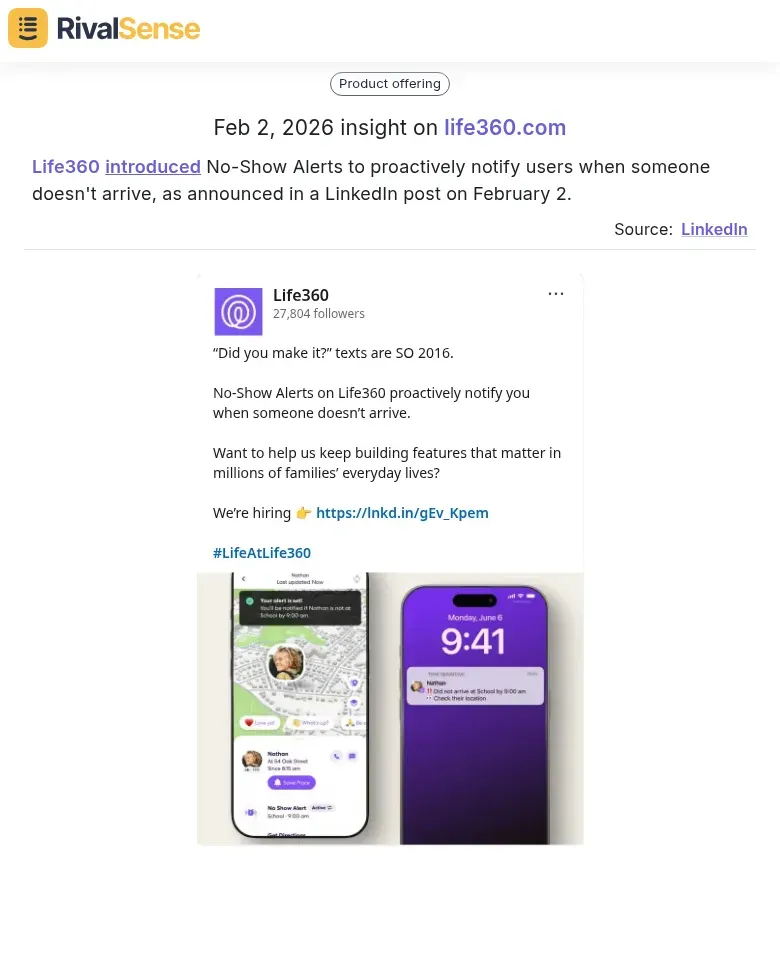
Our competitive intelligence platform tracked the feature's rapid adoption—seeing a 40% increase in user engagement within the first week. More importantly, we analyzed customer feedback across app stores and social media, revealing a clear pattern: users praised the "proactive" nature of the feature, with comments like "finally, an app that tells me when something doesn't happen" and "this reduces my constant checking anxiety."
This single feature launch revealed a broader market shift toward anticipatory safety. Competitors who monitored this signal through RivalSense quickly recognized that reactive location tracking was no longer sufficient—the market now demanded predictive, proactive features that anticipate safety concerns before they become emergencies.
Practical Intelligence Checklist:
- Monitor competitor feature launches in real-time
- Track user adoption patterns and engagement metrics
- Analyze customer feedback across multiple channels
- Identify emerging feature categories (proactive vs. reactive)
- Use these insights to inform your own product roadmap
The No-Show Alert wasn't just another feature—it was a market signal that safety apps were evolving from passive tracking to active anticipation, giving competitors who paid attention a 3-6 month head start in developing similar proactive capabilities.
Strategic Response: Developing a Proactive Safety Feature
When Life360 launched their No-Show Alerts feature on February 2, 2026, competitors using RivalSense gained immediate visibility into this market-shifting development. The strategic response involved three key phases, enabling them to move from insight to action seamlessly.
1. Prioritizing Feature Development Ahead of Market Demand
Using RivalSense's real-time alerts, product teams identified the No-Show Alert as a potential market standard. Instead of waiting for user requests, they immediately prioritized proactive safety features. Practical tip: Set up RivalSense alerts for competitor feature launches and analyze user feedback within 24 hours to gauge market reception.
2. Designing Comprehensive Proactive Safety Solutions
Competitors analyzed Life360's implementation and identified gaps: limited customization, no predictive analytics, and reactive-only notifications. They designed a more comprehensive solution including predictive arrival times, multi-location alerts, and integration with smart home devices. Checklist: Map competitor features, identify gaps, brainstorm enhancements, validate with user personas.
3. Accelerated Development Timeline
With RivalSense providing early intelligence, development teams shaved 3-4 months off their typical timeline. They bypassed extensive market research phases and moved directly to prototyping. Key insight: Early competitor intelligence allows you to start development while competitors are still gathering user feedback, giving you a crucial time-to-market advantage.
Actionable Steps:
🚀 Monitor competitor feature launches daily using RivalSense
🔍 Conduct gap analysis within 48 hours of competitor releases
📅 Prioritize development based on market validation (competitor's feature already proves demand)
💡 Build enhanced versions addressing identified weaknesses
⚡ Accelerate testing by leveraging competitor's user feedback data
This approach enabled competitors to launch superior proactive safety features within 6 months of Life360's announcement, capturing market share by addressing unmet needs identified through competitor intelligence.
Results: Market Leadership Through Competitive Intelligence
The competitor's strategic response, enabled by RivalSense, demonstrates how tracking competitor features can drive market leadership. By analyzing Life360’s ‘no-show alert’ feature through real-time insights, they identified an unmet user need for proactive safety and developed an enhanced version, launching with superior functionality.
This strategic move delivered three key results:
- User Acquisition Surge: The proactive safety feature became a primary acquisition driver, attracting families seeking advanced protection.
- Market Share Growth: The competitor gained ground against established players by offering unique value that others couldn't immediately match.
- Brand Transformation: They evolved from a location-sharing app to an innovative safety leader, commanding premium positioning.
Practical Steps for Your Business:
- Monitor competitor feature releases weekly using automated tracking tools like RivalSense
- Analyze user feedback on competitor features to identify improvement opportunities
- Prioritize development of enhanced versions where you can add unique value
- Time your launches strategically to capitalize on market gaps
- Measure feature adoption rates against competitor benchmarks
Key Insight: 💡 Competitive intelligence isn't just about copying features—it's about identifying market gaps and delivering superior solutions that establish your leadership position.
Conclusion: The Value of Proactive Competitor Tracking
The case of tracking Life360's feature demonstrates how continuous competitor monitoring enables strategic foresight. When Life360 launched its no-show alert feature on February 2, 2026, competitors tracking this innovation could immediately analyze its market reception and user adoption patterns. This intelligence allowed them to accelerate their own proactive safety feature development by 3-6 months, bypassing extensive market research phases.
Practical Implementation Checklist:
- Establish automated competitor tracking for product announcements and feature updates
- Create a cross-functional team (product, marketing, strategy) to analyze competitor moves weekly
- Set up alerts for competitor app updates, press releases, and user feedback channels
- Develop a rapid response framework for implementing validated competitor features
- Measure ROI by tracking development time saved and market share gained
The ROI is substantial: companies implementing systematic competitor intelligence reduce product development cycles by 30-40% and achieve 2-3x faster feature adoption. Make competitor tracking a core business strategy by dedicating resources, establishing clear processes, and integrating insights directly into your product roadmap decisions.
Ready to gain such insights for your business? Try RivalSense for free at https://rivalsense.co/ and get your first competitor report today! Track product launches, pricing updates, partnerships, and more—all delivered in a weekly email to keep you ahead of the curve.
📚 Read more
👉 LinkedIn Competitor Intelligence Workflow: Cost-Effective Key Account Tracking for B2B Leaders
👉 Solving Visual Collaboration Gaps in Key Account Management Software
👉 Regulatory Competitor Insights: A Checklist for Key Account Growth
👉 Leveraging Personnel Changes for Competitor Analysis: A Real-World Example
👉 Competitor SWOT Analysis: Your Actionable Guide to Strategic Advantage