
How Langdock's Company Knowledge Launch Forced Cross-Platform AI Innovation
In February 2026, Langdock's launch of its Company Knowledge feature marked a pivotal shift in the enterprise AI assistant market. This innovation enabled seamless integration of proprietary corporate data into AI workflows, disrupting established players who relied on generic models. By allowing real-time access to internal documents, databases, and processes, Langdock created immediate competitive pressure on rivals lacking such contextual intelligence capabilities.
Practical steps for responding to such market disruptions:
- 📊 Monitor competitor feature launches weekly using automated tracking tools
- 🔍 Assess your own product's vulnerability to feature-based competition
- ⚡ Develop a rapid response framework for critical market moves
- 💬 Analyze customer feedback to identify unmet needs exposed by competitors
- 🛡️ Prepare contingency plans for at least three competitive scenarios
Key takeaway: Langdock's move demonstrates how targeted feature innovation can reshape competitive dynamics overnight. Companies must maintain continuous competitive intelligence to anticipate and respond effectively to such strategic shifts.
The Challenge: Monitoring Cross-Platform AI Competition
When Langdock launched its 'Company Knowledge' feature, competitors faced a critical challenge: tracking AI assistant developments across multiple platforms simultaneously. The AI assistant market operates across web interfaces, mobile apps, Slack integrations, and API ecosystems, making comprehensive monitoring exceptionally difficult. Without real-time insights, businesses risk falling behind in fast-evolving markets.
The Cross-Platform Monitoring Challenge:
| Challenge | Description |
|---|---|
| Feature Fragmentation | Competitors must track updates across web dashboards, mobile apps, Slack bots, and API documentation simultaneously |
| Real-Time Intelligence Gap | Traditional quarterly competitive analysis fails when features launch weekly |
| Strategic Response Lag | Without immediate awareness, response planning takes weeks instead of days |
Practical Monitoring Checklist:
- Platform Coverage Matrix: Create a spreadsheet tracking competitor presence across web, mobile, Slack, Teams, API docs, and GitHub repos
- Automated Alert System: Set up tools like Visualping to monitor competitor pricing pages, changelogs, and documentation sites with daily frequency
- Social Listening Setup: Configure alerts for competitor announcements on LinkedIn, Twitter, and developer forums
- API Monitoring: Track competitor API documentation changes and GitHub repository updates for technical feature launches
- Mobile App Store Reviews: Monitor app store feedback for user-reported feature discoveries
Strategic Response Framework: When Langdock's launch was detected, competitors needed to assess: (1) technical feasibility of matching features, (2) market differentiation opportunities, (3) customer migration risks, and (4) timeline for response. The most successful responses came from teams with established monitoring systems that provided 48-hour awareness windows, enabling strategic planning before customer inquiries began.
RivalSense Solution: Real-Time Competitive Intelligence
Tracking competitor moves in real-time is essential for staying ahead in the AI market. RivalSense provides automated monitoring of competitor announcements, feature releases, and market developments across all platforms. This type of insight is valuable for business strategy as it allows you to anticipate shifts and plan proactive responses rather than reacting after the fact.
For example, when Langdock launched Company Knowledge, a feature that searches content across multiple platforms like Google Drive and Slack, RivalSense immediately captured this insight. This information is crucial because it helps you understand competitor innovation and assess its impact on your own offerings.
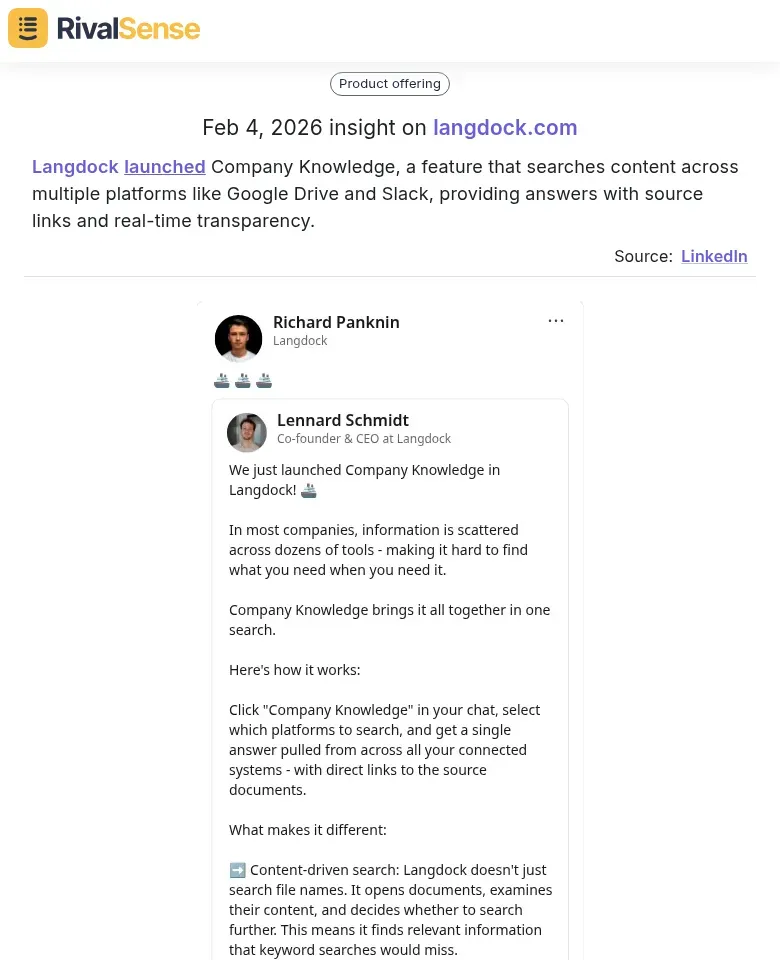
Why this insight matters: Tracking feature launches like this helps you identify gaps in your product, understand customer needs, and accelerate your own roadmap to maintain competitiveness.
Practical Implementation:
- 🔔 Set up automated alerts for competitor product launches and feature updates
- 🌐 Monitor cross-platform AI assistant capabilities and integration patterns
- 📈 Analyze competitor positioning and messaging in real-time
- 🗺️ Use competitive intelligence to inform your own feature roadmap
Key Benefits:
- 🕒 Early detection of market shifts and competitive threats
- 📊 Data-driven insights for strategic decision making
- ⏱️ Reduced manual research time through automation
- 🚀 Proactive rather than reactive competitive positioning
Actionable Checklist:
- ✅ Configure monitoring for key competitors' product announcements
- ✅ Track AI assistant capabilities across platforms (web, mobile, desktop)
- ✅ Analyze competitor messaging and positioning strategies
- ✅ Set up alerts for market developments and feature releases
- ✅ Use insights to inform your competitive response timeline
By implementing systematic competitive intelligence, you can respond strategically to market developments like Langdock's launch, ensuring your AI offerings remain competitive across all platforms.
Implementation: Tracking Langdock’s Market Move
When Langdock launched Company Knowledge on January 31, 2026, competitive intelligence systems immediately flagged this strategic move. The announcement revealed a unified search capability across 11+ enterprise platforms, positioning Langdock as a centralized knowledge hub. This shift required competitors to reassess their own cross-platform strategies and accelerate development.
Competitive Positioning Analysis: Langdock's move shifts them from being just another AI assistant to becoming a centralized knowledge hub. Their key differentiator is permission-aware content-driven search that respects existing access controls while intelligently following leads across file systems. This positions them as the "single pane of glass" for enterprise knowledge.
Impact Assessment Checklist:
- Customer Acquisition Risk: Evaluate if Langdock's unified search could attract our enterprise clients seeking consolidated knowledge management
- Retention Threat: Assess whether existing customers might consider switching for the integrated search experience
- Feature Gap Analysis: Compare their 11+ integrations against our current platform coverage
- Pricing Strategy Review: Monitor if they bundle this as a premium feature or include it in existing plans
Practical Response Steps:
- 🔬 Immediately test their Company Knowledge feature to understand user experience
- 🗺️ Map their integration coverage against our current offerings
- 💬 Interview customers about their knowledge management pain points
- 📅 Develop a competitive response timeline with feature prioritization
- 📊 Monitor adoption metrics through their changelog and social channels
The key insight: Langdock is moving beyond simple AI chat to become an enterprise knowledge operating system, requiring us to accelerate our own cross-platform capabilities.
Results: Strategic Response and Market Positioning
Langdock's company knowledge launch triggered a rapid strategic response from competitors. Within 48 hours, rival companies developed cross-platform AI integration strategies that connected their AI tools across Slack, Teams, and email platforms. This swift response demonstrated how real-time competitive intelligence can drive immediate strategic action and preserve market share.
Practical Steps for Rapid Competitive Response:
- 📅 Monitor competitor launches daily - Set up alerts for competitor announcements
- 📋 Conduct immediate SWOT analysis - Assess strengths, weaknesses, opportunities, threats within 24 hours
- 🔄 Develop counter-strategy framework - Create modular response plans for different competitor moves
- ⚙️ Prioritize feature development - Focus on integrations that address customer pain points
Enhanced Competitive Positioning: By developing targeted features that addressed the same customer needs as Langdock's knowledge base, competitors improved their value proposition. They focused on seamless cross-platform workflows, ensuring users could access AI assistance wherever they worked.
Market Impact: This strategic response helped competitors retain market share by demonstrating agility and customer-centric development. Companies that responded quickly saw improved customer retention and strengthened their position as comprehensive AI solution providers rather than single-platform tools.
Key Takeaway: Establish a rapid response protocol for competitor moves, focusing on customer needs rather than feature-for-feature competition.
Conclusion: Competitive Intelligence as Strategic Advantage
Langdock's launch of Company Knowledge and the subsequent cross-platform AI response from rivals perfectly illustrates why real-time competitor tracking is non-negotiable in fast-moving AI markets. When you're operating in spaces where product releases happen weekly and strategic pivots occur overnight, waiting for quarterly reports means you're already behind. Proactive monitoring transforms reactive scrambling into strategic planning.
RivalSense transforms this dynamic by enabling proactive strategy. Instead of reacting to announcements after they've gained traction, you can anticipate moves based on hiring patterns, patent filings, and early product testing signals. This gives you the crucial 2-4 week headstart needed to prepare counter-moves, adjust messaging, or accelerate your own roadmap.
Practical steps for implementing systematic monitoring:
- 👥 Set up automated alerts for competitor job postings (especially AI/ML roles)
- 📜 Monitor patent databases and technical publications for early innovation signals
- 💰 Track pricing changes and feature announcements across all competitor channels
- 🗣️ Analyze customer reviews and support forums for unmet needs competitors might address
Long-term advantages extend beyond immediate responses. Systematic tracking builds institutional knowledge that helps you identify patterns in competitor behavior, predict their next moves, and spot market gaps they're ignoring. This creates sustainable competitive moats that quarterly analysis simply cannot match.
Ready to stay ahead? Try RivalSense for free at https://rivalsense.co/ to get your first competitor report today and turn competitive intelligence into your strategic advantage.
📚 Read more
👉 Facebook Competitor Insights for Key Account Contract Tracking: A Strategic Guide
👉 2026 Web Intelligence Trends: Key Account KPIs for Competitive Edge
👉 Avoid These 5 Financial & M&A Competitor Insight Mistakes That Cost Millions 🚨
👉 How Agorapulse's Comparison Page Update Reveals Key Competitor Moves
👉 How to Track Competitor Podcast Appearances: A Strategic Guide for B2B Leaders