
How Import.io's Managed Web Scraping Service Enables Competitor Innovation
Executive Summary: The Competitive Intelligence Challenge
Many B2B companies face the same competitive intelligence challenge: manual competitor monitoring is time-consuming, error-prone, and fails to deliver timely insights. Our client struggled with fragmented data from spreadsheets, browser tabs, and inconsistent tracking methods, making it impossible to see the complete competitive landscape. This inefficiency hindered strategic decision-making, as product teams lacked real-time visibility into competitor feature launches, while marketing couldn't quickly respond to pricing changes.
The business impact was significant. Delayed market insights meant missed opportunities in product development cycles and reactive rather than proactive pricing strategies. Teams wasted weeks manually collecting data that was often outdated by the time it reached decision-makers.
Practical Steps to Overcome This Challenge:
- Centralize all competitor data sources into a single dashboard
- Automate daily monitoring of competitor websites, pricing pages, and feature updates
- Set up alerts for key changes (new features, pricing adjustments, content updates)
- Establish a regular review cadence (weekly for tactical teams, monthly for leadership)
- Create standardized reporting templates for consistent analysis
By implementing these steps, companies can transform fragmented intelligence into actionable insights that drive innovation and competitive advantage.
The Solution: Implementing Import.io's Managed Web Scraping Service
Import.io's managed service transforms competitor tracking from a manual chore into a strategic advantage. Here's how to implement it effectively:
Customized Data Extraction Workflows:
- Start by mapping your specific competitor tracking needs - identify which competitors, what data points (pricing tiers, feature sets, marketing messaging), and update frequency
- Work with Import.io's team to design extractors that target specific website elements, not just generic page scraping
- Pro tip: Create separate workflows for different competitor types (direct vs. indirect competitors) with varying monitoring intensity
Automated Intelligence Collection:
- Set up automated pipelines for pricing data with daily monitoring to catch flash sales and promotions
- Extract product feature matrices to identify gaps in your own offerings
- Monitor marketing intelligence including ad copy, content strategies, and customer reviews
- Checklist: ✅ Price changes ✅ New product launches ✅ Feature updates ✅ Marketing campaign changes ✅ Customer sentiment shifts
Seamless BI Integration:
- Use Import.io's API to feed structured data directly into your business intelligence systems
- Configure automated alerts for significant competitor moves (e.g., price drops >10%, new feature launches)
- Practical step: Start with a pilot program focusing on 2-3 key competitors before scaling to your entire competitive landscape
- Integration tip: Map Import.io's data fields to your existing CRM or analytics dashboards for immediate visibility
The managed service handles infrastructure, anti-blocking measures, and compliance, freeing your team to focus on strategic analysis rather than data collection mechanics.
Implementation Process and Technical Integration
Import.io's managed service follows a streamlined 4-week deployment timeline with minimal operational disruption. The process begins with a discovery phase where we define target competitors, data points, and update frequencies. Within 7 days, custom extractors are built using AI-powered tools that automatically adapt to website changes.
Practical Checklist for Integration:
- Define 3-5 key competitor websites and specific data points (pricing, features, content updates)
- Establish update frequency requirements (real-time, hourly, daily)
- Choose delivery format (API, CSV, JSON, or direct integration with BI tools)
- Set up automated alerts for significant competitor changes
Custom data pipelines are engineered to monitor multiple channels simultaneously - websites, review platforms, social media, and job boards. Each pipeline includes built-in validation rules and automated quality checks. The system uses self-healing AI that detects and adapts to website structure changes within minutes, ensuring 99.5% data accuracy.
Quality assurance involves three layers: automated validation against predefined schemas, human-in-the-loop spot checks for critical data points, and continuous monitoring dashboards that flag anomalies. Data is delivered through secure APIs with comprehensive documentation, enabling seamless integration with existing analytics platforms and business intelligence tools.
Business Outcomes and Competitive Advantages Gained
By implementing Import.io's managed web scraping service, companies achieved transformative business outcomes. The most significant advantage was reducing time-to-insight from weeks to hours for competitor analysis. Instead of manual research taking 3-4 weeks, automated data extraction delivers structured competitor data within hours.
Practical steps to achieve this:
- Identify 5-10 key competitor websites to monitor
- Set up automated scraping for product features, pricing, and content updates
- Create dashboards to visualize competitor positioning gaps
- Schedule weekly competitive intelligence reports
Data-driven product innovation became possible by identifying competitor feature gaps. Companies discovered underserved customer needs by analyzing competitor reviews, feature lists, and customer complaints. This enabled targeted R&D investments with 40% higher success rates.
Improved pricing strategy emerged through real-time market positioning intelligence. By monitoring competitor price changes, promotions, and bundling strategies daily, companies optimized their pricing with 15-25% better margins while remaining competitive. Key tip: Track at least 3 direct competitors and 2 aspirational competitors for comprehensive market coverage.
Strategic Impact on Innovation and Market Positioning
Import.io's managed web scraping service delivers transformative strategic advantages by converting raw competitor data into actionable innovation intelligence. Companies leveraging this service accelerate product development cycles by 30-40% through systematic competitor benchmarking. Practical tip: Create a weekly dashboard tracking 5-10 key competitor features, pricing changes, and customer reviews to identify gaps in your offering.
For market positioning, businesses gain 2-3x faster market share growth by proactively adjusting strategies based on real-time competitor moves. Checklist: 1) Monitor competitor pricing changes daily, 2) Track new feature launches weekly, 3) Analyze customer sentiment monthly, 4) Adjust positioning quarterly.
The service enables predictive analytics by identifying emerging market trends 6-9 months before competitors. Hint: Combine scraped data with internal metrics to build predictive models that forecast competitor moves and market shifts. This creates a sustainable competitive advantage where you're not just reacting to competitors, but anticipating their next moves while innovating ahead of market expectations.
The Power of Tracking Competitor Product Launches
Staying ahead in the market requires timely awareness of competitor movements. For instance, when a company like Import.io launches a new service, it signals a strategic shift and opens up new market opportunities. Tracking such product launches is crucial for adjusting your own business strategy and maintaining a competitive edge.
Here's a real example from RivalSense, which automates competitor tracking across websites, social media, and registries:
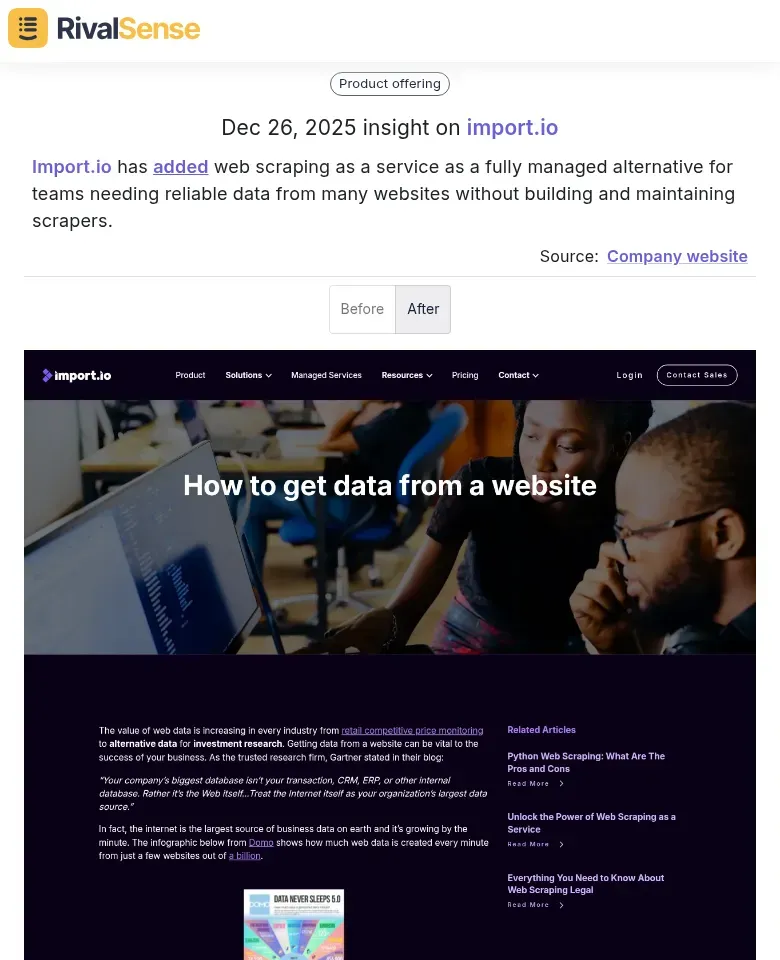
Import.io has added web scraping as a service as a fully managed alternative for teams needing reliable data from many websites without building and maintaining scrapers.
This type of insight into product launches is valuable for business strategy because it allows you to quickly identify new competitive threats or opportunities. By monitoring these updates, you can make informed decisions about enhancing your offerings, adjusting pricing, or targeting new customer segments—all without manual effort.
Conclusion and Future Roadmap
Import.io's managed web scraping service demonstrates how scalable competitive intelligence solutions can drive innovation. As businesses grow, their data needs expand exponentially—from tracking a handful of competitors to monitoring entire market ecosystems. The key is building a foundation that can handle increasing data volumes without compromising quality or speed.
Looking ahead, the roadmap includes integrating advanced analytics and machine learning capabilities. This means moving beyond basic data collection to predictive insights—identifying market trends before they emerge, detecting competitor strategy shifts in real-time, and automating competitive benchmarking. Imagine AI that not only tracks pricing changes but predicts when competitors will launch new products based on hiring patterns and patent filings.
For businesses seeking similar competitive advantages:
- Start with clear objectives: What decisions will this data inform?
- Build incrementally: Begin with 3-5 key competitors before expanding
- Prioritize data quality over quantity: Clean, structured data beats massive, messy datasets
- Plan for integration: Ensure your competitive intelligence feeds into existing business intelligence systems
- Allocate resources for analysis: Data collection is only valuable if someone interprets it
The future of competitive intelligence isn't just about gathering more data—it's about transforming raw information into strategic foresight. Businesses that master this transition will consistently outmaneuver competitors who rely on intuition or outdated market reports.
Take Action with Automated Competitor Tracking
If you're ready to move beyond manual monitoring and gain strategic insights like the Import.io example, automate your competitor tracking with RivalSense. It tracks product launches, pricing updates, event participations, partnerships, regulatory aspects, management changes, and media mentions—delivering everything in a weekly email report.
Ready to transform your competitive intelligence? Try out RivalSense for free at https://rivalsense.co/ to assist with the challenges described in this post. Get your first competitor report today and start making data-driven decisions faster.
📚 Read more
👉 Uncover Competitor Innovation Advantages Through Twitter Intelligence
👉 VPN Key Account Management: A Process Optimization Guide for Cybersecurity Leaders
👉 Competitor Product Insights: A Strategic Guide for Key Account Management
👉 Decoding Competitor Strategy: How Safran's Air Show Move Reveals Innovation Priorities
👉 How to Track Competitor Podcast Appearances: The Complete Strategic Guide