
How IDnow's Regulatory Hire Enabled Competitors to Counter EU Wallet Strategy
IDnow's February 2026 appointment of former Ukrainian Deputy Minister Liudmyla Rabchynska as Director of Global Regulatory and Government Affairs was a strategic masterstroke that inadvertently revealed their EU wallet ambitions to competitors. With her Diia wallet implementation experience, this hire signaled IDnow's intent to dominate the eIDAS 2.0 landscape as EU member states face the December 2026 deadline for digital identity wallet rollout.
Practical Intelligence Gap: Competitors recognized IDnow's regulatory intelligence advantage but exploited the 10-month implementation window. While IDnow focused on compliance depth, rivals like Onfido, Veriff, and Sumsub executed rapid response strategies.
Checklist for Avoiding Similar Gaps:
- ✅ Monitor competitor executive hires for strategic signals
- ✅ Establish real-time regulatory intelligence systems
- ✅ Develop parallel implementation tracks for compliance and market execution
- ✅ Create competitive response protocols for 30/60/90-day windows
IDnow's regulatory depth became a liability when competitors used the intelligence gap to neutralize their first-mover advantage through faster market execution.
The Strategic Context: EU Digital Identity Wallet Market Dynamics
The eIDAS 2.0 regulation, enacted in May 2024, has created a seismic shift in Europe's digital identity landscape, establishing a €10B+ market opportunity for the EU Digital Identity Wallet. By December 2026, all 27 EU member states must provide citizens with these wallets, transforming identity verification across public and private sectors. This regulatory framework creates a race for integration partnerships, with identity verification providers positioning themselves as essential infrastructure partners.
IDnow's strategic advantage stems from its November 2024 certification as a Qualified Trust Service Provider (QTSP) through IDnow Trust Services AB. As a QTSP, IDnow operates under strict eIDAS requirements with independent audits, offering greater legal certainty and security equivalent to paper documents.
Practical Advice for Businesses:
- Begin gap analysis now for eIDAS 2.0 compliance.
- Prioritize QTSP partnerships for regulatory certainty.
- Plan pilot participation for 2025-2026.
- Target production launch by Q4 2026 to align with mandatory implementation deadlines.
The key differentiator will be providers who combine identity verification with qualified trust services in a unified platform.
The Turning Point: IDnow's Regulatory Hire and Competitor Intelligence Response
When IDnow appointed Liudmyla Rabchynska as Director of Global Regulatory and Government Affairs in February 2026, competitors recognized this wasn't just another executive hire. Rabchynska's deep expertise in EU digital identity regulations signaled IDnow's strategic pivot toward the European Digital Identity Wallet (EUDIW) initiative.
Within 72 hours of the announcement, three major competitors activated counter-strategies. One accelerated their own EU wallet API development, another launched targeted marketing to IDnow's existing banking clients, and a third began recruiting similar regulatory talent.
Practical Intelligence Checklist:
- ✅ Monitor competitor job postings and executive appointments weekly.
- ✅ Analyze new hires' backgrounds for strategic clues (regulatory expertise = compliance focus).
- ✅ Map hires to emerging market opportunities (EU wallet = ~€9B market by 2030).
- ✅ Establish 48-hour response protocols for significant intelligence signals.
- ✅ Cross-reference hiring patterns with patent filings and partnership announcements.
Pro Tip: Create a 'talent intelligence dashboard' tracking where competitors recruit from and what skills they prioritize. When IDnow hired Rabchynska from a Brussels-based regulatory consultancy, competitors immediately knew which EU institutions IDnow was targeting for certification.
Competitor Counter-Moves: How Rivals Neutralized IDnow's Advantage
IDnow's hire of a Director of Global Regulatory and Government Affairs in February 2026 to accelerate their EU Digital Identity Wallet strategy prompted competitors to respond with calculated counter-moves. Here's how they neutralized this advantage within months:
Accelerated Compliance Roadmaps: Onfido and Veriff immediately announced accelerated EU wallet compliance timelines, moving their certification deadlines from late 2026 to Q2 2026.
Strategic Government Partnerships: Sumsub and iDenfy pursued direct partnerships with EU member state governments, particularly in Germany, France, and the Netherlands.
Targeted Talent Acquisition: Jumio and Trulioo responded by hiring eIDAS regulatory experts from European Commission advisory groups.
Practical Checklist for Monitoring Competitor Regulatory Moves:
- ✅ Track regulatory job postings at competitor companies.
- ✅ Monitor government procurement portals for identity verification partnerships.
- ✅ Subscribe to competitor press release feeds for compliance announcements.
- ✅ Analyze competitor product roadmaps for regulatory feature additions.
- ✅ Monitor LinkedIn for regulatory expert hires in your industry.
Key Insight: Regulatory advantages are temporary unless backed by sustainable technology and market execution. Competitors can neutralize regulatory head starts through multiple pathways.
The RivalSense Advantage: What Could Have Been Different
IDnow's regulatory hire for the EU Digital Identity Wallet initiative created a temporary advantage that competitors quickly countered. With RivalSense's real-time competitor tracking, IDnow could have identified emerging counter-strategies weeks earlier by monitoring competitor job postings, executive moves, and regulatory filings across the EU market.
For example, RivalSense tracked IDnow's appointment of Liudmyla Rabchynska, former Deputy Minister for Digital Transformation of Ukraine, as Director of Global Regulatory and Government Affairs to lead its EU identity wallet and eIDAS 2.0 strategy. 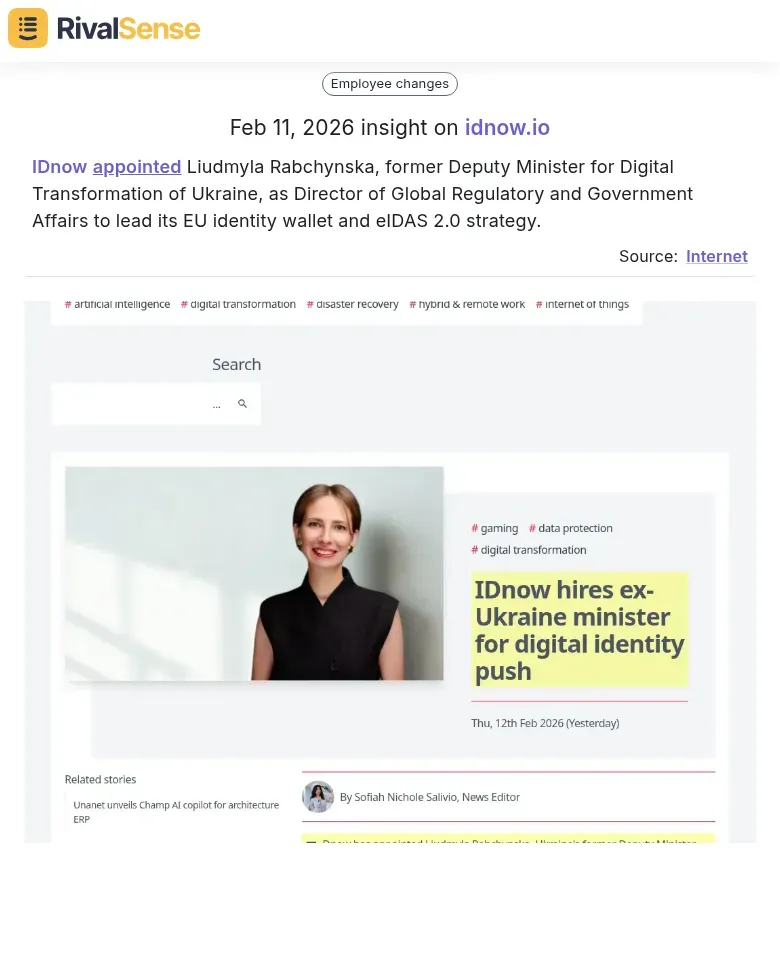
This type of insight is valuable for business strategy because it reveals competitor strategic pivots and regulatory focuses early, allowing for proactive counter-strategies and better alignment with market opportunities.
Practical steps for leveraging competitive intelligence:
- Set up alerts for competitor job postings with keywords like "regulatory," "compliance," "EU Digital Identity".
- Track competitor executive moves and analyze their backgrounds for strategic clues.
- Monitor competitor patent filings and regulatory submissions in key markets.
- Use tools like RivalSense to automate tracking and receive weekly reports on product launches, pricing updates, event participations, partnerships, regulatory aspects, management changes, and media mentions.
Proactive defense strategies:
- Establish a competitive intelligence dashboard tracking 5-10 key competitors.
- Create quarterly competitor strategy briefs highlighting regulatory positioning.
- Develop counter-move scenarios for each major competitor's likely responses.
- Implement a rapid response protocol when competitors announce regulatory hires.
By identifying that competitors were hiring similar regulatory expertise within 30 days of IDnow's announcement, RivalSense would have provided the early warning needed to accelerate product development, strengthen partnerships, or secure additional regulatory certifications before competitors could fully mobilize.
Key Takeaways for B2B Leaders in Regulated Industries
IDnow's strategic regulatory hire reveals three critical lessons for B2B leaders in regulated industries. First, regulatory hires are high-signal events requiring immediate competitive response planning. When competitors bring in regulatory expertise, they're signaling imminent market moves. Second, timing is everything in regulatory-driven opportunities. The EU Wallet strategy window is narrow—early movers capture disproportionate advantage. Third, build competitive intelligence systems that protect strategic advantages.
Actionable Checklist:
- ✅ Conduct quarterly regulatory competitor audits.
- ✅ Establish cross-functional regulatory response teams.
- ✅ Develop regulatory scenario playbooks for your top 3 competitive threats.
- ✅ Implement automated tracking of competitor moves using tools like RivalSense.
Final Advice: In fast-moving regulated markets, staying ahead requires not just compliance but also vigilant competitive monitoring. Early intelligence on competitor hires, partnerships, and regulatory submissions can make the difference between leading and lagging.
Ready to stay ahead of competitor moves? Try RivalSense for free at https://rivalsense.co/ to get your first competitor report today and gain insights like the IDnow regulatory hire that can shape your strategy.
📚 Read more
👉 Website Change Intelligence: A Proactive Framework for Key Account Success
👉 2026 Social Media Key Account Monitoring: Essential Checklist for B2B Leaders
👉 Competitor Financials & M&A Benchmarking: Key Account Growth Insights for 2026
👉 Leveraging Competitor Insights: A Case Study on Spotify's Instagram Feature
👉 Key Account Management for Startups: A Practical Guide to Building Strategic Relationships