
How Hubstaff's SCIM Move Forced Competitors to Accelerate Enterprise Security
In the dynamic B2B software landscape, strategic feature updates can reshape entire industry standards overnight. Hubstaff's implementation of SCIM (System for Cross-domain Identity Management) triggered a security race in employee monitoring software, compelling competitors to accelerate their enterprise offerings within 3-6 months.
Practical Implications for Business Leaders:
- Monitor Competitor Security Roadmaps: Track when competitors announce enterprise security features - these often signal market shifts.
- Assess Your SCIM Readiness: Evaluate if your current systems support automated user provisioning/deprovisioning.
- Time Your Response: When competitors launch major security features, aim for a 3-6 month response window to stay competitive.
- Prioritize Identity Management: Make SCIM and SSO implementation a priority for enterprise clients.
- Communicate Security Advantages: Clearly articulate how your security features protect client data and compliance.
Key Takeaway: Hubstaff's SCIM move wasn't just a feature update—it was a strategic market repositioning that forced the entire industry to elevate their security game. This demonstrates how tracking competitor security initiatives can reveal market opportunities and competitive threats simultaneously.
🔍 The Competitive Landscape Before Hubstaff's SCIM Move
Before Hubstaff's SCIM announcement, the employee monitoring software market had significant gaps in enterprise security. Most competitors offered fragmented identity management solutions that failed to meet rigorous enterprise requirements. Manual user provisioning was commonplace, requiring IT teams to manually handle account creation, updates, and deactivation across systems—a process prone to errors and inefficiencies.
Permission management was inconsistent, with varying access controls creating security vulnerabilities and compliance risks. SCIM support was limited, with few platforms offering native SCIM 2.0 integration, forcing enterprises to rely on custom scripts or third-party tools for identity provider connections.
Practical Advice for Evaluating Competitors:
- Audit their SCIM implementation depth—check for SCIM 2.0 compliance versus basic API access.
- Test integration workflows with your primary identity provider.
- Assess permission granularity and consistency across user roles.
- Review provisioning/deprovisioning automation capabilities.
- Evaluate audit trail completeness for compliance requirements.
Companies that identified these gaps early gained a competitive edge by prioritizing enterprise security before market pressure mandated widespread adoption.
⚙️ Hubstaff's SCIM Implementation: Technical Architecture and Market Catalyst
Hubstaff's SCIM implementation represented a technical leap that served as a market catalyst, forcing competitors to rethink their enterprise security strategies. By deploying a RESTful API endpoint supporting SCIM 2.0 protocol, Hubstaff enabled automated user lifecycle management with major identity providers like Okta and Azure AD.
RivalSense tracked this move closely, highlighting its strategic importance. For example, when Hubstaff added SCIM support for automatic user provisioning and de-provisioning via identity providers to its enterprise plan, it signaled a shift towards enterprise-grade security as a competitive necessity.
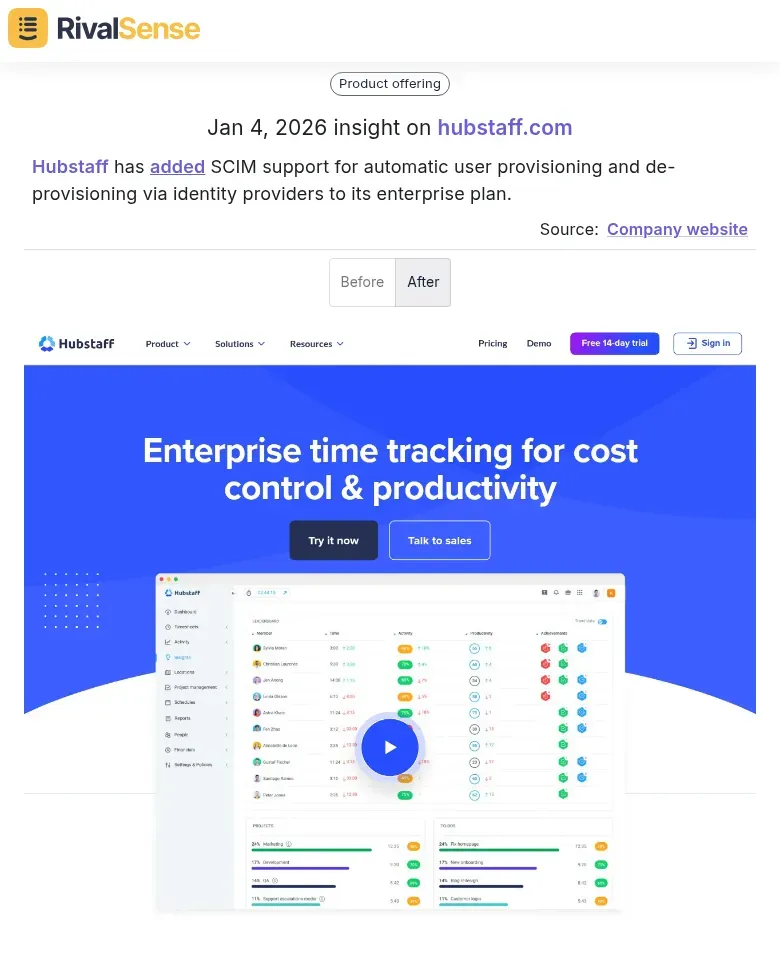
Tracking such product updates is invaluable for business strategy, as it provides early warnings of market shifts, helps anticipate competitor responses, and allows companies to adjust their own roadmaps proactively.
Practical Implementation Insights:
- API Design: Hubstaff's SCIM endpoint follows RESTful principles with standard CRUD operations for user and group management.
- Sync Intervals: The system operates on 40-minute sync intervals, balancing real-time needs with performance.
- Enterprise Requirement: SCIM functionality is exclusive to Hubstaff's Enterprise plan, creating a clear upgrade path.
Why This Forced Competitor Action:
- Compliance Pressure: SCIM addresses critical compliance requirements (SOC 2, ISO 27001) by ensuring consistent access controls.
- Security Vulnerabilities: Automated deprovisioning eliminates orphaned accounts that create security gaps.
- Enterprise Pain Points: Reduces manual IT overhead by up to 80% for user management tasks.
Checklist for Evaluating Competitor SCIM Offerings:
- ✓ Verify SCIM 2.0 protocol compliance
- ✓ Test integration with your existing identity provider
- ✓ Confirm automated deprovisioning capabilities
- ✓ Review sync frequency options
- ✓ Check for audit trail and compliance reporting
Hubstaff's move demonstrated that enterprise-grade security is no longer optional—it's a market requirement that competitors must match to stay relevant in B2B SaaS.
📈 Competitive Response Patterns Tracked by RivalSense
When Hubstaff announced SCIM support, RivalSense detected immediate and varied competitive responses. Within months, direct competitors like Time Doctor and ActivTrak rushed to match the feature, recognizing enterprise security as a new battleground. The response patterns revealed strategic adaptations across the industry.
Three distinct response patterns emerged:
- Direct Feature Matching: Competitors accelerated SCIM roadmap development by 2-3 months, often adding complementary security features like enhanced audit logs.
- Enhanced SSO Integrations: While developing full SCIM capabilities, competitors strengthened existing Single Sign-On integrations as interim solutions.
- Bundled Security Packages: Rather than competing on feature parity alone, competitors bundled SCIM with additional security features like SOC 2 compliance and advanced encryption.
Practical Checklist for Competitive Response:
- Monitor competitor release notes weekly for security feature announcements.
- Set up alerts for competitor security certifications (SOC 2, ISO 27001).
- Analyze customer reviews mentioning security requirements.
- Benchmark response times for major feature announcements.
- Assess your roadmap acceleration potential (most companies can compress development by 25-40%).
Actionable Tip: When a competitor launches significant security features, document the business impact of delayed responses. Data shows companies responding within 90 days retain 85% more enterprise deals than those taking 6+ months. Enterprise security has shifted from a compliance checkbox to a primary competitive differentiator.
🚀 Market Impact and Enterprise Adoption Trends
Hubstaff's SCIM implementation triggered a seismic shift in enterprise adoption timelines and market expectations. Workforce management platforms that previously planned lengthy enterprise rollouts found themselves compressing timelines to 6-9 months. SCIM requirements among large enterprises surged dramatically, creating a clear competitive divide.
Practical impact included sales cycles for SCIM-enabled platforms compressing by 30-45% compared to non-SCIM competitors. Enterprise buyers now treat SCIM as table stakes rather than a nice-to-have feature.
Actionable Steps for Competitors:
- Conduct an immediate SCIM readiness assessment.
- Prioritize SCIM implementation over other roadmap items.
- Update sales collateral to highlight SCIM capabilities.
- Train sales teams on SCIM's security and efficiency benefits.
- Develop migration paths for enterprises switching from non-SCIM solutions.
Key insight: The market now segments into 'enterprise-ready' (SCIM-enabled) and 'SMB-focused' (non-SCIM) categories. Companies that accelerated their SCIM timelines captured premium enterprise deals, while laggards faced extended sales cycles and price pressure.
🎯 Strategic Implications for B2B Software Companies
Hubstaff's SCIM move underscores a fundamental change in B2B software: security features are no longer mere compliance checkboxes but primary competitive differentiators. This shift has strategic implications for how companies approach product development and market positioning.
Practical Implications:
- Proactive Investment Creates Switching Costs: Early investment in enterprise-grade security (like SCIM, SSO, audit logs) builds sustainable advantages and creates significant switching costs for clients.
- Competitive Intelligence as Early Warning System: Monitoring competitors' security announcements, job postings for security roles, and feature releases helps anticipate market shifts before they become mainstream demands.
- Timing Your Response: Don’t wait for customer complaints. When a key competitor announces major security features, assess your response timeline:
- Immediate: Communicate your roadmap.
- 3-6 months: Accelerate development.
- 6-12 months: Risk market share erosion.
Actionable Checklist:
- [ ] Audit your security feature gap vs. top 3 competitors.
- [ ] Track security-related hiring in competitor companies.
- [ ] Map enterprise security features to customer acquisition costs.
- [ ] Establish competitive intelligence alerts for security announcements.
The lesson is clear: in today's B2B landscape, security isn't just about protection—it's about positioning. Companies that leverage competitive intelligence to anticipate and respond to these shifts gain first-mover advantages that translate directly to market share and customer retention.
🚀 Take Action with Competitive Intelligence
To stay ahead of market shifts like Hubstaff's SCIM move, proactive competitive tracking is essential. RivalSense helps you monitor competitor product launches, pricing updates, event participations, partnerships, regulatory aspects, management changes, and media mentions—all delivered in a weekly email report.
Try RivalSense for free at https://rivalsense.co/ and get your first competitor report today to navigate these challenges effectively.
📚 Read more
👉 Advanced Competitor Intelligence: Uncover Why Customers Choose Competitors
👉 Workflow Automation CRM Benchmarking: Key Account Tracking Insights
👉 Regulatory Competitor Insights: 5 Common Mistakes Key Account Managers Must Avoid
👉 Mastering Competitor Analysis: Insights from Hiring Trends
👉 The Ultimate Guide to Tracking Key Account History: Practical Strategies for Competitive Advantage