
How Glean's AI Assistant Evolution Revealed Competitor Growth Opportunities
In the fast-paced world of enterprise technology, staying ahead requires more than just observing competitors—it demands deep, actionable insights. RivalSense's competitive intelligence platform provides exactly that, having detected Glean's strategic pivot from enterprise search to comprehensive AI work assistant infrastructure. Our analysis revealed Glean's evolution from a "Google for enterprise" search tool to positioning itself as the critical middleware layer between AI models and enterprise data systems. This strategic shift positions Glean against Microsoft Copilot, Google Gemini, and Salesforce Einstein in the battle for enterprise AI dominance.
Practical Intelligence Gathering Checklist:
- 🔍 Monitor competitor product positioning changes through press releases and executive interviews
- 🤝 Track integration patterns with major platforms (Slack, Jira, Salesforce, Google Drive)
- 💰 Analyze funding rounds and valuation changes for strategic intent signals
- 🚀 Watch for partnership announcements with model providers (OpenAI, Anthropic, Google)
Key Growth Opportunities Identified:
- Neutral infrastructure layer market as enterprises avoid vendor lock-in
- AI governance and permissions management solutions
- Cross-platform data integration for multimodal AI assistants
- Enterprise AI middleware market projected to reach $15B by 2028
Actionable Insight: Companies should evaluate their AI infrastructure strategy—whether to build proprietary layers or leverage neutral middleware providers like Glean to avoid platform dependency while accelerating AI adoption.
The Competitive Landscape: Enterprise AI Market Dynamics
Understanding market dynamics is essential for crafting a winning strategy, especially in the rapidly evolving AI space. The enterprise AI market is experiencing unprecedented competition as RivalSense tracked Glean's remarkable $7.2B valuation and $150M Series F funding round in June 2025. This occurred amidst intensifying pressure from tech giants bundling AI with existing platforms. Microsoft 365 Copilot and Google Workspace AI represent the bundled approach—seamlessly integrated but potentially limiting for organizations using diverse software ecosystems. In contrast, Glean's independent platform strategy offers cross-platform integration capabilities that avoid vendor lock-in.
Salesforce Einstein demonstrates another competitive dynamic: CRM-focused AI with deep sales integration but narrower functional scope compared to Glean's enterprise-wide approach. RivalSense analysis reveals Salesforce's limitations in cross-platform capabilities versus Glean's ability to connect disparate corporate systems.
Competitive Intelligence Checklist:
- 📊 Monitor funding rounds and valuation changes as market confidence indicators
- 🧩 Track bundling strategies versus independent platform approaches
- 🔗 Analyze integration capabilities across different software ecosystems
- ⚖️ Compare functional scope limitations between specialized vs comprehensive solutions
- 🔒 Watch for vendor lock-in risks in bundled offerings
Practical Tip: When evaluating enterprise AI solutions, prioritize platforms that respect existing permission structures while providing measurable productivity gains across your entire software stack, not just within specific applications.
Glean's AI Assistant Evolution: From Search Tool to Autonomous Agent
Tracking product evolution is key to anticipating market trends and identifying opportunities. Through RivalSense's competitor tracking, we documented Glean's four major AI assistant upgrades that reveal critical market shifts. Initially a basic enterprise search tool, Glean evolved through: 1) Enhanced semantic search with contextual understanding, 2) Proactive recommendations and workflow suggestions, 3) Real-time voice and multimodal capabilities, and 4) Full autonomous agent functionality performing complex workflows across enterprise systems.
This evolution represents a fundamental market shift from AI tools responding to queries to autonomous agents executing workflows. Glean's enterprise graph development enabled this transformation, mapping organizational knowledge and relationships across 100+ enterprise actions in Salesforce, Jira, GitHub, and other platforms.
Recently, RivalSense captured a significant update: Glean Assistant now acts as a team of experts, proactively partners with users, and provides personalized support by learning from their work across tools like Slack and email.
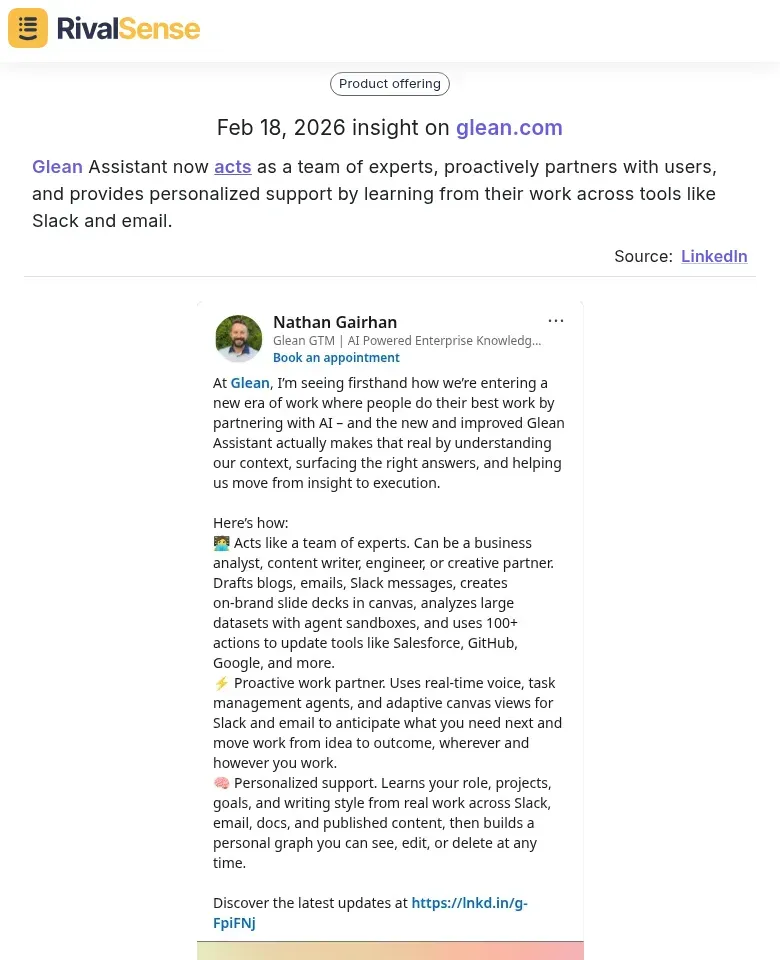
Why this insight matters: Tracking product updates like this is valuable for business strategy as it reveals how competitors are enhancing user engagement and integration capabilities, signaling market trends towards more collaborative and adaptive AI tools.
Practical Insights for Competitor Analysis:
- 📅 Track feature evolution timelines to identify market direction
- 🗺️ Monitor enterprise graph development as a competitive moat
- ➕ Analyze integration expansion patterns (from 10+ to 100+ enterprise actions)
- 🚀 Document capability shifts from reactive to proactive to autonomous
- 🎤 Watch for multimodal adoption as an indicator of market maturity
Actionable Checklist:
- [ ] Map competitor's AI assistant evolution stages
- [ ] Document enterprise graph capabilities and integrations
- [ ] Track autonomous workflow complexity increases
- [ ] Monitor voice and multimodal feature adoption
- [ ] Analyze customer use case expansion patterns
Glean's journey reveals that competitors must evolve from search tools to autonomous workflow platforms or risk market displacement.
Competitor Growth Opportunities Revealed Through RivalSense Analysis
Analyzing competitor movements can uncover hidden opportunities for your business. Our RivalSense analysis of Glean's AI assistant evolution uncovered three key competitor growth opportunities:
-
Permission Management Gaps: Glean's enterprise focus left gaps in granular permission controls for mid-market teams. Competitors could develop simplified, role-based permission systems that balance security with usability. Actionable tip: Audit your target market's permission pain points through customer interviews and feature gap analysis.
-
Cross-Platform Integration Opportunities: While Glean excels at enterprise SaaS integration, we identified underserved opportunities in legacy system connectors and industry-specific platforms. Practical step: Create a matrix comparing integration coverage across competitors to identify white spaces in your vertical.
-
Regulated Industry Advantages: Glean's governance-first approach created competitive moats in finance and healthcare, but also revealed opportunities in adjacent regulated sectors like legal and education technology. Checklist item: Map regulatory requirements in your target industry against competitor compliance features to identify differentiation opportunities.
-
Vertical Specialization vs. Horizontal Platforms: Smaller AI startups can differentiate by developing deep vertical solutions (e.g., legal document analysis, healthcare compliance tracking) rather than competing directly with Glean's broad horizontal platform. Strategic hint: Focus on 2-3 use cases where domain expertise creates defensible advantages over general-purpose AI assistants.
Key Insight: The most promising opportunities exist at the intersection of Glean's strategic choices and underserved customer segments in your target market.
Strategic Implications for B2B Companies in the AI Space
Strategic planning in AI requires foresight into how market leaders are adapting. Glean's evolution from AI assistant to middleware layer reveals critical strategic implications for B2B companies in the AI space. RivalSense analysis identified three key opportunities:
-
Independent AI Layers vs. Bundled Ecosystems: Glean's pivot to middleware shows the growing market for standalone AI infrastructure versus bundled solutions from Microsoft, Google, and Salesforce. Practical tip: Evaluate whether your AI solution should integrate with existing platforms or compete as independent infrastructure.
-
Timing Opportunities: Glean's implementation challenges (data integration complexity, security concerns) created a 6-9 month window for competitors. Checklist: Monitor competitor implementation timelines, identify adoption friction points, and time market entry when incumbents face integration hurdles.
-
Partnership Intelligence: Glean's Workday, Dell, and Palo Alto Networks partnerships reveal strategic priorities: enterprise workflows (Workday), on-premises deployment (Dell), and AI security (Palo Alto). Actionable insight: Analyze competitor partnership patterns to identify underserved market segments and potential alliance opportunities.
Strategic Recommendations:
- 🎯 Focus on solving specific enterprise pain points (data integration, security) rather than competing on general AI capabilities
- 🤝 Build partnerships that address complementary needs in the AI stack
- 🏗️ Position your solution as infrastructure rather than application to avoid direct competition with platform giants
- ⏰ Monitor middleware adoption rates to identify optimal market entry timing
Conclusion: Leveraging Competitive Intelligence for Strategic Advantage
Transforming competitor data into actionable intelligence is the cornerstone of modern business strategy. The Glean case study demonstrates how continuous competitor tracking transforms reactive responses into proactive strategy. By monitoring Glean's AI assistant evolution through RivalSense, companies could identify emerging enterprise AI trends before they became mainstream—from conversational interfaces to workflow integration patterns.
Actionable Steps for B2B Companies:
- Establish Continuous Monitoring: Set up automated tracking of 3-5 key competitors' product updates, pricing changes, and marketing messaging
- Identify Pattern Recognition: Look for recurring themes in competitor announcements—Glean's focus on 'contextual understanding' signaled a broader market shift
- Map Competitive Gaps: Analyze where competitors are investing vs. where they're leaving opportunities open
- Time Your Moves: Use competitor roadmap patterns to anticipate market needs 6-12 months ahead
- Validate Positioning: Test your messaging against emerging competitor narratives before launch
Practical Tip: Create a 'competitor evolution timeline' to visualize how market leaders are adapting to trends. This reveals not just what they're doing, but why—enabling you to position your solution in the whitespace they're overlooking.
By transforming competitor data into strategic intelligence, B2B companies can move from playing catch-up to defining the next wave of enterprise innovation.
Ready to uncover insights like these for your business? Try RivalSense for free to track competitor product launches, pricing updates, partnerships, and more—delivered in a weekly email report. Get your first competitor report today and stay ahead of the curve!
📚 Read more
👉 Optimizing Competitor Website Monitoring for Influencer Partnership Insights
👉 Nanotech SEO Hacks: Quick Competitor Strategy Wins
👉 Optimize Pricing with Competitor Insights to Boost Key Account Metrics
👉 Turning Competitor Partnerships into Strategic Insights
👉 The Ultimate Key Account Tracking User Guide: Practical Strategies for 2026