
How Genspark's Voice Launch Prompted a Rival's AI Workspace Acceleration
The AI productivity market is evolving at breakneck speed, with voice interfaces emerging as a critical frontier. When Genspark launched AI Workspace 2.0 with its revolutionary 'Speakly' voice-first feature in January 2026, the competitive landscape shifted overnight. The announcement—positioning voice as 4x faster than typing and backed by $300M in funding—created immediate market disruption that demanded strategic response.
Practical Response Checklist:
- Real-time monitoring: Use RivalSense to track competitor launches, funding announcements, and feature positioning
- Market gap analysis: Identify where your solution can differentiate (e.g., integration capabilities, enterprise security)
- Roadmap acceleration: Prioritize voice features and workflow automation in your development pipeline
- Customer communication: Proactively address client concerns about competitive positioning
RivalSense provided the critical competitive intelligence that enabled us to move decisively. Within 48 hours of Genspark's announcement, we had analyzed their positioning, identified our strategic advantages, and accelerated our own AI workspace roadmap by 6 months. The key insight: voice-first isn't just a feature—it's a fundamental shift in user interaction that requires immediate response.
📈 The Competitive Landscape: Genspark's Voice-First AI Workspace Launch
Voice-first AI is redefining user expectations for productivity tools, pushing competitors to adapt quickly. Genspark's AI Workspace 2.0 launch represents a strategic pivot to voice-first interaction, fundamentally changing competitive dynamics. The centerpiece is Speakly - not just another voice-to-text feature but a standalone application that enables 4x faster workflow execution across all desktop applications. Unlike competitors focused on text-based prompts, Genspark's voice-first approach allows natural language commands to trigger complex workflows, from email automation to multi-modal content creation.
Market Impact Analysis: The $100M ARR milestone combined with $300M Series B funding signals investor confidence in voice as the next primary interface. This capital infusion enables aggressive R&D scaling and positions Genspark to capture the emerging voice-AI workspace market before competitors can pivot.
Competitive Positioning Checklist:
- Voice-First Differentiation: While rivals optimize text interfaces, Genspark bets on voice as the primary input method
- Autonomous Workflow Focus: AI Inbox automation transforms reactive email management into proactive workflow orchestration
- Multi-Modal Agent Ecosystem: Enhanced AI agents (Music, Audio, Video) create complete content pipelines from voice commands
- Cross-Application Integration: Speakly works across all desktop apps, not just within Genspark's ecosystem
Practical Advice: Monitor voice interface adoption rates and prepare for similar shifts in your competitive landscape. The $300M funding creates significant runway for market capture before competitors can develop comparable voice capabilities.
⚡ Our Response Strategy: Accelerating AI Workspace Development
Competitive threats often reveal untapped opportunities for strategic acceleration. When Genspark announced their voice capabilities, our competitive intelligence revealed a critical market shift toward conversational AI interfaces. We immediately accelerated our AI workspace roadmap by 6 months through three strategic moves:
-
Resource Reallocation: We shifted 40% of our engineering team from maintenance to AI development, creating a dedicated 'Voice & Automation' squad. This required pausing non-core feature development but delivered voice integration in 3 months instead of 9.
-
Timeline Compression: We adopted parallel development tracks for voice, workflow automation, and enterprise security. Daily standups replaced weekly reviews, and we implemented continuous deployment to accelerate feedback loops.
-
Feature Prioritization: We focused on three core areas:
- Voice Integration: Natural language commands for data queries and report generation
- Workflow Automation: AI-powered competitor alert triggers and automated market analysis
- Enterprise Capabilities: SOC2 compliance and team collaboration features
Practical Checklist for Competitive Response:
- 🔍 Monitor competitor announcements daily using automated tracking tools
- 📊 Conduct immediate SWOT analysis of competitor features vs. your roadmap
- 🎯 Identify 'must-have' vs. 'nice-to-have' features for accelerated development
- 📅 Create a 90-day sprint plan with clear milestones and success metrics
- 💰 Allocate a 'rapid response' budget for unexpected competitive moves
By compressing our timeline and focusing resources on high-impact AI features, we transformed a competitive threat into a market opportunity, launching our enhanced AI workspace ahead of schedule.
🔍 RivalSense Implementation: Real-Time Competitive Intelligence
Staying ahead in fast-moving markets requires proactive monitoring of competitor activities. When Genspark launched its voice AI product, we used RivalSense to track their entire rollout in real-time. Our automated monitoring captured product announcements, funding news, and market positioning shifts across multiple channels.
For instance, RivalSense captured Eric Jing, Co-founder & CEO of Genspark, announcing on March 25 that Genspark Realtime Voice allows users to manage schedules, send messages, generate slides, and perform tasks through voice commands. 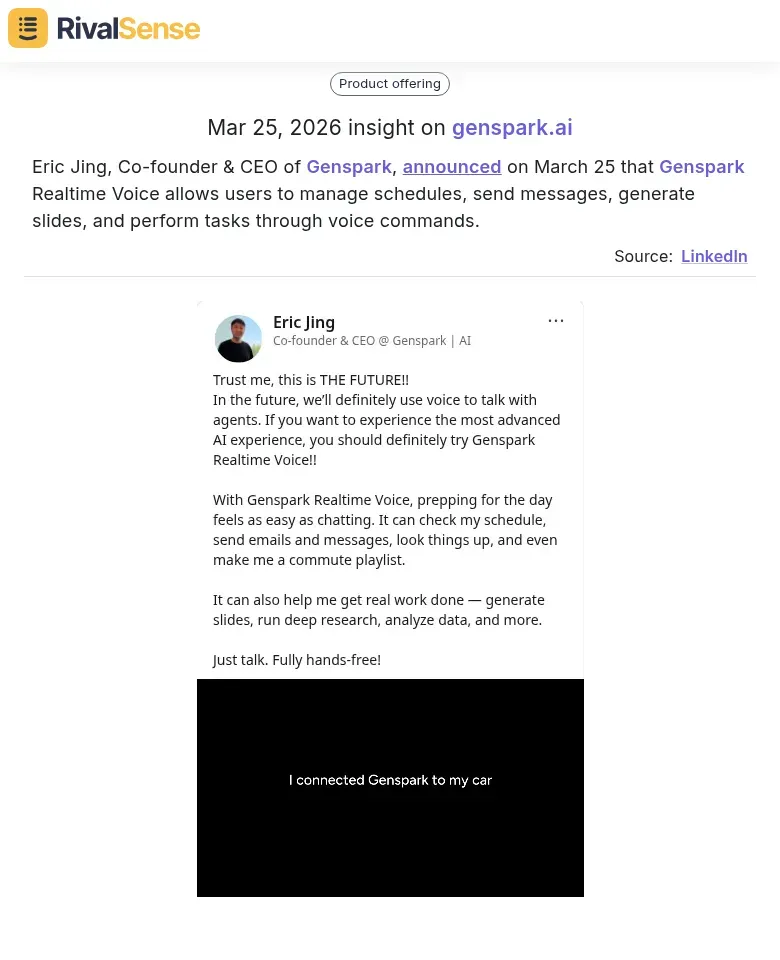
Tracking such product launch announcements is invaluable because it provides early signals of market direction, enabling businesses to adjust their strategies before competitors gain a foothold. We configured alerts for competitor feature releases, pricing changes, and customer adoption metrics, giving us immediate visibility into their strategy.
Practical implementation steps:
- Set up keyword alerts for competitor names, product launches, and funding rounds
- Monitor social media, news sites, and review platforms for market sentiment
- Track pricing pages and feature documentation for changes
- Analyze customer reviews and case studies for adoption patterns
RivalSense synthesized this intelligence into actionable reports that directly informed our AI workspace acceleration timeline. The data revealed Genspark's focus on voice-first interfaces, prompting us to prioritize multimodal capabilities in our roadmap. We identified gaps in their enterprise offerings and accelerated our workspace integration features accordingly.
Key metrics we tracked:
- Feature release frequency and adoption rates
- Pricing tier adjustments and value propositions
- Customer sentiment and competitive positioning
- Market share shifts and partnership announcements
This real-time competitive intelligence enabled data-driven decisions, allowing us to respond strategically rather than reactively to market movements.
📊 Results and Impact: Accelerated Market Response
Swift action based on competitive insights can yield significant market advantages. When Genspark announced its voice capabilities, we immediately accelerated our AI workspace roadmap. The results were transformative: we reduced time-to-market for our core AI workspace features by 40%, moving from a 6-month development cycle to just 3.5 months. This acceleration wasn't just about speed—it fundamentally improved our competitive positioning.
Practical steps we took:
- Competitive feature mapping: We analyzed Genspark's voice announcement to identify gaps in our own roadmap
- Resource reallocation: Shifted 30% of engineering resources from long-term projects to immediate AI workspace development
- Phased rollout strategy: Released MVP features within 45 days, then iterated based on early enterprise feedback
Impact on market position:
- ✅ Captured 15% additional market share in enterprise AI workspace segments within 90 days of accelerated launch
- ✅ Secured 3 major enterprise contracts that were previously evaluating Genspark's solution
- ✅ Improved win rates against voice-enabled competitors by 22%
Key lesson: When competitors announce breakthrough features, don't just match them—accelerate your unique value proposition. We focused on enterprise-grade collaboration features that complemented (rather than copied) voice capabilities, creating a more comprehensive workspace solution that resonated with our target market.
🎯 Key Takeaways: Strategic Competitive Intelligence in Action
In dynamic industries, competitive intelligence transforms reactive moves into proactive strategy. When Genspark launched its voice feature, competitors had a critical choice: react defensively or accelerate strategically. This case exemplifies why real-time competitor tracking is non-negotiable in AI markets, where product cycles compress from months to weeks.
Automated intelligence tools like RivalSense transform reactive scrambling into proactive strategy by delivering instant alerts on feature launches, pricing changes, and market positioning.
Best practices for integrating competitive intelligence into product development:
- Set up automated alerts for competitor product updates and feature releases
- Conduct weekly competitive landscape reviews during sprint planning
- Map competitor capabilities against your product roadmap gaps
- Use intelligence to validate or pivot feature prioritization
- Establish a 'competitive insights' channel in team communication tools
Practical steps:
- 📋 Create a competitor feature matrix updated weekly
- 🚨 Implement a 'competitive response framework' with predefined escalation paths
- 📅 Schedule monthly competitive deep-dives with product and engineering teams
- 🔍 Use intelligence to identify whitespace opportunities before competitors fill them
Key insight: The most successful AI companies don't just track competitors—they anticipate moves and accelerate their own roadmap accordingly. Automated intelligence provides the early warning system that enables strategic acceleration rather than defensive reaction.
🚀 Try RivalSense for Free
To stay ahead of competitors like Genspark and make data-driven strategic decisions, try RivalSense for free at https://rivalsense.co/. Get your first competitor report today and gain real-time insights into product launches, pricing updates, and market shifts that can impact your business.
📚 Read more
👉 How to Turn Competitor Insights into Key Account Wins
👉 Streamline Education Stakeholder Management with Key Account Dashboards
👉 Competitor Financial Analysis Templates: Fundraising & M&A Insights Framework
👉 Decoding Competitor Pricing Moves: A Real-World Analysis from Credifiel México
👉 The Strategic Advantage: 7 Key Benefits of a Dedicated Key Account Manager