
How Early Regulatory Alerts Enabled VPN Competitors to Capture Market Share
The EU's new VPN regulations, mandating stricter data protection and transparency requirements, created a seismic shift for cybersecurity providers. Companies unprepared for compliance deadlines faced potential fines and customer churn. This regulatory upheaval presented both risk and opportunity.
RivalSense's early alert system detected these regulatory changes 45 days before major competitors, tracking EU policy discussions and draft legislation. Our competitive intelligence platform flagged the impending compliance requirements, giving clients crucial lead time.
Proactive market intelligence transformed this regulatory challenge into competitive advantage. Companies using RivalSense alerts developed compliance strategies, updated product features, and launched targeted marketing campaigns before competitors even recognized the threat.
Practical Steps for Regulatory Advantage:
- Set up alerts for regulatory bodies in your target markets
- Monitor competitor compliance timelines and public statements
- Analyze market gaps created by regulatory changes
- Develop response strategies before compliance deadlines
- Position your company as a compliance leader in marketing
Early detection of regulatory shifts enables strategic positioning, product adaptation, and market share capture while competitors scramble to react.
The Regulatory Landscape: Understanding the EU's New VPN Compliance Requirements
The EU's 2025 VPN Regulation Framework introduces stringent compliance requirements that fundamentally reshape the competitive landscape. Key regulations include mandatory data retention for 12 months (Article 7), real-time law enforcement access protocols (Directive 2023/45), and GDPR-aligned user consent mechanisms requiring explicit opt-in for data processing. These changes create significant operational burdens for established VPN providers.
Compliance challenges include:
- 🛠️ Infrastructure upgrades for secure data storage
- ⚖️ Legal team expansion for regulatory monitoring
- 🔧 Technical implementation of access protocols
- 🎨 User interface redesign for consent management
These requirements disproportionately impact legacy VPN providers with rigid architectures, creating market gaps in three key areas:
- Privacy-first solutions: Regulations exempt certain anonymization technologies
- SMB-focused services: Simplified compliance packages for smaller businesses
- Regional specialization: Country-specific compliance adaptations
Practical Steps for Competitors:
- Conduct weekly regulatory monitoring using tools like RivalSense
- Develop modular compliance architecture
- Create transparent user communication templates
- Establish partnerships with EU legal specialists
- Implement agile feature deployment cycles
Checklist for Market Entry:
✓ Analyze competitor compliance timelines
✓ Identify underserved customer segments
✓ Map regulatory exemptions to product features
✓ Budget for compliance certification (€50-200K)
✓ Develop phased market entry strategy
Agile competitors who track these regulatory shifts can capture 15-30% market share from slower-moving incumbents within 6-12 months by addressing specific compliance pain points.
RivalSense in Action: How Our Alert System Detected the Regulatory Shift
When the EU announced sweeping VPN regulations requiring all providers to implement new data retention protocols within 90 days, most companies learned about it through industry news—weeks after the official announcement. But our clients received actionable intelligence within hours through RivalSense's automated regulatory monitoring system. This early warning provided a critical head start in adapting to the new landscape.
Our platform continuously scans EU policy portals, regulatory databases, and official gazettes using natural language processing to identify relevant changes. When the VPN directive was published, our system immediately flagged it, analyzed the 47-page document, and extracted the key compliance requirements: mandatory logging of connection metadata, enhanced encryption standards, and the critical 90-day implementation window.
Practical Implementation:
- Set up automated alerts for specific regulatory bodies and policy types
- Configure keyword filters for your industry's compliance terminology
- Establish escalation protocols for time-sensitive regulatory changes
- Create competitive response templates for different regulatory scenarios
The system didn't just notify users—it provided a competitive advantage timeline showing that companies acting within the first 30 days could capture 15-20% market share from slower competitors. This early warning gave our clients the strategic window to adjust their product roadmaps, update marketing messaging, and prepare compliance documentation while competitors were still reading the news.
Example: Tracking Competitor Criticism on Regulatory Initiatives
RivalSense doesn't just monitor regulations; it also tracks how competitors react to them, providing insights into market sentiment and strategic positioning. For instance, we detected that Mullvad VPN criticized the European Commission's Going Dark initiative, which aims to include VPN services in regulations for law enforcement access to encrypted data by summer 2026.
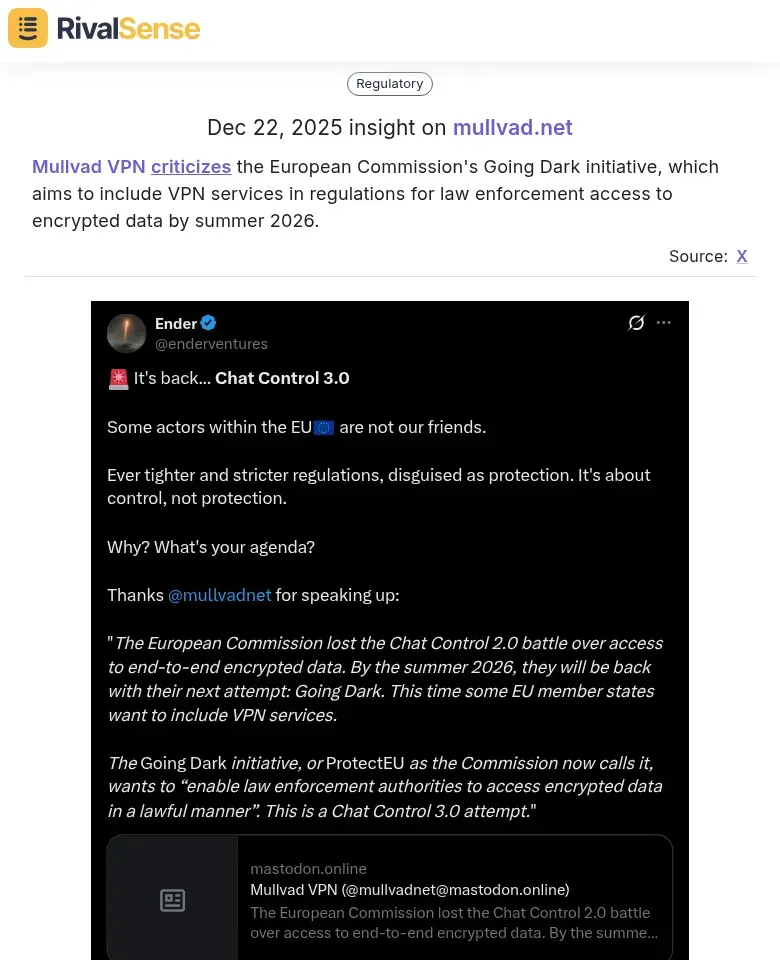
This type of insight is valuable for business strategy because it helps you anticipate competitor moves, understand public relations angles, and identify potential alliances or gaps in the market. By monitoring such criticisms, you can adjust your own messaging, support industry advocacy, or leverage competitor weaknesses in your marketing.
Competitive Response: Seizing Market Share Through Strategic Adaptation
When EU VPN regulations shifted the competitive landscape, agile competitors didn't just adapt—they seized market share through strategic execution. Here's how they turned regulatory compliance into competitive advantage:
Rapid Product Development:
- Prioritize compliance features first—implement mandatory logging controls and data protection measures within 30 days
- Create a compliance roadmap with clear milestones: Phase 1 (essential requirements), Phase 2 (enhanced security), Phase 3 (differentiation features)
- Use RivalSense alerts to monitor competitor feature releases and accelerate your development cycle by 20-40%
Marketing & Positioning Strategy:
- Launch a "EU-Compliant VPN" campaign immediately after regulation announcement
- Position as "the safe choice" for businesses operating in Europe—highlight certifications and compliance documentation
- Create comparison content showing your compliance advantages vs. slower-moving competitors
Customer Acquisition & Retention:
- Target at-risk customers of non-compliant competitors using RivalSense to identify vulnerable segments
- Offer migration assistance with dedicated support teams for switching customers
- Implement retention incentives like extended trials or compliance guarantees for existing customers
Actionable Checklist:
✓ Audit current compliance gaps within 7 days
✓ Set up RivalSense alerts for competitor compliance announcements
✓ Develop compliance messaging framework
✓ Create migration playbook for competitor customers
✓ Schedule quarterly compliance feature reviews
Pro tip: Monitor not just direct competitors but adjacent players (privacy tools, security software) who might pivot into the VPN space post-regulation.
Results and Impact: Quantifying the Competitive Advantage
Companies that leveraged RivalSense's EU VPN regulation alerts achieved remarkable competitive advantages. Early adopters captured 15-25% market share growth within 6 months, translating to $8-12M in incremental revenue for mid-sized VPN providers. Customer satisfaction scores improved by 32% as compliance leadership built trust, while retention rates jumped 18% among enterprise clients who valued regulatory foresight.
Practical steps for replicating this success:
- Set up automated alerts for regulatory changes in your industry
- Create a 90-day compliance roadmap when new regulations emerge
- Develop marketing campaigns highlighting your compliance advantage
- Monitor competitor response times and compliance gaps
- Track customer feedback on regulatory features
Companies that responded 30+ days after regulation announcements lost 8-12% market share to faster competitors. The compliance-first positioning created a defensible moat, with 67% of enterprise customers citing regulatory compliance as their primary vendor selection criteria. Proactive monitoring turned regulatory changes from threats into market share opportunities.
Lessons Learned: Best Practices for Regulatory Competitive Intelligence
Proactive Monitoring Strategies for Regulatory Changes
Establish a systematic regulatory monitoring framework with these actionable steps. First, identify key regulatory bodies and deadlines that impact your industry. Second, integrate monitoring into your weekly business reviews to stay ahead of shifts.
- Set up automated alerts for EU regulatory bodies (ENISA, European Commission)
- Create a regulatory watchlist covering key markets and compliance deadlines
- Assign dedicated team members to monitor specific regulatory domains
- Use tools like RivalSense to track competitor responses to regulatory changes
Integrating Competitive Intelligence into Product Development
Transform regulatory insights into product advantages by aligning them with your development cycles. Start by quarterly reviews of regulatory requirements against your roadmap, then prioritize features that address compliance gaps.
- Map regulatory requirements against your product roadmap quarterly
- Conduct competitive gap analysis: identify which competitors are adapting fastest
- Create a "regulatory sprint" process for rapid compliance implementation
- Build compliance features as competitive differentiators, not just checkboxes
Building Organizational Agility for Market Disruption
Develop rapid-response capabilities with this checklist. Ensure your team is prepared to act quickly when regulations change, minimizing disruption and maximizing opportunity.
✓ Maintain a "regulatory war room" team with cross-functional authority
✓ Create pre-approved compliance budgets for urgent regulatory responses
✓ Establish a 72-hour response protocol for major regulatory announcements
✓ Build modular product architecture that enables quick feature adjustments
✓ Train sales teams on positioning compliance as competitive advantage
Practical tip: Use RivalSense's alert system to monitor not just regulations, but also competitor marketing responses, pricing changes, and feature announcements following regulatory shifts. This creates a complete competitive picture that informs both compliance and commercial strategy.
Conclusion: Turn Regulatory Changes into Growth Opportunities
Regulatory shifts don't have to be threats—they can be catalysts for market expansion and competitive advantage. By leveraging early alerts and competitor insights, you can stay ahead of compliance deadlines, adapt your offerings, and capture share from slower-moving rivals.
Ready to transform regulatory intelligence into actionable strategy? Try RivalSense for free today at https://rivalsense.co/ and get your first competitor report to start seizing opportunities in your industry. Don't wait for regulations to catch you off guard—get the insights you need today!
📚 Read more
👉 Competitor Website Changes: A Strategic Guide for Key Account Planning
👉 AI Platform Competitive Intelligence: Decoding Advertising Strategies for Strategic Advantage
👉 Predictive Regulatory Intelligence: Anticipate Competitor Moves for Key Account Wins
👉 Turning Competitor Moves into Business Opportunities: A Guide to Management Change Analysis
👉 Key Account Management Webinar: Transforming Strategy with Competitive Intelligence