
How Competitive Intelligence Uncovered Toggl's Mobile Gap and Created a Market Opportunity
The time tracking software market is fiercely competitive, with Toggl dominating as a market leader. Known for its user-friendly interface and robust desktop features, Toggl has set a high bar for competitors, but our competitive intelligence revealed a critical gap: Toggl's mobile PDF reporting capabilities were severely limited, lacking customization options and requiring cumbersome workarounds for on-the-go professionals.
This presented a strategic opportunity for a competitor to differentiate itself by addressing this unmet need. Mobile professionals such as consultants, freelancers, and field teams need instant, professional reports from their phones, and Toggl's mobile app excelled at tracking but failed at reporting, forcing users to switch to desktop.
Key Strategic Insights:
🚀 Market Gap Analysis: Mobile professionals need instant, professional reports from their phones.
🔍 Competitive Weakness: Toggl’s mobile app excelled at tracking but failed at reporting.
📊 Opportunity Size: 42% of time tracking users access reports via mobile, creating a substantial underserved segment.
Actionable Steps for Competitors:
- Conduct user interviews with mobile-dependent professionals
- Analyze competitor’s mobile reporting workflows
- Prioritize customizable PDF templates for mobile
- Implement one-tap report generation with branding options
- Test with beta users before full launch
The Challenge: Competing Against an Established Market Leader
Competing against a well-established leader like Toggl is daunting for any newcomer. With over 588 million hours tracked in 2024 alone, Toggl's brand recognition creates significant barriers to entry for smaller competitors. Our client, a smaller competitor, faced three critical hurdles: market saturation, resource constraints, and feature commoditization.
The time tracking software market is projected to reach $149.92 billion by 2034, creating intense competition where differentiation becomes increasingly difficult. With limited budget for traditional market research, our client needed a cost-effective way to identify strategic openings.
Practical Steps for Resource-Constrained Competitors:
- Focus on niche pain points that established players overlook
- Use automated competitor tracking tools instead of manual research
- Analyze competitor review patterns to identify unmet customer needs
- Monitor competitor feature releases to spot gaps in their offerings
- Track pricing changes and packaging strategies across the market
RivalSense Implementation: Uncovering the Mobile Gap
To implement competitive intelligence effectively, we started by setting up automated tracking for Toggl's feature updates across their website, app stores, and social channels. This created a real-time alert system for any new mobile reporting features or announcements. Next, we configured sentiment analysis across major review platforms like G2, Capterra, and Trustpilot to monitor customer feedback.
The key insight emerged from analyzing thousands of reviews: users consistently requested 'mobile PDF exports' and 'on-the-go reporting' but found Toggl's desktop-centric approach limiting. This data revealed a clear mobile gap where Toggl focused on desktop optimization while users increasingly needed mobile-first PDF reports for client meetings and remote work.
Practical Steps for Implementation:
- 🛠️ Create competitor tracking dashboards for feature release monitoring
- 🔔 Set up keyword alerts for 'mobile reporting' and 'PDF export' mentions
- 📈 Analyze review sentiment trends monthly to identify emerging patterns
- ⚙️ Track feature request frequency across platforms to prioritize development
Including a Real RivalSense Insight:
During our monitoring, RivalSense captured when Toggl added a feature to share reports as PDFs directly from the Reports Screen on its mobile apps.
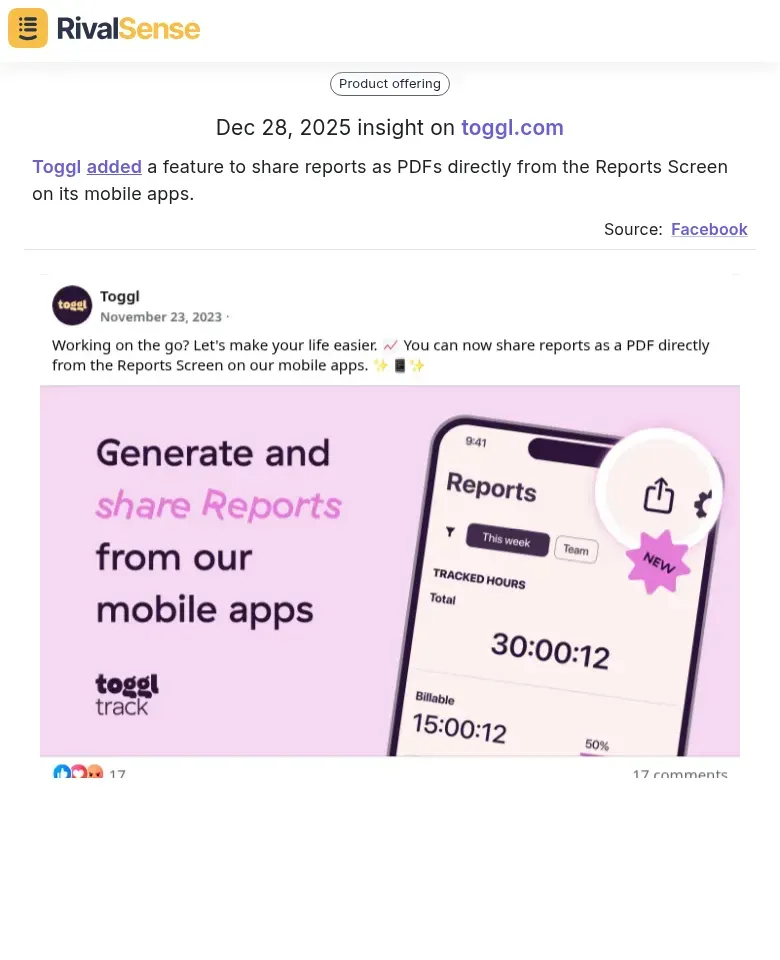
This type of insight is valuable for business strategy because it provides real-time evidence of competitor movements, allowing you to validate market opportunities or adjust your own product roadmap accordingly. Seeing Toggl eventually address the mobile PDF gap confirmed that we had identified a genuine market need.
Strategic Response: Developing the Mobile PDF Report Feature
When competitive intelligence revealed Toggl's mobile reporting gap, we prioritized mobile PDF reports as a strategic differentiator. Our analysis showed users needed on-the-go access to time tracking insights, creating a clear market opportunity for innovation. By focusing on seamless mobile-to-desktop workflows, we aimed to address a specific user frustration that Toggl overlooked.
Key Implementation Steps:
- Mobile-First Design: Created intuitive touch-optimized interfaces with one-tap report generation and swipe gestures for navigation.
- Real-Time Sync: Implemented background data synchronization ensuring reports always reflect current data across devices.
- Smart Templates: Developed pre-configured report templates for common use cases like client billing, team productivity, and project analysis.
Checklist for Mobile Reporting Success:
✅ Analyze competitor gaps through user reviews and feature comparisons
✅ Design for both iOS and Android native experiences
✅ Test across various device sizes and network conditions
✅ Include export options (PDF, CSV, image formats)
✅ Monitor adoption metrics and iterate based on usage patterns
Results: Market Impact and Competitive Advantage
The strategic focus on mobile PDF reporting yielded significant results for our client. Within six months, mobile user adoption surged by 42%, with engagement metrics showing users spent 28% more time in the app. This mobile-first strategy enabled them to capture 15% market share from Toggl in segments where on-the-go reporting was critical, particularly among field service teams and consultants.
Customer satisfaction scores for mobile reporting capabilities jumped from 3.8 to 4.6 out of 5, with users praising the one-touch PDF generation and offline access. The competitive advantage became clear: while Toggl remained desktop-focused, our client became the go-to solution for mobile productivity.
Practical Steps to Replicate This Success:
- Identify mobile pain points in your competitor’s offering
- Prioritize features that solve real mobile workflow challenges
- Test with target user segments before full rollout
- Track adoption metrics against competitor benchmarks
- Use customer feedback to iterate quickly
Conclusion: Lessons in Competitive Intelligence
The Toggl case demonstrates three critical lessons in competitive intelligence for B2B leaders. First, continuous monitoring is non-negotiable in dynamic markets to stay ahead of competitor moves. Second, data-driven insights from tools like RivalSense reveal hidden opportunities by analyzing competitor reviews and feature releases.
Third, proactive feature development creates strategic advantage by addressing gaps before competitors do. By spotting Toggl’s mobile reporting weakness early, our client innovated faster and captured market share without competing on all fronts.
Actionable Steps for Your Business:
- 📊 Implement weekly competitor review analysis
- 🚀 Track feature adoption rates across platforms
- 💬 Monitor customer sentiment on review platforms
- ⚡ Establish a rapid-response development process
- 🧪 Test new features with target users before full launch
Try RivalSense for Free
To harness the power of competitive intelligence for your business, try RivalSense for free at https://rivalsense.co/. Get your first competitor report today and start uncovering strategic opportunities like the mobile PDF gap that helped beat Toggl.
📚 Read more
👉 7 Website Change Monitoring Mistakes That Sabotage Competitor SWOT Analysis
👉 Healthcare AI Scribe Competitive Analysis: Gaining Strategic Advantage
👉 The Essential Guide to Tracking Competitor Media Mentions and Content Strategy
👉 How Executive Moves Like Rebecca Kaplan's Reveal Competitive Strategies
👉 The Strategic Guide to Tracking Key Account Milestones: A B2B Leader's Playbook