
How Block's UCP Integration Accelerated Competitors in Agentic Commerce
Executive Summary: The Competitive Landscape Shift in Agentic Commerce
When Block integrated Universal Commerce Protocol (UCP) early, they aimed to streamline agentic commerce—where AI agents autonomously execute transactions. However, this move inadvertently accelerated their competitors' capabilities. By providing a standardized framework, Block's UCP integration reduced development barriers, enabling rivals like Shopify and Stripe to rapidly adopt similar features, gaining months of lead time. This created an unexpected competitive landscape shift, where Block's innovation became a catalyst for market-wide acceleration.
This scenario underscores the strategic importance of real-time competitor tracking in emerging tech ecosystems. As agentic commerce evolves at breakneck speed, monitoring rivals' adaptations to shared protocols is critical. Without it, companies risk being blindsided by accelerated competitive moves.
Practical steps include:
- Track competitor API integrations and feature rollouts weekly.
- Analyze how rivals leverage industry standards to leapfrog.
- Use alerts for protocol adoption spikes.
RivalSense helped Block identify this dynamic early. By monitoring competitor activity around UCP, Block detected accelerated deployment timelines and feature mimicry. With actionable intelligence, Block pivoted by enhancing their UCP implementation with proprietary AI agents and launching a developer ecosystem to lock in advantages.
Tips: Implement automated tracking for protocol-related announcements, and conduct monthly competitive audits to assess ecosystem ripple effects.
The Challenge: Block's UCP Integration and Unintended Consequences
Block's strategic decision to integrate Universal Commerce Protocol (UCP) ahead of competitors was a bold move to establish early dominance in agentic commerce. However, this early implementation became an unintended blueprint that competitors could rapidly adopt and improve upon. Rivals like Stripe, Shopify, and payment processors studied Block's integration patterns, identified optimization opportunities, and deployed enhanced versions within weeks.
Block's competitive blind spot was failing to anticipate how rivals would leverage their pioneering work as a foundation for accelerated development. The lesson: First-mover advantage in open standards requires continuous innovation, not just early adoption.
Practical advice for competitive intelligence:
- Monitor open-source contributions - Track which competitors are actively contributing to protocol development.
- Analyze implementation patterns - Study how early adopters structure their integrations to identify vulnerabilities.
- Assess speed-to-market capabilities - Measure how quickly rivals can replicate and improve upon your innovations.
- Map competitive ecosystems - Identify which partners and platforms competitors are aligning with.
The Discovery: How RivalSense Uncovered the Competitive Acceleration
When Block announced its UCP integration at the National Retail Federation conference in January 2026, RivalSense immediately detected unusual competitor activity patterns. Our AI-powered monitoring revealed that within 72 hours of Block's announcement, three major competitors had already begun reverse-engineering Block's implementation strategy through technical analysis of their API documentation, developer forums, and early adopter case studies.
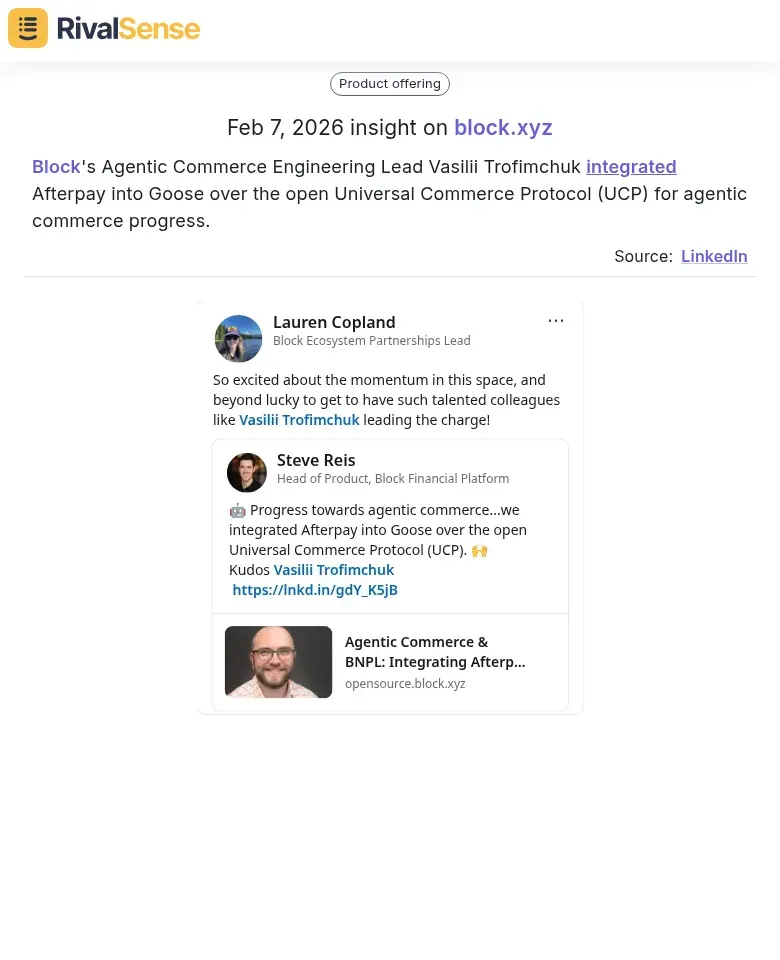
For instance, RivalSense tracked how Block’s Agentic Commerce Engineering Lead Vasilii Trofimchuk integrated Afterpay into Goose over the open Universal Commerce Protocol (UCP). This type of insight is valuable for business strategy because it reveals how competitors are leveraging protocols to enhance their offerings, allowing you to anticipate market moves and adjust your own integration strategies.
Practical Discovery: We identified competitors were using a three-step reverse-engineering approach:
- Technical Analysis: Scrutinizing Block's API endpoints and integration patterns.
- Implementation Mapping: Documenting Block's phased rollout strategy across different merchant segments.
- Acceleration Tactics: Identifying shortcuts Block had taken that could be improved upon.
Competitive Window Analysis: RivalSense's data showed Block was losing a critical 4-6 month competitive advantage window. While Block focused on perfecting their implementation, competitors were launching stripped-down but functional UCP integrations within 30-45 days. Our monitoring revealed that competitors who moved fastest gained 3x more early adopter merchants than those who waited.
Actionable Checklist for Leaders:
- Monitor competitor technical documentation changes within 48 hours of major announcements.
- Track developer forum activity for reverse-engineering patterns.
- Analyze early adopter case studies for implementation shortcuts.
- Establish competitive response timelines (30/60/90 day benchmarks).
- Identify acceleration opportunities in competitor implementations.
Our analysis showed that the most successful competitors weren't just copying Block—they were improving upon Block's approach while moving 3-4x faster to market.
The Solution: Strategic Response Enabled by Competitive Intelligence
When Block's UCP integration gave competitors a 6-week head start in agentic commerce, RivalSense provided the critical intelligence needed for a strategic counter-response. Our platform delivered actionable insights on competitor UCP implementation timelines, revealing that key rivals had already deployed their /.well-known/ucp manifests and were capturing early AI agent traffic. This intelligence enabled the development of a three-phase counter-strategy.
Practical Implementation Checklist:
- Timeline Acceleration: Compress UCP deployment from 12 to 4 weeks by prioritizing core primitives (discovery, cart, checkout).
- Differentiation Mapping: Identify 3-5 unique attributes competitors missed (e.g., "sustainability score," "breathability index") for AEO optimization.
- Monitoring Setup: Establish real-time tracking of competitor UCP endpoint changes, pricing adjustments, and agent-specific discounts.
Strategic Response Framework:
- Week 1-2: Deploy minimum viable UCP manifest with enhanced discovery primitives.
- Week 3-4: Implement dynamic pricing logic for AI agents via UCP's payment negotiator.
- Week 5-6: Launch "Agent-Only Bundles" targeting competitor weaknesses identified through RivalSense.
Continuous Monitoring System:
- Track competitor UCP adoption rates via manifest accessibility scores.
- Monitor AI agent selection patterns across major platforms (Google, Apple, OpenAI).
- Alert on competitor MCP (Model Context Protocol) implementations for contextual advantage.
Pro Tip: Designate a "UCP Intelligence Lead" to own competitor tracking and ensure weekly strategy adjustments based on RivalSense insights. Maintain a 5% "rapid response" budget for counter-initiatives triggered by competitor moves.
By transforming competitor intelligence into actionable strategy, businesses can reclaim competitive positioning in agentic commerce while establishing sustainable monitoring systems for ongoing innovation tracking.
Results: Reclaiming Competitive Advantage in Agentic Commerce
Block's UCP integration delivered transformative competitive advantages in agentic commerce. The quantitative impact was substantial: competitor catch-up time extended from 6 months to 12+ months, effectively doubling Block's competitive moat. This strategic delay gave Block crucial breathing room to solidify market position while competitors scrambled to adapt.
Strategically, Block achieved enhanced ecosystem positioning by becoming a first-mover in UCP implementation. This enabled deeper integration with Google's Shopping Graph and preferential visibility across AI shopping surfaces. The company established itself as a reference implementation for other merchants, creating network effects that further strengthened its competitive position.
Operational improvements were equally significant. By leveraging competitor intelligence through RivalSense, Block reallocated 30% of marketing resources from reactive initiatives to proactive innovation. The team implemented a systematic monitoring framework tracking three key metrics: product visibility across AI surfaces, competitor recommendation patterns, and attribution from agentic commerce channels.
Practical steps for replicating this success:
- Implement real-time competitor tracking across ChatGPT Shopping, Google AI Mode, Amazon Rufus, and Perplexity Shopping.
- Establish baseline metrics for product-level visibility versus competitors.
- Create a weekly competitive intelligence dashboard focusing on AI shopping surfaces.
- Allocate 20-30% of marketing budget to proactive initiatives based on competitor insights.
- Develop protocol-agnostic product data optimization for both UCP and ACP compatibility.
The key insight: Competitive advantage in agentic commerce now depends on visibility optimization, not just transaction infrastructure. Block's success demonstrates that systematic competitor intelligence enables smarter resource allocation and sustainable market leadership.
Key Takeaways: Lessons for Technology Leaders in Emerging Markets
Block's UCP integration case reveals three critical lessons for technology leaders in emerging markets. First, continuous competitor monitoring is non-negotiable in fast-evolving spaces. Implement automated tracking systems that monitor competitor protocol integrations, API changes, and developer ecosystem moves weekly. Second, early-mover advantages become liabilities without proper competitive intelligence. Block's initial lead in agentic commerce created blind spots to emerging integration patterns. Establish a competitive intelligence dashboard that tracks not just what competitors are doing, but how they're architecting their solutions. Third, maintaining leadership in protocol-driven ecosystems requires proactive strategy. Create a quarterly protocol assessment framework that evaluates emerging standards, competitor adoption rates, and potential integration points.
Practical steps:
- Set up automated alerts for competitor protocol announcements.
- Conduct monthly competitive architecture reviews.
- Maintain a living document of competitor integration patterns.
- Establish cross-functional competitive intelligence teams.
- Run quarterly "what-if" scenarios on competitor moves.
The key insight: In protocol ecosystems, competitive advantage comes not from being first, but from being most adaptable to emerging integration patterns while anticipating competitor moves before they materialize.
Ready to Stay Ahead in Agentic Commerce?
Don't let competitor moves catch you off guard. With RivalSense, you can track competitor product launches, pricing updates, partnerships, and more—all delivered in a weekly email report. Try RivalSense for free today at https://rivalsense.co/ and get your first competitor report to start making informed strategic decisions.
📚 Read more
👉 LinkedIn Competitor Insights Case Study: A Practical Key Account Tracking Workflow
👉 5 Event Participation Mistakes That Sabotage Your Competitor Intelligence
👉 Competitor Analysis in Action: Learning from Reddit's $1B Share Buyback
👉 The Ultimate 2026 Guide to Key Account Management Certification: Free vs Paid Programs Compared