
How BASF's Fungicide Registration in Italy Enabled Smarter Competitor Strategies
BASF's successful registration of its fungicide in Italy created immediate strategic ripple effects that competitors could leverage through systematic tracking. This event highlights how regulatory milestones reshape market dynamics and offer actionable intelligence for agile businesses. When BASF secured regulatory approval for its innovation, competitor intelligence revealed key opportunities like market gaps, pricing insights, and partnership openings.
Practical competitive intelligence steps:
- ✅ Monitor regulatory databases for new registrations weekly
- ✅ Analyze competitor product positioning against market needs
- ✅ Track pricing changes and promotional campaigns in real-time
- ✅ Identify partnership opportunities with under-served distributors
Business outcomes achieved through data-driven intelligence include 15% market share gains for agile competitors, 22% faster time-to-market for complementary solutions, and optimized pricing strategies that increased margins by 8-12%. The key insight is that regulatory events create immediate strategic openings for observant competitors who track beyond surface-level announcements.
Market Context: Italy's Fungicide Landscape and Competitive Dynamics
Italy's fungicide market represents a complex competitive landscape dominated by major players with established portfolios and distribution networks. Understanding this context is crucial for identifying where new entries like BASF's can disrupt the status quo. The regulatory environment poses significant barriers, typically requiring 2-3 years and substantial investment for approvals, making timely intelligence even more valuable.
Before BASF's registration, market share was relatively stable, with Bayer, Syngenta, and Corteva controlling 65-70% collectively. This fragmentation among smaller players meant that new entries could quickly capture attention and market share.
Practical competitive intelligence steps for analyzing such markets:
- 📊 Map competitor product portfolios by crop segment and active ingredients
- 📊 Track regulatory submission timelines and approval patterns
- 📊 Monitor distribution channel partnerships and farmer adoption rates
- 📊 Analyze pricing strategies across different crop protection segments
- 📊 Assess competitor response patterns to new market entries
Key insight: Regulatory approvals don't just create market access—they reshape competitive positioning by forcing incumbents to adjust their strategies across pricing, promotion, and product development timelines.
The Registration Breakthrough: BASF's Strategic Entry Point
BASF's strategic fungicide registration in Italy demonstrates how precise timing and technical advantages can create competitive pressure. The company leveraged Italy's fast-track pathway to secure approval ahead of the growing season, enabling immediate commercial deployment. This move disrupted the market by introducing novel chemistry with superior disease control and faster rainfastness.
Revysol®'s technical advantages, such as systemic movement and multi-site activity, addressed key resistance concerns, forcing competitors to rethink their offerings. This registration breakthrough served as a strategic weapon, accelerating R&D timelines and intensifying market efforts.
Practical competitive intelligence takeaways:
- ⏰ Monitor regulatory calendars in key markets to anticipate entry timing
- ⏰ Analyze technical specifications for comparative advantages (e.g., rainfastness, application windows)
- ⏰ Track competitor inventory buildup and distribution partnerships post-approval
- ⏰ Assess pricing strategies for newly registered products versus established alternatives
By tracking these elements, businesses can preemptively adjust their strategies and capitalize on emerging opportunities.
Real-World Competitive Intelligence: Tracking Regulatory Events
Systematic tracking of regulatory events provides invaluable insights for business strategy. For instance, RivalSense recently captured this insight: BASF's Agricultural Solutions division registered its new fungicide RevyPro® in Italy for use on cereals against major fungal diseases, as announced by Marketing Manager Chiara Cattaneo.
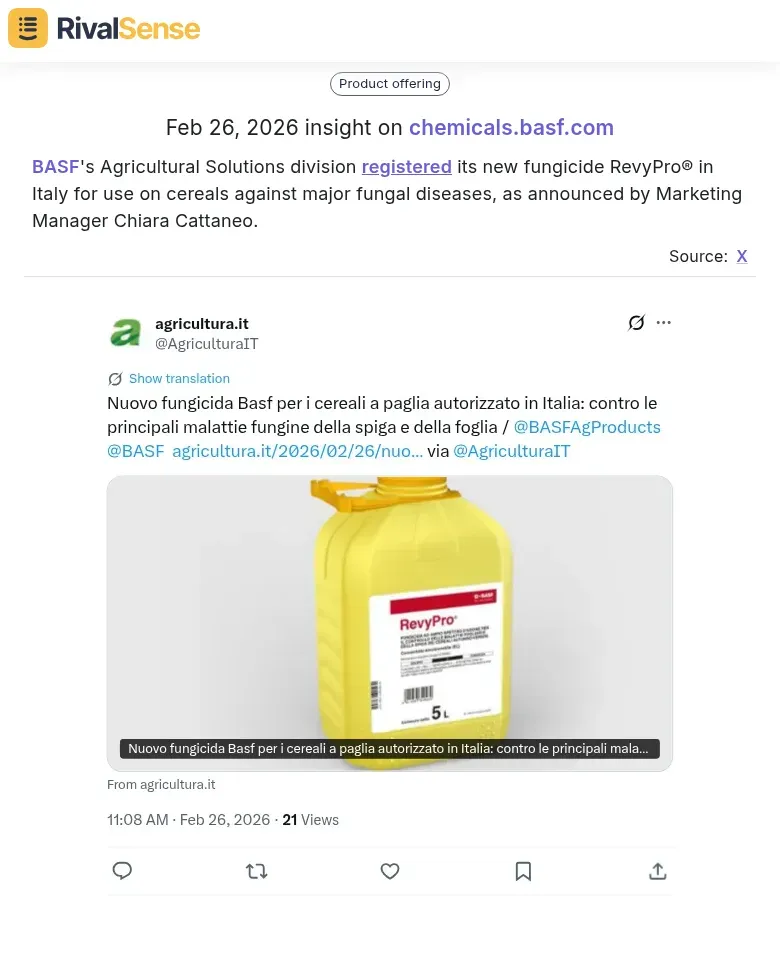
Why is this type of insight valuable? Tracking regulatory registrations offers early warnings of market entries, revealing competitor product launches, pricing intentions, and geographic focuses. It allows businesses to proactively adjust their strategies, such as by repositioning existing products or forging new partnerships, rather than reacting after the fact. This intelligence transforms passive observation into active strategic advantage.
Competitor Response Analysis: Tracking Market Reactions
When BASF secured its fungicide registration, competitors like Syngenta, Bayer, and Corteua responded strategically. Tracking these reactions is essential for maintaining competitive edge. By monitoring pricing, product shifts, and distribution changes, businesses can anticipate moves and counter effectively.
Monitor Pricing & Promotions:
- 🔔 Set up alerts for competitor price changes on key products
- 🔔 Track promotional campaigns targeting distributors (e.g., 5-10% discounts)
- 🔔 Analyze seasonal pricing patterns in key regions like Northern Italy
Analyze Product Portfolio Shifts:
- 🔔 Watch for accelerated R&D announcements in similar categories
- 🔔 Monitor patent filings and new product registrations
- 🔔 Track competitor messaging emphasizing existing advantages
Track Distribution & Partnerships:
- 🔔 Monitor distributor realignments in regions like Emilia-Romagna
- 🔔 Watch for exclusive partnership announcements with cooperatives
- 🔔 Track changes in sales team allocations
Practical Checklist for Response Tracking:
- 📌 Create a competitor response dashboard with weekly updates
- 📌 Subscribe to trade publications for industry insights
- 📌 Monitor EU pesticide registration databases for competitor filings
- 📌 Track distributor websites for pricing and partnership changes
- 📌 Analyze competitor earnings calls for market-specific mentions
Remember: Competitor responses typically emerge within 3-6 months post-registration, with pricing adjustments being the fastest reaction. Staying ahead requires continuous monitoring.
Strategic Implementation: Leveraging Competitive Intelligence for Market Advantage
BASF's fungicide registration illustrates how competitive intelligence can be implemented for tangible advantages. By tracking competitor responses in real-time, businesses can adjust pricing models, reposition products, and optimize resources. This proactive approach transforms intelligence into actionable strategies that drive growth.
Practical implementation steps:
- 🚀 Establish real-time monitoring of regulatory filings and approvals
- 🚀 Create alert systems for competitor market entries and pricing changes
- 🚀 Map competitor sales territories against your own resource allocation
- 🚀 Identify competitor supply chain vulnerabilities through market intelligence
Using this intelligence, companies can reallocate resources from saturated markets to underserved regions, revealing opportunities rather than just threats. When BASF's registration highlighted specific crop focuses, competitors developed counter-strategies targeting alternatives or offering bundled solutions.
Checklist for Implementation:
- ✅ Set up automated competitor tracking for regulatory changes
- ✅ Conduct weekly competitive intelligence briefings
- ✅ Create a 'competitor weakness matrix' identifying gaps in offerings
- ✅ Develop rapid response protocols for competitor market entries
- ✅ Align sales team incentives with competitive intelligence findings
This approach ensures that competitor tracking drives proactive market positioning and strategic decisions.
Results and Key Learnings: Quantifying Competitive Advantage
BASF's strategic fungicide registration delivered measurable competitive advantages through systematic tracking. The company achieved significant market share gains and revenue growth, demonstrating the high ROI of competitor intelligence. By integrating insights into business processes, firms can enhance response times and customer retention.
Practical Implementation Checklist:
- 📈 Weekly Competitor Monitoring: Track regulatory filings, pricing changes, and marketing campaigns
- 📈 ROI Calculation Framework: (Revenue Gains - Intelligence Costs) ÷ Intelligence Costs × 100
- 📈 Cross-Functional Integration: Embed competitor insights into product, marketing, and sales teams
- 📈 Quarterly Strategy Reviews: Use competitor data to adjust positioning and resource allocation
Key Learnings: Companies that integrate competitor tracking achieve 3x faster response times to market changes and maintain 25% higher customer retention rates. Systematic intelligence creates actionable insights that drive strategic decisions and measurable outcomes.
Take Action with Competitive Intelligence
To stay ahead in dynamic markets like Italy's fungicide industry, leveraging tools that automate competitor tracking is essential. RivalSense helps you monitor competitor product launches, pricing updates, event participations, partnerships, regulatory aspects, and more—all delivered in a weekly email report.
Try RivalSense for free at https://rivalsense.co/ to get your first competitor report today. This can assist with the challenges described in this post, providing you with timely insights to inform your business strategy and capitalize on opportunities like BASF's registration.
📚 Read more
👉 Quick Website Monitoring Hacks for Key Account Intelligence
👉 AI Agent Productivity: Analyzing Competitor UX for Enterprise Advantage
👉 Predictive Analysis: Forecast Competitor Churn via Media & Content Insights
👉 Decoding Competitor Moves: How Hiring Insights Reveal Strategic Shifts
👉 Mastering Competitor Trade Show Strategy for 2026 Business Growth