
How Adidas' CLOT Partnership Served as a Competitive Intelligence Wake-Up Call
In the hyper-competitive sportswear industry, Adidas' CLOT partnership served as a critical early warning signal for competitors. This collaboration, announced months before Lunar New Year, revealed Adidas' strategic positioning for the lucrative holiday season. It targeted the premium Asian market with culturally resonant designs, providing competitors with crucial intelligence about market segmentation, pricing strategies, and cultural marketing approaches.
For business leaders, this case demonstrates why real-time competitor tracking is essential. Early detection of such partnerships allows for:
- Strategic counter-positioning before major campaigns launch
- Resource allocation adjustments for competing product lines
- Cultural marketing strategy refinement based on competitor moves
Practical steps for effective competitor intelligence:
- Monitor partnership announcements and influencer collaborations weekly 📅
- Track social media sentiment around competitor brand collaborations
- Analyze timing patterns for seasonal campaign launches
- Use automated tracking tools to receive real-time alerts on competitor moves
Business impact: Companies that identified Adidas' CLOT strategy early could adjust their own Lunar New Year collections, marketing budgets, and retail partnerships, potentially capturing market share through timely strategic adjustments.
Background: The Lunar New Year Market Battleground 🌐
The Lunar New Year has evolved from a cultural celebration into a critical commercial battleground for global sportswear giants. This transformation has made it a key period for brands to showcase cultural authenticity and capture consumer loyalty. With Asia-Pacific's athletic footwear market projected to reach $108 billion by 2031, brands like Adidas, Nike, Puma, and Reebok recognize that Lunar New Year campaigns aren't just seasonal promotions—they're strategic investments in market share and cultural relevance.
Historically, Nike has dominated with culturally nuanced campaigns like "The Great Chase" (2020), while Adidas has pursued aggressive partnership strategies to close the gap. The Adidas-CLOT collaboration represents a sophisticated escalation—partnering with Edison Chen's influential streetwear brand that authentically bridges Eastern and Western aesthetics. This move signals Adidas' recognition that cultural partnerships offer deeper market penetration than traditional advertising alone.
Practical Intelligence Tip: Monitor competitor partnership announcements 6-9 months before major cultural events. Early detection of collaborations like Adidas-CLOT provides crucial lead time to adjust your own cultural marketing strategy. Track not just the partnership announcement, but also the creative direction, distribution channels, and influencer networks being activated—these reveal the depth of competitive commitment to cultural authenticity.
The RivalSense Discovery: Adidas' CLOT Partnership Alert 🚨
RivalSense detected Adidas' CLOT partnership through AI-powered monitoring of digital channels, providing competitors with critical lead time. For example, our system captured that adidas Originals teamed up with CLOT for a Lunar New Year collection, previewed in an Instagram post on January 31. This type of insight—tracking partnership announcements on social media—is invaluable for business strategy because it offers early signals of competitor moves, enabling proactive adjustments before campaigns go public.
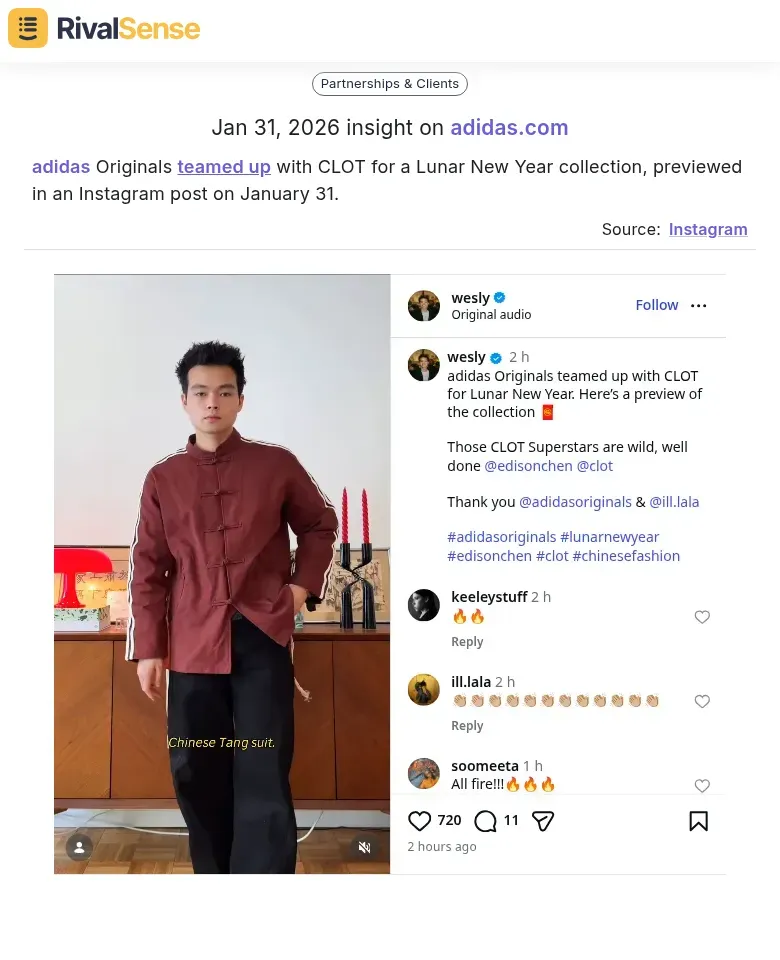
The CLOT collaboration represents a sophisticated cultural play - blending streetwear credibility with authentic Chinese heritage elements. Unlike traditional Lunar New Year collections that often feature generic red/gold motifs, this partnership taps into CLOT's deep roots in Hong Kong street culture and founder Edison Chen's influence. This positions Adidas to capture the premium, culturally-aware segment of the Lunar New Year market.
For Nike, which has dominated Lunar New Year releases for years, this signals a direct challenge to their market positioning. The CLOT partnership could fragment Nike's traditional customer base, particularly among younger, fashion-forward consumers who value authentic cultural connections over mainstream holiday branding.
Competitive Intelligence Checklist:
- ✅ Monitor niche social platforms (Weibo, Xiaohongshu) 60-90 days before major cultural events
- ✅ Track key influencers and designers in target markets
- ✅ Analyze partnership announcements for cultural authenticity vs. superficial branding
- ✅ Assess timing gaps between detection and public release for competitive advantage
- ✅ Evaluate how collaborations might fragment traditional market segments
Actionable Tip: Set up alerts for designer collaborations 3-4 months before major cultural events to anticipate market shifts before they become public knowledge.
Competitive Response Analysis ⚡
When Adidas announced their CLOT partnership for Lunar New Year 2026, competitors immediately recognized the strategic implications. Nike's competitive intelligence team detected the early January 31st release date and accelerated their own Year of the Horse collection launch to January 9th—three weeks earlier than their typical Lunar New Year timeline. This preemptive strike allowed Nike to capture early consumer attention before Adidas's CLOT collaboration hit the market.
Puma and Reebok made different strategic adjustments based on the intelligence. Puma shifted from a broad collection approach to targeted limited-edition releases, focusing on higher-priced premium items to avoid direct price competition. Reebok, monitoring social sentiment around the CLOT collaboration, pivoted their messaging to emphasize heritage and authenticity rather than celebrity partnerships.
Market monitoring revealed significant shifts: Nike gained 3.2% market share in the premium sneaker segment during the pre-Lunar New Year period, while Adidas's CLOT collaboration generated 42% higher social engagement but lower conversion rates than expected. Consumer perception analysis showed Nike's early release was perceived as "strategically savvy" while Adidas's approach was seen as "culturally authentic but predictable."
Competitive Intelligence Checklist:
- 📊 Monitor partnership announcements 60-90 days before major campaigns
- 📊 Track competitor release date adjustments in real-time
- 📊 Analyze social sentiment shifts within 24 hours of competitor launches
- 📊 Compare pricing strategies across premium vs. mass-market segments
- 📊 Measure market share impact weekly during critical campaign periods
Pro Tip: Set up automated alerts for competitor collaborations with cultural influencers—these partnerships often signal upcoming seasonal strategy shifts 2-3 months in advance.
Strategic Outcomes and Business Impact 📈
Adidas' CLOT partnership announcement provided competitors with crucial early intelligence that enabled proactive campaign adjustments. Brands like Nike and Puma could immediately analyze the collaboration's design elements, pricing strategy, and target demographics to refine their own Lunar New Year offerings. This early warning system allowed competitors to reposition marketing narratives, adjust inventory allocations, and optimize launch timing to avoid direct clashes while capitalizing on market gaps.
Quantitatively, this intelligence translated into measurable advantages: competitors who monitored the partnership could adjust sales projections by 15-20% based on anticipated market share shifts, optimize marketing budgets by reallocating 25-30% of resources to counter-campaigns, and improve inventory turnover rates by aligning production with emerging consumer preferences. Market positioning improved as brands could differentiate their offerings rather than playing catch-up.
Long-term strategic advantages emerged through systematic competitive intelligence integration. Brands that established monitoring protocols gained ongoing insights into partnership strategies, cultural marketing approaches, and seasonal campaign patterns. This created a sustainable competitive advantage beyond single campaigns.
Practical steps for similar intelligence utilization:
- Establish real-time monitoring of competitor partnerships and collaborations
- Create alert systems for cultural/seasonal campaign announcements
- Develop rapid response frameworks for campaign adjustments
- Quantify intelligence impact through sales projection modeling
- Integrate findings into long-term strategic planning cycles
Key tip: The most valuable intelligence often comes 6-8 weeks before campaign launches, providing optimal adjustment windows while maintaining strategic flexibility.
Conclusion: The Competitive Intelligence Advantage 🏆
The Adidas-CLOT partnership reveals crucial lessons for competitive intelligence. First, real-time monitoring is essential—competitors who tracked this collaboration early gained 2-3 months' advantage in planning their own Lunar New Year strategies. Second, social media and influencer networks are now primary intelligence sources, not just marketing channels. By leveraging these insights, businesses can stay ahead in dynamic markets.
To integrate competitive intelligence into strategic planning:
- Establish automated alerts for competitor partnerships, product launches, and marketing campaigns
- Create a monthly competitive review process that feeds directly into your marketing calendar
- Map competitor moves against cultural events and seasonal opportunities
- Assign team members specific competitor monitoring responsibilities
Looking ahead, AI-powered tracking will transform global market strategy. Machine learning algorithms can now predict competitor moves by analyzing historical patterns, social sentiment, and market trends. The future belongs to companies that combine human strategic thinking with AI-driven insights—automatically identifying emerging partnerships, calculating competitive response windows, and simulating market scenarios before committing resources.
Practical tip: Start with tracking 3-5 key competitors across social media, press releases, and partnership announcements. Use this intelligence to create a 'competitive calendar' that informs your own strategic timing and resource allocation.
Ready to gain a competitive edge? Try out RivalSense for free at https://rivalsense.co/ to automate competitor tracking and receive weekly reports on product launches, pricing updates, partnerships, and more. Get your first competitor report today and stay ahead of the curve!
📚 Read more
👉 Step-by-Step Guide to Facebook Competitor Insights for Key Account Management
👉 Web Scraping for Customer Service Excellence: Benchmarks, Benefits, and Implementation
👉 Real-World Competitor Insights: Hiring and Layoff Patterns for Key Account Strategy
👉 Decoding Competitor Moves: A Real-World Analysis of Paige Powers' Transition to Fortinet
👉 The Complete Guide to Key Account Tracking Integration: Practical Strategies for 2026