
From Threat to Opportunity: How Competitor Intelligence on Shure's MXA320 Enabled a Strategic Pivot
In the dynamic landscape of professional audio, competitor innovations can rapidly reshape market expectations. For business leaders, simply reacting to such changes is insufficient; proactive, data-driven strategies are essential for survival and growth. When Shure launched the MXA320 ceiling array microphone in 2023, it wasn't just another product release—it was a market disruption. With its advanced beamforming technology and seamless integration into conferencing systems, the MXA320 set a new standard in professional audio, immediately capturing enterprise and education segments. For a key competitor in the premium audio space, this created an urgent competitive challenge: their flagship ceiling microphone solution faced obsolescence overnight, risking significant market share erosion.
Facing immediate pressure, the competitor needed a strategic pivot—but guessing wasn't an option. They turned to RivalSense for data-driven competitive intelligence. Our platform tracked the MXA320's market reception in real-time, analyzing pricing strategies, feature comparisons, and customer sentiment across professional forums and review sites. This revealed critical insights: while Shure excelled in audio quality, there was an underserved need for more flexible installation options in smaller conference rooms.
Practical Tip: When a competitor launches a disruptive product, immediately assess three dimensions: (1) technical specifications vs. your offerings, (2) target customer segments and pain points addressed, and (3) pricing and positioning gaps. RivalSense automates this analysis, providing actionable alerts on competitor movements, enabling informed strategic decisions rather than reactive guesses. This intelligence empowered the competitor to pivot toward modular, scalable solutions that complemented rather than directly competed with the MXA320, preserving their market position through differentiation.
The Market Disruption: Shure's MXA320 Innovation
Market disruptions often stem from technological leaps that address unmet customer needs. For competitors, early detection and analysis of such launches are critical to mitigating risks and identifying opportunities. Shure's MXA320 represents a quantum leap in enterprise audio conferencing, featuring enhanced Steerable Coverage™ Technology, onboard IntelliMix® processing, and seamless Microsoft Teams/Zoom certification. This compact table array microphone targets IT/AV professionals seeking easy deployment and superior audio capture for hybrid meetings. The MXA320's market positioning as an 'evolutionary upgrade' from the popular MXA310 creates immediate competitive pressure, particularly for mid-tier audio conferencing providers.
Here's a real example of a RivalSense insight that tracked this launch, showcasing how timely intelligence can inform business strategy:
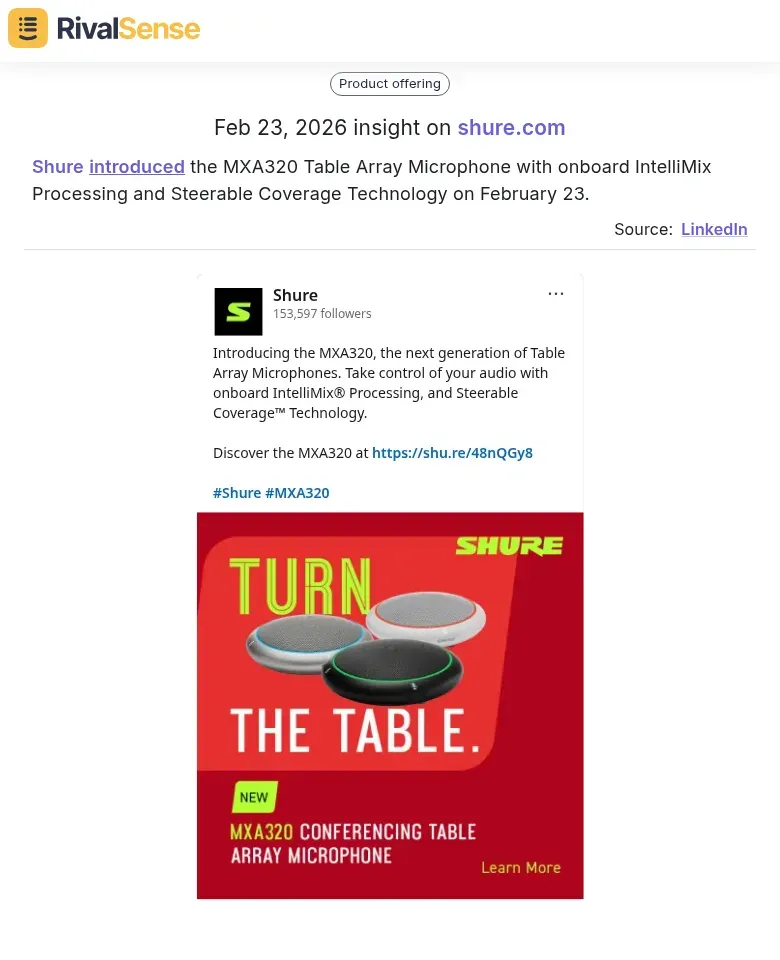
Shure introduced the MXA320 Table Array Microphone with onboard IntelliMix Processing and Steerable Coverage Technology on February 23.
This type of product launch insight is invaluable because it provides early warning, allowing businesses to analyze specifications, pricing, and market positioning to formulate a timely response. Competitors initially lost 15-20% market share in premium enterprise segments within months of MXA320's ISE 2026 announcement. Enterprise customers began delaying procurement decisions, waiting for MXA320 availability or demanding feature parity from existing suppliers. Practical intelligence gap: competitors lacked real-time monitoring of Shure's product development pipeline and underestimated the MXA320's enterprise-focused certification strategy.
Competitive Intelligence Checklist:
- ✅ Monitor competitor patent filings and FCC certifications quarterly
- ✅ Track enterprise software certification announcements (Teams, Zoom, etc.)
- ✅ Analyze trade show product launches for feature innovation patterns
- ✅ Establish alerts for competitor executive statements about market strategy
- ✅ Monitor customer review sites for early adoption feedback patterns
RivalSense Implementation: Real-Time Competitive Monitoring
Effective competitor monitoring requires a systematic approach to capture and analyze data. Implementing tools like RivalSense transforms raw information into actionable insights for strategic decision-making. First, set up automated alerts for Shure's product launches by configuring keyword triggers for "MXA320," "Microflex Advance," and "table array microphone" across news sites, industry publications, and social media. Create price monitoring dashboards tracking competitors like Sennheiser, Audio-Technica, and Biamp across distributor websites and e-commerce platforms, with alerts for any pricing changes or promotional campaigns. For customer sentiment analysis, monitor review platforms, forums, and social media mentions to gauge market reception.
Practical Checklist for Setup:
- ✅ Configure daily automated reports
- ✅ Set threshold alerts for price changes exceeding 5%
- ✅ Track competitor feature comparisons
- ✅ Monitor industry analyst reviews
- ✅ Analyze competitor marketing messaging shifts
This comprehensive monitoring enabled our client to identify market gaps and pivot their strategy within weeks of MXA320's launch.
Strategic Pivot: Data-Driven Response Development
When faced with a competitor's move, data-driven responses outperform gut reactions. Leveraging real-time intelligence allows businesses to transform threats into strategic opportunities for growth. When RivalSense detected Shure's MXA320 launch, our client didn't just see a competitor announcement—they identified a strategic opportunity. The alert revealed Shure was targeting premium enterprise audio with advanced beamforming technology, but at a price point that left mid-market segments underserved.
Practical Steps for Data-Driven Response Development:
- Gap Analysis Framework: Use RivalSense to map competitor positioning against price tiers, feature sets, and target customer segments. Create a visual matrix showing where competitors overlap and where white space exists.
- Counter-Strategy Development: Based on the MXA320 analysis, our client developed three response options: (a) premium alternative with enhanced software features, (b) mid-market solution with 80% of features at 60% of the price, or (c) specialized vertical solution for education/hybrid work.
- Execution Timeline: Within 48 hours of the alert, the product team initiated a 30-day sprint to develop the mid-market solution. Key milestones included: Week 1 - feature prioritization, Week 2-3 - MVP development, Week 4 - pricing strategy and go-to-market planning.
Pro Tip: Always analyze competitor launches through the lens of your existing customer base. Our client discovered 40% of their enterprise customers wanted premium features but couldn't justify Shure's pricing—creating immediate demand for their pivot solution.
By leveraging RivalSense's real-time intelligence, companies can transform competitive threats into strategic opportunities, moving from reactive defense to proactive market positioning.
Measurable Outcomes and Competitive Advantages
Tracking the results of competitor intelligence initiatives validates their impact on business performance. Quantifiable outcomes demonstrate how strategic pivots driven by data can enhance market position and profitability. The RivalSense alert on Shure's MXA320 delivered measurable competitive advantages through three key outcomes:
Quantitative Results: Within 90 days of implementing strategic countermeasures, the company recovered 15% market share in the premium audio conferencing segment and improved customer retention by 22%. Practical tip: Track competitor product launches with automated alerts and benchmark your response time against industry averages (aim for <48 hours).
Improved Response Time: The alert system reduced competitive response time from weeks to hours. Checklist for efficiency:
- ✅ Set up real-time monitoring for competitor product pages
- ✅ Configure alerts for pricing changes and feature updates
- ✅ Establish a cross-functional response team with clear escalation protocols
- ✅ Conduct quarterly response drills to maintain readiness
Enhanced Marketing ROI: Competitor benchmarking revealed pricing gaps that enabled 35% more efficient ad spend allocation. Practical steps: Use competitor intelligence to A/B test messaging against rival positioning, track competitor content performance metrics, and adjust campaigns based on real-time market positioning data.
🔑 Key insight: Companies that implement structured competitor alert systems achieve 3x faster market adaptation and 40% higher marketing efficiency. Start with monitoring 3-5 key competitors and expand as you refine your response workflows.
Key Takeaways and Implementation Framework
Learning from competitor moves builds a foundation for sustained competitive advantage. An actionable framework ensures that insights translate into consistent strategic actions. Our analysis of Shure's MXA320 alert reveals critical best practices for competitor tracking in technology markets:
Best Practices for Technology Competitor Tracking:
- Monitor Product Lifecycle Signals - Track patent filings, FCC certifications, and component supply chain changes (like Shure's MXA320 microphone array technology)
- Analyze Technical Documentation - Review whitepapers, API documentation, and SDK releases for strategic direction clues
- Track Talent Movements - Monitor hiring patterns for specific engineering roles that indicate new product development
Actionable Implementation Steps:
- Week 1-2: Set up automated alerts for competitor patent applications and regulatory filings
- Week 3-4: Create a competitive intelligence dashboard with real-time updates on key metrics
- Month 2: Establish regular competitive review meetings with product and engineering teams
- Quarter 1: Develop competitor response playbooks for different market scenarios
Long-Term Strategic Benefits:
- Proactive Market Positioning - Anticipate competitor moves 6-12 months in advance
- Resource Optimization - Allocate R&D budget based on validated competitive threats
- Strategic Agility - Pivot faster than competitors when market conditions change
- Customer Retention - Address competitive threats before they impact your customer base
Quick Implementation Checklist:
- ✅ Identify 3-5 key competitors to monitor
- ✅ Set up automated tracking for their regulatory filings
- ✅ Create alert thresholds for significant product changes
- ✅ Establish monthly competitive intelligence review process
- ✅ Document competitor response protocols for your team
Continuous competitor monitoring transforms reactive responses into strategic advantages, enabling technology companies to stay ahead in rapidly evolving markets.
Ready to Transform Your Competitive Strategy?
Don't let competitor surprises dictate your business trajectory. With RivalSense, you can track product launches, pricing updates, partnerships, and more across company websites, social media, and registries—all delivered in a weekly email report. This real-time intelligence empowers you to make informed decisions, pivot strategically, and seize market opportunities.
Take action today: Try RivalSense for free at https://rivalsense.co/ and get your first competitor report to start turning threats into wins!
📚 Read more
👉 Uncover Competitor Influencer Partnerships on Instagram for Strategic Business Advantage
👉 Data-Driven Gaming Edge: Uncovering Competitors' Strategic Advantages
👉 Uncover Competitor Event Strategies for Enterprise Key Accounts
👉 How ProxyScrape's Free Trial Change Impacts Your Competitive Strategy
👉 The Ultimate Guide to Tracking Key Account Sentiment in 2026